



You’ve spent another evening wondering if your child’s boundless energy is just a phase or something more. It’s exhausting to constantly question if you’re managing “naughty” behavior or a neurodevelopmental condition that requires specialized support. With the documented prevalence of ADHD in Malaysia at 3.9%, you’re certainly not alone in these concerns. Seeking an ADHD diagnosis child Malaysia is a courageous first step toward clarity, replacing confusion with a professional plan of action.
We understand the quiet fear that a formal label might change how the world sees your child. This guide provides a clear roadmap for your family, detailing the exact process of obtaining a professional diagnosis through clinical assessments. You’ll learn how a multidisciplinary team creates a holistic understanding of your child’s unique strengths. We’ll walk through everything from identifying early signs to accessing post-diagnostic support, giving you the confidence to unlock your child’s full potential in a supportive, child-centered environment.
Key Takeaways
- Understand that ADHD is a neurodevelopmental condition rather than a reflection of parenting, allowing you to move past stigma and focus on your child’s growth.
- Navigate the specific steps required for an ADHD diagnosis child Malaysia, including initial screenings and detailed clinical interviews.
- Discover why a multidisciplinary team of experts is vital for a holistic assessment that rules out physical health concerns like vision or hearing issues.
- Learn how to evaluate diagnostic assessment packages to ensure transparent, fixed pricing that covers comprehensive reports and follow-up consultations.
- Recognize that a diagnosis is a roadmap for development, helping you prioritize early interventions like pediatric occupational therapy or behavioral support.
Recognizing ADHD Signs in the Malaysian School and Home Environment
When you notice your child struggling to stay still or complete simple tasks, it’s natural to feel a mix of frustration and worry. Many parents in Malaysia initially worry that these behaviors are a result of “poor parenting” or a lack of discipline. However, Attention Deficit Hyperactivity Disorder (ADHD) is a neurodevelopmental condition rooted in brain biology, not a reflection of your care. Seeking an ADHD diagnosis child Malaysia is the first step toward understanding how your child’s brain is wired to process information and manage impulses.
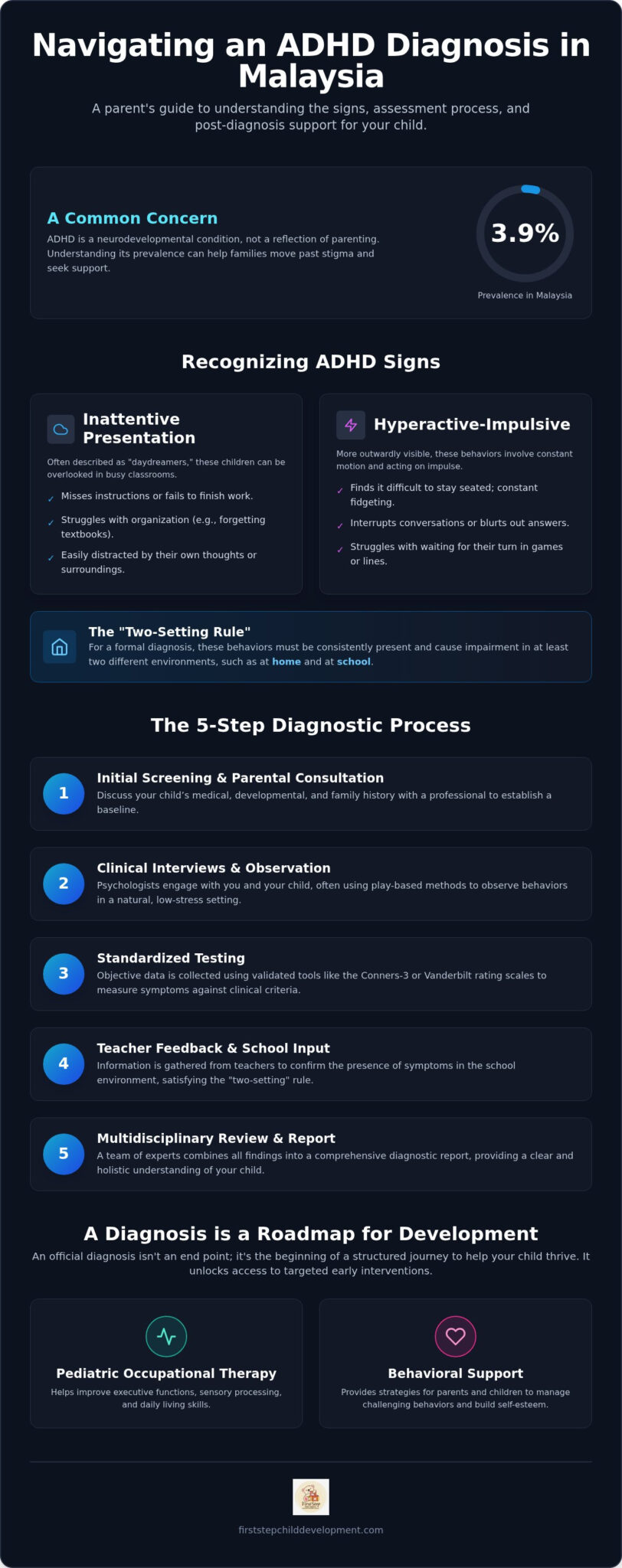
In a typical Malaysian classroom, where students are often expected to sit quietly through long morning assemblies or copy extensive notes from the whiteboard, ADHD symptoms can become quite visible. A child might struggle with the executive function required to keep track of their stationery or forget to bring the right textbooks for the day’s timetable. These challenges often fall into three categories: inattentive, hyperactive-impulsive, or a combined presentation. To meet the criteria for a formal diagnosis, these behaviors must follow the “two-setting rule,” meaning they appear consistently at both home and school, rather than being a reaction to a single stressful environment.
Inattentive vs. Hyperactive Symptoms
In large Malaysian classrooms with 30 or 40 students, the “daydreamers” often go unnoticed. These children represent the inattentive presentation; they aren’t disruptive, but they may miss instructions or fail to finish their work because their minds have wandered. On the other hand, the hyperactive-impulsive presentation is more “loud.” These children might find it physically painful to stay in their seats, often fidgeting with their uniform or interrupting the teacher. They struggle with waiting for their turn during canteen breaks or games, acting on impulse before thinking through the consequences. For parents of preschool-aged children, this guide to Signs of ADHD in a 5-Year-Old can help distinguish age-typical behavior from patterns worth discussing with a professional.
When to Move from Observation to Assessment
The path to a formal ADHD diagnosis child Malaysia begins with observing how these patterns affect your child’s daily life. If your child’s academic performance begins to lag behind their actual intelligence, it’s often a sign that their symptoms are creating a barrier to learning. More importantly, consider the impact on their self-esteem. When a child is constantly labeled as “lazy” or “naughty” by teachers or peers, they may start to believe it themselves. Early intervention is vital to protecting their emotional well-being. If you find that daily routines have become a constant battleground, seeking a professional child psychology consultation Malaysia can provide the clarity your family needs to move forward with confidence.
How to Get an ADHD Diagnosis for Your Child in Malaysia: A Step-by-Step Guide
Obtaining a formal ADHD diagnosis child Malaysia often feels like a daunting task, especially when you’re trying to choose between the public and private healthcare systems. While government hospitals provide affordable care, waiting lists can stretch for many months. Private centers offer a more streamlined, comprehensive path, typically completing a full evaluation over 2 to 4 hours across multiple sessions. This methodical approach ensures no detail of your child’s development is overlooked, providing you with a clear roadmap quickly.
The journey begins with an initial screening and parental consultation to discuss your child’s medical and developmental history. We then move into formal clinical interviews with both parents and the child to observe behaviors in a clinical setting. Following this, standardized testing involves tools like the Conners-3 or Vanderbilt scales to provide objective data. We also collect teacher feedback or conduct school observations to satisfy the “two-setting” requirement. Finally, a multidisciplinary review combines all findings into a detailed diagnostic report. An accurate ADHD diagnosis child Malaysia depends on this rigorous, multi-layered evidence gathering.
The Role of the Clinical Psychologist
Psychologists use play-based observations to see how your child naturally interacts with their environment. This gentle approach reduces anxiety, allowing the “real” child to emerge rather than a version of them that is stressed by a clinical setting. We also perform standardized cognitive testing to ensure that academic struggles aren’t actually linked to other learning difficulties or IQ variations. If you’re ready to begin this process, scheduling a neurodevelopmental assessment Malaysia is a proactive way to get the specialized answers you need.
Gathering Evidence from School
Malaysian teachers are invaluable partners in this process. Since they observe your child in a structured, high-demand environment, their feedback provides a different perspective than what you might see at home. You can approach your child’s teacher for an honest behavioral report by explaining that you’re seeking professional support to help your child succeed. Using standardized forms helps bridge the gap between home and school behavior, ensuring the final diagnosis is holistic and reflects your child’s performance in all areas of their life.
The Multidisciplinary Team: Why a Holistic Assessment Matters
A comprehensive neurodevelopmental assessment Malaysia is rarely a solo effort. Because ADHD often overlaps with other developmental or physical challenges, a team of specialists works together to ensure every observation is cross-referenced. This collaborative approach prevents misdiagnosis and ensures that the final ADHD diagnosis child Malaysia is as accurate as possible. By combining perspectives from psychology, pediatrics, and therapy, we build a 360-degree view of your child’s unique profile.
The pediatrician plays a critical role by ruling out medical issues that can mimic ADHD symptoms. For instance, a child who seems inattentive might actually have undiagnosed vision or hearing problems. Similarly, speech and occupational therapists identify co-occurring delays in communication or motor skills. When these experts share their findings, the result is a unified report that doesn’t just name a condition but explains how your child interacts with the world. This synergy is what makes a professional ADHD diagnosis child Malaysia so valuable for long-term planning.
Ruling Out “Look-Alike” Conditions
It’s vital to distinguish between ADHD and conditions that look similar. Sensory Processing Disorder can cause a child to appear restless or distracted, yet the root cause and treatment are different. Anxiety or past trauma can also manifest as impulsivity or lack of focus. We also utilize IQ testing to identify “Twice Exceptional” (2e) children. These are students who are highly gifted but struggle with ADHD, often masking their symptoms until they hit a certain academic level where their coping mechanisms are no longer enough. In some cases, a thorough evaluation may also reveal signs that warrant a formal autism diagnosis Malaysia, as ADHD and autism spectrum conditions frequently co-occur and share overlapping behavioral presentations.
The Benefit of On-Site Pediatric Support
Firststep’s close affiliation with pediatricians ensures a high level of clinical safety throughout the assessment process. Having medical expertise on-site means we can immediately address physical health concerns that might be impacting developmental growth. This partnership streamlines the referral process if medical interventions are required, saving parents the stress of navigating multiple separate clinics. It ensures your child’s physical health is optimized, providing a solid foundation for their psychological and behavioral progress. You aren’t just getting a report; you’re gaining a dedicated team invested in your child’s holistic well-being.
Evaluating Diagnostic Assessment Packages in Malaysia
Choosing where to go for an ADHD diagnosis child Malaysia involves more than just finding a nearby clinic. In the private sector, many parents find themselves overwhelmed by varying fee structures and hidden costs for report writing or follow-up sessions. A comprehensive assessment package should simplify this process by grouping all necessary clinical components into a single, transparent fee. This ensures you can focus on your child’s needs without worrying about unexpected financial surprises at the end of the diagnostic journey.
A high-quality package typically includes several standardized testing materials, multiple clinical hours with a psychologist, and a dedicated feedback session. This feedback session is perhaps the most valuable part of the process. It’s the moment where complex data is translated into a human story, helping you understand how your child sees the world. Once you have the final diagnostic report, it becomes a powerful tool. You can use it to apply for school accommodations in Malaysia, such as extra time during exams or specialized seating arrangements. These supports are increasingly recognized under the Ministry of Education’s push for inclusive education as highlighted in the National Education Plan 2026-2035.
What to Look for in a Diagnostic Report
A professional report should never just be a list of deficits. Look for a document that provides a clear breakdown of your child’s strengths, such as high creativity or strong problem-solving skills. It must also include specific, actionable recommendations for classroom modifications that a teacher can implement immediately. Finally, ensure it offers evidence-based suggestions for home-based behavioral strategies that your family can use to create a more supportive environment. For children whose academic struggles extend beyond attention difficulties, a psychoeducational assessment Malaysia can provide an even deeper understanding of how your child processes and retains information across different learning domains.
Fixed-Price vs. Per-Session Assessments
Fixed-price packages offer significant peace of mind for families because they guarantee that the process won’t be cut short due to budget constraints. Unlike per-session models, where the total cost can balloon if extra testing is needed, a package covers all standardized tools from the start. Always verify if the package includes a follow-up consultation to explain the results in detail. If you’re looking for a transparent and supportive path forward, you can explore our ADHD assessment options to find the right fit for your family.
From Diagnosis to Development: Creating an Action Plan for Your Child
Holding the final report in your hands often brings a profound sense of relief. You finally have a name for the challenges your child has been facing, replacing years of uncertainty with clinical clarity. However, receiving an ADHD diagnosis child Malaysia is truly the beginning of a supportive journey rather than its conclusion. It’s the moment you transition from searching for answers to implementing a structured action plan that empowers your child to thrive in both social and academic settings.
Prioritizing early intervention is your next critical step. For many children, this involves a combination of Pediatric Occupational Therapy to improve sensory regulation and behavioral support to develop executive functioning skills. As of December 2024, over 9,500 students with ADHD were receiving special education services in Malaysia, proving that a robust support system exists within our national framework. Sharing the diagnosis with your child should be handled with gentle honesty. Explain that their brain simply works differently, focusing on their unique strengths to ensure they feel capable rather than labeled or stigmatized.
Immediate Steps After the Assessment
Once you have your report, schedule a meeting with your school’s Special Education Needs (SEN) coordinator. Under the National Education Plan 2026-2035, Malaysian schools are increasingly equipped to offer inclusive education programs and tailored support. You’ll need to discuss the recommended therapy frequency, which often starts with weekly sessions to build momentum and consistency. We also frequently recommend Play Therapy for younger children. It provides a safe space for them to work through frustrations, building the emotional regulation and self-esteem necessary to navigate the demands of a traditional classroom environment.
The Long-Term Outlook
The long-term success of a child with ADHD in Malaysia depends on consistent, ongoing monitoring. As your child transitions from primary to secondary school, their environment and academic demands will change significantly. Your support network, consisting of therapists, teachers, and family members, must evolve alongside them to meet these new challenges. Proper support leads to significant academic and social milestones, ensuring that ADHD becomes a manageable part of their identity rather than a barrier to their dreams. Ready to take the first step? Book a comprehensive ADHD assessment for your child today.
Empowering Your Child’s Developmental Journey
Moving from the weight of the unknown to a clear, professional plan is a transformative experience for any family. You now understand that a formal diagnosis is more than just a clinical report; it’s a strategic roadmap that identifies your child’s unique strengths and provides the necessary framework for school accommodations and targeted therapy. By relying on a multidisciplinary team, you ensure that every aspect of your child’s growth is considered, from their physical health and hearing to their emotional regulation and cognitive potential.
Navigating the path toward an ADHD diagnosis child Malaysia shouldn’t be a source of additional anxiety. Our fixed-price diagnostic packages are designed to offer full transparency, while our gentle, play-based assessment environment ensures your child feels safe and understood throughout the process. Our expert team is here to partner with you, turning clinical insights into actionable steps for a brighter future. Schedule a Comprehensive ADHD Assessment Today and take the first step toward unlocking your child’s full potential. You’ve already done the hard work of seeking answers, and we’re here to help you find them.
Frequently Asked Questions
How long does a full ADHD assessment take for a child in Malaysia?
A comprehensive evaluation typically takes between 2 to 4 hours, which is often divided across multiple sessions to keep the child comfortable. This steady pace allows our clinical psychologists to conduct thorough observations and standardized testing without the child feeling fatigued. The total duration also accounts for the time needed to conduct parental interviews and compile a detailed diagnostic report for your family.
Is an ADHD diagnosis from a private center accepted by Malaysian schools?
Yes, diagnostic reports from reputable private centers are widely accepted by international, private, and government schools in Malaysia for formal accommodations. These reports provide the clinical evidence required for schools to implement Individualized Education Plans (IEP) or provide exam concessions. A professional ADHD diagnosis child Malaysia serves as a vital communication tool between parents, therapists, and school coordinators to ensure your child’s needs are met.
What is the difference between ADD and ADHD in modern diagnosis?
ADD is an older term that’s no longer used in official clinical settings; it’s now classified as ADHD, Predominantly Inattentive Presentation. Modern diagnostic criteria use ADHD as an umbrella term for children who struggle with attention, hyperactivity, or a combination of both. This ensures that “daydreamers” who aren’t physically restless still receive the specialized support they need to succeed in high-demand environments.
Can my child be diagnosed with ADHD if they can focus on video games for hours?
Yes, a child can still have ADHD even if they hyperfocus on high-stimulation activities like video games. ADHD isn’t necessarily a lack of attention, but rather a difficulty in regulating attention toward tasks that aren’t immediately rewarding. While games provide instant feedback, a child with ADHD will often struggle significantly with low-stimulation tasks, such as copying from a whiteboard or completing multi-step chores at home.
At what age can a child be officially diagnosed with ADHD in Malaysia?
Most clinicians in Malaysia provide an official diagnosis starting from age six, once a child has entered a formal school environment. While early screenings can identify red flags in younger children, behavior must be observed in a structured setting to confirm the diagnosis. If you have concerns before age six, early intervention through pediatric occupational therapy can still provide significant benefits for your child’s developmental growth. For parents noticing possible Signs of ADHD in a 5-Year-Old, looking at patterns across home and preschool can help guide a conversation with a professional.
What happens if the assessment shows my child does not have ADHD?
If the assessment concludes your child doesn’t have ADHD, the process remains valuable because it identifies the actual root of their behavioral or academic struggles. We explore “look-alike” conditions such as anxiety, sensory processing issues, or specific learning difficulties. You’ll still receive a professional report that clarifies your child’s unique profile and provides a clear roadmap for the most appropriate support and therapy.
Do I need a referral from a GP to book an ADHD assessment at Firststep?
No, you don’t need a formal referral from a General Practitioner (GP) to book a consultation or assessment at our center. Parents can reach out directly to our team to schedule an initial screening. This direct access helps families bypass long waiting lists in the public sector, allowing you to begin the ADHD diagnosis child Malaysia process as soon as you notice your child is struggling.
Are ADHD assessment costs covered by insurance in Malaysia?
Most standard medical insurance policies in Malaysia currently exclude neurodevelopmental conditions like ADHD from their coverage. While some high-end corporate plans might offer partial reimbursement, it’s best to check your specific policy details with your provider. We offer transparent, fixed-price diagnostic packages to help families manage their finances clearly, ensuring there are no hidden fees for report writing or follow-up sessions.

Article by
Firststep Child Development Team
Firststep Child Development Team provides evidence-informed educational resources to help parents better understand child development, behaviour and learning. Our multidisciplinary services include clinical psychology, occupational therapy, speech and language therapy, developmental assessments and other child development support in Kuala Lumpur and Selangor.
Disclaimer
This article is for general educational and informational purposes only and is not a substitute for professional medical, psychological or therapeutic advice, diagnosis or treatment. Every child develops differently. If you have concerns about your child's development, behaviour, learning or wellbeing, please consult an appropriately qualified healthcare or allied health professional.