



Psychoeducational Assessment Malaysia: 2026 Parent’s Guide to Learning Support

Imagine watching your child sit at the dining table, staring at a half-finished homework assignment with tears of frustration. You’ve heard suggestions that they just need to focus more, yet you see the immense effort they’re already putting in. When these academic struggles begin to erode their confidence, a professional psychoeducational assessment Malaysia provides the clarity you’ve been seeking. It’s heartbreaking to watch a bright, curious child begin to believe they aren’t capable, simply because their brain processes information differently than their peers.
You likely feel the weight of this uncertainty, wondering if there’s a hidden barrier or if you’re missing a vital piece of the puzzle. Choosing a psychoeducational assessment Malaysia replaces guesswork with scientific understanding, shifting the narrative from struggling to supported. This guide will help you discover how a comprehensive psychoeducational assessment Malaysia can unlock your child’s potential and provide a clear roadmap for academic and emotional success.
We’ll walk you through the journey from clinical intake to classroom support, explain how to navigate the requirements of the Malaysian school system, and show you how a multidisciplinary approach creates a blueprint for your child’s long-term well-being.
Key Takeaways
- Understand how a psychoeducational assessment Malaysia uncovers the root causes of learning challenges, moving beyond labels like “laziness.”
- Learn to distinguish between psychoeducational and clinical assessments to ensure your child receives the most appropriate support for their school environment.
- Discover what standardized testing actually measures, including the vital connection between cognitive logic and academic performance.
- Explore the benefits of a multidisciplinary approach that combines psychological expertise with pediatric and nutritional insights for holistic growth.
- Gain a clear understanding of the assessment journey, ensuring a gentle, low-stress experience that empowers both you and your child.
What is a Psychoeducational Assessment and Why Does It Matter?
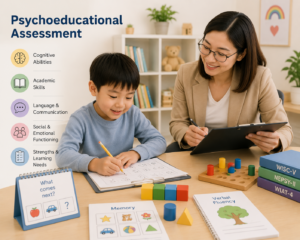
A psychoeducational assessment Malaysia is a specialized, in-depth evaluation that examines a child’s unique cognitive profile, academic skills, and emotional well-being. Unlike a standard school report card that tells you what your child is achieving, this assessment explains how they learn and why they might be hitting certain roadblocks. It’s a comprehensive deep dive into how a child’s brain processes, stores, and retrieves information. By the end of the process, parents receive a clear explanation of their child’s strengths and the specific barriers preventing them from reaching their full potential.
The core purpose of this evaluation is to identify the “why” behind academic or behavioral struggles. Often, what looks like a lack of interest in school is actually a sign of a child who is working twice as hard as their peers but seeing half the results. In 2026, professional standards have moved far beyond traditional IQ testing. A modern assessment takes a holistic view, considering how environmental factors, emotional resilience, and specific cognitive strengths interact. This differs significantly from a brief pediatrician visit or a teacher’s observation because it involves hours of standardized testing and clinical analysis to provide a complete, actionable roadmap for support.
The Difference Between ‘Struggling’ and a Learning Disability
Many parents worry that their child is simply “not trying hard enough” or lacks motivation. However, the reality is often related to processing gaps or executive functioning challenges. Executive functions act as the brain’s management system; they help a child plan, organize, and stay on task. When these systems don’t align with classroom demands, a child might appear to be “lazy” or “unfocused.” In truth, they’re often experiencing a neurological hurdle that makes following a multi-step instruction feel like climbing a mountain. Identifying these gaps allows us to move past the myth of laziness and start building effective strategies.
Identifying Common Learning Challenges in Malaysia
In our unique Malaysian context, identifying learning needs can be complex. Multilingual environments often mean children are switching between English, Bahasa Malaysia, or Mandarin, which can sometimes mask underlying issues. For example, a delay in reading might be incorrectly attributed to language confusion rather than a specific learning need.
- Dyslexia: Persistent difficulty with phonics, word recognition, and spelling despite adequate instruction.
- Dysgraphia: Significant struggles with handwriting, spatial planning on paper, and the physical act of writing.
- Dyscalculia: Trouble understanding number concepts, patterns, or basic math facts that persist over time.
In a typical school day, these challenges might manifest as a child who can speak eloquently about a topic but cannot write a single sentence about it, or a student who feels overwhelmed by a simple math worksheet. A professional psychoeducational assessment Malaysia provides the scientific clarity needed to distinguish between a temporary language-learning phase and a lifelong learning style that requires specialized support.
What Does a Psychoeducational Assessment Measure?
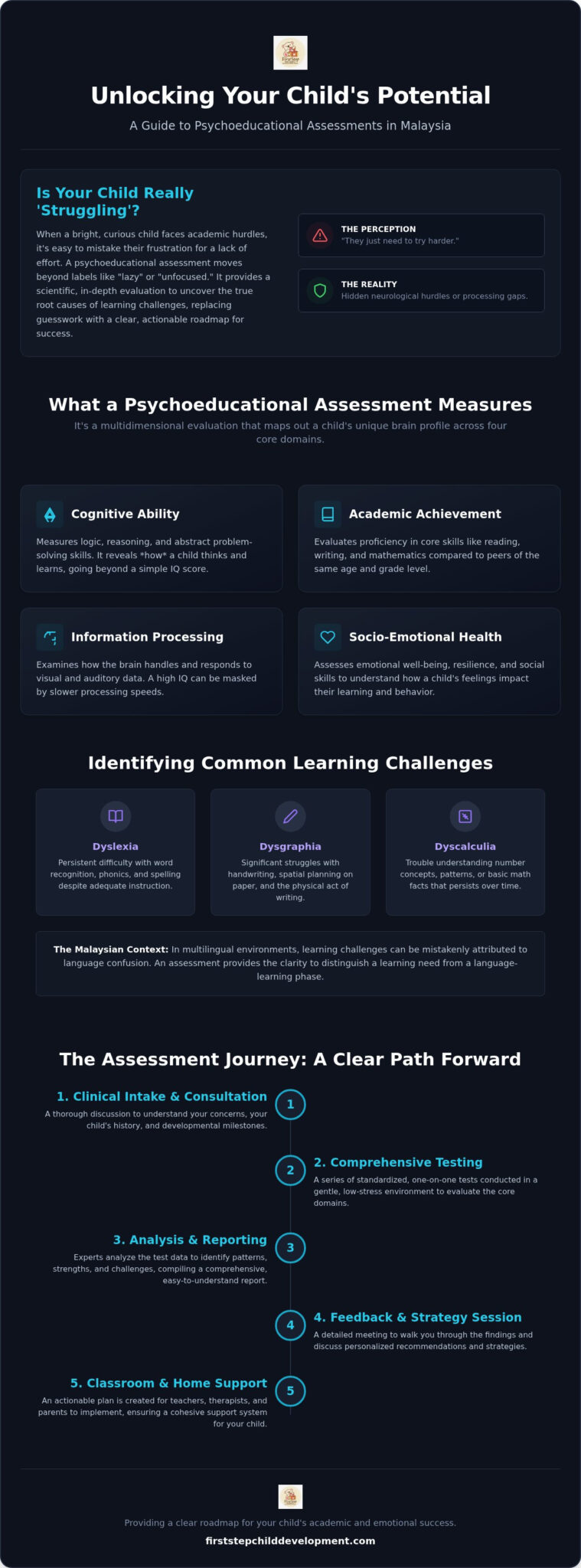
A psychoeducational assessment Malaysia is far more than a single examination. It’s a multidimensional evaluation that maps out how a child interacts with information and their environment. By looking at several distinct domains, we can see where a child’s natural talents lie and where specific neurological roadblocks might be hindering their progress. This objective data helps parents move away from labels like “unmotivated” and toward a concrete understanding of their child’s unique brain profile.
The assessment typically evaluates four core areas:
- Cognitive Ability: This measures logic, reasoning, and abstract problem-solving skills. It provides an IQ score, but more importantly, it shows how a child thinks and learns.
- Academic Achievement: We evaluate proficiency in reading, writing, and mathematics compared to other children of the same age and grade level.
- Information Processing: This examines how the brain handles visual and auditory data. A child might have high intelligence but struggle because they process sounds or sights more slowly than their peers.
- Socio-Emotional Health: We look at anxiety levels, self-esteem, and social interaction patterns. Academic struggles don’t exist in a vacuum; they often impact a child’s emotional resilience.
If you’re noticing these specific patterns in your child’s daily life, speaking with a professional at Firststep can help you decide which areas need the most focus.
Standardized Tools: The WISC-V and Beyond
The Wechsler Intelligence Scale for Children (WISC-V) remains the gold standard for measuring cognitive ability. It’s a highly reliable tool that breaks down intelligence into specific categories like verbal comprehension and fluid reasoning. In 2026, it’s vital to use the most current assessment norms to ensure the results accurately reflect the modern student population. We also utilize supplementary tests to look at phonological processing or specific memory functions if a child shows signs of dyslexia or other learning needs.
Executive Functioning and Attention
Executive functioning acts as the brain’s “control center.” It manages working memory, which is the ability to hold and use information over short periods, and processing speed. Many children struggle in school not because they lack the ability to understand the material, but because their executive systems are overloaded. This is often where we see how attention deficits (ADHD) intersect with learning profiles. You can learn more about this specific process in our guide on ADHD diagnosis child Malaysia. Identifying these intersections is the first step in creating a classroom environment where your child can finally feel successful.
Psychoeducational vs. Clinical Assessments: Choosing the Right Path
Choosing between different types of evaluations can be a source of confusion for many families. While both paths aim to support your child, they serve different primary goals. A psychoeducational assessment Malaysia focuses heavily on the classroom environment, examining how a child’s cognitive profile impacts their ability to learn reading, writing, and math. It’s designed to provide a blueprint for teachers, outlining specific accommodations that can help a student succeed. In contrast, a clinical assessment is typically used to diagnose specific neurodevelopmental or psychiatric conditions, such as depression or anxiety, which may or may not be directly tied to academic performance.
Determining which path to take depends on the specific behaviors you’re observing at home and in school. If your child is struggling with the mechanics of learning or showing a gap between their intelligence and their grades, the educational route is often the best starting point. However, if the primary concerns involve social interactions, repetitive behaviors, or significant mood shifts, a clinical lens might be more appropriate. Many families find that a comprehensive child assessment package, which combines elements of both, offers the most complete picture of their child’s needs. This integrated approach ensures that no stone is left unturned in understanding your child’s development.
When to Prioritize a Psychoeducational Evaluation
You should consider prioritizing an educational evaluation if you notice sudden drops in grades or if your child begins exhibiting school refusal behaviors. Often, a child who once enjoyed school may suddenly resist going because they feel overwhelmed by a hidden learning challenge. Another key indicator is a visible discrepancy between what your child knows and what they can actually produce on paper. This is especially critical during major school transitions, such as moving from primary to secondary school, where the academic workload and organizational demands increase significantly. Having a clear profile before these transitions can prevent a child from losing confidence in a new environment.
Integrating Neurodevelopmental Insights
Academic struggles don’t always exist in isolation. Sometimes, the root cause of a learning delay is an underlying neurodevelopmental condition. Integrating insights from an autism diagnosis Malaysia or an ADHD evaluation can provide a much deeper context for educational findings. When we understand how a child’s brain is wired through a neurodevelopmental assessment Malaysia, we can tailor their learning support to match their specific sensory and social needs. This holistic approach ensures that we aren’t just treating the symptoms of a learning struggle, but supporting the whole child’s growth and emotional well-being across all areas of their life.
The Assessment Journey: From Clinical Intake to Classroom Support
Embarking on a psychoeducational assessment Malaysia is a collaborative process designed to be as supportive and stress-free as possible for your family. It isn’t a one-off examination but a methodical journey that begins with a deep dive into your child’s world. We start with an initial consultation to gather a thorough developmental history, listening closely to your observations and concerns. This stage ensures we aren’t just looking at test scores, but understanding the unique human being behind the data.
Following the intake, we move into the testing phase, where we use standardized tasks to evaluate cognitive and academic performance. To ensure a complete picture, we also distribute questionnaires to parents and, with your permission, teachers. This 360-degree view captures how your child functions in different environments. Once the data is analyzed, we hold a dedicated feedback session. This is where we translate complex clinical findings into a clear, supportive narrative, giving you the “why” behind the struggles and a concrete plan for the “how” of moving forward.
A Gentle, Play-Based Testing Environment
We prioritize your child’s emotional comfort because accurate diagnostic data only emerges when a child feels safe and understood. Our clinicians use a play-based methodology and rapport-building techniques to minimize “test anxiety.” We intentionally build in frequent breaks and adjust the pace to suit your child’s energy levels. By creating a child-centered, low-stress atmosphere, we can see their true capabilities rather than just their reaction to a high-pressure situation. This gentle approach is fundamental to our philosophy of care.
Using the Report for School Accommodations
The final report is more than just a summary; it’s a formal document that serves as a bridge between your home and the classroom. In the Malaysian school system, this report is vital for establishing an Individualized Education Program (IEP) or requesting specific classroom accommodations. These might include:
- Extra Time: Allowing additional minutes for exams to account for slower processing speeds.
- Assistive Technology: Using text-to-speech tools or specialized software for writing challenges.
- Modified Assignments: Breaking down complex tasks into manageable, step-by-step instructions.
A professional report provides teachers with the scientific evidence they need to implement these changes effectively. It empowers you to advocate for your child with confidence, ensuring the school environment adapts to their learning style rather than forcing them to struggle in silence. If you’re ready to start this journey and gain the clarity your child deserves, you can book a consultation with our multidisciplinary team today.
Why Firststep’s Multidisciplinary Approach is Different

At Firststep, we recognize that a child’s academic success is deeply intertwined with their physical health, emotional resilience, and even their nutritional well-being. This is why our approach to a psychoeducational assessment Malaysia goes beyond the traditional model of a single clinician working in isolation. We’ve built a dedicated multidisciplinary team where clinical psychologists collaborate directly with pediatricians, nutritionists, and therapists. This integrated structure ensures that if a child’s learning struggle is compounded by a physical health concern or a sensory processing issue, it’s identified immediately and woven into a cohesive roadmap for success.
Most centers treat the assessment as a final destination, but we view it as the starting point of a supportive relationship. We provide a safe haven where clinical expertise meets compassionate, gentle care. Our goal isn’t just to provide a label, but to offer a clear path forward through continuous support services like play therapy and pediatric occupational therapy. By handling complex developmental concerns with sensitivity and professional clarity, we help lower the anxiety parents often feel when seeking help for their children.
From Diagnosis to Development: Our Integrated Care
Transitioning from a diagnosis to actual development requires more than just a list of test scores. Our team works together to support the “whole child,” ensuring that every recommendation is practical and cohesive. For example, a pediatric nutritionist might join the conversation to explain how specific dietary patterns could be impacting a child’s cognitive energy or focus during school hours. This seamless transition from an initial evaluation to a child psychology consultation Malaysia means your family never feels left alone to navigate the next steps in your child’s growth.
Empowering Parents as Partners
We believe that parents are the most vital partners in a child’s journey toward success. Our feedback sessions are designed to be a conversation, focusing on providing actionable next steps that you can implement at home and in school immediately. We offer ongoing guidance for home-based emotional and behavioral support, ensuring you have the tools to nurture your child’s self-esteem. By choosing a psychoeducational assessment Malaysia at Firststep, you gain the peace of mind that comes from professional clarity and a team that is deeply invested in your family’s well-being. We’re here to guide you through every milestone, turning uncertainty into a clear, confident plan for your child’s future.
Empowering Your Child’s Academic Journey
Understanding your child’s unique learning profile is the first step toward reclaiming their confidence and joy in learning. You’ve seen how a professional psychoeducational assessment Malaysia serves as a blueprint for success, moving beyond simple labels to provide a deep understanding of cognitive and emotional needs. By integrating standardized data with a holistic view of your child’s environment, you can finally replace confusion with a clear, actionable plan for the future.
At Firststep, our multidisciplinary team of psychologists, pediatricians, and therapists provides the expertise needed to navigate these complex developmental milestones. We utilize a gentle, play-based methodology to ensure your child feels safe and supported throughout the entire process. The result is a detailed, professional report that empowers you to advocate for the specific school and home support your child deserves. You don’t have to guess about your child’s potential any longer.
Book a Comprehensive Child Assessment Package Today to begin this transformative journey. We’re here to help you turn school-based struggles into a sustainable path of growth, resilience, and academic achievement.
Frequently Asked Questions
How long does a psychoeducational assessment take to complete?
A complete evaluation typically involves several hours of direct testing, often divided into two or three separate sessions to prevent fatigue. This ensures your child remains engaged and provides the most accurate results. Beyond the testing, the psychologist spends significant time analyzing the data and drafting a comprehensive report. You can usually expect the entire process, from the first consultation to the final feedback meeting, to take approximately three to four weeks.
What is the best age for a child to undergo a psychoeducational assessment?
While children as young as four can be evaluated for developmental milestones, the best age for a full psychoeducational assessment Malaysia is typically between six and seven years old. At this stage, academic demands in school become more formalized, making it easier to identify significant gaps in reading, writing, or math. Early identification is key to preventing a loss of self-esteem, so we recommend seeking support as soon as you notice persistent struggles.
Will my child’s school accept a private assessment report in Malaysia?
Most international and private schools in Malaysia readily accept reports from qualified clinical psychologists to implement Individualized Education Programs (IEPs). These documents provide the scientific evidence teachers need to justify classroom accommodations like extra exam time. For government schools, a private report serves as a vital first step, though you should check with school administrators regarding specific Ministry of Education procedures for official examination arrangements.
How do I explain the assessment process to my child without scaring them?
You should frame the experience as a series of activities designed to help teachers understand how your child’s brain works best. Avoid using words like “test” or “exam,” which can trigger anxiety. Instead, tell them they’ll be doing puzzles, drawing, and playing games with a specialist who wants to help make school feel easier. Emphasize that there are no wrong answers. The goal is simply to discover their unique strengths.
Can a psychoeducational assessment diagnose ADHD or Autism?
Yes, a psychoeducational assessment can identify the symptoms of ADHD or Autism, especially when conducted by a multidisciplinary team. While the primary focus is often on learning and academic performance, we frequently use standardized tools to screen for neurodevelopmental conditions. If specific concerns arise during the process, we can integrate more targeted diagnostic tools to provide a formal diagnosis. This ensures your child receives a profile that covers both their learning style and behavioral needs.
What happens if the assessment doesn’t find a specific diagnosis?
The assessment is still incredibly valuable even if your child doesn’t meet the criteria for a specific diagnosis. The primary goal is to understand their unique cognitive profile, which includes identifying their relative strengths and weaknesses. Even without a label, the report provides actionable recommendations for teachers and parents to improve study habits and emotional resilience. You’ll gain a clear roadmap for support based on your child’s specific way of processing information.
How much does a psychoeducational assessment cost in Malaysia?
The cost of a psychoeducational assessment Malaysia varies depending on the complexity of the evaluation and the specific standardized tools required. Factors like the number of clinical hours and the multidisciplinary involvement of therapists influence the final fee. We recommend contacting our center directly for a detailed explanation of our fixed-price diagnostic packages. This ensures the evaluation is tailored specifically to your child’s unique developmental needs.
How often should a child be re-assessed for learning needs?
A child should typically be re-assessed every two to three years, especially during major academic transitions like moving from primary to secondary school. Because a child’s brain develops rapidly, their learning profile and support needs can change significantly over time. Regular updates ensure that school accommodations remain relevant and effective. If you notice new challenges or a sudden plateau in progress, it’s often a sign that a follow-up evaluation is necessary.
Article by
Firststep Child Development Team
Firststep Child Development Team provides evidence-informed educational resources to help parents better understand child development, behaviour and learning. Our multidisciplinary services include clinical psychology, occupational therapy, speech and language therapy, developmental assessments and other child development support in Kuala Lumpur and Selangor.
Disclaimer
This article is for general educational and informational purposes only and is not a substitute for professional medical, psychological or therapeutic advice, diagnosis or treatment. Every child develops differently. If you have concerns about your child’s development, behaviour, learning or wellbeing, please consult an appropriately qualified healthcare or allied health professional.