


ADHD Assessment
- Clinical Psychologist Assessment
- ADHD Assessment
Understanding ADHD
Attention-Deficit/Hyperactivity Disorder (ADHD) is a neurodevelopmental condition that affects a child’s ability to regulate attention, behaviour, activity levels, and impulses.
Individuals with ADHD may experience difficulties with focus, emotional regulation, organisation, hyperactivity, impulsive behaviour, and school functioning. These challenges can affect learning, relationships, confidence, and daily routines both at home and in school.
A comprehensive ADHD assessment helps parents better understand their child’s strengths, challenges, and support needs, allowing for appropriate intervention and guidance at an early stage.

Signs Your Child May Need An ADHD Assessment
Children develop and behave differently at different ages. However, persistent difficulties with attention, behaviour, impulsivity, or emotional regulation may sometimes indicate the need for further assessment.
You may consider an ADHD assessment if your child frequently experiences:

Attention & Focus Difficulties
- Difficulty sustaining attention during tasks or play
- Easily distracted by surrounding activities or noises
- Frequently forgetful in daily routines
- Often loses belongings such as books, toys, or stationery
- Difficulty completing tasks or following instructions
Hyperactivity & Restlessness
- Constant movement or difficulty staying seated
- Fidgeting, squirming, or restlessness
- Excessive talking or interrupting others
- Difficulty engaging in quiet activities
- Appearing constantly “on the go”
Impulsivity & Emotional Regulation
- Acting without thinking about consequences
- Difficulty waiting their turn
- Interrupting conversations or activities
- Emotional outbursts or frustration
- Difficulty managing emotions appropriately
School & Daily Functioning Concerns
- Difficulty organising schoolwork or routines
- Challenges following classroom expectations
- Frequent behavioural concerns reported at school
- Difficulty managing transitions or instructions
- Struggles with academic performance despite effort
✨Important Note✨
You may consider seeking an ADHD assessment when these difficulties:
- Occur consistently over time
- Appear across different settings (e.g. home and school)
- Affect learning and academic performance
- Impact emotional wellbeing and behaviour
- Create challenges in daily routines or relationships
- Cause difficulties with attention, self-control, or organisation
Helpful Resources for Parents
For additional information and mental health resources related to ADHD and child wellbeing, you may explore:
A professional ADHD assessment can help provide clarity, identify underlying challenges, and guide appropriate support strategies for your child.
Our ADHD Assessment Process
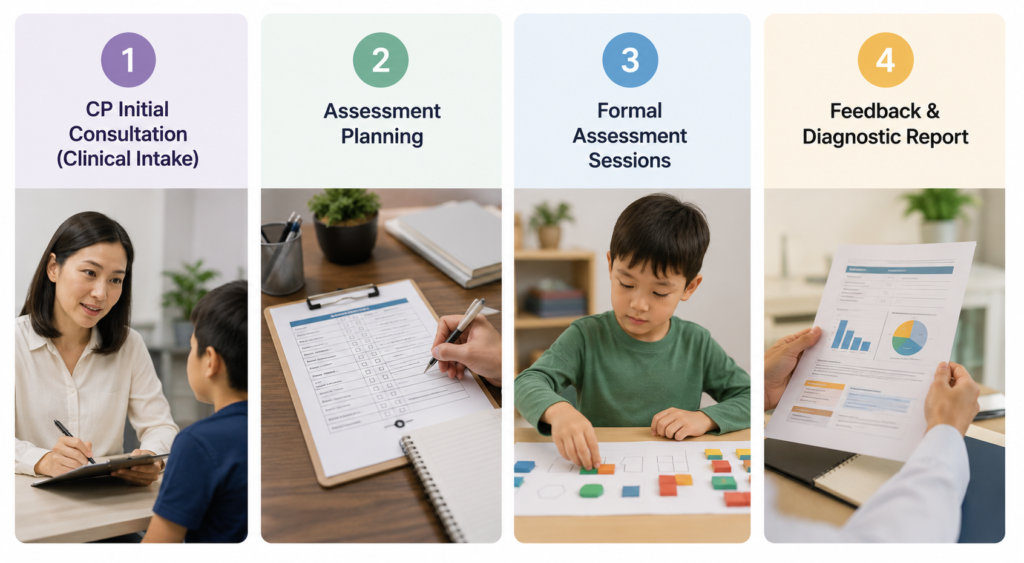
Our ADHD assessment process is designed to provide a comprehensive understanding of your child’s attention, behaviour, emotional regulation, and overall functioning in daily life.
We take a child-centred and evidence-based approach to ensure that each assessment is personalised to your child’s unique needs and concerns.
- Step 1: Initial Consultation (Clinical Intake)
The assessment process begins with an initial consultation session with our Clinical Psychologist.
The purpose of the clinical intake is to gain a better understanding of your child’s developmental, behavioural, emotional, social, and academic functioning, as well as the concerns experienced at home or school.
During this session, we will:
- Gather developmental and family history
- Understand current concerns and presenting difficulties
- Explore behavioural, emotional, social, and academic functioning
- Discuss your child’s strengths, challenges, and daily routines
- Identify possible underlying factors contributing to the concerns
This session also helps determine:
- Whether a formal assessment is needed
- Whether intervention or support may be more appropriate
- Which assessment tools or assessment pathway would be most suitable for your child’s needs
Our goal is to ensure that each child receives an individualised and appropriate approach rather than unnecessary or unsuitable testing.
- Step 2: Assessment Planning
Based on the initial consultation, suitable assessment tools will be carefully selected according to your child’s age, concerns, and developmental needs.
Assessment tools may include:
- Behavioural rating scales
- Parent and teacher questionnaires
- Clinical observations
- Cognitive or executive functioning screening (if needed)
We ensure that the assessment process is tailored and comprehensive rather than using a one-size-fits-all approach.
- Step 3: Formal Assessment Sessions
Your child may attend structured assessment sessions conducted by our Clinical Psychologist.
These sessions may evaluate:
- Attention and concentration
- Impulse control and hyperactivity
- Emotional and behavioural regulation
- Executive functioning skills
- Social and academic functioning
Parents and teachers may also be asked to complete behavioural questionnaires to provide additional insights across different settings.
- Step 4: Feedback Session & Comprehensive Report
Once the assessment is completed, we will arrange a feedback session to discuss the findings and recommendations in detail.
You will receive:
- A clear explanation of assessment findings
- Diagnostic clarification (if applicable)
- Identification of strengths and areas of difficulty
- Individualised recommendations for home and school support
- Guidance on intervention or therapy options if needed
Our goal is to help parents better understand their child’s needs and provide practical guidance for ongoing support and development.
ADHD Assessment Tools Used
🧠Behavioural Rating Scales
Behavioural questionnaires completed by parents and teachers help us understand how your child functions across different environments such as home and school.
These tools may assess:
- Attention and concentration difficulties
- Hyperactivity and impulsivity
- Emotional and behavioural regulation
- Executive functioning challenges
- Social and school functioning
📋Clinical Observation
Clinical observations allow our psychologist to better understand your child’s behaviour, communication style, attention, emotional responses, and interaction patterns during sessions.
🧩Cognitive & Executive Function Screening
Where appropriate, cognitive or executive functioning screening may be conducted to explore areas such as:
- Attention and working memory
- Planning and organisation
- Problem-solving skills
- Processing and self-regulation abilities
🧪Standardised Assessment Tools
Depending on your child’s needs, we may utilise standardised assessment tools such as:
- Conners Rating Scale – Revised
- Behavioural and executive functioning questionnaires
- Parent and teacher rating forms
All assessment tools used are selected based on clinical appropriateness and are interpreted by a qualified Clinical Psychologist.
Why Early Assessment Matters
Early Understanding Leads to Better Support

Identifying challenges early can make a meaningful difference in a child’s development, learning, and emotional wellbeing.
An ADHD assessment can help:
- Better understand your child's strengths and challenges
- Identify factors affecting attention, behaviour, and learning
- Access appropriate support and accommodations at home and school
- Improve emotional regulation, confidence, and self-esteem
- Develop effective strategies to support long-term success
Early assessment is not about labelling a child. It’s about understanding their unique needs and providing the right support at the right time.
Book Your First Session
We welcome your feedback and inquiries. If you have any questions, comments, or suggestions, please don’t hesitate to contact us. Our team is here to assist you and provide the information you need.
Clinical Psychologist Consultation

Ms. Chan Chia Wei
Clinical Psychologist (MAHPC (CP) 00513 | CP1-0556)
Download Brochure
Working Hours
Open Everyday
Monday to Sunday – 8.30am to 6pm
Contact Us
Discover Our Team!
📞+60102502833
firststepdevelopmentcentre@gmail.com
B1-7, Plaza Damas 3, Jalan Sri Hartamas 1, 50480 Kuala Lumpur.
Copyright 2026. Firststep Child Development Sdn Bhd. All rights reserved.