


Learning Difficulties Assessment
- Clinical Psychologist Assessment
- Learning Difficulties Assessment
Learning Difficulties Assessment for Children

Helping parents understand challenges in reading, writing, mathematics, and academic learning through comprehensive psychological assessment.
Some children work hard in school but continue to struggle with reading, writing, spelling, mathematics, or overall academic performance.
A Learning Difficulties Assessment helps identify the underlying factors affecting learning and provides guidance for appropriate support and intervention.
- Evidence-based assessment approach
- Conducted by a Clinical Psychologist
- Comprehensive learning profile evaluation
- Detailed assessment report
- Individualised recommendations for home and school support
What Are Learning Difficulties
Learning difficulties refer to persistent challenges in acquiring and applying academic skills despite adequate learning opportunities and instruction.
Children with learning difficulties may experience difficulties with reading, writing, spelling, mathematics, organisation, memory, or processing information. These challenges can affect academic achievement, confidence, motivation, and emotional wellbeing.
A Learning Difficulties Assessment helps identify a child’s strengths and areas of difficulty, allowing parents, educators, and professionals to better understand their learning needs and provide appropriate support.
What Can A Learning Diffuculties Assessment Help Identify
A Learning Difficulties Assessment helps evaluate difficulties that may be affecting a child’s academic performance and learning progress.
📖Reading Difficulties (Dyslexia)
Children may experience:
- Difficulty recognising words accurately
- Slow or effortful reading
- Poor spelling skills
- Difficulty understanding what they read
- Avoidance of reading-related tasks


✍️Writing Difficulties (Dysgraphia)
Children may experience:
- Poor handwriting
- Difficulty organising ideas in writing
- Challenges expressing thoughts clearly on paper
- Frequent spelling and grammar errors
- Frustration with written assignments

➗Mathematics Difficulties (Dyscalculia)
Children may experience:
- Difficulty understanding number concepts
- Challenges learning mathematical procedures
- Problems solving mathematical problems
- Difficulty remembering mathematical facts
🎓General Learning Difficulties
Children may experience:
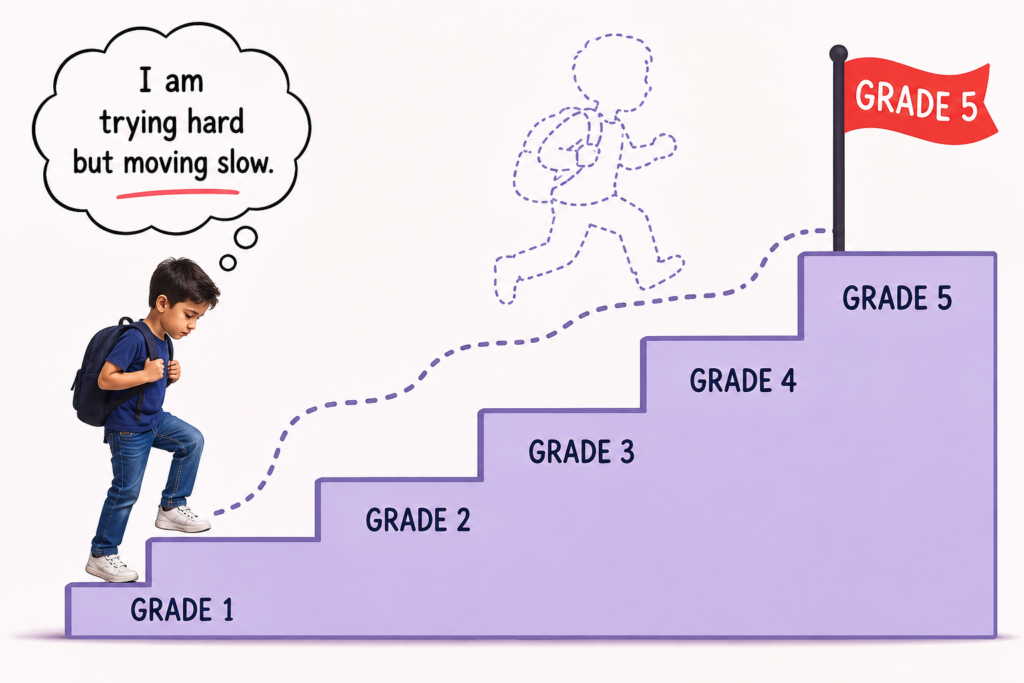
- Slow academic progress
- Difficulty retaining information
- Problems following multi-step instructions
- Difficulty applying learned skills
- Ongoing struggles despite effort and support
A comprehensive assessment helps determine whether these challenges may be associated with a Specific Learning Disorder, broader learning difficulties, cognitive factors, or other developmental concerns.
Signs Your Child May Benefit From An Assessment
You may consider an assessment if your child:
📚Reading & Language Concerns
- Reads below age expectations
- Frequently misreads words
- Struggles with spelling
- Avoids reading activities
- Has difficulty understanding written information
✏️Writing Difficulties
- Produces limited written work
- Has poor handwriting
- Finds writing tasks frustrating
- Struggles to organise thoughts in writing
- Makes frequent spelling and grammar mistakes
🎓Academic Concerns
- Falls behind despite effort
- Requires additional support to complete schoolwork
- Experiences frustration related to learning
- Demonstrates declining confidence in school
- Avoids academic tasks
➗Mathematics Challenges
- Struggles with basic number concepts
- Has difficulty remembering maths facts
- Finds mathematical reasoning challenging
- Requires significant support during maths activities
Our Learning Difficulties Assessment Process
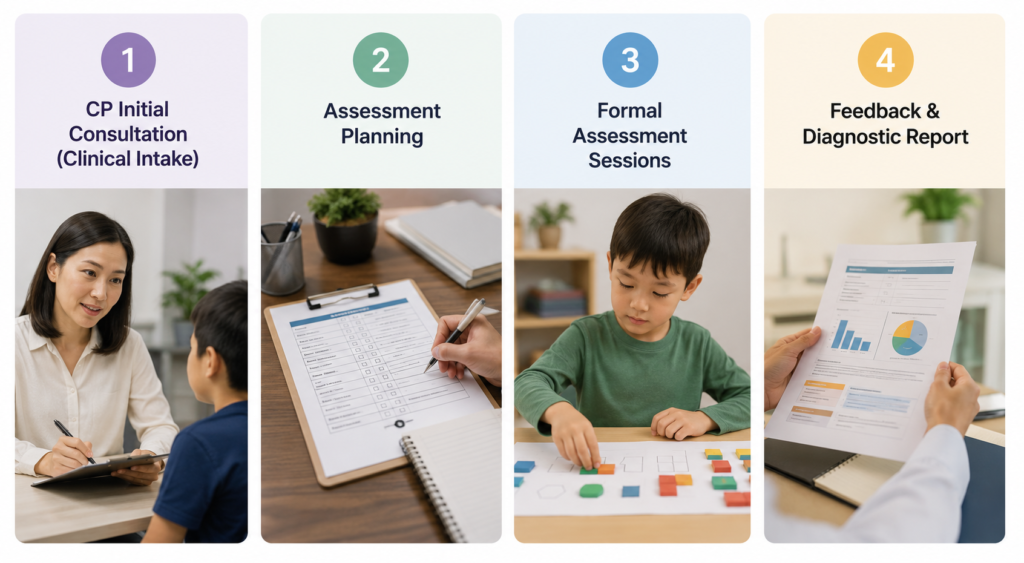
- Step 1 – Initial Consultation (Clinical Intake)
The assessment process begins with an initial consultation session with our Clinical Psychologist.
The purpose of this session is to:
- Understand your child's developmental and educational history
- Explore learning, behavioural, and emotional concerns
- Review academic performance and school feedback
- Identify possible contributing factors
- Determine whether assessment is required
- Identify the most appropriate assessment pathway
This session helps us determine whether formal assessment, intervention, or additional support may be beneficial for your child.
- Step 2 – Assessment Planning
Based on the information gathered during the intake session, suitable assessment tools will be selected according to your child’s age, presenting concerns, educational history, and learning profile.
Our assessment approach is individualised to ensure that each child receives the most appropriate evaluation.
- Step 3 – Formal Assessment
Assessment sessions may evaluate:
- Reading skills
- Writing and written expression
- Mathematics skills
- Academic achievement
- Cognitive functioning
- Learning strengths and weaknesses
- Step 4 – Feedback Session & Comprehensive Report
Following the assessment, a feedback session will be arranged to discuss the findings and recommendations.
Parents will receive:
- A comprehensive explanation of assessment findings
- Identification of learning strengths and challenges
- Diagnostic clarification where applicable
- Recommendations for home and school support
- Guidance regarding intervention and educational planning
Assessment Tools We May Use
Assessment tools are selected based on your child’s age, learning needs, and presenting concerns.
Our Clinical Psychologist may use a combination of standardised assessments to gain a comprehensive understanding of your child’s academic abilities, learning profile, and areas requiring support.
- Wechsler Individual Achievement Test – Fourth Edition (WIAT-4)
The Wechsler Individual Achievement Test – Fourth Edition (WIAT-4) helps evaluate your child’s academic skills and learning performance.
Areas assessed may include:
- Reading skills
- Reading comprehension
- Spelling
- Written expression
- Mathematics skills
- Overall academic achievement
This assessment helps identify areas where a child may be performing below expectations and provides insight into their academic strengths and challenges.
- Learning Difficulties Diagnostic Inventory (LDDI)
The Learning Disabilities Diagnostic Inventory (LDDI) is used to screen for patterns of difficulties commonly associated with learning disorders.
The information gathered helps determine whether further assessment, intervention, or educational support may be beneficial.
It helps identify concerns related to:
- Reading
- Writing
- Mathematics
- Listening and language-based learning
- Organisational and learning-related difficulties
- Cognitive Assessment (When Clinically Indicated)
In some cases, cognitive assessments may be recommended to better understand a child’s thinking and learning abilities.
Understanding a child’s cognitive profile can help explain how they learn, identify learning strengths, and support appropriate educational planning.
Assessments may include:
- WPPSI-IV (for younger children)
- WISC-V (for school-aged children)
- WAIS-IV (for adolescents and adults)
These assessments help evaluate areas such as:
- Verbal reasoning
- Visual-spatial skills
- Working memory
- Processing speed
- Problem-solving abilities
Why Early Assessment Matters
Early Understanding Leads to Better Support
Early identification of learning difficulties can help children receive appropriate support before academic challenges significantly impact confidence, motivation, and emotional wellbeing.
A Learning Difficulties Assessment can help:
- Better understand how your child learns
- Identify specific areas of academic difficulty
- Guide educational planning and intervention
- Support communication with schools and educators
- Improve confidence and learning outcomes
Early assessment is not about labelling a child. It is about understanding their unique learning needs and helping them reach their full potential.
Frequently Asked Questions
Can this assessment identify dyslexia?
The assessment can evaluate reading-related difficulties and help identify challenges commonly associated with dyslexia.
Can this assessment identify dysgraphia?
The assessment can evaluate written expression and writing-related difficulties that may be affecting academic performance.
Can this assessment identify dyscalculia?
The assessment can evaluate mathematical learning difficulties and identify areas of concern related to number and mathematical skills.
Can a child have both ADHD and learning difficulties?
Yes. Some children experience both attention-related difficulties and learning difficulties. A comprehensive assessment helps determine the factors contributing to a child’s challenges.
Does poor academic performance always mean a learning difficulty?
Not necessarily. Academic difficulties may be influenced by various factors, including learning difficulties, attention concerns, emotional factors, educational experiences, or developmental differences.
Will my child receive a report?
Yes. A detailed psychological report outlining findings, strengths, areas of difficulty, and recommendations will be provided.
Can the report be shared with my child’s school?
Yes. Many parents choose to share the report with schools to support educational planning and accommodations where appropriate.
Book Your First Session
We welcome your feedback and inquiries. If you have any questions, comments, or suggestions, please don’t hesitate to contact us. Our team is here to assist you and provide the information you need.
Clinical Psychologist Consultation

Ms. Chan Chia Wei
Clinical Psychologist (MAHPC (CP) 00513 | CP1-0556)
Download Brochure
Working Hours
Open Everyday
Monday to Sunday – 8.30am to 6pm
Contact Us
Discover Our Team!
📞+60102502833
firststepdevelopmentcentre@gmail.com
B1-7, Plaza Damas 3, Jalan Sri Hartamas 1, 50480 Kuala Lumpur.
Copyright 2026. Firststep Child Development Sdn Bhd. All rights reserved.