



Could the behaviours that worry you be part of being five, or signs that your child needs extra support? The Signs of ADHD in a 5-Year-Old can be difficult to recognise because high energy, brief attention and impulsive moments are also common at this age. It’s understandable to feel unsure, especially if you’re seeing challenges at home or hearing concerns from preschool.
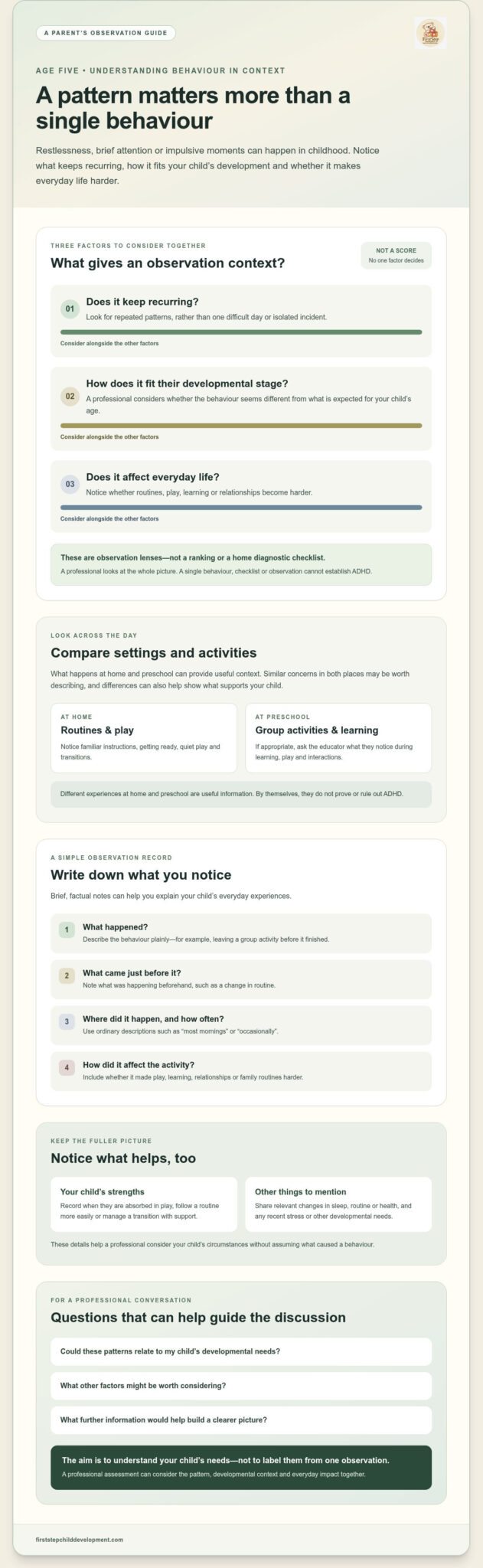
Rather than focusing on one behaviour or trying to label your child, look for patterns. Consider how often a behaviour happens, whether it appears in more than one setting and how much it affects everyday life. A professional can help explore these observations alongside other factors that may influence behaviour.
This guide explains which patterns may be worth discussing, why input from home and preschool matters, and what practical next steps you can take in Malaysia. You’ll also learn how an assessment can help build a clearer picture of your child’s needs, so you can seek guidance with greater confidence.
Key Takeaways
- Signs of ADHD in a 5-Year-Old may involve attention, activity level or impulse control, but a single behaviour or difficult day doesn’t establish ADHD.
- Notice whether behaviours persist, seem different from what’s expected for your child’s age and affect everyday routines.
- Record what happens, where and how often. Include your child’s strengths and situations where they seem more settled.
- A professional assessment can help clarify your child’s needs. Play-based activities and clear feedback can help parents understand the observations.
Signs of ADHD in a 5-Year-Old: Patterns Parents May Notice
One restless afternoon, an unfinished activity or a difficult day doesn’t establish ADHD. Five-year-olds vary in how they focus, move and manage impulses, and the same child may behave differently depending on the situation.
ADHD-related signs are recurring patterns of attention, activity or impulse-control difficulties that need to be understood in context by a professional. A child may show some of these behaviours, but not necessarily all:
- Attention: They may find it hard to stay with an age-appropriate story, game or preschool task, even with support, or often seem not to hear a familiar instruction.
- Activity level: They may move frequently during activities that involve sitting, climb or run when expected to stay nearby, or find quiet play challenging.
- Impulse control: They may regularly call out, interrupt play, reach for something before asking or struggle to wait for a turn.
These examples are worth noting when they recur in everyday situations and affect activities, not simply because a child is energetic or occasionally distracted. The CDC’s overview of ADHD signs and symptoms describes common features, but a professional can help interpret concerns in the context of an individual child.
Why a checklist cannot diagnose ADHD
Some behaviours associated with ADHD also occur during typical development. Tiredness, changes in routine, stress or other developmental needs can affect a child’s attention and behaviour too. A checklist can help you describe what you’ve observed, but it cannot explain why it is happening or determine whether it is ADHD.
Professionals consider the wider picture, including how persistent the behaviours are, whether they fit the child’s developmental stage and whether they affect daily life. Observations from home and preschool can add useful context. If concerns are continuing, learn about ADHD assessment in Malaysia and support for understanding your child’s needs. For another perspective on how developmental patterns can overlap, see this guide to ADHD vs Autism in Children.
When ADHD-Related Behaviours Form a Persistent Pattern
A behaviour is more useful to discuss when it keeps recurring, seems out of step with a child’s developmental stage and makes everyday activities harder. For example, difficulty following routines may affect getting ready, joining preschool activities or playing with others. Professionals consider the whole pattern, not one incident or a checklist in isolation.
No single observation settles the question. A professional assessment considers how long concerns have been present, how they compare with what’s expected for the child’s age and whether they interfere with daily life. The National Institute of Mental Health’s ADHD assessment information also explains why assessment involves more than spotting individual behaviours.
Look across settings and everyday activities
Compare what you notice during home routines, play and preschool activities. Does your child find it difficult to follow a familiar instruction at home but manage group activities at preschool? Do similar concerns arise in both places? Differences are useful context for understanding what helps or makes things harder. They don’t, by themselves, prove or rule out ADHD. With your permission, a preschool educator’s observations may add another perspective.
Consider development and other possible influences
Sleep difficulties, changes in routine, health concerns, recent stress and other developmental needs can affect attention, energy and behaviour. Note when a change began and what was happening around that time, without assuming it caused the behaviour. This information helps a professional consider your child’s circumstances alongside their developmental needs. For broader context, read this guide to ADHD assessment in Malaysia.
If you’re concerned about a continuing pattern, Firststep offers play-based ADHD assessments and clear feedback for parents. Learn more about Firststep’s child-development support.
What Parents in Kuala Lumpur and Selangor Can Observe Before Seeking Guidance
You don’t need to decide what a behaviour means before asking for guidance. A few brief, factual notes can help you explain what you’re seeing and give a child-development professional a clearer picture of your child’s everyday experiences.
A simple observation record for home and preschool
When a concern arises, jot down what happened, what came just before it, where it occurred and how it affected the activity. For example, note that your child left a group activity before it finished, or that getting ready for bed became difficult after a change in routine. Describe how often you notice the behaviour in ordinary terms, such as “most mornings” or “occasionally”. Avoid scoring behaviours or using a home checklist to diagnose ADHD.
Include the fuller picture, too. Note when your child is absorbed in play, follows a routine more easily or manages a transition with support. If appropriate, ask the preschool teacher what they observe during learning, play and interactions with other children. Different experiences at home and preschool are useful information, not a reason to dismiss your concern.
Prepare for a professional conversation
Bring your notes and consider asking:
- Could these patterns relate to my child’s developmental needs?
- What other factors might be worth considering?
- What further information would help build a clearer picture?
Share any relevant changes in sleep, routine or health, along with your child’s strengths and what helps them feel settled. You can also describe whether concerns affect play, learning, relationships or family routines. These details help keep the conversation focused on understanding your child, not applying a label.
Families in Kuala Lumpur, Petaling Jaya and Selangor can explore Firststep’s child-development support.
How to Seek ADHD Assessment Support for a 5-Year-Old in Malaysia
This article can help you organise your concerns, but it can’t determine whether your child has ADHD. Assessment is a professional process that considers a child’s development, behaviour and daily functioning, alongside information shared by parents and, where appropriate, preschool educators.
What an assessment may help clarify
For a five-year-old, assessment can explore how attention, activity and impulse control affect routines, learning and play. It can also help consider other developmental needs or circumstances that may be relevant. The aim is to build a clearer understanding of your child, not to reach a particular conclusion or promise a specific plan.
At Firststep Psychology & Child Development Centre, ADHD assessments include play-based activities and clear feedback for parents. Play can offer a child a familiar way to engage while professionals learn more about their development and needs. Families in Kuala Lumpur, Petaling Jaya and across Selangor can read about the ADHD assessment service in Malaysia.
A calm next step for families
Bring your brief notes from home and any relevant preschool observations to a professional consultation. You might ask what the assessment will consider, how your child’s strengths will be included and what the feedback can help you understand. It’s all right to ask questions or explain what you’re unsure about.
Seeking guidance doesn’t mean you’ve already decided what is happening. Learn more about Firststep Child Development and its support for families.
Take a Thoughtful Next Step
The Signs of ADHD in a 5-Year-Old are best understood as persistent patterns, not isolated behaviours. Notice how they affect everyday routines and gather observations from home and preschool where possible. Your notes can help a professional understand your child’s development, strengths and support needs.
Seeking an assessment doesn’t mean you’re labelling your child. It’s a way to explore concerns with care. Firststep’s ADHD assessments include play-based activities and clear feedback for parents, alongside child-development support. Read more about the ADHD assessment service in Malaysia.
To discuss your concerns, explore Firststep’s ADHD assessment service and learn more at Firststep Child Development.
Frequently Asked Questions
What are the signs of ADHD in a 5-year-old?
Signs of ADHD in a 5-Year-Old may include recurring difficulty sustaining attention, frequent movement or trouble waiting and pausing before acting. A child might often leave an activity before it’s finished, move around during quiet play or interrupt others. Children don’t all show the same behaviours, and these examples alone can’t confirm ADHD. A professional considers whether patterns persist, fit the child’s developmental stage and affect everyday life.
Can a 5-year-old be assessed for ADHD?
Yes, a five-year-old can have a professional assessment. Because behaviours such as high activity and brief attention can also be typical at this age, the assessment needs to consider the child’s development and experiences across settings. In Malaysia, suspected ADHD in children under six should be referred to a child psychiatrist or developmental paediatrician for diagnosis and management. An assessment may include play-based activities and feedback for parents.
How can I tell whether my 5-year-old’s behaviour is typical or a concern?
No single behaviour reliably separates typical development from ADHD. Consider whether a behaviour keeps recurring, seems notably different from what you’d expect for your child’s age and makes routines, play, learning or relationships harder. Compare observations from home and preschool where appropriate. Sleep, changes in routine, health and stress can also influence behaviour, so note relevant changes without assuming they explain the pattern.
What should I do if I notice possible ADHD signs in my child?
Write down brief, factual observations: what happened, where, what came before it and how it affected your child. Include strengths and situations where they seem more settled, and ask their preschool educator for observations if appropriate. Then discuss your concerns and questions with a child-development professional. Families in Kuala Lumpur, Petaling Jaya and Selangor can learn about ADHD assessment in Malaysia.

Article by
Firststep Child Development Team
Firststep Child Development Team provides evidence-informed educational resources to help parents better understand child development, behaviour and learning. Our multidisciplinary services include clinical psychology, occupational therapy, speech and language therapy, developmental assessments and other child development support in Kuala Lumpur and Selangor.
Disclaimer
This article is for general educational and informational purposes only and is not a substitute for professional medical, psychological or therapeutic advice, diagnosis or treatment. Every child develops differently. If you have concerns about your child's development, behaviour, learning or wellbeing, please consult an appropriately qualified healthcare or allied health professional.