



Could your child’s boundless energy be part of their usual development, or might it be a pattern worth exploring? If you’re wondering about ADHD vs Normal Active Child behaviour, activity alone can’t provide the answer. What matters is whether difficulties with attention, impulsivity or high activity persist, appear in different settings and affect everyday life.
It’s understandable to feel unsure: children develop at different rates, and a lively day or challenging moment doesn’t necessarily point to ADHD. This guide explains what to observe over time, how behaviour at home and school can offer useful context, and when a professional assessment may help.
You’ll also learn what notes to share with a professional and how an assessment can bring together clinical observation, standardised testing and parent feedback. For families in Kuala Lumpur and Selangor, the aim is to make a next step feel informed and supportive, not rushed or judgemental.
Key Takeaways
- When weighing ADHD vs Normal Active Child behaviour, look beyond energy levels to recurring patterns and their effect on everyday life.
- Compare what you notice at home with observations from school, where available, to build a fuller picture.
- Keep brief notes on behaviour, context, frequency and impact to help make a conversation with a professional more informative.
- An ADHD assessment brings together different sources of information to help understand a child’s needs; it isn’t a judgement of their character.
ADHD vs a Normally Active Child: Why Activity Alone Is Not the Difference
Children naturally differ in how much they move, how long they concentrate and how they respond to excitement. One lively afternoon, difficulty sitting through a long meal or a burst of energy after school doesn’t, by itself, indicate ADHD. In considering ADHD vs Normal Active Child behaviour, look at the broader pattern rather than judging a child by one moment.
ADHD is a neurodevelopmental condition involving ongoing difficulties with attention and/or hyperactivity and impulsivity that can affect daily functioning. The CDC’s overview of ADHD describes a condition with varied presentations; recognising a possible pattern requires more than matching a child to a symptom list.
What can typical high activity look like?
A child might race around the playground but settle to build a favourite model, listen to a story or follow instructions when the setting changes. Age, temperament, tiredness, stress and surroundings can all influence behaviour. These factors help explain why energy and attention may vary from day to day; they aren’t a way to diagnose or rule out ADHD.
Why ADHD involves more than being energetic
Inattention may look like losing track of instructions or being easily distracted. Hyperactivity can involve persistent restlessness or difficulty staying seated, while impulsivity may mean acting or speaking before considering the consequences. Children can show different combinations of these behaviours. Professionals consider whether they persist over time and meaningfully affect learning, routines or relationships, not simply whether a child is active.
High energy is a behaviour; ADHD is considered when a persistent pattern of attention, activity or impulse-control difficulties affects a child’s everyday functioning. If concerns continue, a professional assessment can help explore the context. Learn about Firststep’s ADHD assessment in Malaysia as one possible next step.
Which ADHD Patterns Matter Across Home, School, and Daily Life?
A behaviour that appears occasionally or in one demanding situation may have a different context from difficulties that keep recurring across everyday life. A child might struggle to wait when tired or lose track of a multi-step instruction during a busy day. If similar challenges repeatedly affect classroom learning, family routines or friendships, it may be useful to look more closely, without treating any single example as proof of ADHD.
Observations from home and school matter because they show whether a difficulty is recurring across settings, and how it affects a child in different situations. The National Institute of Mental Health on ADHD explains that assessment considers symptoms and their impact, rather than relying on one isolated behaviour. Examples can guide a conversation, but they don’t diagnose a child.
What parents and teachers may observe
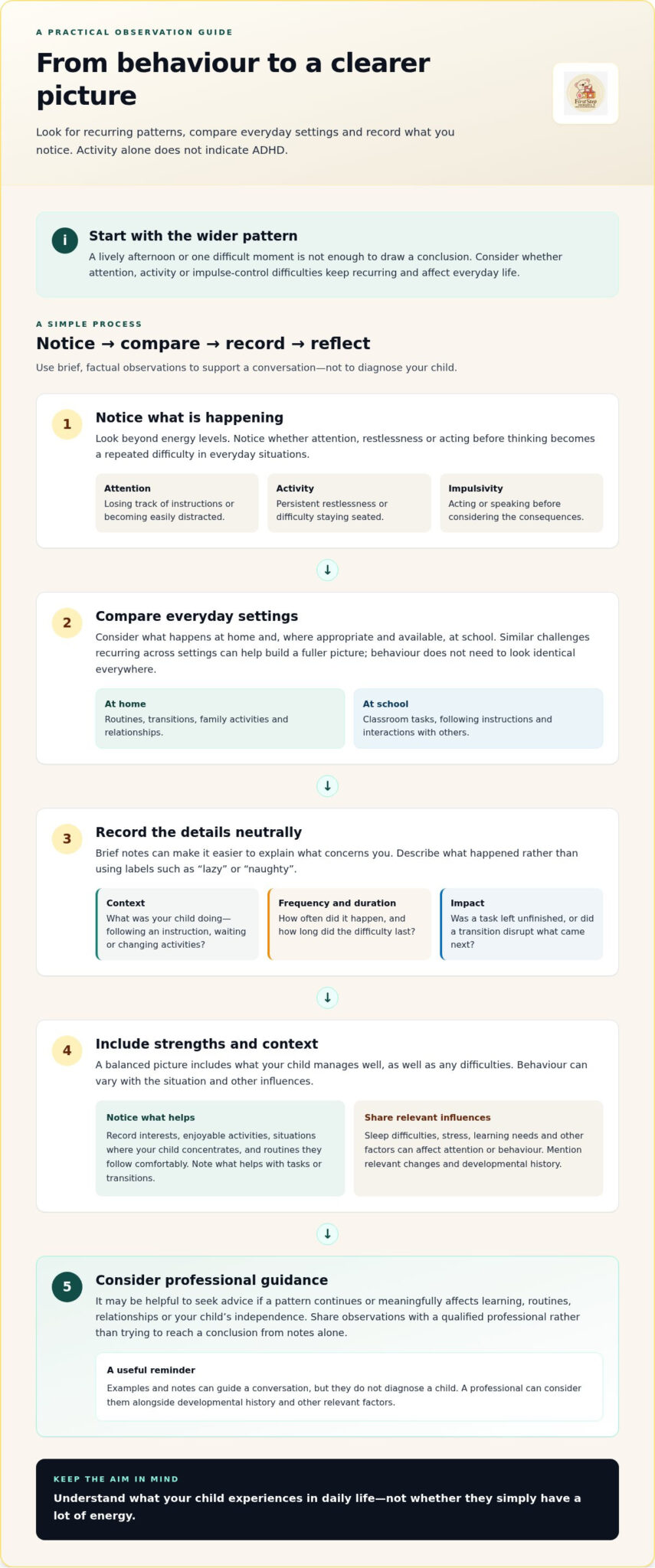
For a clearer picture, record observations neutrally rather than using labels such as “lazy” or “naughty”. Note:
- Context: Was your child following a short instruction, waiting in a queue or changing activities?
- Frequency and duration: How often did it happen, and how long did the difficulty last?
- Impact: Did the task remain unfinished, or did the transition disrupt the next activity?
Where appropriate and available, ask the teacher what they notice about similar tasks at school. The aim is to compare useful details, not to expect identical behaviour in every setting. For more on how ADHD can affect school performance and learning tasks, see this guide to ADHD and school success.
Consider development and other possible influences
Sleep difficulties, stress, learning needs and other factors can affect attention or behaviour. Share relevant changes and concerns with a qualified professional rather than trying to reach a conclusion from notes alone. If you’d like to understand how Firststep supports families, visit Firststep Child Development.
How to Observe Your Child’s Behaviour Before Seeking Advice
Brief, factual notes can help you explain what concerns you and what your child manages well. For a balanced view of ADHD vs Normal Active Child behaviour, note what happened, the context, how often it occurs and how it affects daily life. You’re gathering information, not trying to diagnose your child.
What information is useful to bring?
- Routines and transitions: Is getting ready for school or moving from play to bedtime difficult? What helps?
- Learning and tasks: Does your child lose track of instructions, or complete activities more easily with reminders or an adult nearby?
- Friendships and daily situations: What happens when taking turns or playing with others? Which settings feel easier?
- Strengths: Note interests, activities your child enjoys and situations where they concentrate or follow a routine comfortably.
Where appropriate, include observations from school as well as home. Share relevant developmental history and describe your concerns in your own words. If you’re also looking for age-specific examples, Firststep’s guide to ADHD signs in 5-year-olds may offer a useful perspective; it isn’t a checklist for diagnosing your child.
CHADD’s Overview of ADHD also explains how ADHD may affect everyday functioning, which can help put observations into context.
When might professional guidance be helpful?
Consider seeking advice if a pattern continues or meaningfully affects learning, routines, relationships or your child’s independence. A professional can explore the observations alongside your child’s developmental history and other relevant factors. Notes don’t need to be perfect; they’re a starting point for a clearer conversation.
If you’d like support understanding your observations, learn about a child ADHD assessment at Firststep Child Development.
What Happens When You Explore an ADHD Assessment in Malaysia?
An assessment brings together information to understand a child’s behaviour and support needs. It isn’t based on one lively moment, one observation or a single test. For families considering ADHD vs Normal Active Child concerns, this process can help place observations in a wider developmental context.
At Firststep, an ADHD assessment includes standardised testing, clinical observation and feedback for parents. These elements contribute different perspectives; they don’t guarantee a particular conclusion. Assessment findings should be interpreted alongside a child’s developmental history and everyday functioning.
How assessment can help clarify a child’s needs
A fuller understanding may help identify areas where a child could benefit from support at home, school or in daily routines. The aim is to understand the child’s needs, not to judge their character. You can read more about how an assessment works for broader context. If you’re looking for step-by-step information on ADHD diagnosis, discuss the assessment process with a qualified professional.
For parents comparing activity with persistent patterns, an assessment can offer a structured way to consider concerns and relevant strengths together.
A gentle next step for parents in Kuala Lumpur and Selangor
Firststep Psychology & Child Development Centre supports families in Kuala Lumpur, Petaling Jaya and Selangor. If concerns continue to affect your child’s everyday life, you may wish to explore a professional assessment as an informed next step.
Learn about Firststep’s ADHD assessment in Malaysia and child-centred support, or visit the Firststep Child Development homepage to learn more.
Take the Next Step with Greater Clarity
In considering ADHD vs Normal Active Child behaviour, remember that energy alone doesn’t tell the whole story. What matters is whether attention, activity or impulse-control difficulties form a persistent pattern and affect your child’s everyday life. Notes from home and school can help show where challenges arise, what makes situations easier and how your child’s strengths come through.
A professional assessment can bring these observations into context. At Firststep, the ADHD assessment includes standardised testing, clinical observation and feedback for parents. The centre is affiliated with Firststep Child Specialist Clinic and supported by paediatricians. Assessment is a way to better understand a child’s needs, not a judgement of their character or a promise of a particular outcome.
If concerns continue, you can explore an ADHD assessment or learn more about Firststep. Taking time to seek informed guidance can be a thoughtful step towards understanding how best to support your child.
Frequently Asked Questions
Is my child just active, or could it be ADHD?
Activity alone can’t tell you whether a child has ADHD. Consider whether difficulties with attention, hyperactivity or impulsivity form a persistent pattern and affect everyday functioning. Behaviour can also vary with age, context, sleep, stress and other needs. If you’re concerned, keep neutral notes about what you observe and discuss them with a qualified professional rather than relying on an online checklist.
Can a child with ADHD focus on activities they enjoy?
Yes, a child may concentrate strongly on an enjoyable activity and still find attention difficult in other situations. Interest, structure and the demands of a task can shape what you observe. Being able to focus sometimes neither confirms nor rules out ADHD. A professional considers the wider pattern and how it affects daily life, rather than drawing conclusions from one activity or moment.
How can I tell whether my child’s behaviour happens in more than one setting?
Keep neutral notes about what happens at home, school or during activities, including the situation and its effect on your child’s day. Where appropriate, ask the teacher to share observations, not to diagnose. Your child may behave differently in different settings, and that information can still be useful. No single report or behaviour proves ADHD; share the overall picture with a professional.
Should I seek an ADHD assessment if my child is energetic but doing well?
High energy by itself doesn’t mean your child needs an ADHD diagnosis. Consider whether recurring difficulties affect learning, routines, relationships or other parts of daily life, even if your child is doing well in some areas. If concerns remain, a professional discussion can help you understand what may be happening and whether further assessment could be useful. Seeking advice doesn’t predetermine the outcome.

Article by
Firststep Child Development Team
Firststep Child Development Team provides evidence-informed educational resources to help parents better understand child development, behaviour and learning. Our multidisciplinary services include clinical psychology, occupational therapy, speech and language therapy, developmental assessments and other child development support in Kuala Lumpur and Selangor.
Disclaimer
This article is for general educational and informational purposes only and is not a substitute for professional medical, psychological or therapeutic advice, diagnosis or treatment. Every child develops differently. If you have concerns about your child's development, behaviour, learning or wellbeing, please consult an appropriately qualified healthcare or allied health professional.