


What if the same behaviour could point to different needs? A child who struggles to wait, follow instructions or join a group may leave parents wondering about ADHD vs Autism in Children. It’s understandable to look for clear answers, but a single behaviour or online checklist can’t explain the whole picture.
ADHD and autism have distinct patterns, yet some traits can overlap, and a child may have both. This guide will help you understand those differences without trying to diagnose your child at home. It will also show you what details can be useful to share with a child-development professional.
We’ll look at how attention, communication, social interaction and routines may appear across everyday settings, and why a professional assessment considers your child’s development and needs as a whole. You’ll also find practical ways to record observations and learn what assessment may involve, so you can approach a conversation about your concerns with greater clarity and confidence.
Key Takeaways
- Compare recurring patterns in attention, communication and behaviour rather than drawing conclusions from one trait.
- ADHD vs Autism in Children can involve overlapping behaviours, and some children may have both.
- Record what you notice, where it happens, possible triggers and how it affects daily life; examples from different settings can help.
- A child-centred assessment can consider developmental history, observation and standardised testing to help clarify strengths and support needs.
ADHD vs autism in children: why the differences can be hard to spot
If attention, communication or sensory behaviours leave you unsure what your child needs, that uncertainty is understandable. The question of ADHD vs Autism in Children is rarely answered by matching one behaviour to an online checklist. The wider pattern, including how your child develops and responds in different situations, matters more.
What do ADHD and autism mean in children?
ADHD is a developmental condition involving ongoing patterns of inattention, hyperactivity, impulsivity, or a combination of these. These differences may affect how a child manages focus, activity and waiting. The NHS overview of attention deficit hyperactivity disorder (ADHD) offers further information.
Autism is a developmental condition involving differences in social communication and interaction, alongside restricted or repetitive patterns of behaviour, interests or activities. Sensory experiences may also be part of a child’s profile. Neither condition defines a child’s personality or tells you, by itself, what they can learn or achieve.
Why can ADHD and autism appear similar?
A child who finds it hard to stay engaged in a conversation, for example, might be distracted by what is happening around them, or might be finding the social demands of the interaction challenging. A strong preference for familiar routines may reflect different needs, and changes or busy environments can affect children in individual ways.
Age, development, setting and the child’s own profile all shape what adults observe. The same child may respond differently at home, in class or with friends. Some children may also have both conditions, so apparent overlap does not automatically point to one explanation.
One visible behaviour can raise a question, but it cannot distinguish ADHD from autism on its own. A fuller assessment considers patterns over time and the child’s developmental history, rather than treating a single moment as an answer. This section offers general educational guidance for families, not an individual diagnosis.
ADHD vs autism symptoms: compare patterns across daily life
In ADHD vs Autism in Children, the useful distinction is often the pattern behind a behaviour, not how it looks in one moment. These examples can help you frame observations, but they aren’t a home diagnostic checklist. Children vary, and similar behaviours may have different explanations.
| Area | Patterns sometimes associated with ADHD | Patterns sometimes associated with autism |
|---|---|---|
| Attention and conversation | May lose track of a conversation, interrupt or shift focus before a task is finished. | May find the back-and-forth flow of conversation or reading unspoken social cues challenging. |
| Activity and routines | May act quickly or find it hard to pause and wait. | May prefer predictability, or show repetitive behaviours or focused interests. |
| Sensory experiences | May be distracted by sounds, movement or other input. | Sensory experiences may be unusually intense or different, though this varies between children. |
How may attention and social communication patterns differ?
A child who interrupts might be responding before they have had time to pause, or may be finding the timing of conversational turn-taking difficult. A child who seems not to listen might be distracted, unsure how to join in, or focused on something else. The outward behaviour alone can’t reveal the reason. Eye contact, friendships and classroom performance are not stand-alone evidence; consider the broader pattern and the child’s experience.
Can a child have both ADHD and autism?
Yes. ADHD and autism can co-occur, so noticing traits associated with one doesn’t rule out the other. An assessment considers developmental history, behaviour across situations and the child’s individual strengths and support needs, rather than relying on a single score or observation.
For families in Kuala Lumpur and Selangor, learning what a child-development assessment involves can make the next conversation feel more manageable.
What parents can observe before discussing ADHD or autism concerns
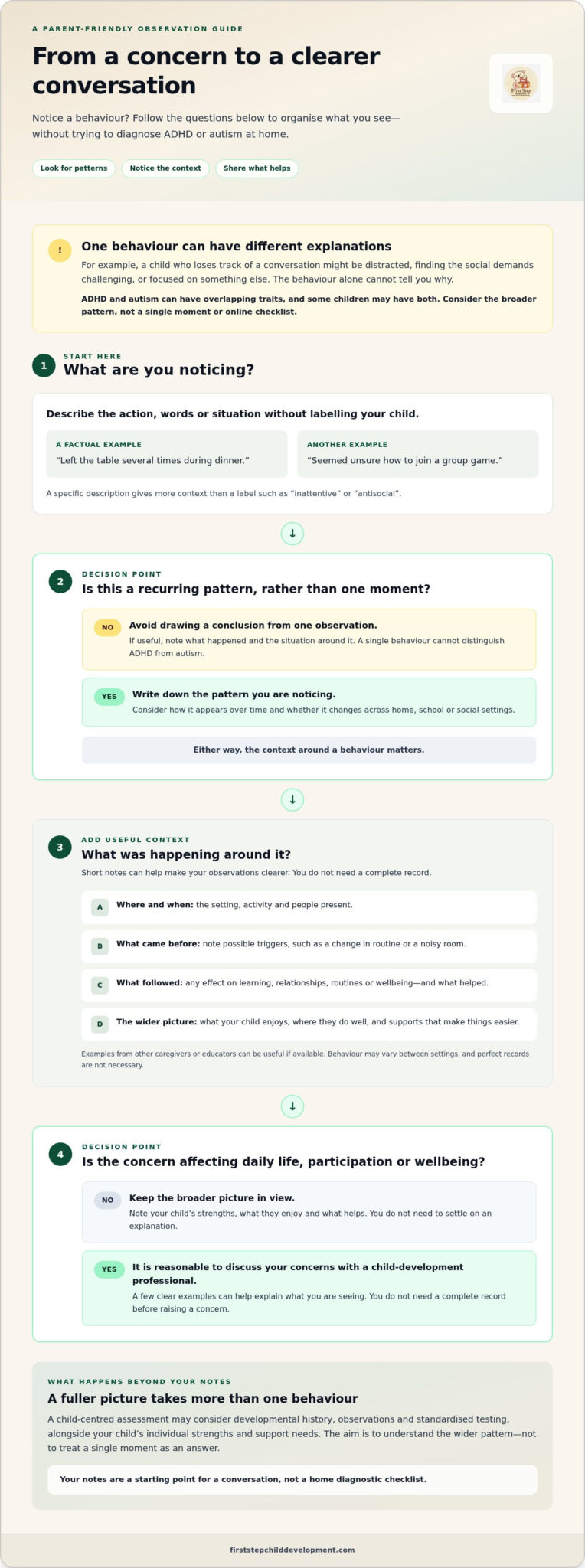
You don’t need a complete record to raise a concern. A few clear examples can help a professional understand what you’re seeing and whether it affects your child’s daily life.
Try noting:
- What happened: Describe the action, words or situation without labelling your child.
- Where and when: Include the setting, activity and people present, such as getting ready for school or playing with friends.
- How often and what came before: Note whether it happens repeatedly and any possible triggers, such as a change in routine or a noisy room.
- What followed: Record the effect on learning, relationships, routines or wellbeing, as well as what helped.
Examples from home, school and social settings can be useful if available, but perfect records aren’t necessary. Include what your child enjoys, where they do well, supports that make things easier, relevant developmental history and questions you’d like to ask. Persistent concerns that affect participation or wellbeing are reasonable to discuss with a child-development professional.
Which observations are useful to bring to an assessment?
Brief, factual descriptions are more useful than labels such as “inattentive” or “antisocial”. For example, note that your child left the table several times during dinner, or seemed unsure how to join a group game. Where possible, include perspectives from other caregivers or educators, while remembering that behaviour may vary between settings.
Why should parents avoid relying on online checklists alone?
Checklists can help you organise questions, but they can’t capture a child’s developmental history, circumstances or strengths. Similar answers may reflect different needs, and overlapping traits can be difficult to interpret without context.
A screening checklist can suggest what to discuss; a comprehensive assessment considers the child’s wider developmental picture. If you’re ready to talk through your observations, explore child-development support at Firststep Psychology & Child Development Centre.
Getting a child-centred ADHD or autism assessment in Kuala Lumpur and Selangor
An assessment can help build a fuller understanding of your child, including their developmental history, strengths and support needs. For families considering ADHD vs Autism in Children, the aim is not to force every observation into one explanation. It is to understand the child’s individual profile and consider what may help.
What can families expect from an assessment conversation?
At Firststep Psychology & Child Development Centre, assessment packages include clinical observation, standardised testing and detailed feedback for parents. These elements can contribute different kinds of information: how a child responds during observation, how they perform on relevant testing, and how findings relate to the concerns and examples shared by the family.
Feedback gives parents an opportunity to understand the findings and discuss possible next steps. The specific approach depends on the assessment; it does not guarantee a particular diagnosis or outcome. If you’d like a broader overview of the process, see how child assessments work.
How can assessment findings guide support?
Findings may help families and professionals consider support that fits a child’s needs, whether at home, in school or through therapy. Recommendations should take account of the whole child, not just a test result or one behaviour. A child’s strengths matter too: what captures their interest, what helps them communicate, and which adjustments make everyday activities more manageable.
Firststep offers ADHD and autism assessment pathways for families in Kuala Lumpur and Selangor. If you’re considering a professional discussion, you can explore an ADHD assessment or an autism assessment, and learn more about Firststep Psychology & Child Development Centre.
Take the next step at your family’s pace
You don’t need to arrive with a firm theory about what explains your child’s behaviour. It’s enough to share what you’ve noticed and what you hope to understand better. A professional conversation can help you consider the questions that matter for your child now, while keeping their individual strengths and needs in view.
If you’re ready to explore assessment in Kuala Lumpur or Selangor, you can learn about a child ADHD assessment or an autism assessment. The right next step in understanding ADHD vs Autism in Children is a thoughtful discussion, not a conclusion reached from a checklist.
Explore Firststep Psychology & Child Development Centre to learn more. With a clearer understanding of your child’s needs, you can move forward with greater confidence and care.
Frequently Asked Questions
Does avoiding eye contact mean a child is autistic?
No single way of using eye contact can answer that question. Instead of prompting your child to look at you, notice how they show attention or connection in ways that feel comfortable to them, such as responding to their name, sharing an interest, or using gestures. These observations can offer useful context, but they aren’t a test of autism.
Can a teacher’s observations help with an ADHD or autism assessment?
Yes. A teacher may be able to describe how your child manages particular classroom demands, which can complement what you see at home. If appropriate, ask for a brief written summary of the situations that are difficult and any approaches that help. This can make it easier to discuss support between home and school, while leaving interpretation to the assessment process.
Can an online checklist diagnose ADHD or autism in a child?
No. If you use a checklist to organise your thoughts, keep the completed answers and note who filled it in and when. Share that context rather than relying on the final score alone. A checklist may be based on broad questions that don’t reflect your child’s age, circumstances or the reason for a particular response, so its result needs careful interpretation.
Should parents wait to see if a child grows out of these behaviours?
You don’t have to wait for a behaviour to become more disruptive before seeking guidance. While arranging a discussion, try small, practical adjustments such as giving one instruction at a time or offering extra warning before a change in activity. Notice whether these make a difference, and share that information. Support can respond to a child’s current needs without settling a diagnosis first.

Article by
Firststep Child Development Team
Firststep Child Development Team provides evidence-informed educational resources to help parents better understand child development, behaviour and learning. Our multidisciplinary services include clinical psychology, occupational therapy, speech and language therapy, developmental assessments and other child development support in Kuala Lumpur and Selangor.
Disclaimer
This article is for general educational and informational purposes only and is not a substitute for professional medical, psychological or therapeutic advice, diagnosis or treatment. Every child develops differently. If you have concerns about your child's development, behaviour, learning or wellbeing, please consult an appropriately qualified healthcare or allied health professional.