



What if unfinished homework or forgotten instructions reflect the demands of a task, rather than a lack of effort? Can ADHD Affect School Performance? Yes. ADHD can make it harder for a child to focus, organise materials, follow instructions or complete work, even when they understand the lesson and want to do well.
It’s understandable to worry that these struggles may be seen as laziness or poor behaviour. ADHD is one possible explanation, but learning difficulties and other needs can also affect school life. A child’s challenges deserve curiosity and support, not assumptions about their character or ability.
This guide explains how ADHD-related needs may show up in different school tasks, and offers practical ways to share observations with teachers and support learning. It also explores when a broader professional assessment may help clarify what’s getting in the way, so the next steps can be based on your child’s individual needs.
Key Takeaways
- Can ADHD Affect School Performance? It can, in different ways, from organising schoolwork to participating in class, and its impact varies from child to child.
- Learn how ADHD-related attention and self-management needs differ from learning difficulties, while recognising that both can occur together.
- Use a simple approach to spot patterns, note specific examples and discuss helpful supports with your child’s teachers.
- Find out when ongoing difficulties, distress or challenges in daily life may make professional guidance useful.
Can ADHD affect school performance? Understanding the classroom impact
Can ADHD Affect School Performance? Yes, it can, but the effects vary between children and situations. School performance includes more than test results: it can involve learning, completing tasks, organising materials, joining classroom activities, maintaining confidence and building relationships. A child may understand a topic yet find it difficult to show that knowledge consistently.
ADHD-related needs can make classroom tasks harder to manage, but they don’t define a child’s ability or future potential. Looking at which parts of a task are difficult can be more helpful than making assumptions about effort.
How attention and executive-function demands show up in lessons
Executive function refers to the skills we use to plan, remember instructions, organise steps and manage a task through to completion. A pupil might lose track of a teacher’s multi-step instructions, begin written work but not finish it, or forget which materials to bring home.
These examples are educational information, not a checklist for diagnosing ADHD. The CDC’s overview of ADHD provides further information, but a child’s needs can only be understood in context.
Why school performance can vary across subjects and days
Task length, structure, interest and classroom demands can all affect how manageable schoolwork feels. A short activity with clear steps may be easier to complete than a longer assignment requiring sustained attention and independent planning. That variation alone doesn’t prove ADHD or mean a child lacks motivation.
For example, a child in Kuala Lumpur might contribute confidently during a lively classroom discussion, yet struggle to organise a longer Bahasa Melayu writing task. After school, tiredness or a change in routine may make it harder to start homework. These observations can help parents and teachers identify where support may be useful, without treating one difficult day or subject as the whole story.
ADHD and learning difficulties: understanding what may overlap
ADHD and a specific learning difficulty are different, though a child can have both. ADHD-related needs may affect attention, organisation and managing tasks. A learning difficulty, such as dyslexia, can make acquiring particular academic skills, such as reading or spelling, harder even when a child is engaged. In short, ADHD can affect how a child manages learning tasks; a specific learning difficulty can affect how they develop a particular skill.
So, “Can ADHD Affect School Performance?” Yes, but grades or one classroom observation can’t explain why a child is struggling. Look for patterns across different areas: reading accuracy, written expression, mathematics, following instructions and completing work. For instance, a child may understand a maths method when talking it through but lose marks while recording each step, or find reading difficult even during a quiet, supported activity. These examples are clues to discuss, not proof of a condition.
When school struggles may have more than one explanation
Attention and academic skills can interact, making the cause difficult to identify from schoolwork alone. Sleep difficulties, stress, emotional wellbeing and other learning needs may also influence concentration or progress. Notice what happens across subjects and settings, and share specific examples with the teacher. One low mark, unfinished worksheet or distracted moment doesn’t establish a diagnosis.
How assessment can clarify a child’s learning profile
A professional assessment may consider developmental history, observations, parent input and the child’s performance on relevant tasks. The aim is to understand strengths and support needs, not judge ability or effort. If attention and self-management concerns persist, an ADHD assessment may help explore them. If particular academic skills remain difficult, a learning difficulties assessment can look more closely at that profile. Assessment can also help parents understand findings and consider practical next steps. Learn more about Firststep Psychology & Child Development Centre as you consider what guidance may suit your child.
Supporting a child with ADHD at school and at home
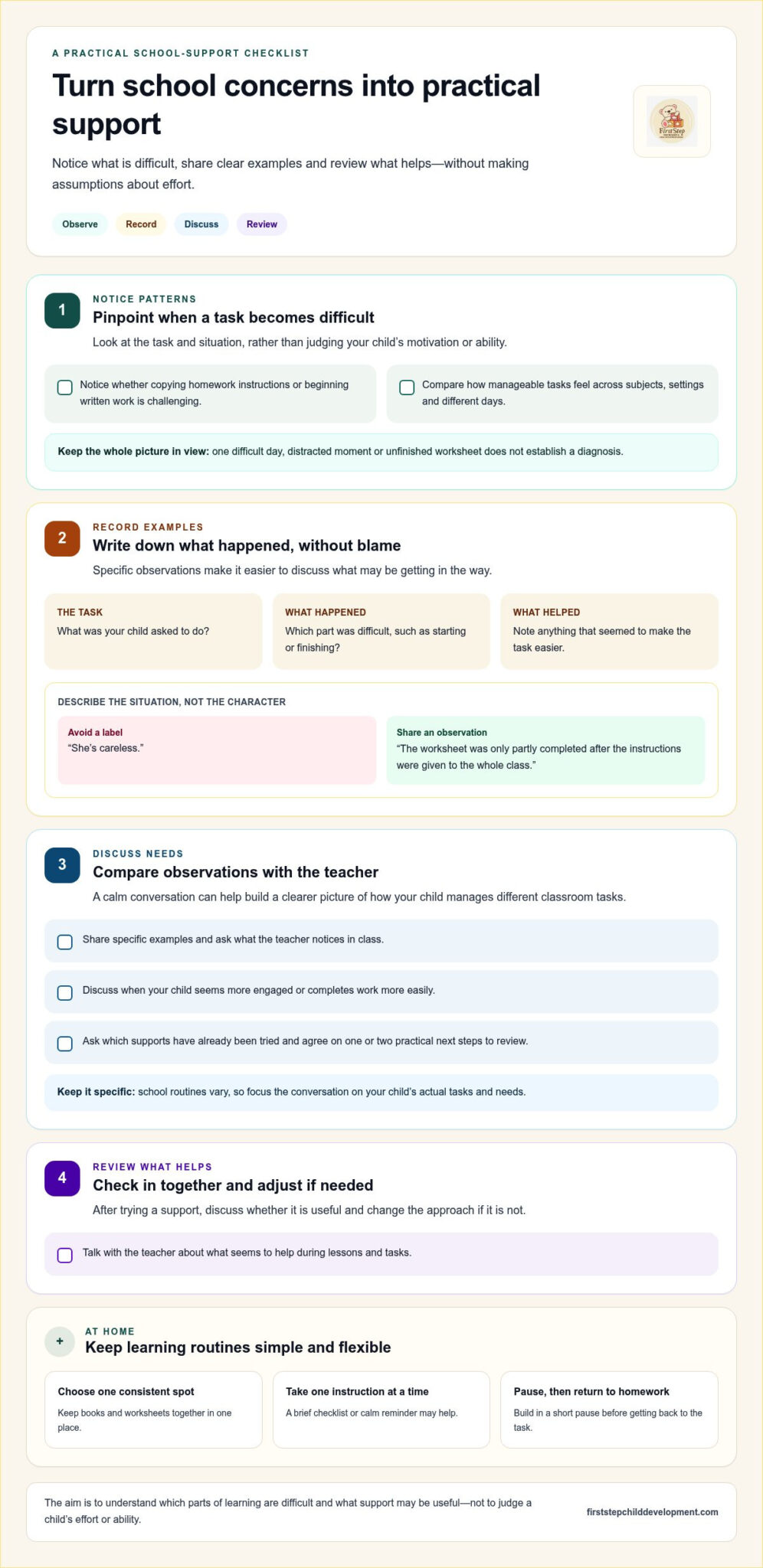
Helpful support starts with understanding which parts of the school day are difficult. You don’t need to solve everything at once. A shared approach can turn general worries into practical steps to try and review.
- Notice patterns: identify when a task becomes difficult, such as copying homework instructions or beginning written work.
- Record examples: note what happened, the task involved and what seemed to help, without judging your child’s effort.
- Discuss needs: share these observations calmly with the teacher and ask what they notice in class.
- Review what helps: check in together after trying a support, and adjust it if it isn’t useful.
Discussing school concerns without blame
Describe observable situations rather than labelling character. For example, say, “The worksheet was only partly completed after the instructions were given to the whole class,” rather than, “She’s careless.” Invite the teacher to share what happens in different lessons, including when your child seems more engaged or completes work more easily.
School routines vary between Malaysian schools and classrooms, so focus the conversation on your child’s actual tasks and needs. Ask which supports have already been tried and agree on one or two practical next steps to review.
Building practical routines around learning tasks
At home, keep routines simple and flexible. Your child might place books and worksheets in one consistent spot, check one instruction at a time, then take a short pause before returning to homework. A brief checklist or a calm reminder may help, but no single approach suits every child.
Share with the teacher which conditions seem to make tasks easier, such as clear written steps or a quieter space, and ask what they observe at school. School-home collaboration works best when adults share observations and adapt support to the child’s individual needs.
Routines can make everyday tasks more manageable, but they don’t diagnose or treat ADHD and may not address every learning need. If you’d like to explore professional support, learn about Firststep Child Development.
When to seek guidance about ADHD and school performance
Consider seeking guidance if school difficulties continue over time, cause your child distress or affect learning and daily life, such as completing homework or managing everyday routines. “Can ADHD Affect School Performance?” is one question to explore, not a conclusion about what is causing the difficulty. Asking for help doesn’t predetermine a diagnosis or decide what your child’s school experience will be.
A clinical psychologist consultation can help you discuss what you’ve noticed and consider whether further assessment may be useful. If attention-related concerns persist across settings, you could discuss whether an ADHD assessment is appropriate. If particular academic skills remain difficult, learning needs may also warrant closer exploration.
What parents can bring to an initial discussion
You don’t need to arrive with a complete record. A few concrete examples from home and school can help: when a difficulty occurs, what the task involved, and what seemed to make it easier. If you already have relevant schoolwork or teacher feedback, bring it along. The first conversation is a chance to listen, gather information and clarify concerns, not a promise of a particular conclusion.
Choosing a next step that fits the concern
Notice whether the main concern is managing attention and tasks, acquiring a particular academic skill, or a combination. These patterns can guide a discussion about possible next steps, but they don’t establish a diagnosis on their own. A broader assessment may help build a clearer picture when several developmental or learning questions overlap.
If you’d like to talk through your child’s needs, explore a clinical psychologist consultation and learn more about Firststep Child Development.
Take the next step towards understanding your child
Can ADHD Affect School Performance? It can, but school struggles don’t define a child’s ability or what they may achieve. A helpful next step is to keep curiosity at the centre of the conversation: ask your child what feels difficult, what feels manageable and what kind of support helps them feel ready to learn. Their perspective can add valuable context to observations from home and school.
You don’t need to have every answer before seeking guidance. A professional conversation can help you consider the concerns more clearly and decide what might be useful to explore next, without assuming a diagnosis or a particular outcome.
If school difficulties are affecting your child, you can explore a clinical psychologist consultation and learn more about Firststep Child Development. With understanding and thoughtful support, your child can be met with greater confidence and care.
Frequently Asked Questions
Can a child have ADHD and still do well at school?
Yes. A child can achieve well and still find the effort of keeping up tiring or difficult. Look beyond marks by asking how long homework takes, whether your child needs frequent reminders, and how they feel after a school day. Noticing both achievements and the effort behind them can help adults support a child’s strengths without overlooking tasks that are taking a heavy toll.
Does ADHD mean a child has a learning disability?
No. If a child continues to find one academic skill difficult, it may be useful to look closely at that skill rather than assume attention is the only factor. For example, note whether the difficulty appears during different kinds of reading or writing activities. Sharing these observations can help identify what further exploration may be useful and whether support should address a particular skill as well as classroom demands.
Can ADHD affect a child’s friendships at school?
It may affect social interactions for some children, but difficulties with friendships aren’t inevitable. After a disagreement, try asking, “What happened just before that?” or “What would you like to happen next time?” This can help your child describe events without feeling blamed. If conflicts or exclusion keep happening, or your child is worried about going to school, share the concern with a trusted school contact.
Can school stress make ADHD symptoms worse?
Stress can make some children’s concentration or emotional regulation more difficult, but stress alone doesn’t establish ADHD. To understand what may be adding pressure, notice whether distress clusters around particular situations, such as busy transitions, group work or tests. Ask your child what feels hardest and what helps them feel settled. If distress continues or affects everyday wellbeing, discuss it with a qualified professional.
Should parents tell their child’s school about an ADHD assessment?
Parents can decide whether sharing information would help the school respond to their child’s needs. Consider what is useful to communicate, such as a relevant recommendation or a particular classroom challenge, and involve your child in the conversation in a way that suits their age and understanding. You don’t need to share every personal detail. School processes vary, so keep the discussion focused on practical support for your child.

Article by
Firststep Child Development Team
Firststep Child Development Team provides evidence-informed educational resources to help parents better understand child development, behaviour and learning. Our multidisciplinary services include clinical psychology, occupational therapy, speech and language therapy, developmental assessments and other child development support in Kuala Lumpur and Selangor.
Disclaimer
This article is for general educational and informational purposes only and is not a substitute for professional medical, psychological or therapeutic advice, diagnosis or treatment. Every child develops differently. If you have concerns about your child's development, behaviour, learning or wellbeing, please consult an appropriately qualified healthcare or allied health professional.