



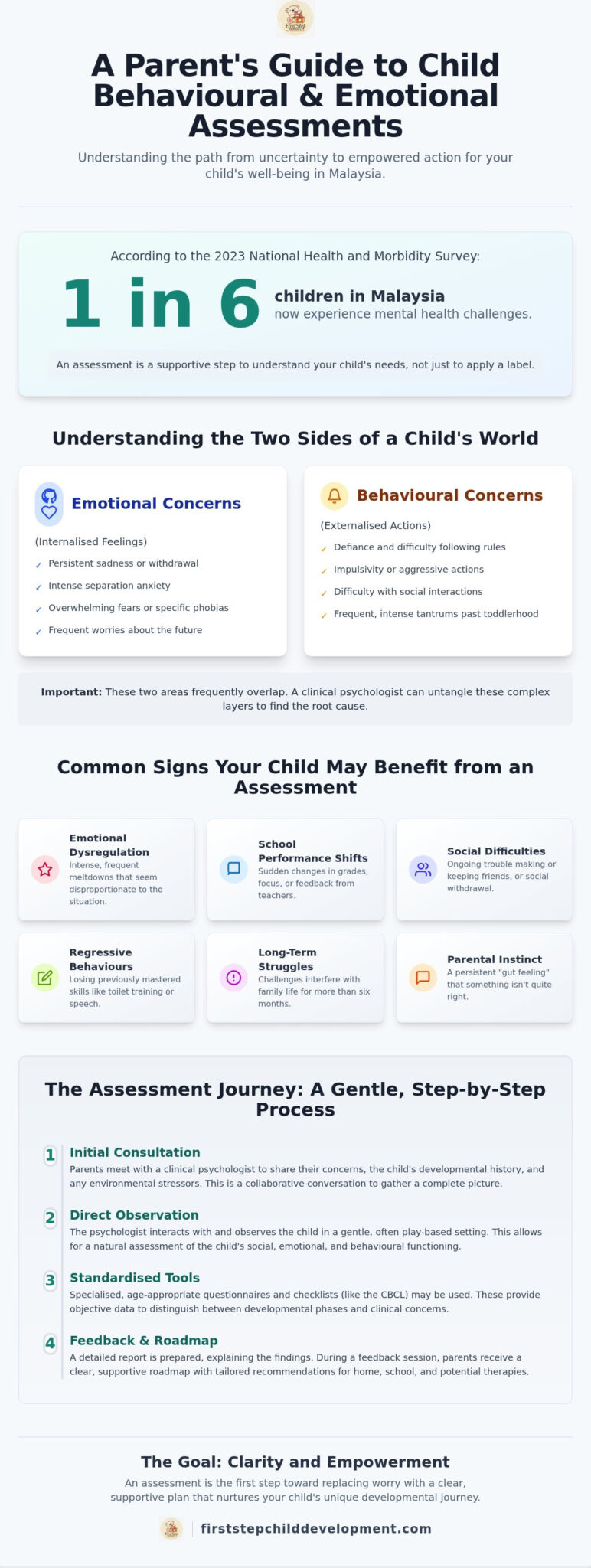
Did you know that approximately one in six children in Malaysia now experiences mental health challenges? According to the 2023 National Health and Morbidity Survey, prevalence rates have nearly doubled in recent years, leaving many parents wondering where the line sits between a typical developmental phase and a clinical concern. It’s completely normal to feel a sense of anxiety when your child struggles with big emotions or social hurdles that you can’t quite decode on your own.
Choosing to pursue a professional child behavioural and emotional assessment Malaysia is a vital step toward replacing that uncertainty with a clear, supportive roadmap for your child’s development. These assessments aren’t about labels; they’re about gaining a sophisticated understanding of your child’s needs so you can provide the right support at home and in school. By working with experienced clinical psychologists, you can move from a place of worry to one of empowered action.
This guide explains the assessment process in the KL and Selangor area, offering practical strategies and professional guidance to help your family find lasting peace of mind.
Key Takeaways
- Understand how professional evaluations identify the root causes of challenges like anxiety or social withdrawal, moving beyond simple labels to provide a supportive roadmap.
- Learn to recognise the subtle signs that your child might benefit from a child behavioural and emotional assessment Malaysia, such as persistent emotional dysregulation or changes in school performance.
- Discover what to expect during play-based observation sessions and parental consultations, ensuring a gentle and stress-free experience for your family at a development centre.
- Gain clarity on the differences between clinical psychologists and paediatricians to ensure you choose a multidisciplinary team that offers holistic care tailored to your child’s unique needs.
What is a Child Behavioural and Emotional Assessment?
A child behavioural and emotional assessment Malaysia is a comprehensive evaluation conducted by a professional to look at the whole child. It’s helpful to view this process as a functional roadmap for development rather than a restrictive diagnostic label. By examining a child’s social, emotional, and behavioural functioning, specialists can identify the specific drivers behind challenges like anxiety, aggression, or social withdrawal. This clarity transforms parental worry into a structured plan of action.
Early detection is vital for families in KL and Selangor. Pinpointing these challenges early allows parents to access specialized early intervention programs that build essential coping skills. During a child behavioural and emotional assessment Malaysia, practitioners often utilize standardized tools such as the Child Behavior Checklist (CBCL). This provides an objective baseline, helping families distinguish between temporary “phases” and clinical concerns that need professional support.
Emotional vs. Behavioural: Understanding the Difference
While these terms are often used together, they represent different ways a child processes their world. Emotional concerns are usually internalised. These include persistent sadness, specific phobias, or intense separation anxiety. Conversely, behavioural concerns are externalised actions, such as defiance, impulsivity, or difficulty following rules in the classroom. In a clinical setting, these two areas frequently overlap. For example, a child experiencing deep-seated anxiety may display outward aggression as a defence mechanism. A clinical psychologist assessment untangles these complex layers to reveal the underlying cause, ensuring that the support provided addresses the heart of the issue rather than just the symptoms.
Common Signs Your Child May Benefit from an Assessment
Identifying when a child’s struggles require professional attention can be challenging for any parent. While every child grows at their own pace, certain patterns suggest that a child behavioural and emotional assessment Malaysia may be beneficial. One significant indicator is persistent difficulty regulating emotions. While tantrums are expected in toddlers, intense, frequent meltdowns that continue well into the school years often signal an underlying need for support.
Watch for shifts in your child’s daily habits or social circles. Significant changes in school performance or social interaction within KL and Selangor classrooms can be red flags. You might also notice regressive behaviours, such as a loss of previously acquired social skills or speech patterns. Additionally, if your child has ongoing difficulty making or keeping friends, it could impact their school readiness. A Malaysian study on childhood emotional problems highlights that these early signs are often reported by parents before they escalate into more complex hurdles.
When to Seek Professional Support
It’s helpful to consider the frequency and intensity of these behaviours. If their struggles interfere with family harmony or daily life for more than six months without improvement, it’s time to act. Don’t underestimate your “gut feeling” as a parent. If you feel something isn’t quite right, seeking a child behavioural and emotional assessment Malaysia through a clinical psychologist consultation can provide the clarity you need. We understand that this step feels big, but early insight is a gift to your child’s future wellbeing. If you’re unsure where to start, you can learn more about how our assessments work to help ease any concerns.
The Assessment Process: What Happens at a Child Development Centre?
Understanding the steps of a child behavioural and emotional assessment Malaysia helps demystify the experience for families. The process begins with a detailed initial consultation. During this interview, parents share their child’s developmental history and current environmental stressors. This is followed by direct observation, where a psychologist engages the child in play-based sessions to witness natural social interactions and emotional responses.
Standardised testing adds an objective layer to these observations. Tools like the Strengths and Difficulties Questionnaire (SDQ) or specialised emotional scales gather data that compares a child’s progress with age-appropriate milestones. Finally, a feedback session brings everything together, providing a clear support plan for the family to follow.
A Gentle, Play-Based Approach
At Firststep, we prioritise a gentle, play-based environment to ensure children feel safe. This approach allows our multidisciplinary team, including paediatricians and therapists, to contribute their expertise to a holistic final report. If you’d like to understand how this method works in greater depth, our guide to play-based assessment for child development Malaysia explains how specialists gather accurate developmental data while your child simply enjoys being themselves in a safe, welcoming environment. By integrating these different perspectives, we ensure the assessment reflects the child’s true potential. This collaborative effort provides a comprehensive view of your child’s wellbeing.
What to Expect in the Final Report
The final report translates complex clinical findings into practical strategies for home and school. It serves as a living document to guide teachers and caregivers. If academic hurdles are present, this report often provides the necessary foundation for learning difficulties assessments. If you’re ready to gain this clarity for your child behavioural and emotional assessment Malaysia, you can book a clinical psychologist assessment today.
Choosing the Right Support in Kuala Lumpur and Selangor
Selecting the right professional for a child behavioural and emotional assessment Malaysia involves more than just a quick search. In the KL and Selangor area, parents often choose between a solo practitioner and a multidisciplinary centre. A multidisciplinary environment provides more holistic care because it allows different specialists to collaborate on a single case. This teamwork ensures that your child’s needs aren’t viewed in isolation but as part of a complete developmental picture.
Understanding the distinction between roles is also vital. A paediatrician maintains a medical focus, ruling out physical health issues or neurological concerns. Conversely, a clinical psychologist focuses on the behavioural and emotional mechanics behind a child’s struggles. Choosing a centre where these experts work together provides the most comprehensive insight. Practical considerations like location, follow-up availability, and language options, such as English, Malay, or Mandarin, are also essential for long-term success.
Effective support doesn’t end when the report is signed. The post-assessment journey relies heavily on Parent Consultation & Guidance. This phase empowers you with the tools to implement clinical recommendations within your daily family rhythm, turning professional advice into practical, at-home progress.
Integrating Assessment with Early Intervention
A thorough clinical psychologist assessment acts as a gateway to targeted support. These findings often lead directly to specialised speech therapy or pediatric occupational therapy. In some cases, a nutritionist consultation is recommended to address behavioural hurdles related to diet or sensory-based feeding issues. This integrated approach ensures that every facet of your child’s wellbeing is supported under one roof, providing a seamless transition from evaluation to empowerment. By choosing a child behavioural and emotional assessment Malaysia that offers this continuity, you give your child a strong foundation for growth.
Empowering Your Child’s Developmental Path
Understanding the unique way your child interacts with the world is the first step toward providing the support they truly need. Moving from a place of uncertainty to a clear, professional roadmap allows you to support your child’s growth with confidence. A thorough child behavioural and emotional assessment Malaysia ensures that every facet of their development is considered by a multidisciplinary team of experts. By prioritising a gentle, play-based assessment for child development Malaysia approach, specialists gather the insights needed to create detailed feedback reports that offer practical strategies for both home and school.
If you are concerned about your child’s development, learn more about our professional clinical psychologist assessments or visit Firststep Psychology & Child Development Centre to book a consultation. You don’t have to navigate this journey alone. With the right professional guidance, you can unlock your child’s full potential and find the lasting peace of mind your family deserves. Your proactive steps today build a stronger foundation for their tomorrow.
Frequently Asked Questions
How much does a child behavioural assessment cost in Malaysia?
Private sector costs for a child behavioural and emotional assessment Malaysia vary depending on the depth of the evaluation and the specific tools used. While government clinics offer subsidised rates, private centres provide faster access to specialists. It’s best to check if your provider offers fixed-price diagnostic packages. These typically include the clinical interview, observation sessions, and a comprehensive feedback report to ensure financial clarity for your family.
How long does the emotional assessment process take at your centre?
The duration of the process depends on your child’s unique needs and the complexity of the concerns. Generally, the assessment involves an initial consultation, one or more direct observation sessions, and a final feedback meeting. From the first appointment to the delivery of the final report, parents can typically expect the process to take several weeks. This methodical pace ensures our clinical team has enough time to provide a thorough evaluation.
Can a behavioural assessment diagnose ADHD or Autism?
A child behavioural and emotional assessment Malaysia provides a broad overview of a child’s functioning, which often reveals indicators of ADHD or Autism. If these markers are present, our clinical psychologists may recommend a specific ADHD or Autism assessment to provide a formal diagnosis. This structured approach helps ensure your child receives the most accurate support plan, focusing on their specific developmental strengths and the hurdles they face in daily life.
Do I need a referral from a GP to see a child psychologist in Malaysia?
You don’t strictly need a referral from a GP to see a clinical psychologist in the Malaysian private sector. Parents can book a consultation directly with a child development centre to begin the evaluation process. However, if you plan to seek services at a government hospital, you’ll usually require a referral from a primary care doctor at a Klinik Kesihatan. Direct booking at private centres often reduces waiting times significantly.
Will my child be “labelled” for life after an assessment?
An assessment is designed to be a roadmap for support, not a permanent label that limits your child’s potential. The findings are confidential and serve to help educators and therapists understand how to better support your child’s unique learning and emotional needs. Identifying challenges early allows for targeted interventions that help children move past hurdles, often reducing the need for clinical support as they grow and develop more robust coping skills.

Article by
Firststep Child Development Team
Firststep Child Development Team provides evidence-informed educational resources to help parents better understand child development, behaviour and learning. Our multidisciplinary services include clinical psychology, occupational therapy, speech and language therapy, developmental assessments and other child development support in Kuala Lumpur and Selangor.
Disclaimer
This article is for general educational and informational purposes only and is not a substitute for professional medical, psychological or therapeutic advice, diagnosis or treatment. Every child develops differently. If you have concerns about your child's development, behaviour, learning or wellbeing, please consult an appropriately qualified healthcare or allied health professional.