



Imagine your child walking into a room filled with toys and curiosity rather than cold medical equipment. For many families, the search for a play-based assessment for child development Malaysia begins with a desire to replace clinical anxiety with professional clarity. You might worry that a rigid setting will scare your little one, or feel confused by different therapy types while fearing a label without a path forward.
It’s natural to feel protective of your child’s emotional well-being. We believe that an evaluation shouldn’t be a source of stress, but a supportive first step toward realising their potential. This multidisciplinary approach allows specialists to gather accurate developmental data while your child simply enjoys being themselves in a safe, welcoming environment.
This guide explains how play-based evaluations provide a clear, holistic understanding of your child’s unique journey. We’ll explore how psychologists and therapists work together to create a non-threatening experience and provide you with actionable, professional steps for early intervention.
Key Takeaways
- Discover how a play-based assessment for child development Malaysia replaces clinical anxiety with a gentle, child-led environment that encourages natural behaviour.
- Learn why a multidisciplinary approach involving psychologists and therapists provides a more complete picture of your child’s unique strengths and needs.
- Get practical advice on preparing your child for their assessment to ensure the experience is positive, calm, and productive.
- See how professional findings are translated into a clear roadmap for early intervention, helping you move forward with confidence and clarity.
What is a Play-Based Assessment for Child Development?
A play-based assessment (PBA) is a functional, child-led evaluation method that prioritises a child’s natural environment. Rather than asking a toddler to sit at a desk, clinicians observe them in a room designed for exploration. It’s an approach that values the child’s comfort, allowing their true personality and skills to emerge. In many ways, it’s the most authentic way to understand how a young mind works.
For families in Malaysia, this method is especially relevant. Our children often navigate bilingual or multicultural environments, which can sometimes make traditional, language-heavy testing feel restrictive. A play-based assessment for child development Malaysia focuses on how a child interacts with their world, regardless of their primary language. This provides a clearer picture of their developmental milestones without the pressure of rigid verbal prompts.
Why Traditional Testing Isn’t Always the First Step
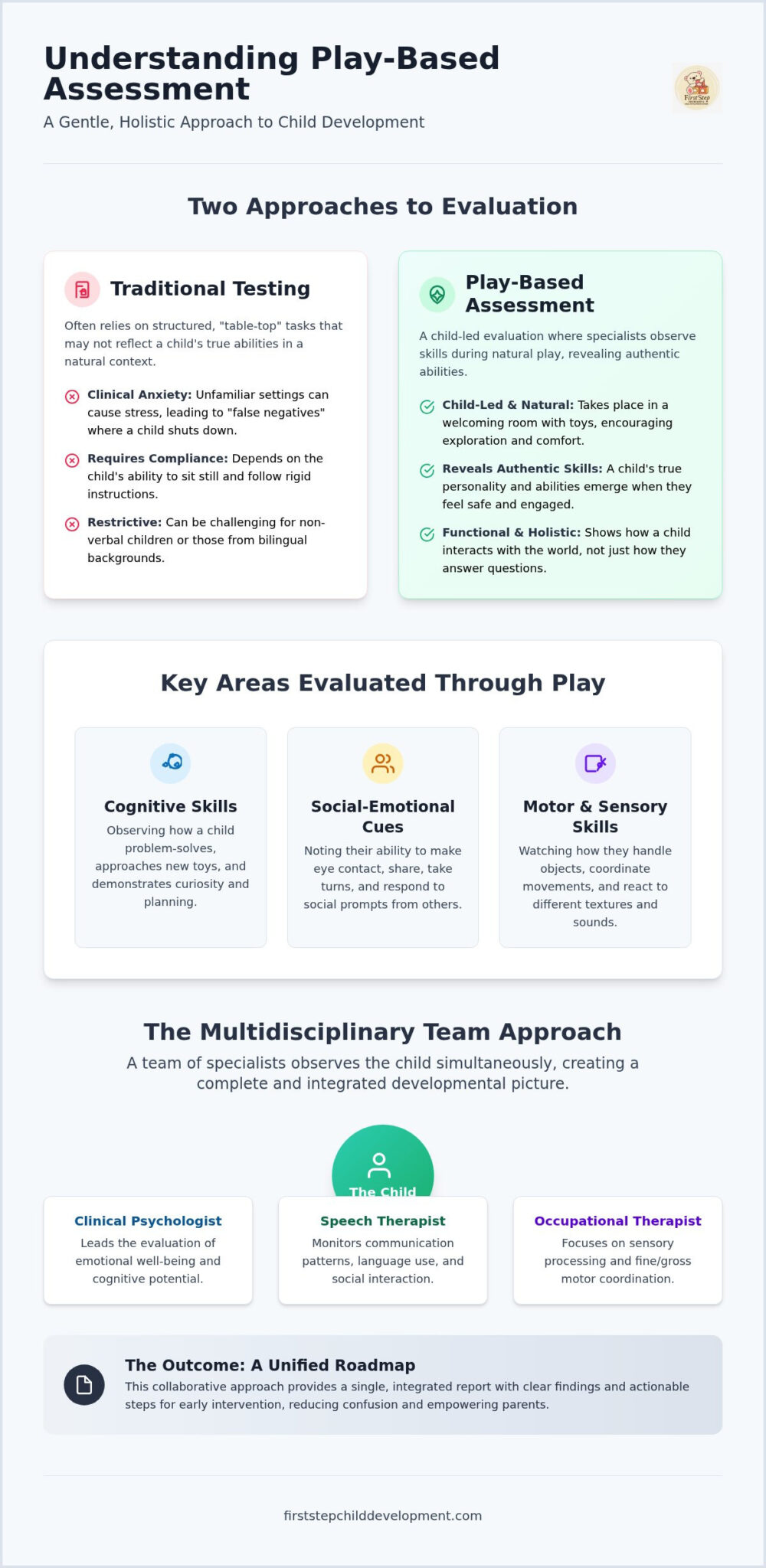
Traditional “table-top” standardised tests often require a level of compliance that many young children aren’t ready for yet. When a child feels overwhelmed by a clinical setting, they might shut down or refuse to engage. This clinical anxiety can lead to “false negatives,” where the results suggest a delay that doesn’t actually exist. For toddlers and non-verbal children, a naturalistic setting is essential. You can learn more about how an assessment works in a way that respects your child’s emotional boundaries.
Key Areas Evaluated Through Play
Because play is a child’s natural language, it reveals a wealth of information about their growth. Experts in learning through play recognise that these interactions are complex and multi-layered. During a session, clinicians typically look at:
- Cognitive Skills: How a child figures out a complex toy or approaches a new problem.
- Social-Emotional Cues: Their ability to make eye contact, take turns, and respond to social prompts.
- Motor and Sensory Processing: How they handle objects and react to different textures or sounds.
The Multidisciplinary Child Assessment: Why a Team Approach Matters
Developmental growth isn’t a straight line; it’s a complex web of social, physical, and cognitive threads. When families seek a play-based assessment for child development Malaysia, they often find that a single perspective isn’t enough. A multidisciplinary approach brings together a team of specialists who observe the child through different professional lenses simultaneously. This ensures that no subtle cue is missed and that every strength is identified.
A Clinical Psychologist typically leads the evaluation of emotional well-being and cognitive potential. Meanwhile, Pediatric Occupational Therapy focuses on how the child processes sensory information and manages motor coordination during play. Finally, Speech Therapy is woven into these observations to monitor communication patterns and social interaction. This collaborative observation provides a much richer data set than isolated clinical tests ever could.
The Power of Collaboration in Kuala Lumpur Clinics
In a coordinated setting, clinicians don’t just work alongside each other; they communicate in real time. A combined report integrates findings from psychologists, therapists, and even nutritionists to create a holistic picture of your child’s world. This prevents the fragmented “referral loop” that often leaves parents feeling exhausted and confused. By having a core team in one centre, families receive consistent feedback across all developmental domains.
This integrated model is specifically designed to lower parental anxiety by providing a clear, unified path forward. It’s about moving away from isolated labels and toward a comprehensive understanding of potential. If you’re feeling overwhelmed by different therapy options, you can speak with a clinical psychologist to understand how a play-based assessment for child development Malaysia can provide the clarity your family needs.
What to Expect: A Step-by-Step Play-Based Assessment
Understanding the process helps lower anxiety for both parents and children. When scheduling a play-based assessment for child development Malaysia, we recommend framing the visit as a “special play date” rather than a clinical appointment. This simple shift in language helps your child arrive with curiosity rather than fear, allowing their natural skills to shine through from the moment they enter the room.
Phase 1: Initial Parent Consultation
In our KL and Selangor centres, the journey begins with a detailed discussion about your child’s developmental history. We listen to your specific observations and set clear goals for the evaluation. Whether you are seeking diagnostic clarity or checking for school readiness, this initial step ensures the entire multidisciplinary team is aligned with your family’s unique needs.
Phase 2: The Play Session
The actual assessment takes place in a room filled with engaging activities like block building, imaginative role-play, and sensory toys. Clinicians join the child’s play rather than directing it from a distance. This allows us to observe “spontaneous” skills, such as how they solve a problem when a toy doesn’t work or how they initiate social contact. These are vital indicators of development that often don’t appear in structured, table-top tests.
While the session feels like fun, clinicians use standardised tools like the ADOS-2 or Bayley Scales to measure specific milestones objectively. By integrating these tools into a natural setting, we gather high-quality clinical data without the stress of traditional testing. The process concludes with a comprehensive feedback session. We translate our observations into a clear, jargon-free report that serves as a practical roadmap after your play-based assessment for child development Malaysia. If you are ready to gain this clarity, you can learn more about booking a clinical psychologist assessment today.
Moving from Assessment to Early Intervention in Malaysia
The completion of a play-based assessment for child development Malaysia marks the beginning of a transformative journey. It’s often said that the early years represent a “Golden Window” for growth. Research from bodies like the CDC suggests that roughly one in six children may face a developmental disability, making early identification a powerful tool for future success. The report you receive isn’t just a list of observations; it’s a functional blueprint for an Early Intervention Program tailored to your child’s specific needs.
This roadmap provides essential clarity when addressing concerns like ADHD and Autism. For school-aged children, a learning difficulties assessment helps identify academic hurdles before they become overwhelming. By acting during these formative years, you’re providing your child with the specialised support they need to navigate their unique developmental path with confidence.
Creating a Personalised Growth Plan
The results of a multidisciplinary evaluation dictate the specific frequency and focus of future therapies. For instance, a child might benefit from twice-weekly speech sessions combined with targeted occupational therapy. We also consider the child’s health holistically. A nutritionist consultation is often integrated into the plan to support cognitive and physical growth through dietary guidance. This ensures every aspect of your child’s well-being is handled with professional care.
Support for Parents and Caregivers
We recognise that receiving a developmental report can be an emotional experience. Our role is to empower you to become your child’s strongest advocate. While the Malaysian government has removed entry screening tests for primary schools to reduce pressure, having a professional report allows you to collaborate effectively with teachers. Whether you need to understand more about how an assessment works for behavioural needs or simply require parent guidance, we’re here to partner with your family every step of the way.
Empowering Your Child’s Developmental Journey
Choosing a play-based assessment for child development Malaysia allows you to replace clinical stress with professional insight. By observing your child in a natural, child-led environment, our multidisciplinary team of psychologists, occupational therapists, and speech therapists can capture their true strengths and unique challenges. This collaborative approach ensures that your family receives a holistic understanding rather than a fragmented set of labels; it provides a clear roadmap for the years ahead.
Located in the heart of KL and Selangor, our centre is designed to be a safe haven where your concerns are handled with sensitivity and expertise. Every child deserves the opportunity to reach their full potential through timely, personalised support. Ready to understand your child’s potential? Learn more about our Clinical Psychologist Assessments or visit Firststep Psychology & Child Development Centre to book a consultation. We’re here to help you take that confident next step.
Frequently Asked Questions
Is a play-based assessment as accurate as a formal IQ test?
Yes, it is highly accurate for evaluating functional development in young children. While a formal IQ test measures specific cognitive scores, a play-based assessment for child development Malaysia captures how a child applies their skills in real-world scenarios. It often provides more reliable data for toddlers who might feel overwhelmed by the rigid structure of traditional standardised testing, ensuring a clearer picture of their true potential.
How long does a multidisciplinary child assessment typically take in Malaysia?
A multidisciplinary child assessment usually involves several stages across a few weeks. The initial consultation and the play observation session itself typically last between 90 minutes and three hours. Following this, the team requires time to collaborate and synthesise their findings into a comprehensive report. You can usually expect a final feedback session and the completed report within two to three weeks of the observation date.
At what age should I consider a play-based assessment for my child?
You should consider this approach for children between the ages of 18 months and 6 years. This period is critical because play is the primary way young children communicate their understanding of the world. For infants as young as 12 months, early screenings can identify sensory or motor delays. Identifying needs during these formative years ensures you don’t miss the vital “Golden Window” for early intervention.
Do I need a referral from a pediatrician for an assessment at Firststep?
No, you don’t need a formal referral from a pediatrician to book an assessment at our centre. Many parents contact us directly after noticing specific delays in speech, motor skills, or social interaction. While we often collaborate with medical doctors, our clinical psychologists and therapists are qualified to conduct initial evaluations and guide your family through the diagnostic process without an external doctor’s letter.
Will the assessment report be accepted by schools in Kuala Lumpur or Selangor?
Yes, reports from a play-based assessment for child development Malaysia are widely recognised by international and private schools across Kuala Lumpur and Selangor. These documents provide teachers with a functional understanding of your child’s learning style and support needs. Because our reports are written by qualified clinical psychologists and multidisciplinary therapists, they serve as authoritative evidence for classroom accommodations or placement in specialised learning programs.
Article by
Firststep Child Development Team
Firststep Child Development Team provides evidence-informed educational resources to help parents better understand child development, behaviour and learning. Our multidisciplinary services include clinical psychology, occupational therapy, speech and language therapy, developmental assessments and other child development support in Kuala Lumpur and Selangor.
Disclaimer
This article is for general educational and informational purposes only and is not a substitute for professional medical, psychological or therapeutic advice, diagnosis or treatment. Every child develops differently. If you have concerns about your child's development, behaviour, learning or wellbeing, please consult an appropriately qualified healthcare or allied health professional.