



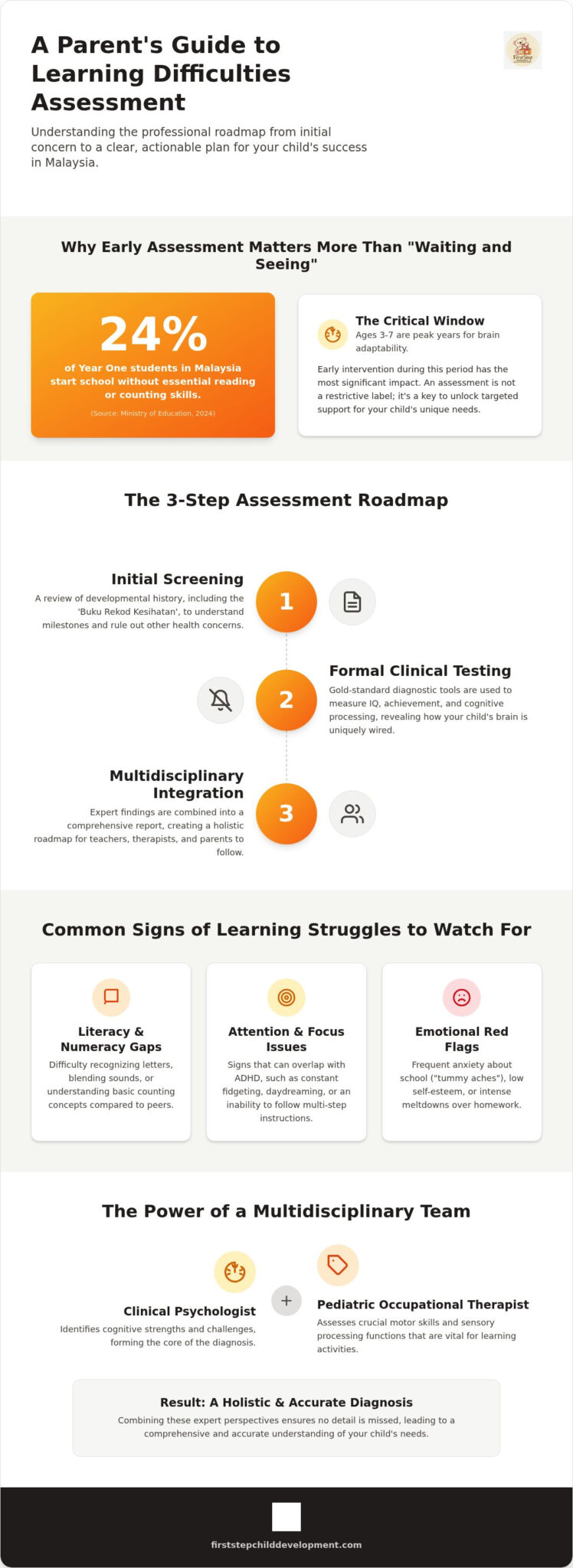
In 2024, the Ministry of Education revealed that roughly 24% of Year One students in Malaysia started school without essential reading or counting skills. If your child is struggling to keep up, you might wonder if they’re simply a “slow bloomer” or if something deeper is at play. Seeking a learning difficulties assessment Malaysia can feel like a daunting step, especially when you’re worried about labels or facing long waiting lists at government hospitals. It’s natural to feel protective of your child’s experience while wanting to ensure they don’t fall behind their peers.
We understand that you want the best for your child’s future without the stress of clinical coldness. This guide provides the professional clarity you need to move from confusion to confidence by offering a compassionate roadmap for development. You’ll learn how to distinguish between different developmental challenges, understand the practical differences between public and private care, and discover actionable steps to help your child thrive in the classroom. Let’s explore how a multidisciplinary approach can unlock your child’s unique potential.
Key Takeaways
- Learn why moving past the “slow bloomer” myth is essential for supporting a child’s development during critical windows of neuroplasticity.
- Understand the professional 3-step process used for a learning difficulties assessment Malaysia to ensure a clear and accurate diagnostic roadmap.
- Compare the timelines and procedures of the Malaysian public healthcare system against the faster access provided by private developmental centres.
- Discover how a formal assessment facilitates inclusive education through Individual Education Plans (IEPs) and specialized school readiness support.
Debunking the “Slow Bloomer” Myth: Understanding Learning Difficulties in Malaysia
Parents often hear well-meaning advice to “just wait and see” when a child struggles to hit developmental milestones. In Malaysia, cultural phrases like “tunggu jap” or “he’s just a late talker” are common. However, these myths can unintentionally delay essential support. What is a learning disability? Essentially, it’s a neurodevelopmental difference in how the brain processes, stores, and retrieves information. It doesn’t mean a child is less intelligent; it simply means their brain is wired differently.
Choosing a professional learning difficulties assessment Malaysia early on is vital because of neuroplasticity. Between the ages of 3 and 7, a child’s brain is incredibly adaptable. The “wait and see” approach often misses this critical window where intervention has the most impact. Don’t view a diagnosis as a restrictive label. Instead, see it as a key that unlocks targeted support, such as an Early Intervention Program (EIP). This proactive path helps children build the foundational skills they need before the academic demands of primary school increase.
Common Signs of Learning Struggles in Malaysian Classrooms
Many families first notice challenges when a child enters Standard One. In 2024, the Ministry of Education noted that approximately 122,000 Year One students lacked basic literacy and numeracy skills. A comprehensive learning difficulties assessment Malaysia can clarify whether these struggles are temporary or signs of a deeper issue. Common indicators include:
- Literacy and Numeracy Gaps: Difficulty recognizing letters, blending sounds, or understanding basic counting concepts compared to classmates.
- Attention and Focus: Signs of ADHD, such as constant fidgeting or an inability to follow multi-step instructions, which can overlap with learning disorders like dyslexia.
- Emotional Red Flags: Frequent “tummy aches” on school mornings, low self-esteem, or intense meltdowns over homework. If these emotional and behavioural patterns are a primary concern, a dedicated child behavioural and emotional assessment Malaysia can provide additional clarity alongside a learning evaluation.
These signs aren’t evidence of laziness or lack of effort. They’re clear signals that a child needs a different type of map to navigate their educational journey successfully.
The 3-Step Learning Difficulties Assessment Process
A professional learning difficulties assessment Malaysia follows a methodical path to ensure no detail is overlooked. This structured process transforms parental concerns into a clear, actionable strategy that supports a child’s unique growth. It moves logically from early observations to a comprehensive understanding of a child’s potential.
Step 1: Initial Screening. We begin by reviewing your child’s developmental history. This includes examining the ‘Buku Rekod Kesihatan’ to identify when milestones like crawling, walking, or first words were reached. These early indicators provide vital context for current classroom challenges and help rule out other physical health concerns.
Step 2: Formal Clinical Testing. Our specialists use gold-standard diagnostic tools to measure IQ, academic achievement, and cognitive processing. These tests aren’t like school exams. Instead, they help us understand how your child perceives, processes, and remembers information, highlighting where their wiring differs from the typical learning curve.
Step 3: Multidisciplinary Integration. We combine findings from various experts to create a holistic view. The process concludes with a detailed feedback session where you receive a comprehensive report. This document acts as a roadmap for both teachers and therapists, ensuring everyone is aligned through a professional learning difficulties assessment Malaysia.
Why a Multidisciplinary Team is Essential
A single perspective often misses the nuances of a child’s development. A clinical psychologist consultation is central to this process, identifying cognitive strengths used to overcome academic hurdles. However, learning also involves motor skills and sensory processing. This is where pediatric occupational therapy insights are vital. Combining these disciplines ensures the diagnostic picture is accurate. If you are unsure where to start, learn more about how our assessments work to find the right path.
Navigating the Malaysian Healthcare Landscape: Private vs. Public
In Malaysia, families usually choose between two distinct pathways for diagnostic support. The government route typically begins with a consultation at a local Klinik Kesihatan (KK). While consultation fees at government clinics range from RM1 to RM5 for citizens, the primary challenge is the long waiting list for specialist hospital referrals. For parents who want to avoid these delays, the private pathway offers significantly faster access to a learning difficulties assessment Malaysia in professional centres across Kuala Lumpur and Selangor. This speed is often crucial when a child is falling behind in the school curriculum.
Logistics play a big role in a successful evaluation day. You should bring your child’s ‘Buku Rekod Kesihatan’, recent school work samples, and any feedback from teachers. These items help our team build a complete developmental history. To help your child feel comfortable, we use play-based assessment for child development Malaysia instead of rigid, clinical testing. This gentle method reduces anxiety and allows our specialists to see how your child interacts and solves problems in a natural, stress-free setting.
Fixed-Price Packages vs. Per-Session Fees
Understanding the costs involved provides much-needed peace of mind. Many private centres offer fixed-price diagnostic packages, which provide financial transparency by covering everything from the clinical intake to the final feedback report. This prevents the stress of unexpected per-session fees. A comprehensive clinical psychologist assessment is a valuable investment in your child’s future. It gives you the evidence-based data required to secure school accommodations and tailored learning plans. If you want to move forward with professional support, schedule a learning difficulties assessment Malaysia at our centre today.
Life After the Assessment: Turning a Diagnosis into a Roadmap
Many parents fear that a formal diagnosis will lead to their child being segregated in a “special school.” In Malaysia, this is a common misconception. A professional learning difficulties assessment Malaysia actually serves as a bridge to inclusive education. It provides the clinical evidence needed for schools to implement an Individual Education Plan (IEP). This plan ensures your child receives specific accommodations while remaining in a mainstream environment. These assessments are also vital for determining school readiness, ensuring your child enters the classroom with the right support from day one.
Beyond the classroom, the diagnostic report connects you to targeted interventions. Whether your child needs speech therapy to improve communication or play therapy to process emotional frustration, the assessment provides the specific data required for effective treatment. For children whose primary challenges involve managing emotions or social behaviour, a child behavioural and emotional assessment Malaysia can complement the learning evaluation to ensure all aspects of your child’s wellbeing are addressed. We also prioritise regular parent guidance. Supporting your child’s emotional well-being at home is just as important as their academic progress. When you understand why your child is struggling, you can replace frustration with patience and informed encouragement.
Building a Support Network in KL and Selangor
Choosing a multidisciplinary centre in KL or Selangor offers significant advantages. Having the learning difficulties assessment Malaysia and subsequent therapy in one location ensures a seamless flow of information between specialists. This collaborative environment means that your child’s progress is monitored from multiple angles, leading to better long-term outcomes. Understanding their own brain wiring helps children regain their lost confidence. They stop seeing themselves as “slow” and start seeing themselves as capable learners who simply use a different set of tools. This shift in perspective is often the first step toward lasting academic and social success.
Empowering Your Child’s Educational Journey
Moving past the “wait and see” approach is the first step toward understanding your child’s unique needs. You’ve learned that a formal diagnosis isn’t a barrier to mainstream education; instead, it acts as a vital roadmap for Individual Education Plans and targeted support. By choosing a comprehensive learning difficulties assessment Malaysia, you provide your child with the clarity they deserve and the tools they need to regain their confidence in the classroom. This proactive path ensures that developmental differences are identified early, allowing for intervention when it is most effective.
Our multidisciplinary team of experts provides a gentle, play-based assessment for child development Malaysia environment designed to lower anxiety for both you and your child. We deliver detailed diagnostic reports that serve as a professional foundation for school accommodations and home guidance. If you are concerned about your child’s progress in school, learn more about our learning difficulties assessment or visit Firststep Psychology & Child Development Centre to schedule a consultation. Your child’s development is a journey, and we are here to walk beside you every step of the way.
Frequently Asked Questions
How much does a learning difficulties assessment cost in Malaysia?
In the private sector, a comprehensive evaluation typically costs between RM1,300 and RM3,250 depending on the complexity of the tests required. Government hospitals offer heavily subsidised rates for citizens, often just RM1 to RM5 for initial specialist consultations. Private centres provide significantly faster access to a learning difficulties assessment Malaysia. This investment covers the clinical intake, standardised testing, and a detailed professional report for school use.
Can a paediatrician diagnose dyslexia, or do I need a clinical psychologist?
While a paediatrician can identify developmental delays, a formal diagnosis of dyslexia usually requires a clinical psychologist. They use psycho-educational testing to compare a child’s intellectual potential with their actual academic performance. This specific testing identifies the “gap” in processing that defines a learning disorder. Paediatricians often work alongside psychologists to rule out medical issues, ensuring your child receives a holistic and accurate diagnostic picture.
Will a private assessment report be accepted by Malaysian government schools?
Yes, government schools in Malaysia recognise reports from registered private clinical psychologists. These documents are essential for applying for an OKU card through the Social Welfare Department (JKM) or for enrolling a child in the Integrated Special Education Programme (PPKI). Having a professional report ensures that teachers can implement a tailored Individual Education Plan (IEP), allowing your child to receive the necessary classroom accommodations and exam support.
What is the difference between a learning difficulty and an intellectual disability?
A learning difficulty refers to a specific struggle in areas like reading or maths, even though the child has an average or high IQ. An intellectual disability affects overall cognitive functioning and daily adaptive skills across all areas of life. Understanding this distinction is a key part of a learning difficulties assessment Malaysia, as it helps determine whether a child needs specific academic strategies or broader developmental support.
How long does the entire diagnostic process take from the first appointment?
The timeline usually spans two to four weeks in a private setting. This includes an initial intake session, the actual assessment day, and a final feedback meeting where you receive the written report. The public system, however, often involves waiting lists of several months for a specialist appointment. Choosing a private centre allows you to start the intervention process much sooner, which is vital for your child’s academic progress.
Article by
Firststep Child Development Team
Firststep Child Development Team provides evidence-informed educational resources to help parents better understand child development, behaviour and learning. Our multidisciplinary services include clinical psychology, occupational therapy, speech and language therapy, developmental assessments and other child development support in Kuala Lumpur and Selangor.
Disclaimer
This article is for general educational and informational purposes only and is not a substitute for professional medical, psychological or therapeutic advice, diagnosis or treatment. Every child develops differently. If you have concerns about your child's development, behaviour, learning or wellbeing, please consult an appropriately qualified healthcare or allied health professional.