



Imagine watching your child at the playground, wondering if their preference for active play over quiet puzzles means they aren’t quite ready for the classroom. With the National Education Blueprint 2026 to 2035 introducing new flexibility for Standard 1 entry, many parents feel a quiet pressure to decide if their child should start at age six or seven. It’s natural to feel uncertain when comparing your child’s progress to their peers, which is why a school readiness assessment Malaysia is often the first step toward gaining professional clarity and confidence.
You want the best start for your little one, and we understand that this decision feels monumental. This guide will help you navigate these feelings by detailing the essential developmental milestones your child needs for school success. You’ll discover how a professional assessment provides the clarity your family needs to move forward without the weight of comparison or worry. We’ll explore the latest Ministry of Education guidelines, key social-emotional markers, and how specialised support can empower your child’s unique journey toward formal education.
Key Takeaways
- Learn how Malaysia’s updated education landscape prioritises holistic maturity, including social and emotional skills, over academic rote learning.
- Identify the five core developmental domains your child needs to master before entering Standard 1, from communication to physical coordination.
- Discover how a professional school readiness assessment Malaysia provides an expert perspective on whether your child is a “late bloomer” or requires specialised support.
- Gain practical strategies for supporting your child at home through structured routines and play-based techniques that build confidence and security.
Understanding School Readiness in Malaysia’s Education Landscape
School readiness isn’t just about a child’s ability to recite the alphabet or count to twenty. It’s a holistic state that encompasses their physical, social, and cognitive maturity. While many parents focus on academic milestones, research highlights that the domains of school readiness include several vital areas:
- Physical coordination and motor skills
- Social-emotional maturity and regulation
- Cognitive and language development
A school readiness assessment Malaysia can help parents understand these nuances before their child enters the formal education system. In the context of the National Education Blueprint 2026 to 2035, this understanding is more important than ever as the transition to primary school becomes more flexible.
The Standard 1 Entry Age Debate: 6 or 7?
Starting from the 2027 academic year, Malaysian parents have the option to enrol their children in Primary 1 at age six. This isn’t compulsory; you can still choose to wait until they’re seven if you feel they need more time. Chronological age doesn’t always align with developmental progress. A child might be six years old but still developing the emotional resilience needed for a structured classroom. Pushing a child into Standard 1 before they’re prepared can lead to unnecessary stress. Using a developmental assessment for toddlers Malaysia helps parents move past guesswork, providing objective data to guide this significant decision.
Why Readiness Matters for Long-Term Success
A child’s first experiences in formal schooling set the tone for their entire academic journey. When children enter school ready, they’re more likely to develop a positive attitude toward learning and higher self-esteem. Conversely, those who struggle early on often face challenges with social integration and classroom behaviour. A school readiness assessment Malaysia ensures your child has the foundational skills to thrive, not just survive. By focusing on holistic readiness, we help children build the confidence they need to navigate the complexities of primary school life, ensuring they’re equipped to handle social interactions and follow instructions effectively.
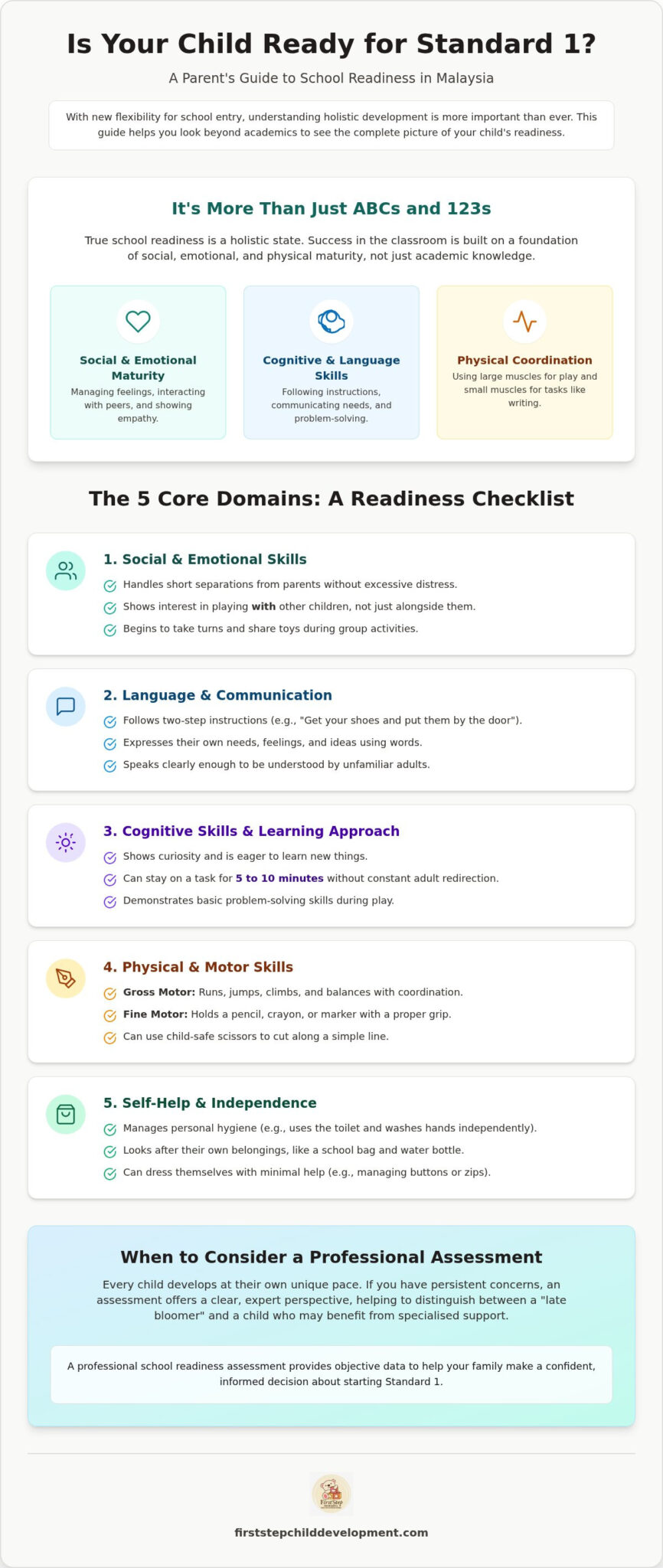
The 5 Core Domains: A School Readiness Checklist for Parents
Moving beyond simple academic drills, true readiness involves a complex interplay of neurodevelopmental milestones. A school readiness assessment Malaysia looks at how a child’s brain processes information and regulates sensory input. This evaluation covers language, communication, and physical coordination. For instance, can your child follow a two-step instruction like “take off your shoes and put them on the rack”? These small actions demonstrate the executive function required for a busy classroom.
Social and Emotional Regulation Checklist
Emotional maturity is often a stronger predictor of school success than early reading skills. Parents should observe how their child manages “big emotions” when things don’t go their way. Consider these markers:
- Can they handle short separations from you without excessive distress?
- Do they show an interest in playing with others, or do they only play alongside them?
- Are they beginning to take turns and share toys during group activities?
This Preschool Readiness Checklist provides a helpful baseline for social skills. If your child struggles significantly with these interactions, a clinical psychologist consultation can offer tailored strategies to build their confidence. For parents who notice persistent emotional or behavioural difficulties alongside readiness concerns, a child behavioural and emotional assessment Malaysia can help distinguish between typical developmental variation and challenges that may benefit from targeted support.
Self-Help and Independence Skills
Independence in the classroom reduces anxiety and allows children to focus on learning. A child is generally ready for Standard 1 when they can manage personal hygiene and belongings, such as water bottles and school bags, independently. They should also be able to stay on task for 5 to 10 minutes without needing constant adult intervention. Physical development also plays a role here; fine motor skills, like holding a pencil correctly, are essential for the writing demands they’ll soon face. Gross motor coordination, such as balancing or jumping, is equally vital for active participation in physical education.
When to Seek a Professional School Readiness Assessment
Parents often wonder if their child is simply a “late bloomer” or if they face underlying developmental challenges. While every child grows at their own pace, certain red flags suggest that a professional school readiness assessment Malaysia is necessary. These signs might include significant speech delays, persistent difficulty following simple routines, or sensory issues that interfere with daily play. Differentiating between a natural growth curve and underlying conditions like ADHD or Autism requires expert observation. If you suspect your child may be struggling with reading or numeracy, a learning difficulties assessment Malaysia can provide the professional clarity needed to distinguish between a late bloomer and a child who needs targeted support.
At Firststep, we use a gentle, play-based environment to observe how your child interacts and learns. Our multidisciplinary team, including clinical psychologists and pediatric occupational therapists, uses standardised tools to build a complete picture of your child’s needs. This objective data replaces guesswork with professional clarity, ensuring you have the right information to support your child’s transition to primary school.
The Benefits of Early Identification
Identifying developmental gaps early allows families to access support long before the first day of school. Early intervention programs can bridge these hurdles, helping your child build the resilience they need for a structured classroom. A detailed assessment report provides actionable feedback, significantly reducing parental anxiety by offering a clear, professional path forward. If you’re unsure about your child’s progress, you can book a professional school readiness assessment to gain peace of mind.
Moving Beyond ABCs: What Psychologists Actually Test
A formal evaluation goes far beyond checking if a child knows their numbers. Psychologists examine executive function, which involves how a child plans, focuses, and remembers instructions. We also test working memory and visual-spatial skills to understand their unique learning profile. This insight helps you choose a school environment where your child can truly flourish, rather than just struggle to keep up with the curriculum.
How to Support School Readiness at Home
While a school readiness assessment Malaysia provides a professional roadmap, the daily environment at home is where foundational skills truly take root. You can build your child’s confidence by creating a school-like routine that mirrors the predictability of a classroom. Establishing set times for meals, play, and rest helps children feel secure, reducing the anxiety often associated with new transitions. You might also introduce a visual schedule, which is a common tool used in many Malaysian kindergartens to help children anticipate what comes next. Encouraging independence through small chores, such as clearing their plate or packing their bag, also fosters the self-reliance they’ll need in Standard 1.
Using play-based strategies at home is a powerful way to build social skills without adding academic pressure. Focus on the process of learning rather than the product. When you praise your child’s effort during a difficult task, you teach them that persistence is more valuable than just getting the right answer. This mindset shift is vital for long-term academic resilience and helps children feel comfortable making mistakes. You can learn more about how these observations translate into clinical insights by understanding how an assessment works at our centre.
Practical Activities for Daily Growth
Simple, everyday interactions can significantly boost readiness. Try these activities to support your child’s development:
- Shared reading: Instead of just reading the words, ask “what happens next?” to build focus and comprehension skills.
- Board games: These are excellent tools for teaching turn-taking, following rules, and managing the emotions of winning or losing.
Talking Positively About the Transition
Prepare your child for the shift by using social stories that describe what a typical school day looks like. This helps demystify the unknown. It’s important to validate their feelings if they seem nervous. Acknowledge that feeling a little bit scared is okay, while simultaneously building excitement about the new friends they’ll meet. If your child continues to struggle with these transitions or shows signs of significant distress, a clinical psychologist consultation can provide personalised guidance to support their emotional well-being and help your family navigate the upcoming school year with confidence.
Empowering Your Child’s Educational Journey
Preparing for the transition to primary school is a journey that looks different for every family. True readiness involves a child’s social maturity, physical coordination, and emotional resilience rather than just academic knowledge. With the flexibility offered by the latest education guidelines, you have the space to choose the timing that best suits your child’s unique growth. If you find yourself feeling uncertain, a professional school readiness assessment Malaysia can transform that worry into a clear, actionable plan.
At Firststep, our multidisciplinary team provides a gentle, play-based environment to evaluate your child’s progress. You’ll receive a detailed feedback report that highlights their strengths and provides peace of mind. Ready to support your child’s next big step? Learn more about our School Readiness Assessments at Firststep Psychology & Child Development Centre or visit our homepage at Firststep. We’re here to help your child step into the classroom with confidence and joy.
Frequently Asked Questions
What is the best age for a child to start Standard 1 in Malaysia?
The best age depends entirely on your child’s individual developmental maturity rather than their birth date alone. Under the National Education Blueprint 2026 to 2035, you have the flexibility to enrol them at age six or wait until they’re seven. A child who is socially and emotionally confident at six may thrive, while another might benefit from an extra year of play-based learning to build resilience for the primary curriculum.
What is included in a professional school readiness assessment?
A professional school readiness assessment Malaysia typically involves a series of standardised tests and play-based observations. Our multidisciplinary team evaluates five core domains including language, cognitive skills, social-emotional regulation, and motor development. We also look at executive functions like working memory and attention span. Parents receive a comprehensive report with specific recommendations to support their child’s transition into a formal classroom setting with quiet confidence.
How can I tell if my child has a learning difficulty or is just a late bloomer?
Differentiating between a natural growth curve and a learning difficulty requires objective, professional observation. While “late bloomers” often catch up with their peers given time, children with underlying challenges may show persistent red flags. These include significant speech delays, difficulty following multi-step instructions, or extreme sensory sensitivities. A formal learning difficulties assessment Malaysia provides the data needed to identify if specialised support is required for your child’s long-term academic success.
Can a school readiness assessment help with school placement in Malaysia?
Yes, the insights gained from a school readiness assessment Malaysia can be invaluable when choosing between national, international, or private schools. By understanding your child’s unique learning profile, you can select an environment that matches their pace and sensory needs. Some schools also accept these professional reports as part of their admissions process to ensure they can provide the appropriate level of support for your child’s individual development.
Do I need a doctor’s referral for a developmental assessment in KL?
You don’t usually need a formal doctor’s referral to book a consultation at Firststep. Parents in Kuala Lumpur and Selangor can contact us directly to discuss their concerns and schedule an evaluation. While some insurance providers might require a referral for claims, our centre is designed to be an accessible safe haven. We work closely with you to ensure your child receives gentle, expert attention without unnecessary bureaucratic hurdles.
Article by
Firststep Child Development Team
Firststep Child Development Team provides evidence-informed educational resources to help parents better understand child development, behaviour and learning. Our multidisciplinary services include clinical psychology, occupational therapy, speech and language therapy, developmental assessments and other child development support in Kuala Lumpur and Selangor.
Disclaimer
This article is for general educational and informational purposes only and is not a substitute for professional medical, psychological or therapeutic advice, diagnosis or treatment. Every child develops differently. If you have concerns about your child's development, behaviour, learning or wellbeing, please consult an appropriately qualified healthcare or allied health professional.