


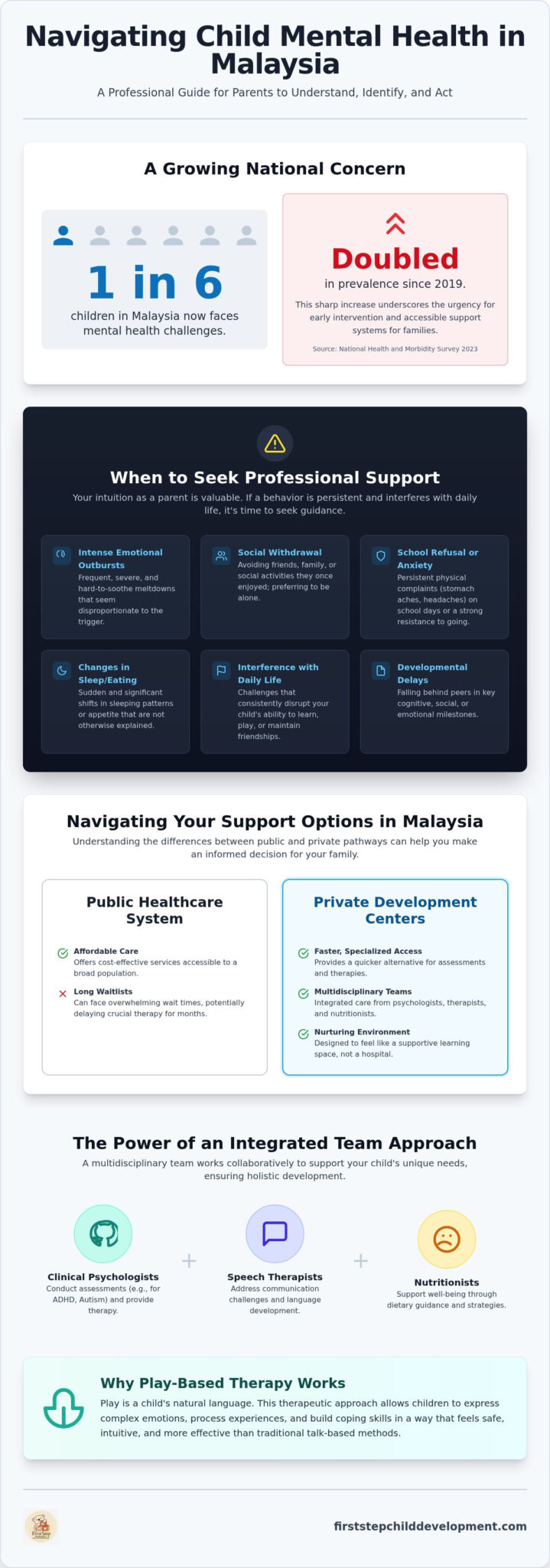
Did you know that one in six children in Malaysia now experiences mental health challenges? This rate has doubled since 2019, according to the National Health and Morbidity Survey 2023, leaving many families searching for reliable child mental health support Malaysia. It’s common to feel stuck between wondering if a behavior is just a normal phase and worrying about the potential stigma of a clinical label. When you’re also facing long wait times or confusing specialist lists, the path forward feels anything but clear.
We’re here to help you move from uncertainty to a place of quiet confidence. You’ll gain a professional perspective on how to manage the clinical and emotional pathways to support your child’s development with expert guidance tailored for Malaysian families. This guide provides a structured roadmap for seeking help, explains the specific roles of assessments and therapies, and shows you how a multidisciplinary approach can unlock your child’s true potential in a nurturing, child-centered environment.
Key Takeaways
- Identify the specific emotional and behavioral indicators that signal it’s time to transition from home monitoring to professional support.
- Navigate the step-by-step process of diagnostic assessments for conditions like ADHD and Autism to gain a clear roadmap for your child’s future.
- Discover how to access integrated child mental health support Malaysia through a multidisciplinary team of clinical psychologists, speech therapists, and nutritionists.
- Learn why play-based therapeutic approaches allow children to communicate their inner world more effectively than traditional clinical methods.
- Gain practical guidance on preparing your child for their first specialist visit to ensure the experience feels safe, supportive, and empowering.
Understanding the Landscape of Child Mental Health in Malaysia
Child mental health is more than just the absence of a clinical diagnosis. It’s the foundation of how your child thinks, feels, and interacts with the world around them. In the current Mental health landscape in Malaysia, we’re seeing a significant shift in how families approach developmental well-being. The National Health and Morbidity Survey 2023 highlighted that one in six children faces mental health challenges, a statistic that has prompted a nationwide focus on better protection and care. Seeking child mental health support Malaysia isn’t a sign of parental failure; it’s a courageous, proactive step toward ensuring your child has the tools they need to thrive.
The National Child Action Plan (2026–2030) reflects this urgency, emphasizing that mental wellness is a fundamental right for every Malaysian child. We’ve moved away from the old “wait and see” approach. Today, parents are encouraged to view psychological support as a form of “emotional coaching” that helps children build resilience. Whether you’re navigating the public system or looking into private centers, understanding these pathways is the first step toward peace of mind.
The Shift Toward Early Intervention
The first 1,000 days of a child’s life are often described as a “window of opportunity.” During this period, the brain develops at an incredible pace, making it the most effective time for Early Intervention Programs (EIP). Proactive support during these early years doesn’t just address immediate delays. It builds the cognitive and emotional architecture needed for future academic success. By identifying needs early, we help children avoid the frustration of falling behind their peers socially or educationally. It’s about empowering them before small hurdles become significant obstacles.
Navigating Private vs. Public Pathways
Malaysian families typically choose between three main routes: the public healthcare system, NGOs, or private child development centers. While public hospitals offer affordable care, they often grapple with overwhelming waitlists that can delay crucial therapy for months. Private centers provide a faster, more specialized alternative. These environments are designed to feel less like a “hospital” and more like a supportive learning space. When choosing a center for child mental health support Malaysia, look for a multidisciplinary team that includes clinical psychologists, speech therapists, and nutritionists working together. This collaborative approach ensures your child isn’t just seen as a set of symptoms, but as a whole person with unique strengths and potential.
Identifying Red Flags: When to Seek Professional Support
Every child has bad days. It’s natural to question whether a sudden change in mood or a difficult week at school is just a passing phase or a sign of something deeper. While every child develops at their own pace, certain persistent patterns serve as indicators that a family might benefit from professional child mental health support Malaysia. Recognizing these red flags isn’t about jumping to conclusions; it’s about being an observant, proactive partner in your child’s growth. When emotional or behavioral struggles start to interfere with your child’s ability to learn, play, or make friends, it’s usually time to look closer.
Parental intuition is one of the most powerful tools in early intervention. You know your child’s “baseline” better than anyone else. If your gut feeling tells you that something isn’t quite right, that observation is clinically significant. Professional guidance helps translate those feelings into a clear roadmap for support, ensuring your child doesn’t have to navigate their challenges alone.
Emotional and Behavioral Distress in Kids
Distinguishing between a typical toddler tantrum and clinical behavioral challenges often comes down to frequency, intensity, and duration. A “normal” tantrum usually has a clear trigger and ends relatively quickly. In contrast, frequent meltdowns that seem impossible to soothe may suggest your child is struggling to process their environment. In the Malaysian context, we often see childhood anxiety manifest as school refusal. This might not look like a “refusal” at all, but rather persistent physical complaints like stomach aches or headaches on school mornings.
Emotional dysregulation is a child’s inability to manage their emotional responses effectively, often resulting in outbursts or withdrawal that interfere with their school performance and social relationships. If you notice your child becoming increasingly socially withdrawn or showing sudden changes in sleep and eating habits, these are signals that their internal world is under stress. Understanding the common behavioral challenges in children and their underlying roots can help you decode these signals before they escalate. A Clinical Psychologist Consultation can provide the clarity needed to understand these behaviors and develop healthy coping strategies.
Neurodevelopmental Red Flags
Neurodevelopmental concerns often appear as missed milestones or “spiky” development, where a child excels in one area but struggles significantly in others. For toddlers, early indicators of Autism Spectrum Disorder (ASD) might include limited eye contact, a lack of “pointing” to share interest, or delayed speech. These signs are often subtle and easily missed without specialized observation.
ADHD often presents differently depending on the setting. A child might seem “fine” at home where they feel safe, but struggle with aggression or defiance in the classroom due to the high demand for sustained attention. Similarly, learning difficulties can hide behind behavioral issues. A child who feels they “can’t keep up” with reading or math may act out to distract from their frustration. Identifying these needs through an ADHD Assessment or Learning Difficulties Assessment before they impact your child’s self-esteem is a vital part of child mental health support Malaysia. Early detection allows us to frame these challenges not as failures, but as unique ways of learning that require a tailored approach. Families navigating these concerns can benefit from exploring structured emotional behavioral support for children to understand the full range of options available in Malaysia.
Diagnostic Assessments: A Step-by-Step Guide for Parents
Seeking a formal diagnosis is often the most anxiety-inducing part of the journey for parents. You might worry about your child being “labeled” or how a clinical finding will affect their future. However, a comprehensive assessment is actually a powerful tool for empowerment. In the context of child mental health support Malaysia, a formal report is the key that unlocks essential school accommodations and highly targeted therapy plans. It replaces guesswork with professional clarity, ensuring you’re no longer treating symptoms in isolation but supporting your child’s unique neurological profile.
For younger children, we prioritize play-based assessments as the gold standard. Traditional “sit-down” testing can be intimidating and often fails to capture a child’s true capabilities. By observing how a child interacts with specific toys, follows gentle prompts, and manages transitions in a specialized play environment, our clinical team gains deep insights into their social communication and cognitive processing. It’s a thorough yet gentle process designed to make the child feel safe and successful while providing the data needed for a precise diagnosis.
The Assessment Process Breakdown
A multidisciplinary approach ensures no detail is overlooked. The journey typically follows three structured stages designed to provide peace of mind through professional clarity:
- Step 1: Clinical Interview. We begin by listening to your journey. This session focuses on developmental history, parental observations, and specific concerns at home or school.
- Step 2: Direct Observation and Testing. The child participates in standardized activities. Depending on the need, this might include an ADHD Assessment, Autism Assessment, or IQ Assessment using globally recognized tools adapted for the Malaysian environment.
- Step 3: Feedback and Reporting. We conclude with a detailed session to explain the findings. You’ll receive a comprehensive written report that includes clear, actionable recommendations for teachers and therapists.
Understanding Specific Evaluations
Not every child requires the same type of evaluation. An ADHD Assessment looks beyond simple “hyperactivity” to measure executive functions like working memory and impulse control. For families concerned about social development, an Autism Assessment evaluates sensory profiles and communication nuances. If your child is struggling academically despite their best efforts, a Learning Difficulties Assessment can identify specific gaps like dyslexia or dysgraphia. These evaluations provide the evidence-based foundation needed to build a customized support system that honors your child’s potential and fosters their long-term growth.
Therapeutic Approaches: Finding the Right Fit for Your Child
Traditional “talk therapy” often falls short for young children because they simply don’t have the sophisticated vocabulary required to explain complex emotions. When seeking child mental health support Malaysia, it’s vital to choose modalities that respect a child’s developmental stage. Instead of sitting on a couch and talking, children need active, engaging ways to communicate their inner world. By using methods that feel natural to them, we lower their anxiety and build a foundation of trust from the very first session.
Play Therapy serves as the primary bridge between a child’s feelings and a therapist’s understanding. In this environment, toys are the child’s words and play is their language. Alongside this, Speech Therapy addresses more than just pronunciation; it helps late talkers and children with social communication challenges find their voice. For those struggling with sensory processing or motor delays, Pediatric Occupational Therapy provides the physical and neurological regulation needed to participate fully in daily life. These services work in harmony to support the whole child, rather than just treating a single symptom.
The Power of Play-Based Intervention
Children often carry anxieties or process difficult experiences through symbolic play. A specialized therapist acts as a gentle guide, following the child’s lead to help them re-enact and resolve internal conflicts in a safe, controlled setting. This approach allows children to “speak” through sand trays, puppets, or art, making the therapeutic process feel like a natural part of their day rather than a clinical appointment. Play-based therapy builds emotional resilience by providing children with a safe space to practice problem-solving and self-regulation skills through creative expression.
Multidisciplinary Care: The Team Approach
Effective child mental health support Malaysia is rarely the work of a single specialist. Behavioral health is often deeply connected to physical well-being, which is why a Nutritionist Consultation can be a critical component of care. Diet can significantly impact mood, energy levels, and focus, particularly for children with neurodevelopmental differences. When a nutritionist reviews a child’s intake, they provide the biological support that allows psychological therapies to be more effective.
When Pediatricians and Clinical Psychologists collaborate with therapists under one roof, they create a 360-degree view of your child’s health. This integrated approach ensures that every specialist is working toward the same goals, leading to faster and more sustainable progress. It eliminates the confusion of conflicting advice and gives parents a single, clear path forward. If you’re ready to see how a coordinated team can support your family’s journey, you can explore our multidisciplinary therapy services to find the right fit for your child’s unique needs.
Empowering Your Child: Next Steps for Malaysian Families
Taking the first step toward professional support is a significant milestone in your family’s journey. It marks the transition from worrying in private to working with a dedicated team that understands your child’s unique potential. Empowerment starts with how you frame this experience at home. When families seek child mental health support Malaysia, the goal isn’t just to “fix” a specific behavior but to build a lifestyle of emotional wellness that lasts a lifetime. By approaching this process with quiet confidence, you show your child that seeking help is a proactive strength.
Preparing for the First Consultation
How you describe the upcoming visit can significantly impact your child’s comfort level. Avoid using intimidating clinical terms that might trigger fear. Instead, explain that they’re going to meet a “feelings coach” or a “play teacher” who helps children learn new ways to manage big emotions or succeed at school. This simple shift in vocabulary helps the center feel like a safe haven rather than a scary medical office. To make the most of your initial appointment, come prepared with the following items:
- Recent school reports or written feedback from teachers regarding behavior and academic performance.
- A brief timeline of developmental milestones, including speech, motor skills, and social interactions.
- A list of specific “red flags” or patterns you’ve observed at home.
- Any previous medical records or results from past screenings.
Don’t hesitate to ask your clinical psychologist about their specific experience with your child’s age group or their approach to play-based intervention. A transparent, collaborative relationship between parents and specialists is the foundation of successful therapy.
Creating a Supportive Home Environment
You are your child’s most important advocate and their primary “co-therapist.” The real transformation happens when therapist-recommended strategies are woven into your daily routines. Consistency is key. Whether it’s implementing a visual schedule to reduce ADHD-related anxiety or using specific language to support a child with Autism, your involvement at home accelerates progress. It’s also vital to balance academic expectations with emotional well-being. In our high-pressure educational culture, prioritizing your child’s mental health foundation is the best way to ensure their long-term academic success.
Choosing a multidisciplinary center like Firststep ensures that your child is supported by a team that sees the whole picture. By combining clinical psychology, speech and occupational therapies, and nutritional guidance, we provide a comprehensive roadmap tailored to your family’s values. If you’re ready to move from uncertainty to a clear path of growth, Schedule a consultation with our multidisciplinary team today. Together, we can unlock your child’s unique potential in a nurturing, professional environment.
Investing in Your Child’s Brightest Future
Navigating developmental concerns is a journey that requires both clinical expertise and a parent’s intuitive care. You’ve seen how early intervention through specialized play-based assessments provides the clearest roadmap for your child’s growth. By choosing a multidisciplinary team of psychologists, therapists, and pediatricians, you ensure every aspect of your child’s well-being is addressed in a safe, nurturing environment. Securing high-quality child mental health support Malaysia is about empowering your child to reach their full potential while replacing uncertainty with professional clarity.
Our center is dedicated to providing detailed feedback and actionable reports that give you the tools to support your child at home and in school. We believe that every child has unique strengths waiting to be unlocked through the right therapeutic partnership. If you’re ready to take the next step toward peace of mind and developmental progress, we’re here to guide you. Book a Professional Consultation for Your Child today. You don’t have to navigate this path alone; we’re here to be your partner in your child’s success.
Frequently Asked Questions
How do I know if my child needs a psychologist or just more discipline?
Discipline focuses on teaching rules and boundaries, while child mental health support Malaysia addresses the underlying emotional or neurological causes of behavior. If your child’s outbursts, withdrawal, or anxiety persist despite consistent and fair discipline, it often indicates they lack the internal regulation skills to meet your expectations. A professional assessment helps determine if the behavior is a developmental gap that requires child behavioral therapy rather than a simple lack of obedience.
What is the difference between a psychiatrist and a clinical psychologist for children?
Psychiatrists are medical doctors who primarily manage mental health through medication and medical interventions. Clinical psychologists focus on diagnostic assessments and therapeutic modalities like Play Therapy or Speech Therapy. Most families begin their journey with a psychologist to understand the root cause of a challenge before deciding if medical intervention from a psychiatrist is necessary for their child’s well-being.
How much does a child mental health assessment cost in Malaysia?
Industry data for 2026 shows that comprehensive child and teen psychological assessments in Malaysia typically range from RM 1,300 to RM 2,600. These costs vary based on the complexity of the tools used and the depth of the final report. While we don’t list our specific clinical fees here, we focus on providing multidisciplinary value that includes detailed feedback and actionable strategies for your child’s school and home life.
Can my child get school accommodations with a private diagnostic report?
Yes, a professional diagnostic report is the standard document required by schools to implement an Individual Education Plan (IEP). Most international and private schools in Malaysia recognize these reports to provide essential accommodations, such as extra time during examinations or specialized classroom support. This documentation ensures your child’s learning environment is tailored to their specific neurological profile.
How long does it take to see progress in play or speech therapy?
Therapeutic progress is a gradual journey that depends on the child’s unique needs, but most parents notice initial shifts in communication or emotional regulation within three to six months. Consistency is the most vital factor in this process. Attending weekly sessions and implementing the therapist’s recommended strategies in your daily home routine will lead to faster and more sustainable developmental growth.
Is an ADHD or Autism diagnosis permanent, or can children ‘outgrow’ it?
ADHD and Autism are neurodevelopmental differences, which means the brain is wired in a unique way that doesn’t change over time. While children don’t “outgrow” these conditions, they learn to thrive by developing powerful coping mechanisms and life skills through child mental health support Malaysia. Early intervention provides the foundation for them to navigate the world confidently and successfully as they grow into adulthood.
What should I do if my spouse doesn’t agree that our child needs help?
It’s common for parents to have different perspectives, often due to a fear of their child being “labeled” or misunderstood. We recommend inviting your spouse to an initial Clinical Psychologist Consultation to hear a neutral, professional perspective in a safe environment. Seeing the evidence-based data from an assessment often helps both parents align on a path that prioritizes the child’s long-term happiness and success.
Are the services at Firststep covered by insurance in Malaysia?
Mental health coverage for children in Malaysia varies significantly depending on your specific insurance provider and policy. Some international plans or premium local policies do offer reimbursement for diagnostic assessments and certain therapeutic services. We encourage you to check with your insurance agent to see if “psychological services” or “developmental therapies” are covered under your current plan’s benefits.
Article by
Firststep Child Development Team
Firststep Child Development Team provides evidence-informed educational resources to help parents better understand child development, behaviour and learning. Our multidisciplinary services include clinical psychology, occupational therapy, speech and language therapy, developmental assessments and other child development support in Kuala Lumpur and Selangor.
Disclaimer
This article is for general educational and informational purposes only and is not a substitute for professional medical, psychological or therapeutic advice, diagnosis or treatment. Every child develops differently. If you have concerns about your child's development, behaviour, learning or wellbeing, please consult an appropriately qualified healthcare or allied health professional.