



2026 Guide: Helping Your Toddler Talk in Malaysia

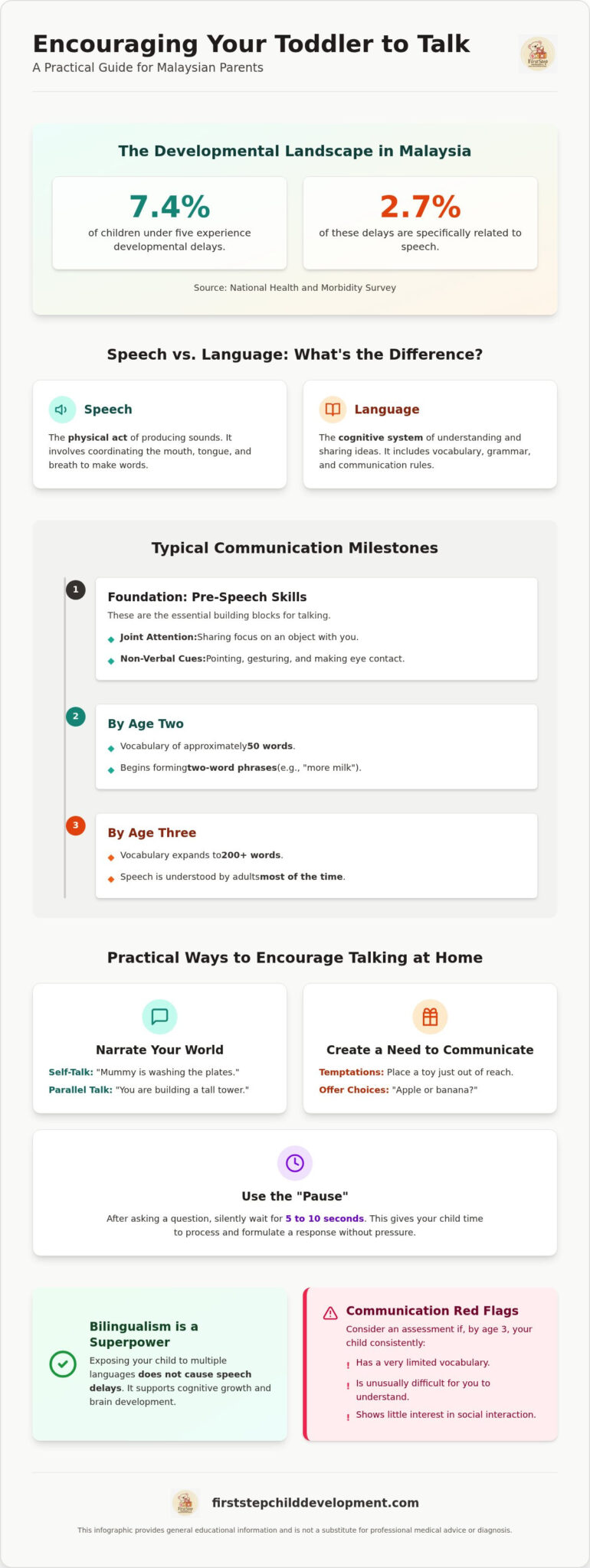
According to the National Health and Morbidity Survey, 7.4% of Malaysian children under five experience developmental delays, with speech delays specifically rising to 2.7%. If you find yourself watching other children at the playground and wondering why your little one is still relying on gestures, you aren’t alone. Learning how to encourage toddler to talk Malaysia often involves navigating a rich, multilingual environment while preparing for the 2026 preschool curriculum updates.
It’s natural to feel a mix of anxiety and confusion, especially when trying to balance English, Malay, or other languages at home. You want to provide a strong foundation without causing unnecessary pressure. This guide offers evidence-based strategies and a practical checklist designed for our local context. We’ll help you understand developmental milestones and identify when professional intervention might be beneficial.
We’ll explore actionable home exercises that turn daily routines into learning opportunities and explain how bilingualism supports cognitive growth. You’ll gain a clear path forward and the peace of mind that comes from knowing how to support your child’s communication journey effectively.
Key Takeaways
- Learn to distinguish between your child’s understanding and their actual speech by following our guide on developmental milestones for ages 18 months to three years.
- Master simple, evidence-based techniques like ‘Parallel Talk’ to learn how to encourage toddler to talk Malaysia through your natural daily household routines.
- Navigate our country’s multilingual environment with confidence by understanding why bilingualism does not cause speech delays and how to use situational language strategies effectively.
- Identify specific communication red flags and discover how play-based speech therapy assessments can provide a clear, supportive path forward for your child’s development.
Understanding Toddler Speech and Language Milestones
Parents often feel anxious when comparing their child’s progress to peers at the park or in playgroups. It’s helpful to view toddler speech and language milestones as a broad spectrum of growth rather than a rigid deadline. Distinguishing between receptive language, which is what your child understands, and expressive language, which is what they actually say, is the first step in knowing how to encourage toddler to talk Malaysia effectively.
The Difference Between Speech and Language
While often used interchangeably, these terms describe distinct developmental skills. Speech refers to the physical coordination of the mouth, tongue, and breath to produce specific sounds. Language is the cognitive system used to share thoughts and feelings, including vocabulary and grammar. A child might have a sophisticated internal understanding of language but struggle with speech clarity, making their words difficult for others to interpret without professional support.
Milestones for Toddlers in Malaysia
In our local environment, where many children grow up hearing multiple languages, milestones remain a vital guide for parents. By age two, most children use approximately 50 words and begin forming two-word phrases. By age three, their vocabulary often expands to 200 words or more, and they should be understood by adults most of the time. Joint Attention is the shared focus of two individuals on an object, serving as a critical pre-speech skill that signals a child’s readiness to interact.
Non-verbal communication, such as consistent eye contact and pointing, is just as important as spoken words. These actions show that your child is eager to connect and share their world with you. If you notice a delay in these foundational skills, a professional Speech Therapy assessment can provide the clarity and support your family needs to move forward with confidence.
Daily Checklist: Practical Ways to Encourage Talking at Home
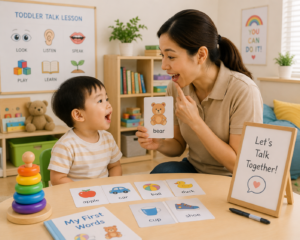
Supporting your child’s communication doesn’t require expensive tools; it happens within the rhythm of your daily routine. Many parents ask how to encourage toddler to talk Malaysia, and the answer often lies in simple, intentional interactions during mealtime or play. By narrating life as it happens, you provide a rich linguistic environment that helps your child map words to actions. Learning how to encourage toddler to talk Malaysia involves more than just teaching words; it’s about building a consistent, supportive connection.
Modeling and Narrating Daily Life
Self-Talk involves describing your own actions as you perform them. For example, during bath time, you might say, “Mummy is pouring the water. Splash!” Conversely, Parallel Talk is when you narrate what your child is doing. If they are playing with a car, you could say, “You’re pushing the red car. Vroom!” Keep your language slightly ahead of theirs. If they use single words, use two-word phrases. This modeling is essential for reaching speech and language developmental milestones without adding unnecessary pressure.
Creating a Need to Communicate
Sometimes we are so attuned to our children’s needs that they don’t actually need to speak. You can create “communication temptations” by placing a favourite toy on a high shelf where they can see it but can’t reach it. Instead of anticipating every want, offer choices. Asking “Do you want the apple or the banana?” requires a more active response than a simple yes or no.
The most powerful tool is the “Pause.” After asking a question, wait for 5 to 10 seconds. This silence gives your child’s brain time to process the information and formulate a response. Reducing screen time in favour of these face-to-face moments is vital, as real-world interaction is irreplaceable. If you feel your child isn’t responding to these home strategies, a Speech Therapy consultation can help identify specific areas for growth and provide tailored guidance for your family.
Navigating Bilingualism and Multilingualism in Malaysia
Growing up in Malaysia often means navigating a beautiful tapestry of Malay, English, Mandarin, or Tamil. Many parents worry that this exposure might lead to confusion, but research consistently shows that bilingualism does not cause speech delays. When considering how to encourage toddler to talk Malaysia, it’s essential to embrace our multilingual culture as a strength rather than a hurdle.
The Bilingual Advantage in Child Development
Growing up with multiple languages provides significant cognitive benefits, including improved executive function and problem-solving skills. When monitoring progress, remember that your child’s total vocabulary across all languages is the true measure of their development. Experts at the Yale School of Medicine emphasize Understanding language development milestones involves looking at the child’s ability to communicate, regardless of which language they use. We encourage parents to speak the language they feel most comfortable and fluent in, as this provides the highest quality linguistic model for the child.
Language Mixing vs. Language Delay
It is perfectly normal for Malaysian toddlers to mix languages, often referred to as code-switching or “Manglish.” This behaviour shows they are creatively using their full linguistic repertoire to express themselves. However, it’s vital to distinguish this from an expressive language delay, where a child struggles to form basic ideas in any language. Parents should not stop using multiple languages if a delay is suspected, as removing a language can disrupt established communication bonds without addressing the root cause of the delay.
If you notice your child isn’t meeting milestones in their dominant language, seeking a Speech Therapy assessment can offer clarity. Our multidisciplinary team is here to guide you on how to encourage toddler to talk Malaysia while respecting your family’s cultural and linguistic heritage.
Red Flags: Signs of Speech Delay in 3-Year-Old Malaysia
It’s common to hear anecdotal advice suggesting that some children are simply “late bloomers.” While every child develops at their own pace, specific indicators suggest that a child may need extra support. If you’re looking for how to encourage toddler to talk Malaysia, identifying these red flags early is the most proactive step you can take. Early recognition allows for a smoother transition into school and social environments.
The 3-Year-Old Speech Checklist
By the age of three, a child’s communication should be functional and social. You might consider professional guidance if you notice the following signs:
- Vocabulary: Using fewer than 50 words or failing to use three-word sentences.
- Comprehension: Difficulty following simple instructions or answering basic questions.
- Social Interaction: Showing little interest in playing with others, poor eye contact, or not responding to their name.
- Clarity: Family members or strangers find it very difficult to understand what the child is saying.
- Sound Production: A lack of varied consonant sounds or a total absence of babbling earlier in development.
When ‘Late Bloomer’ Becomes a Concern
The “wait and see” approach can often lead to missed opportunities. Research shows that addressing speech delays before primary school significantly improves future literacy and social confidence. For a more detailed look at these indicators, please read our Speech Delay Guide for Parents in Malaysia (2026). Speech delays aren’t just about talking. They affect how a child builds friendships and understands the world. Understanding how to encourage toddler to talk Malaysia begins with knowing when to seek professional advice. If you have concerns about these milestones, we recommend scheduling a Speech Therapy assessment to establish a clear path forward.
Seeking Professional Support: Speech Therapy and Assessments
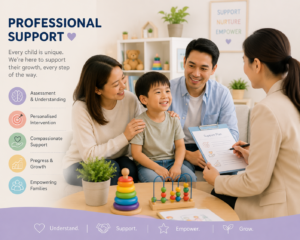
When home strategies and environmental adjustments don’t yield the progress you’ve hoped for, professional intervention offers a structured path forward. Knowing how to encourage toddler to talk Malaysia often requires the expertise of a multidisciplinary team. A Speech-Language Pathologist (SLP) does not just teach words; they evaluate the physical, cognitive, and social foundations of communication through a gentle, play-based assessment. This approach ensures your child feels safe and engaged while the specialist observes their natural interactions and identifies specific areas for growth.
The First Step: Professional Consultation
A Clinical Psychologist Consultation is often a vital starting point to rule out other developmental factors, such as sensory processing issues or cognitive delays. Our specialists work alongside pediatricians to provide a holistic view of your child’s growth. For a comprehensive overview of this process, see our Neurodevelopmental Assessment Malaysia: 2026 Parent Guide. During a Speech Therapy session, we use evidence-based techniques tailored to your child’s unique personality, turning therapy into a rewarding, play-centred experience.
Empowering Your Child’s Potential
Early intervention is about more than just current speech; it’s about long-term academic and social readiness. An Early Intervention Program (EIP) provides a structured environment where communication gaps are addressed through personalized therapy plans. Your involvement as a parent is the most critical component of this journey. We prioritise parental guidance, ensuring you have the tools to continue progress at home. By understanding how to encourage toddler to talk Malaysia with expert backing, you give your child the opportunity to reach their full potential. If you’re ready to take that next step, you can Book a consultation with Firststep Psychology & Child Development Centre today.
Empowering Your Child’s Communication Journey
Supporting your child’s speech development is a journey of patience and intentionality. By integrating techniques like Parallel Talk into your daily routine and embracing our country’s rich multilingual environment, you create a foundation for lasting growth. Understanding milestones helps you know when to act, ensuring your child receives the right support at the right time. Learning how to encourage toddler to talk Malaysia involves both these home-based efforts and knowing when to seek professional guidance.
If you have concerns about your child’s progress, our specialized multidisciplinary team of experts is here to partner with you. We provide a gentle, play-based assessment environment designed to put your family at ease while offering comprehensive diagnostic and therapeutic support. You don’t have to navigate these developmental questions alone. We invite you to Schedule a Speech and Language Consultation for Your Toddler at Firststep Child Development. Your child has immense potential, and with the right Speech Therapy support, they can find their voice and thrive.
Frequently Asked Questions
Does watching TV or tablets cause speech delay in toddlers?
Excessive screen time can reduce the face-to-face interaction necessary for language development. While not a direct cause for all, the WHO recommends no screen time for children under one. Interaction with caregivers is the primary way toddlers learn to communicate. Understanding how to encourage toddler to talk Malaysia involves prioritising active, human engagement over passive digital consumption during these formative years.
Is it true that boys start talking later than girls in Malaysia?
While some studies suggest girls may reach early milestones slightly sooner, the expected developmental windows are the same for all children. Relying on this myth can lead to harmful delays in seeking help. If a boy isn’t meeting the standard milestones for his age, it’s important to investigate rather than assuming he’ll just catch up naturally later on.
Can a toddler be confused by hearing Malay, English, and Mandarin at home?
No, hearing multiple languages does not cause confusion or speech delay. Malaysian children are often naturally multilingual and can distinguish between different languages from a very young age. This environment actually provides cognitive advantages. The key is consistent exposure. If you’re looking for how to encourage toddler to talk Malaysia, continue using your most fluent languages at home with confidence.
What is the difference between a late talker and a speech delay?
A late talker typically has good understanding and social skills but a limited spoken vocabulary, while a speech delay involves a more significant lag in communication abilities. Late talkers often catch up, but a true delay may require professional intervention to address underlying issues. A clinical assessment is the only reliable way to distinguish between these two developmental paths.
Should I wait until my child is 4 or 5 before seeking speech therapy?
Waiting until school age is generally discouraged because early intervention is significantly more effective. By age four, children are expected to use complex sentences and clear speech for socialising. Addressing concerns when they first arise, often around age two or three, gives your child the best chance to reach their full potential before they enter the formal Malaysian school system.
How many words should a 3-year-old be able to say?
Most three-year-olds have a vocabulary of at least 200 to 1,000 words and can speak in sentences of three or more words. They should be able to ask “why” questions and be understood by strangers about 75% of the time. If your child uses fewer than 50 words at this age, it’s a strong indicator that a professional evaluation is needed.
What happens during a professional speech assessment for a toddler?
A professional assessment is a gentle, play-based process where a specialist observes your child’s communication through toys and games. The therapist evaluates sound production, vocabulary, and how well the child understands instructions. This relaxed setting helps the specialist see your child’s true abilities. It’s a collaborative session where you’ll also discuss your observations and concerns to create a personalised support plan.
Can diet or nutrition affect my child’s ability to talk?
While nutrition supports overall brain development, there’s no specific food that directly causes speech. However, underlying issues like iron deficiency can affect energy levels and focus, which are necessary for learning. A balanced diet ensures your child has the physical resources to engage with their environment. If you have concerns, a nutritionist consultation can provide specialised guidance for your child’s holistic growth.

Article by
Firststep Child Development Team
Firststep Child Development Team provides evidence-informed educational resources to help parents better understand child development, behaviour and learning. Our multidisciplinary services include clinical psychology, occupational therapy, speech and language therapy, developmental assessments and other child development support in Kuala Lumpur and Selangor.
Disclaimer
This article is for general educational and informational purposes only and is not a substitute for professional medical, psychological or therapeutic advice, diagnosis or treatment. Every child develops differently. If you have concerns about your child’s development, behaviour, learning or wellbeing, please consult an appropriately qualified healthcare or allied health professional.