



Imagine watching your child stand on the edge of the playground, wanting to join in but not quite knowing how to start the conversation. It’s heartbreaking to see them excluded, and it’s natural to wonder if they’re simply quiet or if there’s a deeper developmental hurdle. You aren’t alone in feeling this uncertainty. Many parents in KL and Selangor seek out social skills development therapy to help their children bridge this gap and find their place among peers.
Understanding the difference between a temporary phase and a need for support is the first step toward peace of mind. This guide will help you identify when professional intervention is the right move to foster meaningful connections and build your child’s confidence. We’ll explore key developmental milestones, provide practical strategies you can use at home, and explain how a multidisciplinary approach supports your child’s long-term success in school and beyond.
Key Takeaways
- Understand how social skills development therapy helps children interpret non-verbal cues and manage emotional regulation beyond simple conversation.
- Explore why a multidisciplinary team is essential for building a comprehensive social toolkit tailored to your child’s unique needs.
- Recognise the subtle signs across different developmental stages that indicate when a child might benefit from structured social support.
- Learn what to expect during the therapeutic process, from the initial consultation to the implementation of actionable strategies at home.
What is Social Skills Development Therapy?
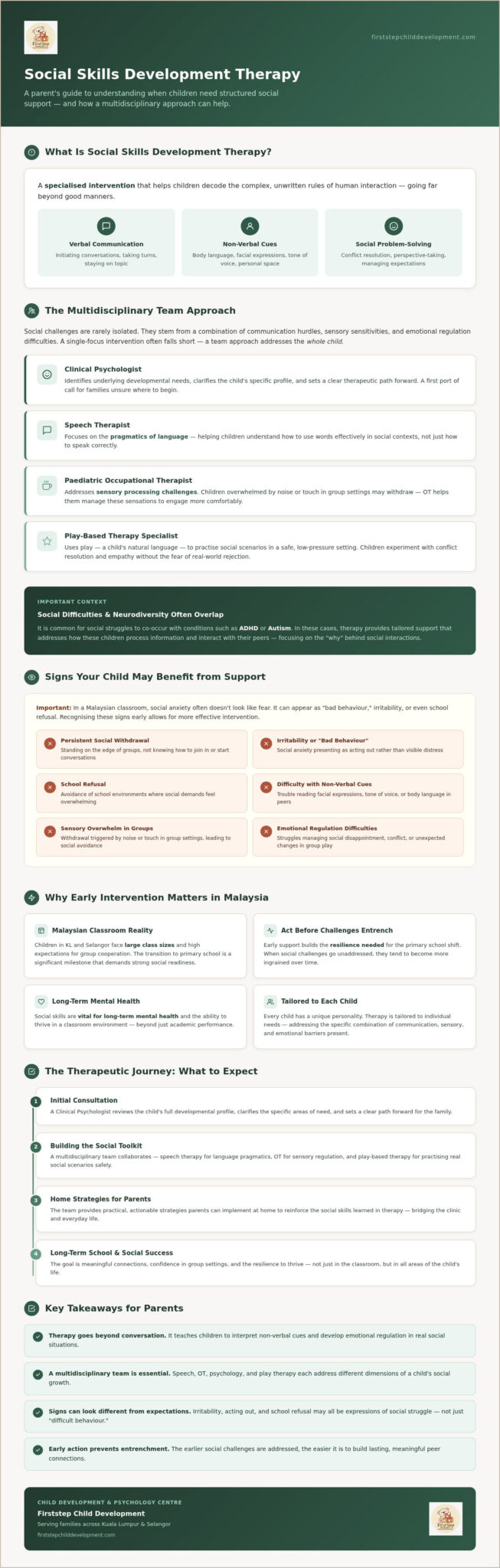
Social skills development therapy is a specialised intervention designed to help children decode the complex, unwritten rules of human interaction. While some view social success as merely having good manners, this therapy delves much deeper. It focuses on helping children understand social cues, build meaningful relationships, and navigate the nuances of social skills development. This process includes mastering non-verbal communication, developing empathy, and practising emotional regulation. These skills are vital for a child’s long-term mental health and their ability to thrive in a classroom environment.
Many children who struggle socially also face challenges related to neurodiversity. It’s common for social difficulties to overlap with conditions such as ADHD or Autism. In these cases, social skills development therapy provides the specific, tailored support necessary to address how these children process information and interact with their peers. By focusing on the “why” behind social interactions, children gain the tools to feel more comfortable in various settings.
The Core Pillars of Social Interaction
Social success relies on several foundational skills that work together. Therapy typically focuses on three main areas:
- Verbal communication: This involves more than just speaking; it includes knowing how to initiate conversations, take turns, and stay on topic without oversharing.
- Non-verbal cues: Children learn to interpret body language, facial expressions, and tone of voice, while also becoming aware of their own personal space.
- Social problem-solving: This helps children navigate conflicts, understand different perspectives, and manage the subtle expectations of different social settings.
Why Early Intervention Matters in Malaysia
In Malaysia, the transition to primary school is a significant milestone. Children in KL and Selangor often face large class sizes and high expectations for group cooperation. Early support helps them build the resilience needed for this shift. If you’re concerned about your child’s progress, exploring an Early Intervention Program can provide the structured guidance they need to succeed before social challenges become more ingrained.
A Multidisciplinary Approach to Social Growth
Social challenges are rarely isolated issues. They often stem from a combination of communication hurdles, sensory sensitivities, and emotional regulation difficulties. This is why a single-focus intervention often falls short. At Firststep, we provide a gentle and professional environment where a multidisciplinary team collaborates to build your child’s social “toolkit.” By looking at the whole child, we ensure that every barrier to connection is addressed with sensitivity and expertise.
Understanding child social development milestones is crucial for identifying where a child might need extra support. Our social skills development therapy integrates various perspectives to create a holistic growth plan. If you’re unsure where to begin, a Clinical Psychologist Consultation can help clarify your child’s specific needs and set a clear path forward.
The Role of Speech and Occupational Therapy
Specialists work together to tackle different facets of interaction. Speech Therapy focuses on the pragmatics of language, helping children understand how to use words effectively in social contexts. Meanwhile, Pediatric Occupational Therapy addresses sensory processing issues. For many children, feeling overwhelmed by noise or touch in a group can lead to withdrawal. OT helps them manage these physical sensations so they can engage more comfortably with others.
Play-Based Therapy and Emotional Regulation
Play is a child’s natural language. Through a structured Play-Based Therapy Guide, children can practise social scenarios in a safe, low-pressure setting. This approach allows them to experiment with conflict resolution and empathy without the fear of real-world rejection. It’s an essential component of emotional regulation, giving them the confidence to manage social settings with resilience.
Signs Your Child May Benefit from Social Support
Every child has a unique personality. Some are naturally observant and quiet, while others are more outgoing. However, when social struggles become persistent and cause distress, professional guidance can make a significant difference. In the busy environment of a Malaysian classroom, social anxiety often doesn’t look like fear. It can manifest as “bad behaviour,” irritability, or even school refusal. Recognising these signs early allows for more effective social skills development therapy.
Parents in KL and Selangor often notice their child struggling to keep up with the fast-paced social demands of primary school. If you feel your child is “missing” certain milestones, trust your intuition. Early observation is a powerful tool, and acknowledging these challenges is the first step toward providing the right support.
Social Milestones by Age Group
- Toddlers (2-3 years): Children usually engage in parallel play, playing alongside peers rather than with them. They should begin basic turn-taking. If engagement is limited, it’s helpful to review milestones related to speech therapy.
- Preschoolers (4-5 years): This age involves cooperative play and a growing understanding of others’ feelings. Persistent difficulty sharing or joining groups may be a sign they need support.
- School-aged: Dynamics become complex. Children must navigate subtle social cues and unwritten rules. Inability to maintain friendships often signals a need for intervention.
When to Seek a Professional Assessment
A formal assessment is the first step in understanding the “why” behind social challenges. It provides clarity on whether these difficulties are related to neurodevelopmental conditions. Seeking an Autism Assessment or an ADHD Assessment can help identify specific processing styles. Understanding these patterns allows us to tailor support to your child’s unique way of seeing the world. If you’re concerned about your child’s social progress, you can learn more at Firststep Child Development to find the best path forward.
Entering a clinic can feel daunting for both parents and children. At Firststep, we ensure the experience is welcoming and child-centered. Our approach to social skills development therapy prioritises play-based methods to keep children engaged and motivated. This isn’t about “fixing” a child; it’s about empowering them to reach their full potential and navigate their world with confidence. We provide clear parental feedback reports after sessions, ensuring you stay informed and confident in the path we’ve chosen together.
The Therapeutic Process Step-by-Step
The journey follows a methodical path designed to provide clarity and results. First, we conduct a comprehensive diagnostic assessment to identify your child’s unique strengths and challenges. Following this, we design a tailored multidisciplinary plan that may involve specialists in psychology, speech, or occupational therapy. Finally, regular sessions focus on specific social goals, such as turn-taking, sharing, or emotional regulation, within a supportive and safe environment.
Practical Strategies for Parents at Home
Your involvement is the bridge between therapy and real-world success. Modelling positive interactions during daily routines helps your child see these skills in action. Social modelling is the practice of demonstrating appropriate social behaviours, such as active listening or polite requesting, during family meals or outings. You can also use social stories or role-play to prepare for upcoming school events in KL or PJ. These tools help reduce anxiety by giving your child a predictable script for new situations, making the transition to larger social groups much smoother.
Supporting Your Child’s Social Journey
Navigating social interactions is a complex skill that evolves throughout childhood. By recognising the subtle signs of struggle early and embracing a multidisciplinary approach, you’re providing your child with a strong foundation for future success. Whether it’s mastering non-verbal cues or building the confidence to join a group, social skills development therapy offers a structured yet gentle path toward meaningful connection. It’s about understanding your child’s unique perspective and providing the specific tools they need to thrive in their own way.
Our expert team in KL and PJ is dedicated to providing compassionate, play-based care tailored to your family’s needs. Through personalised assessments and clear feedback, we help you turn uncertainty into a proactive plan for growth. If you’re concerned about your child’s social progress, schedule a professional consultation with Firststep Child Development today to discover how we can support your journey. Let’s work together to help your child navigate the world with confidence and joy. You can find more information at Firststep Child Development.
Frequently Asked Questions
Is social skills therapy only for children with Autism or ADHD?
Social skills development therapy is beneficial for a wide range of children, not just those with a formal diagnosis. While it’s a cornerstone of support for children with Autism or ADHD, it also helps those experiencing social anxiety, language delays, or general difficulties in making friends. Any child who finds it challenging to interpret social cues or manage their emotions in a group setting can gain valuable tools from this specialised support.
How long does it take to see progress in social skills development therapy?
Every child’s journey is unique, so there’s no fixed timeline for seeing results. Some children show small improvements in turn-taking or eye contact after a few months, while deeper skills like conflict resolution may take longer. Consistency is key, and progress often depends on the child’s specific goals and how well strategies are reinforced at home. Our multidisciplinary team focuses on steady, sustainable growth rather than immediate, temporary changes.
Can social skills be taught to a shy child who prefers playing alone?
Yes, social skills can definitely be taught to children who are naturally reserved. Shyness is a personality trait, but social skills are practical tools that any child can learn. Therapy doesn’t aim to change your child’s personality; instead, it provides them with the confidence to engage with others when they choose to. We help them navigate social situations comfortably without forcing them to be someone they aren’t.
What is the difference between social skills therapy and a typical playgroup?
A typical playgroup offers informal interaction, whereas social skills development therapy is a structured, goal-oriented intervention led by clinical specialists. In therapy, we use evidence-based techniques to target specific hurdles, such as interpreting non-verbal language or managing frustration. Unlike a playgroup where socialising happens naturally, therapy involves intentional teaching and play-based assessments to help a child overcome specific barriers to connection in a controlled, supportive environment.
How can I explain social skills therapy to my child in a positive way?
It’s best to frame the sessions as a fun opportunity to learn how to be a “friendship expert.” You can explain that they’ll be meeting a special teacher who uses games and toys to help them understand how to play and talk with other children more easily. Focus on the play-based nature of the sessions, reassuring them that it’s a safe, happy space where they’ll learn new ways to have fun with peers.

Article by
Firststep Child Development Team
Firststep Child Development Team provides evidence-informed educational resources to help parents better understand child development, behaviour and learning. Our multidisciplinary services include clinical psychology, occupational therapy, speech and language therapy, developmental assessments and other child development support in Kuala Lumpur and Selangor.
Disclaimer
This article is for general educational and informational purposes only and is not a substitute for professional medical, psychological or therapeutic advice, diagnosis or treatment. Every child develops differently. If you have concerns about your child's development, behaviour, learning or wellbeing, please consult an appropriately qualified healthcare or allied health professional.