



What if the very toys scattered across your living room floor held the key to unlocking your child’s emotional world? For many parents in Kuala Lumpur, watching a child struggle with big emotions or school pressure can feel incredibly isolating. It is natural to seek a solution that feels substantial, which is why some worry that play-based therapy for children might not be “real” therapy compared to traditional talk-based methods.
We understand that you want more than just a playdate; you want results that translate into a calmer home and a more confident child. It is exhausting to feel like you are guessing what is wrong when your child cannot find the words to tell you themselves. You deserve a path forward that respects your child’s developmental stage while providing professional clarity.
This guide will show you how professional sessions use play to help children process trauma and regulate their behaviour effectively. You will learn how this clinical approach provides clear feedback on developmental progress, helping your family move from a place of worry to one of deep understanding and lasting growth.
Key Takeaways
- Understand that play-based therapy for children is a clinical mental health approach where play acts as a child’s natural language to express complex feelings.
- Learn how a specialised therapeutic playroom provides a safe, consistent environment where children use toys like sand trays and dollhouses to work through their challenges.
- Identify the emotional and behavioural red flags, such as sudden withdrawal or school-related regression, that indicate when it’s time to seek professional intervention.
- Discover the benefits of a multidisciplinary approach that combines play sessions with expert parental guidance and feedback to support your child’s holistic development.
What is Play-Based Therapy for Children?
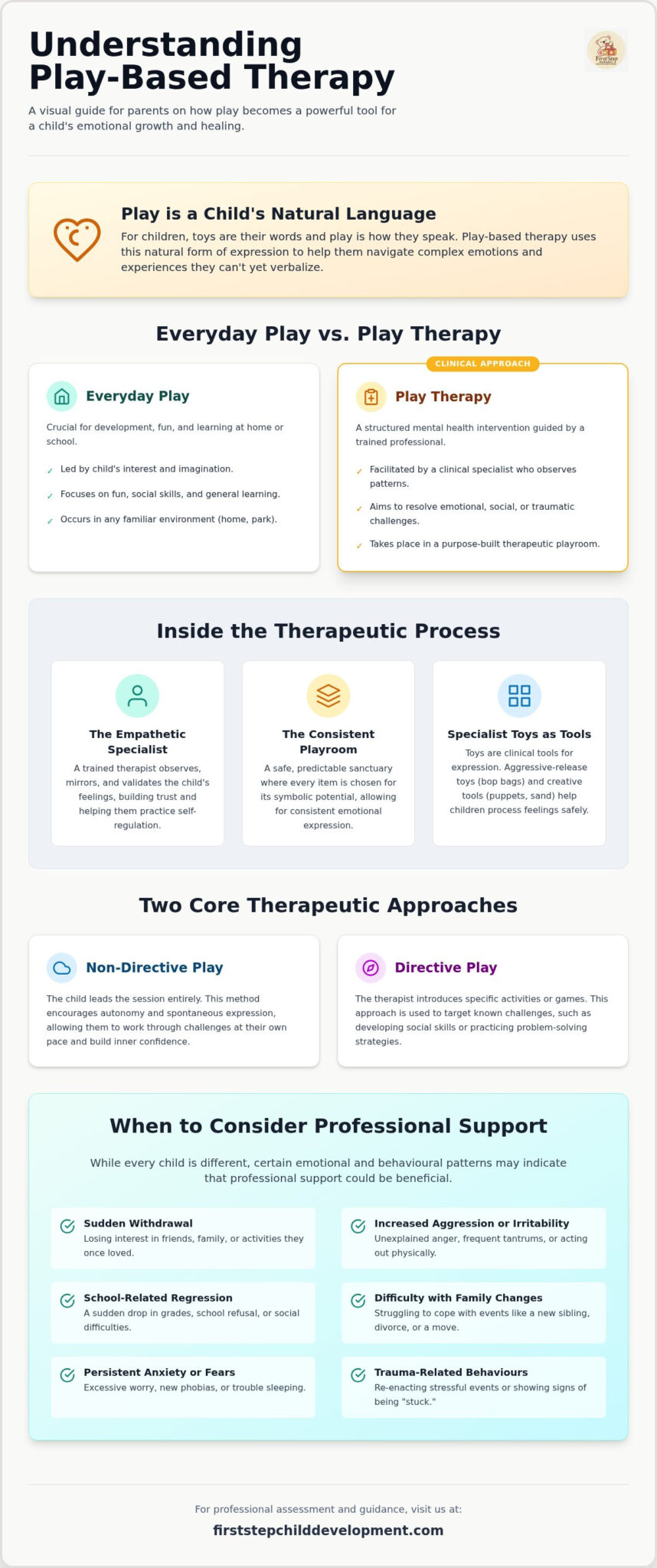
Play-based therapy for children is a structured, clinical mental health modality where play becomes the primary vehicle for communication. Unlike adults who possess the vocabulary to describe complex internal states, children use their natural environment to express themselves. In this context, toys are viewed as the child’s words and play is their language. By providing a safe, consistent space, a What is Play-Based Therapy specialist can help a child navigate emotional hurdles that they cannot yet put into sentences. This professional setting allows a child to “speak” through action, making it an essential tool for early intervention.
The Difference Between Play and Play Therapy
While playing at home is vital for development, therapeutic play is facilitated by a trained professional, such as a clinical psychologist. The therapist isn’t just a playmate; they are an empathetic observer who identifies themes and patterns in the child’s choices. They look for specific indicators that may be missed in a casual setting:
- Repetitive themes that might signal unresolved stress or trauma.
- Specific emotional expressions through character roles and storytelling.
- Patterns of interaction that reflect real-world social or school challenges.
This methodical observation helps translate a child’s actions into a clear developmental roadmap for parents. It provides a level of insight that “just playing” cannot achieve alone.
Why Conventional Talk Therapy Isn’t Always Effective for Young Children
Most children under the age of 12 haven’t yet developed the abstract reasoning or verbal skills required for traditional “couch” therapy. Their “logic” brain is still maturing, making it difficult to explain why they feel anxious or angry. Play-based therapy for children bypasses these cognitive limitations. It accesses emotional truths directly through action and metaphor, allowing the child to process feelings without the pressure of a direct interview. This approach is particularly effective for families seeking a clinical psychologist consultation to address behavioural concerns that seem beyond words. It allows the child to feel seen and understood on their own terms.
How Play Therapy Works: Inside the Therapeutic Process
The therapeutic playroom is designed as a sanctuary of consistency. Unlike a typical play area, every item here is chosen for its symbolic potential. Sand trays, dollhouses, and art supplies aren’t just for entertainment; they are clinical tools. According to the Association for Play Therapy, this environment allows children to express what is troubling them when they don’t have the verbal tools. Sessions typically last 45 to 50 minutes, providing enough time for deep engagement without overstimulating the child.
The specialist acts as an empathetic observer throughout the process. They mirror the child’s actions and validate their feelings to build trust. Through this interaction, children practice self-regulation, learning to manage big emotions in a safe space. This skill eventually transfers to the classroom and home. If you’re curious about how these sessions could support your family, you can learn more about our multidisciplinary approach in KL.
Non-Directive vs. Directive Play Therapy
In non-directive play, the child leads the session entirely. This encourages spontaneous emotional expression and autonomy, allowing the child to resolve issues at their own pace. Conversely, directive play involves the therapist introducing specific activities to address known challenges like social skills. Both methods are valuable components of play-based therapy for children, often used interchangeably depending on the child’s needs.
The Role of Specialist Toys in Expression
Specific toys serve distinct purposes in the room. “Aggressive-release” toys like bop bags allow for the safe expression of anger, while “creative-expression” tools like puppets help children distance themselves from scary experiences. A child might use a puppet to voice a fear they’re too frightened to claim as their own. This metaphorical distance makes it safer for them to process difficult events without feeling overwhelmed.
When Should You Consider Play Therapy for Your Child?
Identifying the right time for professional support can be challenging for any parent. In Malaysia, children often face unique stressors, ranging from rigorous academic expectations to changing family dynamics in a fast-paced urban environment like Kuala Lumpur. While some children are naturally vocal, others internalise their stress, making it difficult to gauge their well-being. Knowing when to step in is the first step toward healing.
Common Emotional and Behavioural Indicators
Parents should look for shifts in personality or habits that persist for more than a few weeks. Emotional “red flags” often include excessive anxiety, unexplained sadness, or sudden social withdrawal. Behaviourally, you might notice increased aggression, defiance, or regression, such as bedwetting in school-aged children. If these signs occur, a clinical psychologist consultation can help determine if play-based therapy for children is the right path. Consider this checklist of common signs:
- Frequent, intense meltdowns that seem disproportionate to the situation.
- Difficulty making or keeping friends at school or in social groups.
- Persistent nightmares or significant changes in sleep patterns.
- Unexplained physical complaints like stomach aches or headaches.
Supporting Children through Major Transitions in Malaysia
Major life changes like divorce or moving house are significant, but local academic transitions also carry immense weight. Moving from a gentle preschool to the high-pressure environment of an SJK(C) or a competitive international school can be overwhelming for a young mind. Play-based therapy for children acts as a vital buffer during these times. It provides a dedicated space where they can process performance pressure and social anxiety without the fear of failure. For families whose children are showing signs of worry or fear during these transitions, understanding how play therapy helps children with anxiety in Malaysia can be an invaluable first step. If your child is struggling to adapt to a new school environment, we invite you to explore a professional assessment to gain clarity on how best to support their growth.
The Firststep Approach: Holistic Support for Your Child
At Firststep, we believe that emotional support shouldn’t exist in a vacuum. Our multidisciplinary team in Kuala Lumpur works collaboratively to ensure that play-based therapy for children is part of a comprehensive care plan. By combining play sessions with speech therapy or pediatric occupational therapy, we address your child’s needs from every angle. This integrated approach allows for a more accurate diagnosis and a smoother developmental journey.
We prioritise a gentle, child-centred environment where your child’s pace is always respected. A key part of our process is the parental feedback session. We don’t just work with your child; we empower you with practical strategies to use at home. This ensures that the progress made in the playroom continues in your daily life, fostering a stronger family connection and giving you the tools to support your child’s emotional regulation.
Integrating Play Therapy into a Development Plan
Play-based therapy for children often complements other clinical services, such as an autism assessment or ADHD support. We look at the whole child, considering how nutrition, physical development, and mental health intersect. This holistic view ensures that we aren’t just treating symptoms but are supporting your child’s overall potential for growth and happiness in a way that feels natural and unforced. For families also navigating challenges around mealtimes, understanding how occupational therapy for feeding issues in Malaysia can complement a child’s broader development plan is an important piece of the puzzle. Parents who have noticed developmental delays alongside emotional challenges may also benefit from learning how an early intervention program in Malaysia can build a stronger developmental foundation during the most formative years.
What to Expect During Your First Visit to Firststep
Your first visit begins with a thorough intake process designed to make both you and your child feel at ease. We focus on building trust from the very first moment, ensuring the environment feels like a safe haven rather than a clinical setting. For more details on our process, parents can refer to our Neurodevelopmental Assessment Malaysia guide to understand how we structure our care and what to expect during each stage of the journey.
If you’re ready to see how professional support can help your child thrive, we invite you to learn more about our child developmental assessment services. At Firststep Psychology & Child Development Centre, we are here to partner with you on every step of your child’s journey.
Supporting Your Child’s Emotional Language
Understanding your child’s inner world doesn’t have to be a guessing game. By recognising that play is their natural language, you can provide them with the tools they need to navigate emotional and behavioural challenges effectively. Choosing play-based therapy for children ensures they have a safe, professional space to process school-related stress or difficult life transitions at their own pace.
At Firststep, our multidisciplinary team of clinical psychologists and pediatricians is dedicated to providing expert support across Kuala Lumpur and Selangor. We don’t just focus on the sessions; we provide reassuring, parent-focused feedback reports that empower you with practical strategies for the home. You don’t have to navigate these developmental hurdles alone.
If you are concerned about your child’s emotional well-being, learn more about our Play Therapy services or book a consultation at our centre today. We are here to partner with you in fostering your child’s growth and long-term happiness.
Frequently Asked Questions
Is play therapy just ‘playing’ or is there a real clinical benefit?
Play therapy is an evidence-based clinical modality that uses play as a medium for psychological healing. While it looks like fun, it’s a structured process where a therapist identifies symbolic meanings in a child’s actions. This approach helps children resolve internal conflicts and improve their social skills. It provides real clinical benefits that traditional talk therapy often cannot achieve with younger children.
How long does a typical play therapy programme last for a child?
A typical programme usually lasts between 12 and 20 sessions, though this varies depending on the specific needs of the child. Some families notice improvements earlier, while others require longer-term support to address deep-seated challenges. Consistency is vital, so sessions are typically held once a week. We provide regular reviews to track progress and adjust the treatment plan as your child develops.
Can parents be involved in the play therapy sessions?
Parents are an essential part of the process, though they don’t always sit in the playroom during every session. At Firststep, we offer parent consultation and guidance sessions to share strategies for the home. In some cases, such as Filial Play Therapy, you may be invited to join the session to strengthen your bond. This collaborative approach ensures that the therapeutic benefits extend far beyond our centre.
What age is play-based therapy most effective for?
Play-based therapy for children is primarily effective for those between the ages of 3 and 12. During this developmental stage, children process their experiences through metaphor rather than abstract logic. However, these techniques can be adapted for older children or adolescents who struggle with verbal expression. It meets the child at their current developmental level, ensuring they feel safe and understood throughout the process.
How can I tell if my child is making progress in play therapy?
You’ll likely notice progress through improved emotional regulation and a reduction in the red flag behaviours that initially caused concern. This might look like fewer meltdowns, better communication at home, or increased confidence at school. Our team provides clear, professional feedback on developmental progress after sessions. These insights help you understand the subtle shifts in your child’s well-being and social interactions. For children who continue to struggle with peer relationships or fear of social situations, exploring child social anxiety treatment in Malaysia alongside play therapy can provide a more targeted path toward building lasting social confidence.
Article by
Firststep Child Development Team
Firststep Child Development Team provides evidence-informed educational resources to help parents better understand child development, behaviour and learning. Our multidisciplinary services include clinical psychology, occupational therapy, speech and language therapy, developmental assessments and other child development support in Kuala Lumpur and Selangor.
Disclaimer
This article is for general educational and informational purposes only and is not a substitute for professional medical, psychological or therapeutic advice, diagnosis or treatment. Every child develops differently. If you have concerns about your child's development, behaviour, learning or wellbeing, please consult an appropriately qualified healthcare or allied health professional.