



Self-Care Skills & Occupational Therapy: A Parent’s Guide to Independence in Malaysia

Watching your child learn to button their own shirt or use a spoon for the first time is a moment of quiet pride for any parent. These small steps towards independence are the building blocks of confidence. But what happens when these milestones don’t come as easily as you expected? The morning rush can become a source of stress, and you may find yourself worrying about your child’s readiness for school.
If you’re a parent in Malaysia noticing that your child struggles with daily tasks like dressing, eating, or toileting, you are not alone. It’s natural to wonder if this is just a phase or a sign of an underlying developmental challenge. The good news is that there is gentle, professional support available.
This guide explains how pediatric occupational therapy (OT) helps children master essential self-care skills. We will explore what these skills are, why they are so important for school readiness in Malaysia, and how occupational therapists provide the tools for your child to thrive with confidence.
Understanding Self-Care Skills in Child Development
In the world of Occupational therapy, a child’s primary “occupation” is to grow, learn, play, and interact with their environment. A fundamental part of this is learning to care for themselves. These abilities, known as Activities of Daily Living (ADLs), are the practical, everyday tasks that allow us to function independently.
Mastering self-care is about more than just convenience; it is deeply connected to a child’s self-esteem and sense of accomplishment. When a child can say, “I did it myself,” they are not just celebrating a completed task—they are building a foundation of confidence that will support them in school and social settings. In the Malaysian context, where children are expected to manage school uniforms and packed lunches (like a tiffin or bento box), these skills become crucial for a smooth transition into primary school.
What are Self-Care Skills (ADLs)?
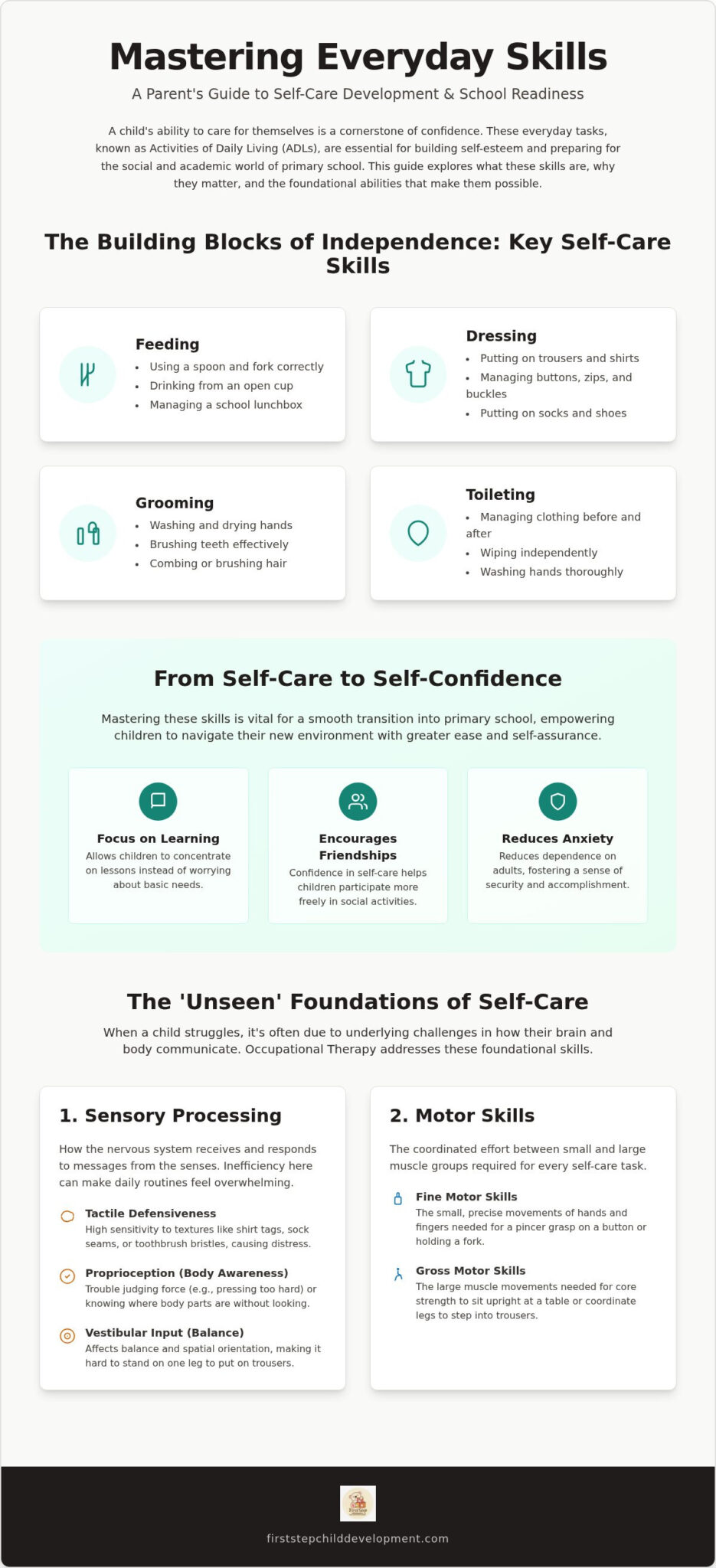
Self-care skills are the essential routines we perform daily. For children, these typically include:
- Feeding: This involves more than just eating. It includes using a spoon and fork correctly, drinking from an open cup without spilling, and independently managing a lunchbox at school.
- Dressing: This covers everything from pulling on trousers and putting on a t-shirt to managing more complex fasteners like buttons, zips, and buckles on shoes or a traditional baju Melayu.
- Grooming: These are hygiene-related tasks such as washing and drying hands, brushing teeth, and combing hair.
- Toileting: This skill involves managing clothing before and after using the toilet, wiping, and washing hands independently.
Why Independence Matters for School Readiness
The leap to primary school, or Standard 1, is a significant milestone in Malaysia. Teachers expect children to have a baseline of independence to manage a larger, more structured classroom environment. A child who can confidently manage their own toilet needs, open their lunchbox, and put on their shoes after physical education is better equipped to focus on learning and making friends.
When a child is overly dependent on adults for these basic tasks, it can lead to social challenges. They may feel anxious, avoid group activities, or become singled out by peers. Building self-care skills before school begins helps reduce this anxiety, empowering your child to navigate their new environment with greater ease and self-assurance.
The Sensory and Motor Foundations of Daily Tasks
When a child struggles with a seemingly simple task like putting on socks, it’s rarely a matter of defiance. Often, there are “unseen” barriers related to how their brain and body are communicating. Occupational therapy helps identify and address these foundational challenges, which typically fall into two categories: sensory processing and motor skills.
Sensory Processing and Self-Care
Sensory processing is how our nervous system receives messages from the senses and turns them into appropriate motor and behavioural responses. If this system is not working efficiently, daily routines can feel overwhelming.
- Tactile Defensiveness: A child may be highly sensitive to certain textures. The tag on a shirt, the seams on socks, or the bristles of a toothbrush can feel intensely uncomfortable, leading to meltdowns during dressing or grooming.
- Proprioception: This is our “body awareness” sense, which tells us where our body parts are and how much force to use. A child with poor proprioception might squeeze toothpaste all over the counter or press so hard with a crayon that it breaks.
- Vestibular Input: This sense, governed by our inner ear, controls balance and spatial awareness. A child might struggle to stand on one leg to pull on their trousers without falling over.
Fine and Gross Motor Requirements
Self-care tasks require a coordinated effort between large and small muscle groups.
- Fine Motor Skills: These are the small, precise movements of the hands and fingers. A pincer grasp is needed to pick up a small button, while a tripod grip is essential for holding a fork or toothbrush correctly.
- Gross Motor Skills: These involve the large muscles of the body. Good core strength is necessary for a child to sit upright at the dinner table without slumping, and coordination is needed to lift their legs into their trousers.
Understanding these underlying components is the first step. An occupational therapist can help pinpoint the exact source of the difficulty. Learn more about how professionals evaluate these skills in our guide to occupational therapy assessments in Malaysia.
Self-Care Milestones: When to Seek Occupational Therapy
Every child develops at their own unique pace, and there is a wide range of what is considered “normal.” However, developmental milestones can serve as a helpful guide for parents. It’s important to distinguish between a child who “won’t do” a task (which may be behavioural) and one who “can’t do” it despite trying (which suggests a skill-based challenge).
If you have consistently taught and encouraged a skill but your child continues to struggle significantly more than their peers, it may be time to seek a professional opinion.
Age-Appropriate Self-Care Expectations
Here is a general timeline for self-care skills. Remember, this is a guide, not a strict checklist.
- Toddlers (2-3 years): Can pull down their own trousers, remove socks and unlaced shoes, and begin using a spoon to feed themselves.
- Preschoolers (4-5 years): Can dress and undress independently (except for complex fasteners), use the toilet on their own, brush their teeth with supervision, and put on shoes (though may still need help with laces).
- Primary Age (6-7 years): Should be able to manage all aspects of dressing, including buttons and zips, bathe with minimal supervision, and manage their belongings at school.
Identifying the Need for an OT Assessment
Consider seeking an assessment if you consistently notice the following “red flags”:
- Your child has extreme difficulty following simple two-step instructions for routines (e.g., “Take off your shoes and put them in the rack”).
- They show intense frustration, anger, or complete avoidance when faced with a specific self-care task like brushing teeth or getting dressed.
- Despite repeated practice and encouragement at home, they are not making progress with age-appropriate skills.
- Morning and evening routines are a constant source of family stress and conflict.
These challenges can sometimes be part of a broader picture. A comprehensive neurodevelopmental assessment can help determine if the difficulties are isolated or related to other developmental conditions.
How-To: Practical OT Strategies for Home Success
Occupational therapy doesn’t just happen in a clinic; its success relies on integrating strategies into your child’s daily life. Empowering parents with practical tools is a core part of the process. Here are some effective techniques you can use at home to support your child’s journey towards independence.
The Backward Chaining Method
This is a powerful technique used by therapists to teach multi-step tasks without causing frustration. Instead of asking the child to start from the beginning, you start at the end. It ensures the child always finishes on a note of success.
- Parent Does Most of the Work: You complete every step of the task except for the final one. For example, when putting on a shirt, you help your child put it over their head and get their arms through the sleeves.
- Child Completes the Final Step: You leave the very last step for your child, such as pulling the shirt down over their tummy. They complete it and immediately feel a sense of accomplishment.
- Gradually Move Backward: Once they have mastered the last step, you complete all steps except the last two. Now, they put their second arm in the sleeve and pull the shirt down. You continue moving backward one step at a time until the child can complete the entire task from the beginning.
This method works because it minimizes failure and builds confidence, making your child more willing to try.
Task-Specific Tips for Parents
- For Dressing: Practice with loose-fitting clothing first, as it’s easier to manage. Have your child sit on a low stool or the floor when putting on trousers and socks to improve their balance.
- For Feeding: If your child struggles with hand awareness, try using slightly weighted or wider-handled utensils. This can provide more sensory feedback and improve control.
- For Grooming: For a child sensitive to noise, the echo in a bathroom can be distressing. Placing a soft rug on the floor or keeping the door open can help dampen the sound. Let them choose their own toothbrush or toothpaste flavour to give them a sense of control.
- For All Routines: A visual schedule with pictures or drawings of each step in the morning routine (e.g., wake up, use toilet, brush teeth, get dressed, eat breakfast) can provide predictability and reduce anxiety.
Personalized Occupational Therapy at Firststep
At Firststep Child Development Centre, we understand that every child’s journey is unique. Our approach to pediatric occupational therapy is gentle, play-based, and centered on your child’s individual strengths and challenges. We believe in creating a safe, nurturing environment where children feel empowered to try new things without fear of failure.
The process begins with a comprehensive occupational therapy assessment. This initial evaluation allows our therapists to understand the root causes of your child’s difficulties through clinical observation disguised as purposeful play. We collaborate closely with our in-house team of clinical psychologists and pediatricians to ensure a holistic view of your child’s development.
What Happens in a Firststep OT Session?
An OT session at our centres in Kuala Lumpur or Selangor looks a lot like play, but every activity is carefully chosen to target specific goals. A session might involve:
- Swinging on a therapy swing to improve vestibular processing and balance.
- Playing with therapeutic putty or beads to build fine motor strength for buttoning.
- Navigating an obstacle course to enhance motor planning and coordination needed for dressing.
Throughout the process, we provide regular feedback and create a customized home program. We see parents as our most important partners, and empowering your family with the right strategies is key to your child’s long-term progress.
Starting Your Journey with Firststep
If you feel your child could benefit from professional support, the first step is often a consultation. This allows us to understand your concerns in detail and recommend the most appropriate path forward, whether it’s a specialized OT evaluation or a broader assessment. Sometimes, understanding the emotional or behavioural components is also helpful, which is where our child psychology services can provide additional insight.
Frequently Asked Questions (FAQs)
How long does it take to see progress in self-care skills with OT?
Progress varies for every child. It depends on the complexity of their challenges, the frequency of therapy, and the consistency of practice at home. Some children show improvements in a few months, while others may need longer-term support. The goal is steady, sustainable progress.
Can occupational therapy help my child with picky eating in Malaysia?
Yes. Picky eating can often be linked to sensory sensitivities (e.g., textures, smells) or oral-motor challenges. An occupational therapist can work on desensitizing a child to different food textures and strengthening the oral muscles needed for chewing through a play-based approach called “food chaining.”
Is my child too old to start occupational therapy for self-care?
It’s never too late to build foundational skills. While early intervention is ideal, occupational therapy can benefit older children and teenagers who still struggle with daily living activities, helping them build confidence and independence for life.
What is the difference between a behavioural issue and a self-care skill delay?
A behavioural issue is often when a child can perform a task but won’t, perhaps due to a power struggle or seeking attention. A skill delay is when a child can’t perform the task because of an underlying sensory, motor, or planning challenge. An OT assessment is the best way to distinguish between the two.
Do I need a doctor’s referral for occupational therapy in Malaysia?
While a referral from a pediatrician or doctor is helpful, it is not always required to book an initial assessment at a private centre like Firststep. You can contact us directly to discuss your concerns.
Can OT help my child with ADHD focus on getting dressed?
Absolutely. Occupational therapists can help children with ADHD by breaking down tasks into manageable steps, using visual schedules to keep them on track, and incorporating sensory strategies that help improve focus and reduce fidgeting during routines.
How can I support my child’s OT goals if I work full-time?
Consistency is more important than quantity. Your therapist will provide a home program with simple, effective activities that can be integrated into your existing daily routines, such as during bath time or before bed. Even 10-15 minutes of focused practice each day can make a significant difference.
What should I bring to my child’s first OT assessment?
Bring any previous developmental reports or school feedback you may have. It’s also helpful to have a list of your main concerns and specific examples of the tasks your child finds difficult. Most importantly, come prepared to share your unique insights into your child’s strengths and personality.
Helping your child develop self-care skills is a journey of patience and celebration. If you are concerned about your child’s progress, know that professional and compassionate support is available. Understanding the root of the challenge is the first step towards building a future of confidence and independence.
To learn more about how our team can support your family, explore our pediatric occupational therapy services or contact us for a consultation. You can find more information about our approach at https://firststepchilddevelopment.com/.
Article by
Firststep Child Development Team
Firststep Child Development Team provides evidence-informed educational resources to help parents better understand child development, behaviour and learning. Our multidisciplinary services include clinical psychology, occupational therapy, speech and language therapy, developmental assessments and other child development support in Kuala Lumpur and Selangor.
Disclaimer
This article is for general educational and informational purposes only and is not a substitute for professional medical, psychological or therapeutic advice, diagnosis or treatment. Every child develops differently. If you have concerns about your child’s development, behaviour, learning or wellbeing, please consult an appropriately qualified healthcare or allied health professional.