



Last week, a mother sat in our waiting area, gently explaining to her son that they were visiting a special playroom to meet a teacher who helps children understand how their brains work. It’s natural to feel a sense of hesitation or even fear when you begin preparing your child for a psychological evaluation. You might worry about the weight of a potential label or wonder if the process itself will cause your little one unnecessary stress.
We believe that an assessment should be a supportive experience that provides a path forward rather than a source of anxiety. This guide will show you how to support your child emotionally and logistically to ensure accurate results and a stress-free visit. By approaching the session with quiet confidence, you help create a safe space where your child’s true potential can be observed through play and engagement.
We’ll explore how to explain the appointment in age-appropriate terms, what to pack for the day, and how to manage the practical details of the visit. You’ll gain the clarity needed to help your child feel calm, cooperative, and ready for their next steps in development.
Key Takeaways
- Shift the perspective from “identifying problems” to a holistic understanding of your child’s unique developmental and cognitive strengths.
- Discover how to use calm, honest language when preparing your child for a psychological evaluation to help them feel safe and reduce performance anxiety.
- Learn practical logistics, such as optimal scheduling and physical readiness, that ensure your child can perform at their best during the session.
- Gain clarity on what happens during the assessment process and how collaborative feedback helps you plan the next steps for your family’s journey.
Understanding the Purpose of a Child Psychological Evaluation
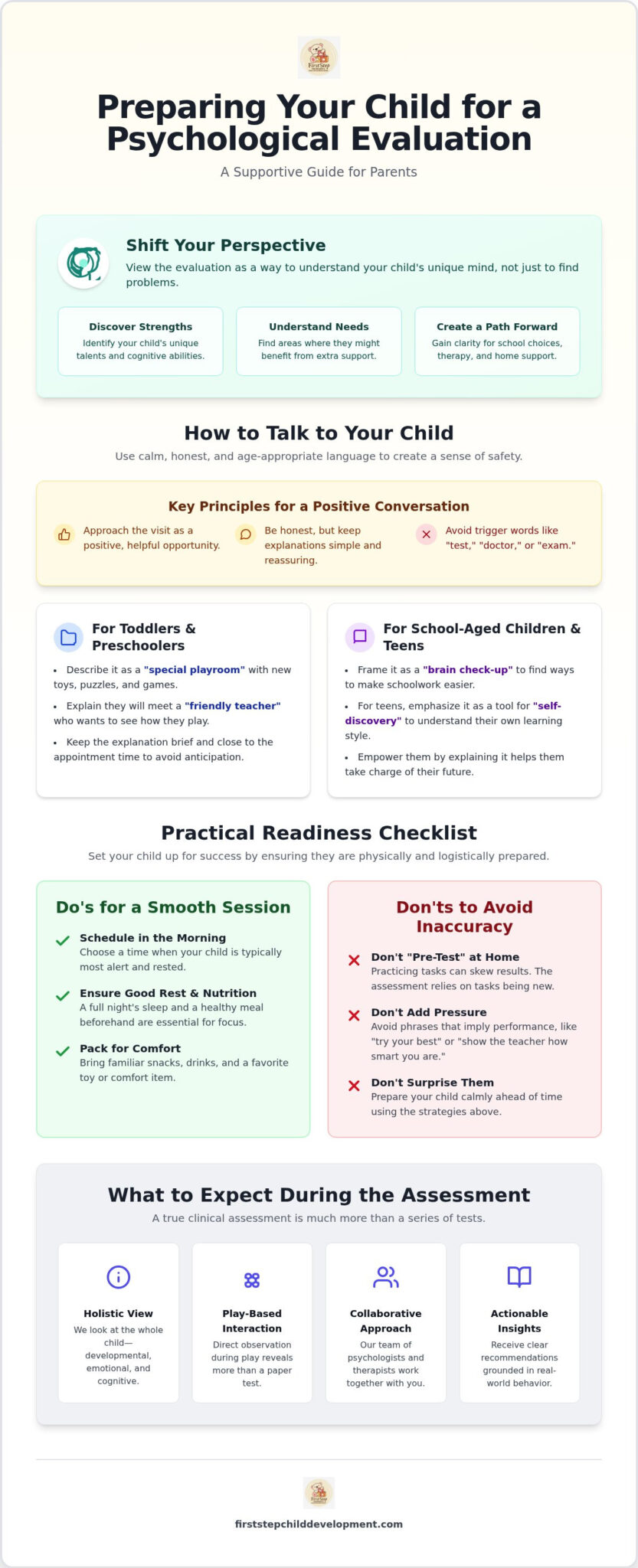
A psychological evaluation is much more than a simple checklist. It’s a comprehensive look at your child’s developmental, emotional, and cognitive landscape. When you are preparing your child for a psychological evaluation, it helps to shift your perspective. Rather than searching for a deficit or a problem, think of this as a way to discover how your child’s mind works. Every child has a unique set of strengths, and identifying these is just as important as finding areas where they might need a little extra support.
The ultimate goal is to create a clear path forward. By seeking a neurodevelopmental assessment Malaysia, you’re gathering the information needed to guide future school choices, therapy needs, and home support. This process is most effective when it’s multidisciplinary. At our centre, we involve clinical psychologists, therapists, and even nutritionists to ensure we see the whole child. This collaborative approach provides a level of professional clarity that a single test simply cannot offer.
The Difference Between Testing and Assessment
It’s common to use the terms “testing” and “assessment” interchangeably, but they serve different roles. Testing refers to the standardised tools used to measure specific skills, like memory or reading speed. While these numbers are useful, they’re only one part of the story. Understanding this distinction is vital when preparing your child for a psychological evaluation, as a true clinical assessment is much broader and more human.
We place a heavy emphasis on play-based interactions and direct observations. Watching how a child solves a puzzle, interacts with a new person, or handles a minor frustration tells us things a paper test never could. This holistic view ensures that our final recommendations are grounded in your child’s real-world behaviour. It’s about seeing the person behind the data and unlocking their full potential.
How to Talk to Your Child About the Evaluation
One of the most delicate parts of preparing your child for a psychological evaluation is the initial conversation. Children are highly perceptive and often pick up on parental stress. The general rule is to be honest, keep explanations simple, and remain calm. If you approach the visit as a positive opportunity, your child is likely to do the same.
Try to avoid trigger words such as “test,” “doctor,” or “exam.” For many school-aged children, these terms are linked to performance anxiety or physical discomfort. Instead, use positive framing. You might say, “We are going to find out how your brain works best so we can help you at school.” If you feel uncertain about the sequence of events, reviewing how does an assessment work can help you speak with more confidence.
Scripts for Toddlers and Preschoolers
At this age, the focus should remain entirely on the “play” aspect of the visit. You can describe the centre as a special playroom filled with new toys, puzzles, and games. Explain that they’ll meet a friendly teacher who wants to see how they play and solve problems. Keep the explanation brief and close to the appointment time to prevent an unnecessary build-up of anticipation.
Explaining the Visit to School-Aged Children and Teens
Older children benefit from knowing that this visit is a “brain check-up.” It’s helpful to explain that everyone learns differently, and this session is about finding the right tools to make schoolwork feel easier. For teenagers, emphasise self-discovery. Frame the evaluation as a way for them to understand their own cognitive profile, which empowers them to take charge of their future. If you’d like to discuss these strategies further, a clinical psychologist consultation can provide personalised guidance for your specific situation.
Practical Steps: Logistics and Physical Readiness
Physical readiness is just as critical as emotional support when preparing your child for a psychological evaluation. A child’s physical state directly influences their cognitive performance and their ability to regulate emotions during tasks. We recommend scheduling sessions for the morning, when children are typically at their most alert. This timing ensures we see your child’s peak functioning before the natural fatigue of the day sets in.
It’s vital that parents avoid “pre-testing” or practicing similar tasks at home. Standardised results rely on the tasks being novel; prior exposure can skew data and fail to reflect natural abilities. If your child has specific feeding issues that might affect their energy, you may wish to discuss this during a nutritionist consultation to ensure they’re physically supported throughout the process.
The Night Before and Morning Of
A restful night’s sleep is the foundation for a successful session. On the morning of the assessment, provide a protein-rich breakfast to maintain steady energy levels. Keep your morning routine predictable. Reducing household stress before you arrive helps your child enter our centre in a calm, receptive state of mind.
What to Pack for the Session
Comfort is key. Feel free to bring a favourite toy or blanket for younger children. For longer assessment packages, pack a water bottle and healthy, non-messy snacks. These small comforts provide security and keep hunger at bay during breaks. If you’re ready to begin, you can book a clinical psychologist assessment to learn more about our multidisciplinary approach.
What to Expect During and After the Assessment
A clinical psychologist assessment typically unfolds in three structured stages: an initial parent interview, direct child observation, and standardised testing. While preparing your child for a psychological evaluation, it’s reassuring to know that you are often nearby or even directly involved in the room. This is especially true for younger children or play-based sessions, ensuring they feel secure while the clinician gathers a holistic view of their developmental landscape.
The process concludes with a feedback session, which serves as your family’s roadmap. This meeting translates clinical data into actionable advice tailored to your child’s unique profile. For younger children, these results might indicate that an Early Intervention Program (EIP) is the most effective next step to provide specialised support during critical developmental windows.
Navigating the Feedback Session
During this session, prepare to hear a balanced perspective on your child’s cognitive strengths and areas for growth. It’s helpful to bring a list of specific questions regarding school support in Malaysia. Whether you’re navigating international school systems or local curricula, this session provides the professional clarity needed to advocate for your child’s unique needs effectively.
Integrating Results with School and Home
The final report is a powerful document for teachers in KL and Selangor schools. It enables them to implement targeted classroom strategies, such as modified instructions or environmental adjustments, that align with how your child learns best. Remember that preparing your child for a psychological evaluation is the start of a supportive journey. These results are not a final destination; they are a foundation for empowering your child to flourish in their daily life.
Empowering Your Child’s Developmental Journey
Preparing your child for a psychological evaluation is a significant step toward unlocking their full potential and ensuring they receive the right support at home and in school. By focusing on a play-based approach and maintaining a calm, honest dialogue, you help transform a clinical process into a positive experience of self-discovery. Whether you’re navigating the early years or supporting a teenager, remember that this assessment is a tool for clarity and growth rather than a final label.
Our multidisciplinary team of experts at Firststep provides a compassionate, play-based environment that’s trusted by parents across Kuala Lumpur and Selangor. We’re here to partner with you every step of the way, offering detailed feedback that serves as a practical roadmap for your family. If you’re ready to understand your child’s unique potential, learn more about our clinical psychologist assessments or visit our homepage to connect with our team. You’re taking a proactive step toward a brighter, more supported future for your child.
Frequently Asked Questions
How long does a typical child psychological evaluation take?
A typical assessment usually takes between three to six hours, often divided into multiple sessions to prevent fatigue. When you are preparing your child for a psychological evaluation, it’s helpful to know that we prioritise their comfort over speed. At our centre in Petaling Jaya, we may schedule shorter blocks across two days. This ensures your child remains alert and engaged, which leads to more accurate and reliable results.
Will I be in the room with my child during the assessment?
Your presence in the room depends on your child’s age and comfort level. For toddlers and preschoolers, parents are usually present to provide emotional security. For school-aged children and teens, we often suggest one-on-one sessions to allow for independent interaction with the psychologist. We always discuss this with you beforehand, ensuring you’re nearby in our waiting area in Selangor if your child needs a quick comfort break or reassurance.
What if my child refuses to cooperate or has a meltdown during the session?
There is no need to worry if your child has a difficult moment or refuses to cooperate. Our multidisciplinary team is highly experienced in managing emotional outbursts and resistance using a gentle, play-based approach. We simply pause the session, offer a quiet space for regulation, or reschedule if the child is too overwhelmed. These observations actually provide valuable clinical insights into your child’s emotional regulation and sensory needs in real-world situations.
Can a psychological evaluation help with an ADHD or Autism diagnosis in Malaysia?
Yes, a comprehensive evaluation is a primary tool for identifying neurodevelopmental conditions like ADHD and Autism in Malaysia. By preparing your child for a psychological evaluation, you’re enabling our team to use standardised diagnostic tools and clinical observations. These sessions help us understand your child’s unique cognitive profile. While we don’t provide medical prescriptions, our reports offer the professional clarity needed to access specialised therapy or school support in Kuala Lumpur.
How soon will we receive the final report and feedback?
You can typically expect to receive the detailed feedback report within two to three weeks after the final assessment session. This timeframe allows our team to score standardised tests and collaborate on a multidisciplinary review of the findings. We then schedule a dedicated parent consultation to explain the results in plain English. This ensures you leave our centre with a clear, actionable roadmap for your child’s next steps and future growth.

Article by
Firststep Child Development Team
Firststep Child Development Team provides evidence-informed educational resources to help parents better understand child development, behaviour and learning. Our multidisciplinary services include clinical psychology, occupational therapy, speech and language therapy, developmental assessments and other child development support in Kuala Lumpur and Selangor.
Disclaimer
This article is for general educational and informational purposes only and is not a substitute for professional medical, psychological or therapeutic advice, diagnosis or treatment. Every child develops differently. If you have concerns about your child's development, behaviour, learning or wellbeing, please consult an appropriately qualified healthcare or allied health professional.