



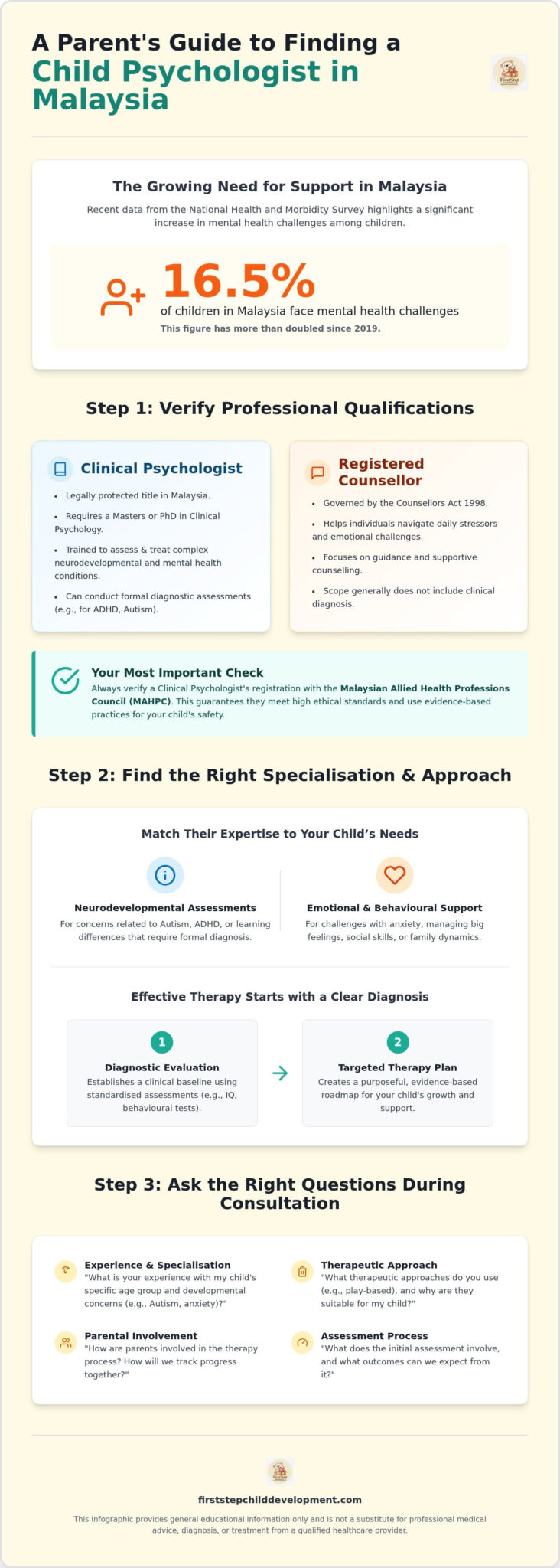
Recent data from the National Health and Morbidity Survey reveals that 16.5% of children in Malaysia now face mental health challenges, a figure that has more than doubled since 2019. As a parent, noticing your child struggle with emotional or behavioural hurdles is deeply personal and often overwhelming. It’s natural to feel a sense of urgency while wondering how to find a good child psychologist who truly understands your child’s unique needs without the experience feeling overly clinical or intimidating.
You want to ensure your child receives expert support, but navigating credentials and therapeutic approaches shouldn’t be a source of stress. This guide provides a clear roadmap for parents in the Klang Valley and beyond. We’ll help you distinguish between different professional roles, verify essential MAHPC registrations, and explain what a gentle, play-based diagnostic process actually looks like. By understanding these specialisations and therapeutic styles, you can feel confident that your child’s developmental journey is in safe, compassionate, and expert hands.
Key Takeaways
- Learn how to verify professional credentials by checking MAHPC registration to distinguish between clinical psychologists and registered counsellors in Malaysia.
- Discover how to find a good child psychologist by matching their specific expertise—whether in neurodevelopmental assessments or emotional regulation—to your child’s unique needs.
- Understand why a multidisciplinary, play-based approach is essential for creating a gentle and effective therapeutic environment for younger children.
- Identify the critical questions to ask during your first consultation, ensuring the specialist has relevant experience with your child’s specific age group and developmental concerns.
Understanding Qualifications and Professional Standards in Malaysia
When researching how to find a good child psychologist, the first step is understanding the legal landscape in Malaysia. In our local context, the term “psychologist” is often used broadly, but the title “Clinical Psychologist” is legally protected. Since July 2020, the Allied Health Professions Act 2016 (Act 774) mandates that every clinical psychologist must be registered with the Malaysian Allied Health Professions Council (MAHPC). This differs from registered counsellors, who are governed by the Counsellors Act 1998 and typically focus on helping individuals navigate daily stressors or emotional challenges.
Clinical psychologists must complete a rigorous educational path, involving a specialised Masters or PhD in Clinical Psychology. This intensive training allows them to bridge the gap between emotional support and medical understanding. A Clinical Psychologist is a specialist trained in assessing and treating complex neurodevelopmental and mental health conditions. They possess the expertise to conduct deep-dive evaluations, such as a clinical psychologist assessment, which provides a comprehensive view of a child’s developmental profile.
Why Clinical Registration Matters for Your Child
Registration isn’t just a formality; it acts as a vital safety net for your family. It guarantees that the professional maintains high ethical standards and employs evidence-based practices rather than unproven methods. When a practitioner is MAHPC-registered, they’re accountable to a regulatory body, providing parents with a clear path for recourse if professional conduct is ever in question. This formal oversight ensures that your child’s therapy is grounded in Understanding Child Psychotherapy and validated clinical protocols. Ultimately, choosing a registered professional means you’re partnering with an expert who is committed to the highest level of care and transparency.
Identifying the Right Specialisation for Your Child’s Needs
Identifying the right professional involves looking beyond the general title to the specific challenges your child is facing. Some children require support for emotional regulation, such as managing big feelings or social anxiety. Others may need specialised Clinical Psychologist Assessments to investigate neurodevelopmental conditions. A significant advantage in the Malaysian healthcare landscape is the multidisciplinary team. When clinical psychologists collaborate closely with paediatricians and occupational therapists, they provide a comprehensive view that a solo practitioner might miss. This integrated care is especially helpful when looking for specialists in ADHD or Autism, where medical and psychological insights often overlap.
This team-based approach allows for a “whole-child” perspective. For example, a child’s struggle with focus in school might stem from a sensory processing issue, a learning gap, or even a nutritional deficiency. By having experts from various fields working together, parents in KL and Selangor avoid the stress of coordinating between different clinics. This level of coordination is a hallmark of quality care. It ensures that every professional is on the same page, moving toward the same goals for your child’s development.
Assessment vs. Ongoing Therapy
A common question for parents learning how to find a good child psychologist is whether to start with therapy or an evaluation. A thorough journey usually begins with a diagnostic evaluation. This process involves standardised testing, including IQ and behavioural assessments, to establish a clear clinical baseline. These results inform the therapeutic plan, ensuring that interventions are targeted and purposeful rather than generic. By choosing a professional who prioritises this diagnostic phase, you gain a clear roadmap for your child’s future growth. If you aren’t sure which path is right, a clinical psychologist consultation can help clarify the most effective next steps for your family.
Evaluating the Therapeutic Approach: Play, Talk, and Connection
Choosing the right methodology is just as vital as checking credentials. While adults often benefit from traditional talk therapy, younger children lack the vocabulary to express complex internal struggles. This is why Play Therapy is so effective. It allows the specialist to observe a child’s natural behaviour, social cues, and emotional regulation in a safe, familiar setting. When researching how to find a good child psychologist, prioritise those who use play to bridge the gap between clinical objectives and your child’s daily reality. A skilled professional uses these sessions to identify patterns and provide you with clear, actionable feedback that you can implement immediately.
The relationship should feel like a partnership. We often describe this as the “Trusted Advisor” persona. Instead of working in isolation, the psychologist acts as a compassionate guide for the entire family. They’re transparent about the therapeutic process, explaining the “why” behind each activity. This collaborative spirit ensures that therapy isn’t a mysterious hour once a week, but a purposeful journey toward empowerment and growth for your child. It’s about building a connection where the child feels seen and the parents feel supported.
The Role of Parental Involvement
A child’s progress is most sustainable when their support system is unified. When considering how to find a good child psychologist, ensure they offer dedicated parent consultation and guidance. This forms part of a “wraparound” care model where strategies used in the clinic are aligned with home and school environments. When everyone is on the same page, the child feels understood across all areas of their life. This consistency reduces confusion and accelerates developmental milestones. If you’re seeking a team that values your role in the process, you can explore our consultation services to see how we partner with families for long-term success.
Key Questions to Ask During Your Initial Consultation
The first meeting is a vital opportunity to ensure a specialist aligns with your family’s values and your child’s unique needs. When researching how to find a good child psychologist, your questions should move beyond basic logistics to explore their clinical depth. We recommend a structured approach to this conversation to gain professional clarity and peace of mind:
- Step 1: Ask about their specific experience with your child’s age group and primary concern. A toddler’s developmental milestones require a vastly different clinical lens than the social complexities faced by a teenager.
- Step 2: Enquire about their assessment process and what the final report will include. A quality report provides a detailed roadmap with actionable strategies for both teachers and caregivers rather than just a simple label.
- Step 3: Confirm their registration status with the MAHPC and their clinical affiliations in Malaysia to ensure they meet the 2026 regulatory standards for clinical practice.
- Step 4: Ask how they coordinate care with other professionals. Progress is often more sustainable when a psychologist proactively shares insights with speech therapy or pediatric occupational therapy specialists.
Red Flags to Watch For
While seeking support, it’s essential to remain vigilant. Avoid practitioners who guarantee a specific “cure” or immediate results. Therapeutic progress is a journey of steady development, not a series of instant fixes. Be cautious of overly generic feedback that doesn’t feel personalised to your child’s specific behaviours and strengths. A “trusted advisor” will always provide nuanced, evidence-based insights rather than templated responses. If a consultation feels rushed or the professional avoids explaining their methodology, it may be a sign to continue your search elsewhere. Knowing how to find a good child psychologist means prioritising transparency and clinical honesty over easy promises.
Empowering Your Child’s Developmental Journey
Finding the right support starts with verifying professional credentials and ensuring your specialist is registered with the MAHPC. You now have the tools to distinguish between clinical roles and understand why a multidisciplinary team, including paediatricians and nutritionists, offers a more comprehensive path forward. By prioritising a gentle, play-based environment, you ensure that therapy feels like a safe haven rather than an intimidating clinical experience. Knowing how to find a good child psychologist is about more than just checking a list; it’s about building a partnership with a trusted advisor who values your child’s unique potential.
If you’re concerned about your child’s development or emotional wellbeing, learn more about our Clinical Psychologist Consultations or visit Firststep Child Development to explore our specialised neurodevelopmental assessment packages. Taking this first step is a profound act of care that sets the foundation for your child’s future growth and happiness.
Frequently Asked Questions
What is the difference between a child psychologist and a psychiatrist in Malaysia?
In Malaysia, the primary difference lies in the approach to care and medical authority. A clinical psychologist focuses on psychological assessments and therapy to address developmental or emotional concerns. Conversely, a psychiatrist is a medical doctor who can prescribe medication for mental health conditions. While both professionals support your child’s wellbeing, a clinical psychologist uses non-medical interventions like play therapy or behavioural strategies to foster growth and potential.
How many sessions will my child need before we see progress?
Every child’s developmental journey is unique, so the number of sessions depends on their specific needs and goals. Many families begin to notice subtle shifts in communication or emotional regulation after six to eight sessions. However, progress is a steady process rather than an immediate result. Regular parent consultation and guidance sessions are also vital to ensure that the strategies used in the clinic are consistently applied at home for long-term success.
Can a child psychologist help with school refusal or learning difficulties?
Yes, a clinical psychologist is specifically trained to identify the underlying causes of school refusal or academic struggles. By conducting a learning difficulties assessment or an IQ assessment, the specialist can determine if the issue stems from an undiagnosed learning gap, anxiety, or sensory processing challenges. Understanding how to find a good child psychologist involves seeking a professional who provides a clear roadmap to help your child feel confident and supported in the classroom.
Is a referral from a pediatrician necessary to see a child psychologist in KL?
You don’t strictly need a referral to book a private consultation in KL or Selangor. However, many parents find it helpful to start with their paediatrician, especially if there are physical health concerns. At Firststep, we work within a multidisciplinary team that includes paediatricians and nutritionists. This collaborative approach ensures that all aspects of your child’s health and development are addressed through a single, coordinated and professional care plan.
What should I tell my child before their first appointment to reduce anxiety?
It’s best to describe the visit as a chance to meet a new friend who helps children understand their feelings through play. Explain that they’ll be in a gentle, play-based environment where they can talk, draw, and play with toys. Avoid using words like ‘doctor’ or ‘test’ if those trigger anxiety. Emphasising that you’ll be nearby and that the session is a safe space helps them feel secure, calm, and curious.

Article by
Firststep Child Development Team
Firststep Child Development Team provides evidence-informed educational resources to help parents better understand child development, behaviour and learning. Our multidisciplinary services include clinical psychology, occupational therapy, speech and language therapy, developmental assessments and other child development support in Kuala Lumpur and Selangor.
Disclaimer
This article is for general educational and informational purposes only and is not a substitute for professional medical, psychological or therapeutic advice, diagnosis or treatment. Every child develops differently. If you have concerns about your child's development, behaviour, learning or wellbeing, please consult an appropriately qualified healthcare or allied health professional.