



When a child refuses to go to school, the behaviour may be a sign of distress rather than something to punish. If mornings have become tense or drop-offs increasingly difficult, it’s understandable to want a clear answer. Child Refuses to Go to School: Causes & What Parents Can Do explores what may be making school feel hard and how to respond without jumping to conclusions.
School refusal can have emotional, social, academic or health-related causes. A child may struggle to explain what is wrong, and pressure or punishment can add to the distress. A calm, curious response is a helpful place to begin.
This guide explains how to notice possible reasons, support your child at home and work with their school on practical next steps. It also covers when persistent distress may call for professional guidance, including support for families in Kuala Lumpur, Petaling Jaya and Selangor.
Key Takeaways
- School refusal describes difficulty attending linked to distress. It is a reason to explore what is happening, not a diagnosis or automatic sign of misbehaviour.
- Consider emotional, social, academic, health and routine-related factors, including separation worries, peer difficulties, workload and changes at home.
- When a child refuses to go to school, begin by listening calmly, noticing patterns and agreeing on a manageable next step without threats or shame.
- If distress persists or disrupts daily life, a child psychology consultation in Kuala Lumpur, Petaling Jaya or Selangor can help explore your child’s needs without assuming a diagnosis.
Child Refuses School: Understanding the Behavior
Repeated resistance to school deserves curiosity and support, not automatic blame. A child may be unable to explain what feels difficult, even when their distress is real. In plain English, school refusal means difficulty attending or staying at school that is linked to emotional distress. It describes a pattern, not a diagnosis. A peer-reviewed review of school refusal offers further background, but your child’s individual circumstances matter most.
This differs from truancy, which may involve skipping school without a parent’s knowledge or approval. Distress-related avoidance is often visible to caregivers, but behaviour alone cannot confirm either explanation. One difficult morning, or a change in attendance, is not enough to draw a conclusion. Start with questions rather than labels.
How school refusal may appear in everyday routines
Notice whether difficulty tends to arise at a particular point, such as getting dressed, leaving home, arriving at the school gate or separating from you. Your child might cry, become unusually quiet, cling to you or report a stomach ache or headache. Take physical complaints seriously: they should not be dismissed as invented, but they do not identify a cause on their own. Note when the distress starts, whether it eases at home and what your child says about school. Brief notes can help you spot patterns to discuss with school staff.
Why refusal is not enough to identify a cause
Similar behaviour can have different explanations. Your child may be worried about separation, struggling with friendships or classroom demands, adjusting to a transition, coping with a health concern or reacting to a change at home. Attendance difficulties alone cannot establish anxiety, ADHD, autism or another condition. If attention or learning concerns are also part of the picture, an ADHD assessment in Malaysia can help explore your child’s needs. School refusal itself is not evidence of ADHD. Consider the whole context, including what your child experiences before, during and after school.
Why Children May Refuse School: Emotional, Social, and Learning Factors
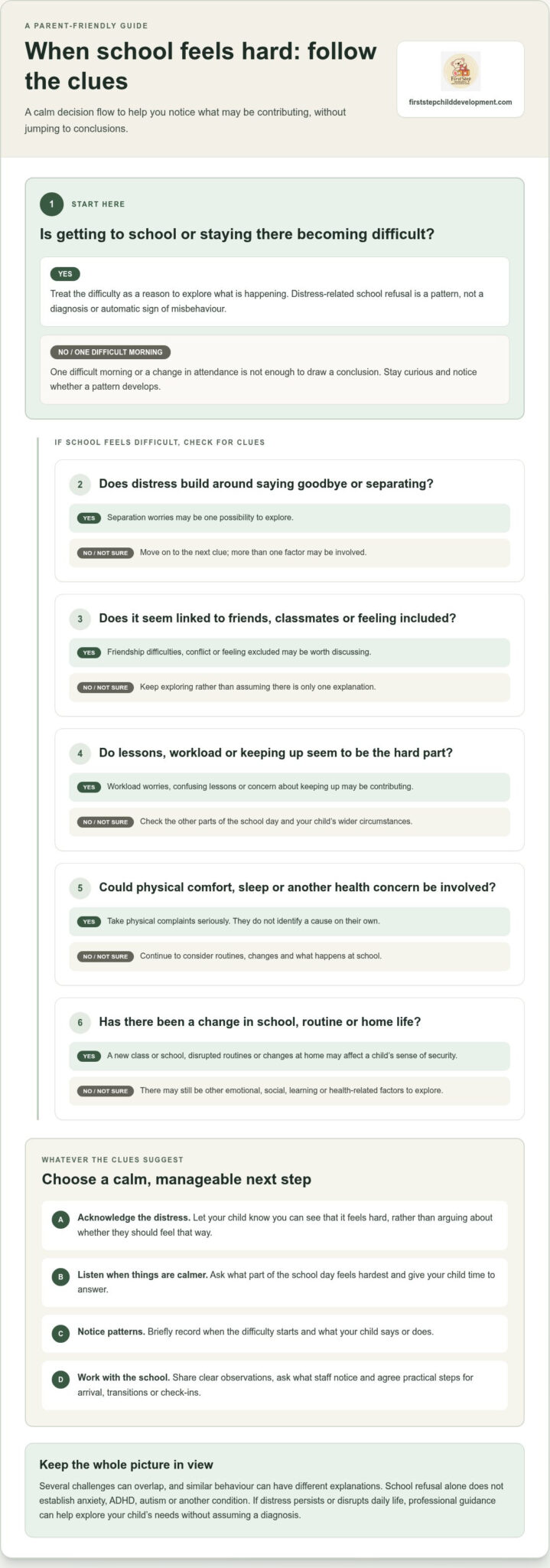
There is no single explanation that fits every child. To understand why a child may refuse to go to school, consider several possibilities that can overlap:
- Emotional: separation worries, fear of making mistakes or feeling overwhelmed.
- Social: friendship difficulties, conflict with classmates or feeling excluded.
- Academic: workload concerns, lessons that feel confusing or worries about keeping up.
- Health: physical discomfort, poor sleep or another health concern that makes the school day harder.
- Routine and change: a new class or school, disrupted routines or changes at home that affect a child’s sense of security.
A child may be managing more than one challenge, such as finding lessons difficult while also feeling unsettled by a change in routine. Treat these as possibilities to explore, not conclusions to draw from attendance alone.
Look for patterns without trying to diagnose
Notice when distress begins, which situations seem hardest and what appears to bring relief. Is it strongest before a particular lesson, after a weekend or when it is time to say goodbye? Compare your child’s account with what you observe and what school staff notice. If attention-related concerns also arise in different settings, an ADHD assessment may help explore the wider picture. School refusal alone does not establish ADHD.
Questions that can help a child explain what feels difficult
Choose a calm moment rather than the rushed school run. Try open questions such as, “What part of the school day feels hardest?” or “How are things with the other children?” Give your child time to answer and avoid suggesting what they should feel. One concern, or several interacting emotional, social, learning, health or routine-related factors, may be contributing.
To learn more about support for children’s development, explore Firststep’s child development services.
What Parents Can Do When a Child Will Not Go to School
A difficult morning can leave everyone unsettled. There is no single answer for every family, but a calm, consistent response can help you understand what is happening and choose a manageable next step.
- Acknowledge the distress. Try, “I can see this feels hard today,” rather than arguing about whether your child should feel this way.
- Listen when things are calmer. Ask what feels difficult and allow time for an answer. You do not need to solve everything in that moment.
- Notice patterns. Keep a brief record of when the difficulty occurs and any details that may help explain it.
- Agree on one next step. Depending on the situation, this might mean following the usual getting-ready routine or contacting the school to discuss support.
Responding to difficult mornings
Keep your words short and steady: “I know you’re worried. Let’s get dressed, then we’ll talk about what would help.” A predictable routine may offer reassurance. Limited choices, such as choosing which item to pack first, can give a child some control. These approaches will not suit every child or morning. Avoid threats, lengthy debates and promises that everything will change straight away.
Working with the school on a realistic plan
Share clear observations with the teacher or relevant school staff, including when distress begins and what your child has said. Ask what they notice before, during and after school. Agree on practical steps for arrival, transitions or check-ins, decide how you will share updates, and set a time to review whether the plan is helping. If emotional or behavioural concerns are also present, include those in the discussion.
If distress persists, worsens or disrupts everyday life, seeking professional guidance is a constructive step, not a sign of parental failure. A clinical psychologist consultation can help explore your child’s experiences and circumstances. Learn more about support at Firststep Psychology & Child Development Centre.
When to Seek Child Psychology Support in Kuala Lumpur or Selangor
Consider professional guidance if school-related distress continues, becomes more intense, disrupts family life or attendance, or remains hard to understand despite listening and working with the school. You do not need to wait until you have a clear explanation. A consultation can help make sense of the concerns and consider possible next steps. It does not automatically mean your child will receive a diagnosis.
What a child psychologist can help a family explore
A child psychologist may discuss what your child has said, what you and other caregivers have observed, and what school staff report about lessons, friendships and transitions. Looking at these details together can keep the conversation focused on your child’s circumstances rather than one difficult behaviour. Any recommendations should reflect the child’s individual needs and the information available. A clinical psychologist consultation can provide professional support as you explore persistent school distress.
Know when the situation needs urgent help
Routine support is different from an immediate safety concern. If your child may be in danger, has seriously harmed themselves or you cannot keep them safe, seek urgent help through local emergency services or go to the nearest hospital emergency department. Do not wait for a routine appointment when immediate safety is at risk.
A gentle next step for parents in Malaysia
For families in Kuala Lumpur, Petaling Jaya and Selangor, reaching out for support is a considered step, not an admission of blame. Understanding what is behind a child’s reluctance can take time. Start by exploring your child’s experience and the situations that feel hardest. You can learn about Firststep’s approach and support options through its child development services.
Take the Next Step at Your Child’s Pace
You do not have to decide about support in the middle of a difficult morning. If you are considering professional guidance, jot down the questions you would like answered and the changes you hope to understand. This can help make an initial conversation more focused, even if you are still unsure what is behind your child’s reluctance.
For families in Kuala Lumpur, Petaling Jaya and Selangor, learning why a child refuses to go to school can begin with a calm conversation and a closer look at patterns. If attention or learning concerns are part of the wider picture, explore Firststep’s ADHD assessment. To learn more about a clinical psychologist consultation and Firststep’s child development support, visit Firststep’s website.
Frequently Asked Questions
Is school refusal the same as truancy?
No. The terms describe different patterns, but behaviour alone cannot explain why a child is absent. School refusal is commonly associated with distress about attending, while truancy often refers to unauthorised absence without the same visible distress. A child may hide worries or struggle to explain them, so appearances can mislead. Treat neither term as a diagnosis; focus on understanding your child’s circumstances.
Can school refusal begin after a school holiday?
Yes. Returning after a break may make separation worries, routine changes or concerns about school more noticeable for some children. The timing alone does not reveal the reason. Ask what feels difficult about going back and consider whether anything has changed, such as a timetable or classroom arrangement. Notice whether the difficulty settles or continues, and speak with the school or seek professional guidance if it persists or significantly affects daily life.
Should I keep my child at home if they are distressed about school?
There is no single answer that fits every child or situation. Consider your child’s immediate wellbeing, how intense the distress is, and whether there are health or safety concerns. Let the school know if your child will be absent and discuss a supportive plan for staying connected and returning. Avoid using absence as punishment or promising an immediate return. If difficulties continue, a qualified professional can help you consider the circumstances.
Can a child refuse school even if they say they like it?
Yes. A child can enjoy school overall but find one part of the day difficult, such as a particular lesson, a change of classroom or saying goodbye at the gate. Ask them to describe a typical school day, including the parts they look forward to and those they would change. This can reveal contrasts that a general question like “Do you like school?” may miss.
What should I do if my child’s school refusal is getting worse?
Take worsening distress seriously without assuming what is causing it. Note changes in attendance, sleep, mood and your child’s own words, then share relevant observations with the school. If the pattern persists or disrupts daily life, discuss your concerns with a professional. If immediate safety is at risk, seek urgent in-person help.

Article by
Firststep Child Development Team
Firststep Child Development Team provides evidence-informed educational resources to help parents better understand child development, behaviour and learning. Our multidisciplinary services include clinical psychology, occupational therapy, speech and language therapy, developmental assessments and other child development support in Kuala Lumpur and Selangor.
Disclaimer
This article is for general educational and informational purposes only and is not a substitute for professional medical, psychological or therapeutic advice, diagnosis or treatment. Every child develops differently. If you have concerns about your child's development, behaviour, learning or wellbeing, please consult an appropriately qualified healthcare or allied health professional.