



At the school gate, your child clings to you and cries as you prepare to leave. It’s upsetting, and it can leave you wondering whether this is a passing phase or a sign they need extra support. The question, Separation Anxiety in Children: What’s Normal?, doesn’t have one answer for every child.
It’s understandable to want to ease the goodbye while also knowing what to expect. Separation anxiety can be part of development, and children may respond differently as they grow. What matters is the pattern: how intense the distress is, whether your child can settle after you leave, and how much it affects everyday life.
This article explains how separation anxiety may change across childhood, offers calm, consistent ideas for everyday goodbyes, and describes when speaking with a child psychologist may be helpful. The aim is to help you make sense of what you’re seeing without jumping to conclusions or overlooking distress that is affecting your child.
Key Takeaways
- Separation Anxiety in Children: What’s Normal? depends partly on a child’s developmental stage and how distress affects everyday life.
- Notice whether separation distress keeps returning and how your child manages after you leave, rather than drawing conclusions from one difficult goodbye.
- A predictable goodbye routine can help: prepare your child, acknowledge their feelings, and part calmly and consistently.
- A child psychologist consultation can help you discuss persistent distress and possible next steps; seeking guidance doesn’t automatically mean your child has a diagnosis.
Separation Anxiety in Children: What Can Be Normal as They Grow?
Separation distress can occur during childhood, but whether it’s expected depends on the child’s development, the situation and how much it affects daily life. Separation anxiety is a child’s worry or distress when apart from a familiar caregiver; feeling this does not, by itself, mean they have a mental health condition.
So, Separation Anxiety in Children: What’s Normal? There isn’t one behaviour or age that gives a complete answer. Look at the broader pattern and circumstances, rather than judging a single goodbye.
Why separation can feel difficult for children
A child may become tearful, ask a caregiver to stay, or seek extra reassurance before being left with another trusted adult. They might also seem unsettled in an unfamiliar setting. These reactions can be a way of communicating worry when a child is still building confidence with a transition. They don’t, on their own, show that a parent has done something wrong or that the child has an unhealthy attachment.
Why age and context matter
Children develop at different rates, and their responses can vary with experience, temperament and what else is happening in their lives. Starting childcare, changing caregivers, or returning after a school holiday may bring separation worries to the surface. A child who is comfortable with a familiar routine may need more reassurance when that routine changes.
Consider what has changed and how your child responds across different settings. The Children’s Hospital of Philadelphia’s overview of separation anxiety offers further context on how separation worries may appear at different ages. The next section looks at patterns that may call for closer attention.
When Does Separation Anxiety in Children Need Closer Attention?
A difficult goodbye can happen for many reasons, and one upsetting drop-off cannot establish a mental health condition. What may be useful is the pattern over time: how intense the distress is, whether it happens repeatedly, how your child recovers after you leave, and whether it interferes with everyday activities.
Signs to observe across everyday separations
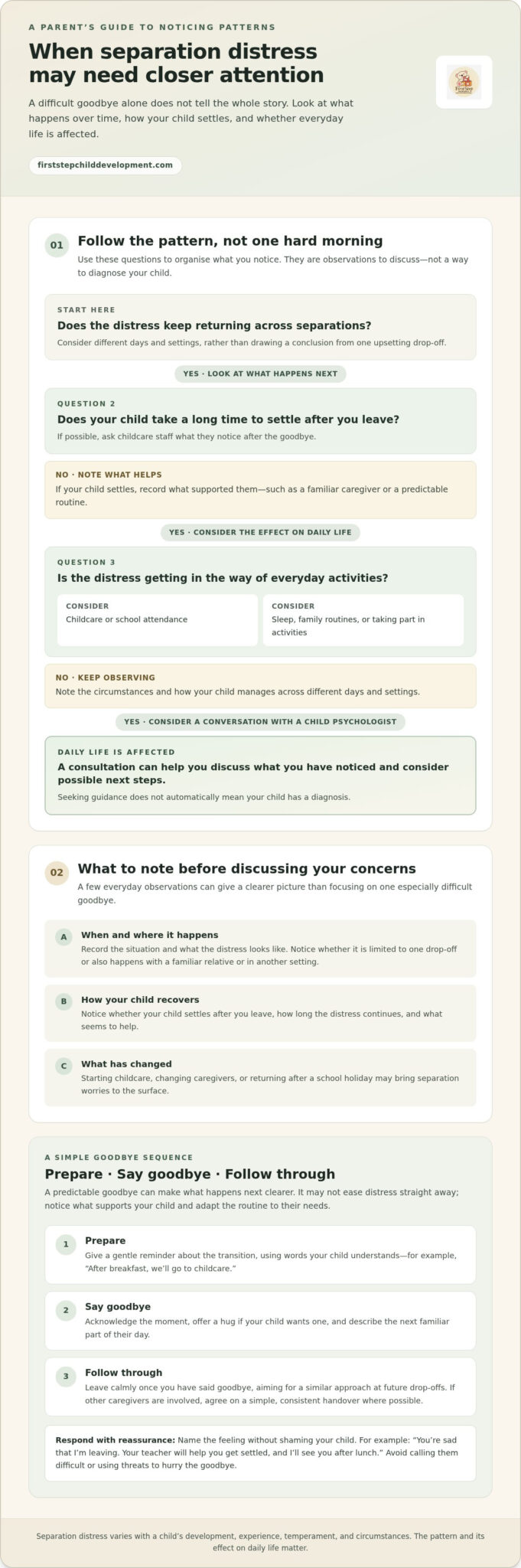
Try noting what happens before, during and after a separation. For example, does your child become distressed only at childcare drop-off, or also when staying with a familiar relative? Do they settle after the goodbye, or remain upset for much of the activity? Understanding Separation Anxiety in Children can offer further context about possible signs, but observations are not a diagnosis.
- Record when the distress occurs and what it looks like.
- Notice what helps your child settle, such as a familiar caregiver or predictable routine.
- Consider whether it affects attendance, sleep, family routines or participation in activities.
Looking at these details across different days can give a clearer picture than focusing on one especially hard morning. If possible, ask childcare staff what they observe after you leave, too.
When the pattern affects daily routines
Closer attention may be helpful if distress keeps recurring, takes a long time to ease, or makes it difficult for your child to attend childcare, sleep or take part in usual activities. The impact matters as much as the behaviour itself. A child who cries briefly but then joins in may be experiencing something different from a child whose distress continues to disrupt the day.
These are observations to discuss, not conclusions about a diagnosis. A clinical psychologist consultation can help parents consider the child’s circumstances and the effect on daily life. If ongoing separation worries are affecting your family, you can learn about clinical psychologist consultations as one way to explore possible next steps.
What Can Parents Do During Separation and Difficult Goodbyes?
A predictable goodbye can give your child a clearer sense of what happens next. It may not ease distress straight away, so notice what seems to support your child and adapt the routine to their needs.
A calm, predictable goodbye routine
Keep the steps simple and use similar words each time. Before a change in routine, explain what’s coming in language your child understands. At drop-off, offer a warm goodbye and follow through, rather than returning for several more departures that may add uncertainty.
- Prepare: Give a gentle reminder about the transition, such as, “After breakfast, we’ll go to childcare.”
- Say goodbye: Acknowledge the moment, offer a hug if your child wants one, and describe the next familiar part of their day.
- Follow through: Leave calmly once you’ve said goodbye, aiming for a similar approach at future drop-offs.
Adapt the words and timing to your family’s routine and the childcare setting. If other caregivers are involved, agree on a simple, consistent handover where possible.
Responding to distress without dismissing feelings
Try naming the feeling without shaming your child: “You’re sad that I’m leaving. Your teacher will help you get settled, and I’ll see you after lunch.” A calm, confident tone can reassure without suggesting that your child’s feelings are wrong. Avoid calling them difficult or using threats to hurry the goodbye.
If separation worries sit alongside other emotional or behavioural concerns, a clinical psychologist consultation can help parents discuss what they’ve noticed. You can also explore support for your child at Firststep.
How a Child Psychologist Can Help When Separation Anxiety Persists
If separation worries keep affecting your child’s routines, talking with a child psychologist can help you make sense of what you’re observing. A consultation is an opportunity to discuss when the distress happens, what may be contributing to it, and how it affects your child and family. Seeking guidance doesn’t, by itself, mean your child has a diagnosis.
What parents can bring to a consultation
You don’t need to arrive with a complete explanation. Everyday examples can help build a fuller picture, especially details about what happens before, during and after a difficult separation. You might share:
- Which separations tend to be difficult, and whether this varies between home, childcare or other familiar settings.
- Any recent changes in routines, caregiving arrangements or the child’s environment.
- How your child shows distress, what seems to help, and how the situation affects sleep, attendance or family routines.
- What you or other caregivers have noticed over time.
These observations can guide a thoughtful conversation about the child’s circumstances and possible next steps. The focus is on understanding, not jumping to conclusions about Separation Anxiety in Children: What’s Normal?
Finding a supportive next step in Kuala Lumpur or Selangor
Firststep Psychology & Child Development Centre offers child-focused clinical psychologist consultations and parent guidance for families in Kuala Lumpur, Petaling Jaya and Selangor. The conversation can help parents consider their child’s needs and discuss appropriate support, without assuming a particular outcome.
If you’d like to talk through persistent separation concerns, explore clinical psychologist consultations for children and learn more about Firststep Child Development.
Take the Next Step at Your Child’s Pace
There’s no need to decide what a difficult goodbye means from one moment alone. If you’re still wondering, “Separation Anxiety in Children: What’s Normal?”, give yourself space to notice how the concern develops and whether it continues to affect your child’s everyday life. Your observations can be a helpful starting point for a conversation, even if you’re unsure what to ask.
Seeking professional guidance doesn’t mean you’ve already reached a conclusion about your child. It can simply offer a chance to explore what you’re seeing and consider possible next steps together. You know your child’s routines and responses best, and asking for support is one way to approach those concerns with care.
If a conversation would be helpful, learn about a child psychologist consultation or visit Firststep Child Development to explore support for your child. Take the next step when you feel ready.
Frequently Asked Questions
Is separation anxiety common when a child starts childcare or school?
Some children find the first days in a new setting harder than others, and this alone doesn’t indicate a problem. If your child can talk about it, ask what feels unfamiliar: perhaps the room, noise, activities or not knowing what happens next. For a younger child, drawing or pretend play may offer another way to share impressions without needing to answer direct questions.
Can separation anxiety return after a change in routine?
Yes, a child’s response may change when life around them changes. A return of worry after a break can be useful information, but it doesn’t explain the cause on its own. Consider whether other events are happening at the same time, such as illness, a new family responsibility or changes in caregiving. This broader context can help you respond thoughtfully rather than assuming one change is responsible.
What should I tell a child psychologist about my child’s separation anxiety?
Alongside your concerns, share what your child enjoys, where they feel at ease and what helps them feel secure. You can also mention strategies you’ve already tried and how your child responded. If you have a particular question or hope for the consultation, say so. This helps make the conversation relevant to your family, even if you’re still working out what the distress means.
Can caregivers and childcare staff use the same goodbye routine?
They can share the key parts without making every handover identical. A childcare setting may have its own arrival arrangements, so agree on how adults will support the child within those practical limits. It can also help to use realistic language about what happens next, rather than promising an exact event or time that may change. The aim is a dependable message, not a rigid script.

Article by
Firststep Child Development Team
Firststep Child Development Team provides evidence-informed educational resources to help parents better understand child development, behaviour and learning. Our multidisciplinary services include clinical psychology, occupational therapy, speech and language therapy, developmental assessments and other child development support in Kuala Lumpur and Selangor.
Disclaimer
This article is for general educational and informational purposes only and is not a substitute for professional medical, psychological or therapeutic advice, diagnosis or treatment. Every child develops differently. If you have concerns about your child's development, behaviour, learning or wellbeing, please consult an appropriately qualified healthcare or allied health professional.