



A child who seems distracted in class may be finding the work difficult, feeling worried or simply running low on sleep. “My Child Cannot Focus in School: ADHD or Something Else?” is an important question, but difficulty concentrating alone can’t confirm ADHD.
It’s understandable to feel concerned, especially when teachers notice your child missing instructions, leaving tasks unfinished or struggling to stay engaged. Attention can be affected by several things, including sleep, emotional stress, learning difficulties, or vision and hearing problems. The pattern matters: when the difficulty happens, how long it lasts, and whether it appears at home as well as at school.
This article explains what to observe across lessons, tasks and settings, and how those details can help you speak with your child’s teacher or a professional. You’ll also learn when a child-friendly assessment may help clarify what support your child needs, without rushing to a label or assuming a particular diagnosis.
Key Takeaways
- Difficulty focusing is an observation, not a diagnosis; ADHD is one possibility among several factors that may affect attention.
- For “My Child Cannot Focus in School: ADHD or Something Else?”, look for patterns across tasks and settings, and note how often they occur and how they affect learning.
- Ask your child’s teacher for specific examples, including when your child finds it easier or harder to concentrate.
- A child-friendly assessment can help explore attention concerns and give parents clearer guidance without assuming a particular diagnosis.
A child who cannot focus in school: what the pattern may be telling you
Unfinished classwork, missed instructions or frequent daydreaming can worry parents, especially when a teacher raises the concern. It’s natural to ask, My Child Cannot Focus in School: ADHD or Something Else? But difficulty paying attention is an observation, not a diagnosis. In everyday terms, focus means listening, staying with a task and returning to it after a distraction. Difficulty focusing at school can have several possible explanations, not only ADHD. A general overview from the Centers for Disease Control and Prevention (CDC) describes ADHD, but a classroom behaviour alone can’t establish whether a child has it.
My Child Cannot Focus in School: ADHD or Something Else? Start with classroom observations
A teacher might notice that a child loses track of multi-step instructions, starts work but leaves it unfinished, or needs reminders to return to a task. These examples help describe what is happening and when. They don’t diagnose a condition. The details matter: “didn’t finish” is less informative than noting which task it was, what instruction was given and what support helped the child continue.
Why one difficult lesson is not the whole picture
Consider frequency, context and impact rather than drawing conclusions from one lesson or a single difficult day. Is the child regularly missing instructions, or did it happen during an unusually tiring or challenging class? Does it affect learning or completing everyday tasks? Children’s ability to concentrate naturally varies with their age, interest, energy and the activity. The aim isn’t to expect identical focus in every situation, but to understand whether a recurring pattern is making school harder. These observations can help parents and teachers discuss the concern clearly, without labelling the child too soon.
ADHD or something else? Understand other reasons a child may lose focus
ADHD is one possible explanation for ongoing attention difficulties, but a school concern alone doesn’t establish that a child has ADHD. Worry, stress, poor sleep and learning challenges can also make it harder to stay engaged. The question “My Child Cannot Focus in School: ADHD or Something Else?” is best explored by considering what else is happening in the child’s life and learning.
These factors may overlap, and a list of possibilities can’t identify the cause for an individual child. The Centers for Disease Control and Prevention (CDC) information on ADHD explains the condition and its assessment; understanding a child’s specific situation requires more than matching one behaviour to a description.
When worry, stress or sleep may be affecting attention
A child preoccupied with a friendship problem, a change at home or an upcoming test may find it difficult to follow a lesson. Tiredness can also make listening and staying with a task harder. Notice whether focus changes after disrupted sleep or around particular situations, and share relevant changes with the teacher or a professional. These clues are useful context, not proof of a cause.
When learning challenges may look like inattention
If reading instructions, writing answers or understanding a topic feels difficult, a child may pause, drift away or appear disengaged. The behaviour may be a response to work that feels confusing, rather than a lack of interest. Look for patterns around particular subjects or task types, and whether your child engages more readily when instructions are clarified. If these difficulties persist, a learning difficulties assessment can help explore the child’s learning needs alongside attention concerns.
Keeping an open mind helps adults consider a child’s needs without settling too quickly on a label.
What parents can observe before acting on school focus concerns
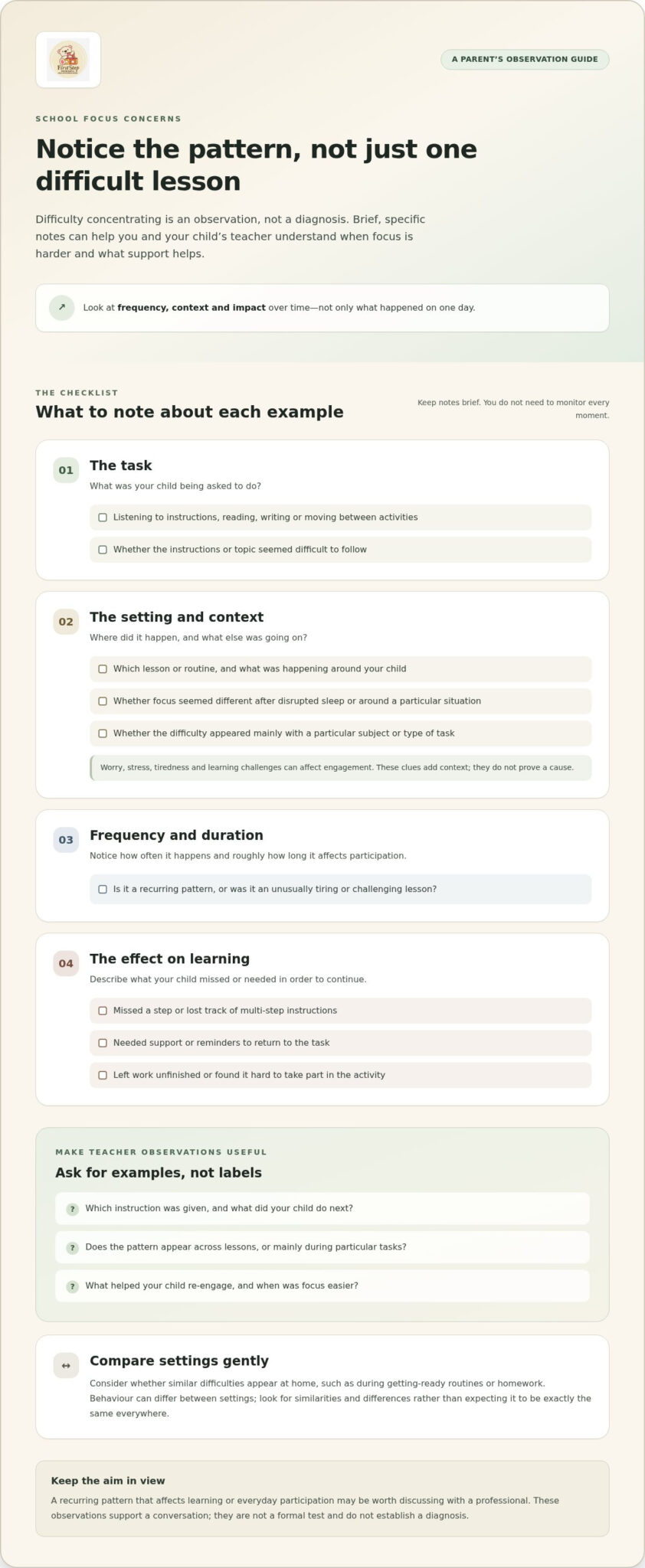
Clear, specific observations can help you and your child’s teacher understand what is getting in the way, without trying to diagnose the reason yourselves. Keep brief notes over time rather than relying on memory or one difficult day.
For each example, record:
- The task: Was your child listening to instructions, reading, writing or moving between activities?
- The setting: Which lesson or routine was it, and what was happening around them?
- Frequency and duration: How often did the difficulty occur, and roughly how long did it affect participation?
- Effect on learning: Did your child miss a step, need support to restart or leave work incomplete?
These notes are a guide to discussion, not a formal test. You don’t need to monitor every moment.
How to make teacher observations more useful
Ask for examples rather than labels such as “not paying attention”. For instance, which instruction was given, what did your child do next, and what helped them re-engage? Ask whether the pattern appears across different lessons or mainly during particular tasks. It can also help to know when focus is easier, such as during practical activities or with shorter instructions.
Compare this with home routines, such as getting ready or completing homework, while remembering that behaviour can differ between settings. A child may find one environment easier to manage than another. The aim is to notice similarities and differences, not to expect exactly the same behaviour everywhere.
When to discuss the pattern with a professional
Consider seeking guidance if the difficulty continues, affects learning or makes it hard for your child to take part in everyday activities. If your child is five, age-specific examples may help frame questions, but no single sign confirms ADHD. A professional can explore the concern in context; Firststep’s ADHD assessment is one option for parents seeking a clearer understanding.
For school-focused ideas, you can also explore strategies with your child’s teacher. To learn more about Firststep, visit the Firststep Child Development homepage.
How a child-focused assessment can clarify school attention concerns
When school difficulties persist or affect learning, a professional assessment can help explore what may be contributing. A Clinical Psychologist Assessment or ADHD Assessment considers a child’s needs without promising a particular result. The aim is to build a clearer understanding, not to fit a child to a label. For parents asking, “My Child Cannot Focus in School: ADHD or Something Else?”, that distinction matters.
At Firststep Psychology & Child Development Centre, assessments are child-friendly and play-based, with clear feedback for parents. A broader guide to how assessments work can help families understand the process.
What parents can expect from a supportive assessment conversation
You can share your child’s age, what the school has noticed and the examples you’ve recorded. It may also help to describe how your child manages everyday tasks at home. These details give a professional useful context to explore the concern. The discussion should be respectful and without judgement, with feedback that helps you understand the findings and consider appropriate support.
Firststep is at B1‑7, Plaza Damas 3, Jalan Sri Hartamas 1, 50480 Kuala Lumpur. The centre is open Monday to Sunday – 8.30am to 6pm and closed on public holidays. For enquiries, call or WhatsApp 010‑2502833, or email firststepdevelopmentcentre@gmail.com.
A gentle next step for families in Kuala Lumpur and Selangor
Professional guidance can help make sense of what you’ve observed and what support may fit your child. If you feel ready to explore that conversation, you can explore ADHD Assessment or learn about Firststep Child Development.
Take the next step at your child’s pace
The question “My Child Cannot Focus in School: ADHD or Something Else?” doesn’t need an immediate answer. A thoughtful next step is to seek guidance that helps you understand your child’s individual needs, rather than deciding on a label before the picture is clear.
At Firststep, clinical psychologists work alongside a multidisciplinary team of child specialists. A respectful assessment conversation can help parents make sense of their concerns and consider what support may suit their child. There’s no need to have every detail figured out before asking for professional input.
If you feel ready to explore assessment, you can learn about ADHD Assessment, or discover more about Firststep Child Development. Taking one considered step can help you move forward with greater understanding and confidence.
Frequently Asked Questions
Can a child have ADHD and a learning difficulty at the same time?
Yes, ADHD and a learning difficulty can occur together, so identifying one doesn’t rule out the other. A child might, for example, manage class discussions but struggle with reading or written work. If you’re wondering, “My Child Cannot Focus in School: ADHD or Something Else?”, share both the attention concern and any subject-specific difficulties with a professional, who can consider the child’s needs more fully.
Can a child focus on favourite activities and still have ADHD?
Yes. Concentrating on a favourite activity neither confirms nor rules out ADHD. A child may find a hands-on hobby easier to stick with than a lengthy task with several instructions. Consider how attention varies across different activities and whether difficulties affect learning or everyday participation. One example, whether positive or challenging, isn’t enough on its own to explain a wider pattern.
What information should I bring to an appointment about school focus concerns?
Bring a few examples from home and school, such as a homework task your child found difficult or a routine they managed more easily. If available, teacher comments or relevant schoolwork can add useful context. You don’t need to organise everything into a formal report or arrive with an explanation. A short note about what you’ve noticed is a helpful starting point.
Should I wait for the school to raise concerns before seeking guidance?
No. You can raise a concern even if the school hasn’t mentioned one. Describe what you’ve noticed and ask the teacher whether anything similar happens in class, or whether it seems limited to a particular routine. If the difficulty continues or affects learning or participation, a professional discussion may help you consider possible next steps without assuming a diagnosis.
Is difficulty focusing in only one subject still worth discussing?
It can be, especially if the difficulty keeps affecting your child’s participation. A challenge limited to one subject may point to something specific about the work, such as unfamiliar vocabulary or a task format your child finds demanding. Ask the teacher what they notice and whether your child engages differently with other activities. This information can guide a useful conversation without establishing ADHD.

Article by
Firststep Child Development Team
Firststep Child Development Team provides evidence-informed educational resources to help parents better understand child development, behaviour and learning. Our multidisciplinary services include clinical psychology, occupational therapy, speech and language therapy, developmental assessments and other child development support in Kuala Lumpur and Selangor.
Disclaimer
This article is for general educational and informational purposes only and is not a substitute for professional medical, psychological or therapeutic advice, diagnosis or treatment. Every child develops differently. If you have concerns about your child's development, behaviour, learning or wellbeing, please consult an appropriately qualified healthcare or allied health professional.