



Toddler Doesn’t Respond to Name: Is It Autism? Not necessarily. A toddler may not turn when called because they’re absorbed in play, distracted, tired or unsure what’s being asked. It’s also reasonable to wonder whether they hear their name consistently. One behaviour alone can’t identify autism, but it is worth noticing and discussing if it happens often.
You’re right to pay attention, and it’s understandable to feel unsettled by conflicting advice. What matters is the wider pattern: how your child communicates and connects with others, and whether they show repetitive behaviours or strong, focused interests. Notice whether they respond to other sounds, look towards you, use gestures or share attention during play. These observations can help a professional understand your child’s development.
This article explains what name response can and can’t tell you, which other signs may be relevant, and when to seek a developmental assessment. If you’re in Kuala Lumpur or Selangor, a child-focused assessment can be a calm, practical next step, offering a broader picture without assuming a diagnosis in advance.
Key Takeaways
- “Toddler Doesn’t Respond to Name: Is It Autism?” A single response pattern can’t answer this; consistency and context matter.
- Look at communication, social interaction and behaviour together to build a more useful picture of your toddler’s development.
- Record the setting, competing activity and response, and notice whether familiar voices or quieter surroundings make a difference.
- A child-focused assessment can explore your concerns and your toddler’s broader developmental profile, with clear feedback for parents.
A toddler not responding to their name: what this observation can, and cannot, tell you
A toddler not turning when you call their name can be associated with autism, but it doesn’t establish a diagnosis. “Responding” might mean pausing, looking towards you, making a sound or otherwise showing they’ve noticed. Children don’t all respond in the same way, and a single missed call is not enough to draw a conclusion.
An observation is something you notice; a diagnosis requires a broader professional assessment.
Why might a toddler not turn when called?
Context can make a difference. A child deeply absorbed in building with blocks may not notice a call straight away, while television, conversation or other sounds can compete for their attention. They may also hear the sound without understanding that their name is a cue to respond. These are possibilities to consider, not explanations for any particular child.
Notice whether the pattern happens repeatedly and in different situations, rather than relying on one moment. If you remain concerned, share what you’ve observed with a qualified professional. Consistent examples can be more helpful than trying to interpret the behaviour alone.
Does not responding to a name mean autism?
No. The question “Toddler Doesn’t Respond to Name: Is It Autism?” can’t be answered from name response alone. Professionals consider a child’s wider development, including communication, social interaction and behaviour, alongside their individual history. The CDC’s overview of autism signs and symptoms describes a range of characteristics, rather than a single defining behaviour.
For example, an assessment may explore how a child communicates needs, shares attention or engages with people during familiar routines. It can also help clarify whether hearing or understanding should be considered. If you’d like to discuss your concerns in Kuala Lumpur, Firststep Psychology & Child Development Centre’s Autism Assessment uses a child-focused, play-based approach to explore a broader developmental profile and provide feedback to parents. It doesn’t assume a diagnosis from one observation.
How name response fits alongside other signs of autism
A child’s response to their name is one piece of information, not a stand-alone test. Professionals look for patterns across communication, social interaction and behaviour. Autism diagnostic frameworks describe characteristics across more than one area, so a single behaviour cannot determine whether a child is autistic.
What other developmental observations may be useful?
Notice how your toddler communicates needs and shares interest with familiar people. For instance, do they use gestures, sounds or words to ask for something, or try to show you something they find interesting? You might also observe how they engage with others during a familiar song, snack time or play routine.
These examples are prompts for observation, not a diagnostic checklist. Note what you see across different routines, settings and caregivers. A behaviour may vary with the activity or person, and no single example proves autism.
Why a broader developmental assessment matters
An assessment can consider developmental history alongside information from parents and observations of the child. This wider view helps a professional understand strengths, needs and any patterns that may warrant further attention. Sharing observations across situations is more useful than relying on one moment to answer whether a child may be autistic.
Support for developmental needs can be discussed based on a child’s profile; families don’t need to treat a label as the only reason to seek guidance. The US National Institute of Child Health and Human Development explains the role of early intervention for autism. A professional can help parents understand what steps may be appropriate, and families can explore Firststep Child Development’s child-focused support.
What parents can observe and share when a toddler does not respond to their name
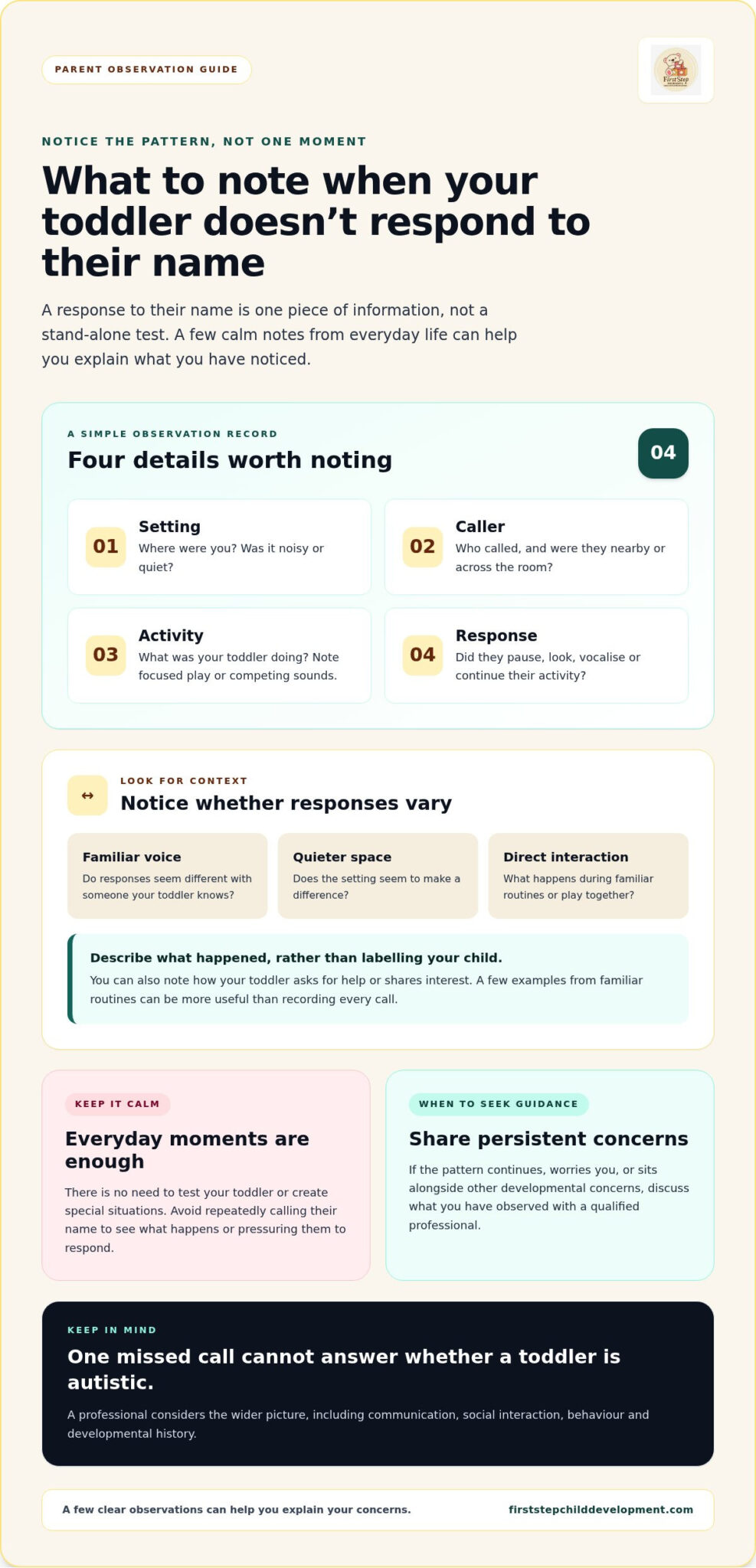
A few calm notes from everyday life can help you describe what you’re seeing without trying to interpret it. You don’t need to test your toddler or create special situations. Simply notice what happens during ordinary routines, and share any persistent concerns with a qualified professional.
A simple observation record for home
After an instance that stands out, jot down the details:
- Setting: Where were you, and was it noisy or quiet?
- Caller: Who called your toddler’s name, and from nearby or across the room?
- Activity: What was your child doing? Note possible competing sounds or focused play.
- Response: Did they pause, look, vocalise or continue their activity?
You can also note whether responses seem different with a familiar voice, in a quieter space or during direct interaction. Include other plain observations, such as how your toddler asks for help or shares interest. Describe what happened rather than labelling the child. Bring a few examples from familiar routines, not a record of every call.
When should parents seek professional guidance?
Raise the concern if the pattern continues, is worrying you, or sits alongside other developmental concerns. You don’t need to work out what inconsistent responses mean before asking for guidance. A professional can listen to your observations and consider what further understanding or support may be helpful.
Avoid repeatedly calling your toddler to see what happens or pressuring them to respond. This can make ordinary interactions feel like a test, and it won’t provide a diagnosis. If you’re ready to discuss your concerns, you can explore child-focused support at Firststep Child Development.
Toddler Support for Name Response in Kuala Lumpur
If your toddler often doesn’t respond to their name, a professional assessment can help explore your concerns alongside their broader developmental profile. It isn’t based on this behaviour alone, and the purpose is to build a clearer understanding of your child, not to promise or assume a particular diagnosis.
What can parents expect from a supportive assessment?
Firststep Child Development provides a child-friendly, play-based Autism Assessment. The assessment considers your child’s development while giving you space to share what you’ve noticed at home or in other everyday settings. You’ll receive clear feedback to help you understand the discussion and possible next steps.
You can read about the Autism Assessment and the assessment process. When booking by phone or WhatsApp, parents can share their child’s age and the concerns they’d like to discuss.
How to contact Firststep Child Development
The centre is at B1‑7, Plaza Damas 3, Jalan Sri Hartamas 1, 50480 Kuala Lumpur. Opening hours are Monday to Sunday – 8.30am to 6pm; the centre is closed on public holidays.
For enquiries, call or WhatsApp 010‑2502833, or email firststepdevelopmentcentre@gmail.com. If you’re ready to explore a professional assessment, you can learn about an Autism Assessment or visit Firststep Child Development.
Take the next step with confidence
If you’re still asking, “Toddler Doesn’t Respond to Name: Is It Autism?”, you don’t need to settle the question on your own. Let your observations guide a conversation with a professional, rather than become a reason to judge yourself or your child. Seeking guidance is simply a way to understand what may be helpful next.
A developmental assessment can offer space to discuss your concerns and consider your toddler’s needs with care. At Firststep Child Development, families can explore an Autism Assessment through a play-based approach, with clear feedback and support from a multidisciplinary team of child specialists. An assessment can help build understanding, without assuming a particular outcome.
When you feel ready, take a gentle first step: learn more about Firststep Child Development. You’re paying attention, and that care can help you find a thoughtful way forward for your family.
Frequently Asked Questions
Does not responding to their name always mean a toddler has autism?
No. Not responding to their name can be one developmental observation, but it isn’t enough to identify autism. A toddler may miss a call for different reasons, and a professional looks at the child’s development as a whole. The concern behind “Toddler Doesn’t Respond to Name: Is It Autism?” is best explored through a broader conversation, not a yes-or-no conclusion based on one behaviour.
Can hearing difficulties affect a toddler’s response to their name?
Yes. If a toddler has difficulty hearing sounds clearly, they may not consistently notice someone calling them. This is one possibility to raise, not a conclusion about your child. Tell the professional you speak with what you’ve noticed, including how your toddler responds to everyday sounds. They can advise whether hearing should be considered as part of understanding your concerns.
At what age should a toddler respond to their name?
The CDC includes looking when called by name among its 9-month developmental milestones. Milestones describe skills most children can do by a certain age; they aren’t diagnostic cut-offs. Children develop at different rates, so a missed response on its own doesn’t establish a problem. If you’re concerned at any age, discuss the pattern with a professional.
What should I do if my toddler sometimes responds but sometimes does not?
Variable responses can happen, and they don’t by themselves confirm or rule out autism. Consider whether the change is new, or whether your toddler has stopped using a skill they previously had. Share that detail with a qualified professional, particularly if you’ve noticed a loss of communication or other abilities. You don’t need to wait for responses to become consistent before asking for guidance.
How is autism assessed in a toddler in Kuala Lumpur?
A professional assessment may bring together developmental history, parent observations and direct information about how the child communicates and interacts. It’s helpful to mention the languages your toddler hears and uses, along with any previous assessments or relevant reports, so their development can be understood in context. In Kuala Lumpur, parents can explore Firststep’s Autism Assessment as one option for discussing concerns.
Article by
Firststep Child Development Team
Firststep Child Development Team provides evidence-informed educational resources to help parents better understand child development, behaviour and learning. Our multidisciplinary services include clinical psychology, occupational therapy, speech and language therapy, developmental assessments and other child development support in Kuala Lumpur and Selangor.
Disclaimer
This article is for general educational and informational purposes only and is not a substitute for professional medical, psychological or therapeutic advice, diagnosis or treatment. Every child develops differently. If you have concerns about your child's development, behaviour, learning or wellbeing, please consult an appropriately qualified healthcare or allied health professional.