



Why Does My Child Forget What I Just Told Them? Understanding Working Memory in Children
“Please put your shoes on, pack your bag, and bring your water bottle.”
A few seconds later, your child asks, “What am I supposed to do again?”

Have you ever asked your child to do something, only to hear them ask a few seconds later:
“What did you say?”
Maybe you asked them to put their shoes away, bring their water bottle, and get their school bag ready.
But halfway through, they have forgotten what they were supposed to do.
Or perhaps you notice that your child can remember their favourite cartoon character perfectly, but somehow forgets the three things you just asked them to do.
It can be frustrating.
You may even find yourself thinking:
“Are they not listening?”
“Why do I have to repeat myself so many times?”
“How can they forget something I just told them?”
Sometimes, however, the issue may not be that your child isn’t listening.
They may be finding it difficult to hold information in their mind while using it.
This skill is known as working memory.
Working memory is an important part of everyday learning and development. It helps children remember instructions, follow steps, solve problems, learn new information, and complete tasks.
So, what exactly is working memory, and how can parents support it?
What Is Working Memory?
Working memory is the ability to temporarily hold information in your mind and use that information while completing a task.
Think of it as a small mental workspace.

For example, imagine you tell your child:
“Go to your room, get your school bag, and bring me your water bottle.”
Your child needs to:
❃ Remember what you said
❃ Keep the information in mind
❃ Remember the sequence of tasks
❃ Complete each step
❃ Keep track of what they have already done
All of these steps involve working memory.
Children use working memory throughout the day, often without us realising it.
It can be involved when they:
❃ Follow instructions
❃ Remember classroom information
❃ Complete homework
❃ Solve maths problems
❃ Remember rules during games
❃ Follow a recipe or craft activity
❃ Remember what they wanted to say
❃ Keep track of several steps in a task
For children, these skills are still developing.
There are many reasons a child may forget what they have just been told.
Sometimes, the information simply contains too many steps for them to hold onto at once.

For example, compare these two instructions:
“Put your toys away.”
versus
“Put your cars in the box, put your books on the shelf, put your blocks in the basket, then get your shoes and put them by the door.”
The second instruction requires your child to remember much more information.
It is not necessarily about whether your child wants to listen.
Their brain may simply need the information to be presented in a way that is easier to manage.
7 Signs Your Child May Be Struggling With Working Memory
1. They Forget Instructions After Hearing Them
You may give your child an instruction and notice that they start doing something else a few moments later.

For example:
“Please get your shoes.”
Your child walks to their room.
Then they come back and ask:
“What was I supposed to get?”
Occasionally forgetting is completely normal.
However, if this happens frequently, especially with multi-step instructions, it may be useful to observe the pattern.
2. They Can Start a Task but Forget What Comes Next
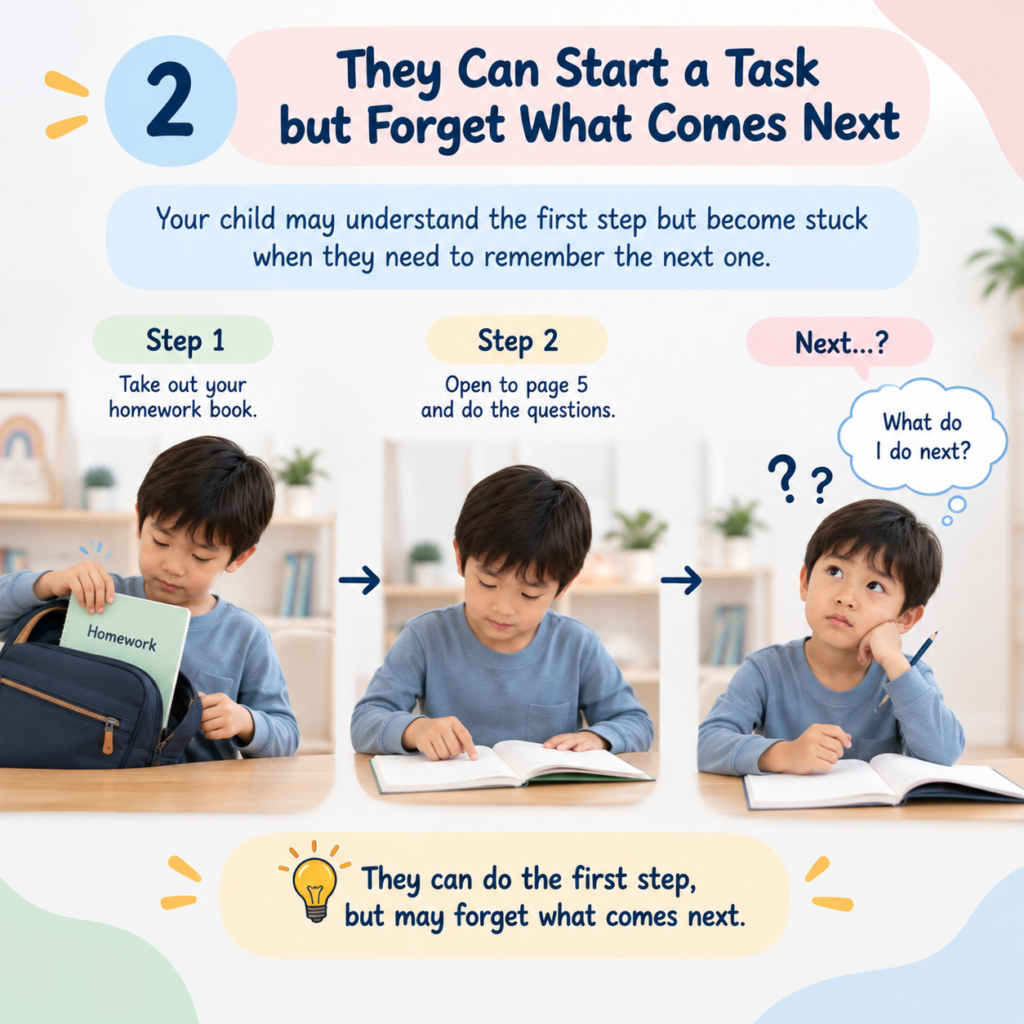
Your child may understand the first step but become stuck when they need to remember the next one.
For example, they may take out their homework book but then forget which page they were supposed to complete.
This can be particularly noticeable during homework or activities involving several steps.
3. They Need Instructions Repeated Frequently
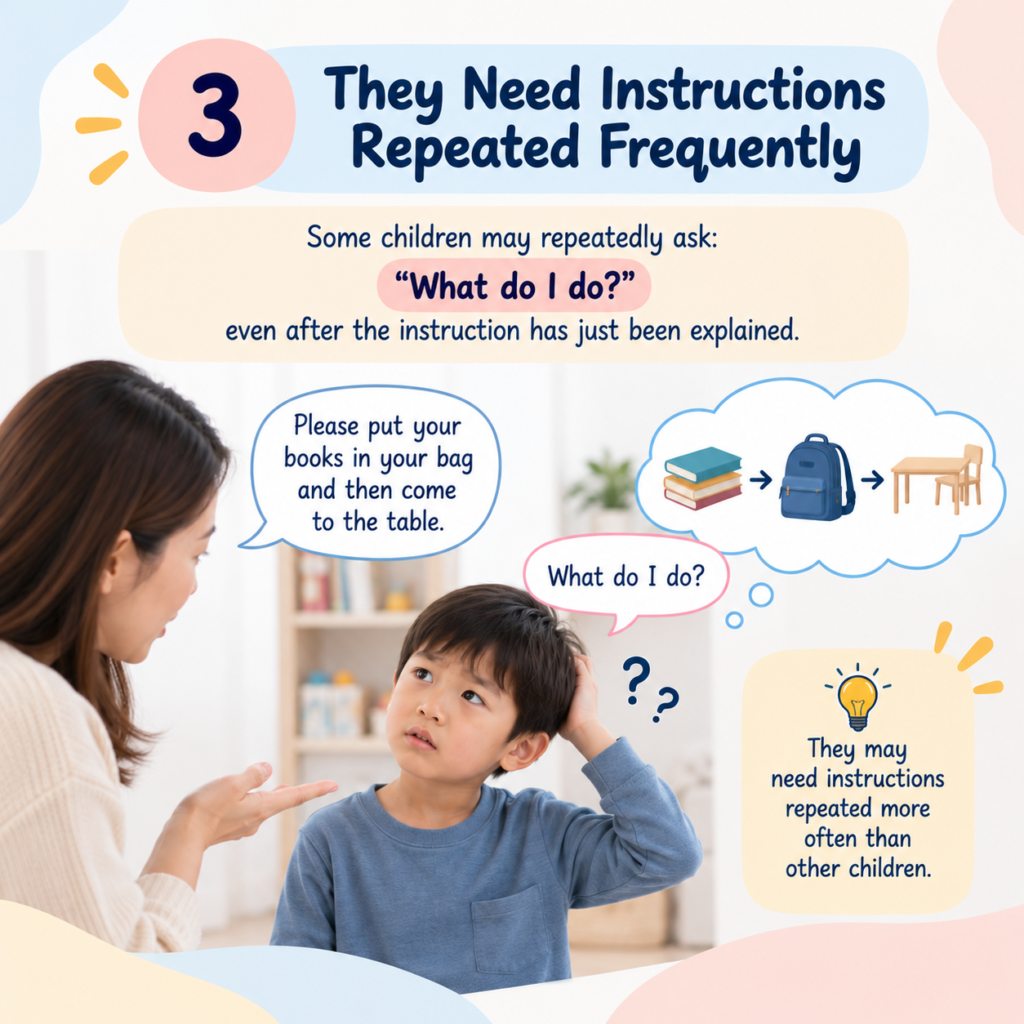
Some children may repeatedly ask:
“What do I do?”
even after the instruction has just been explained.
Rather than immediately assuming they were not paying attention, consider whether the instruction contained too much information at once.
You can try breaking it down.
Instead of:
“Get dressed, pack your bag, put your lunch inside and wear your shoes.”
Try:
“First, get dressed.”
Then give the next step.
4. They Forget Things They Were Just Asked to Bring
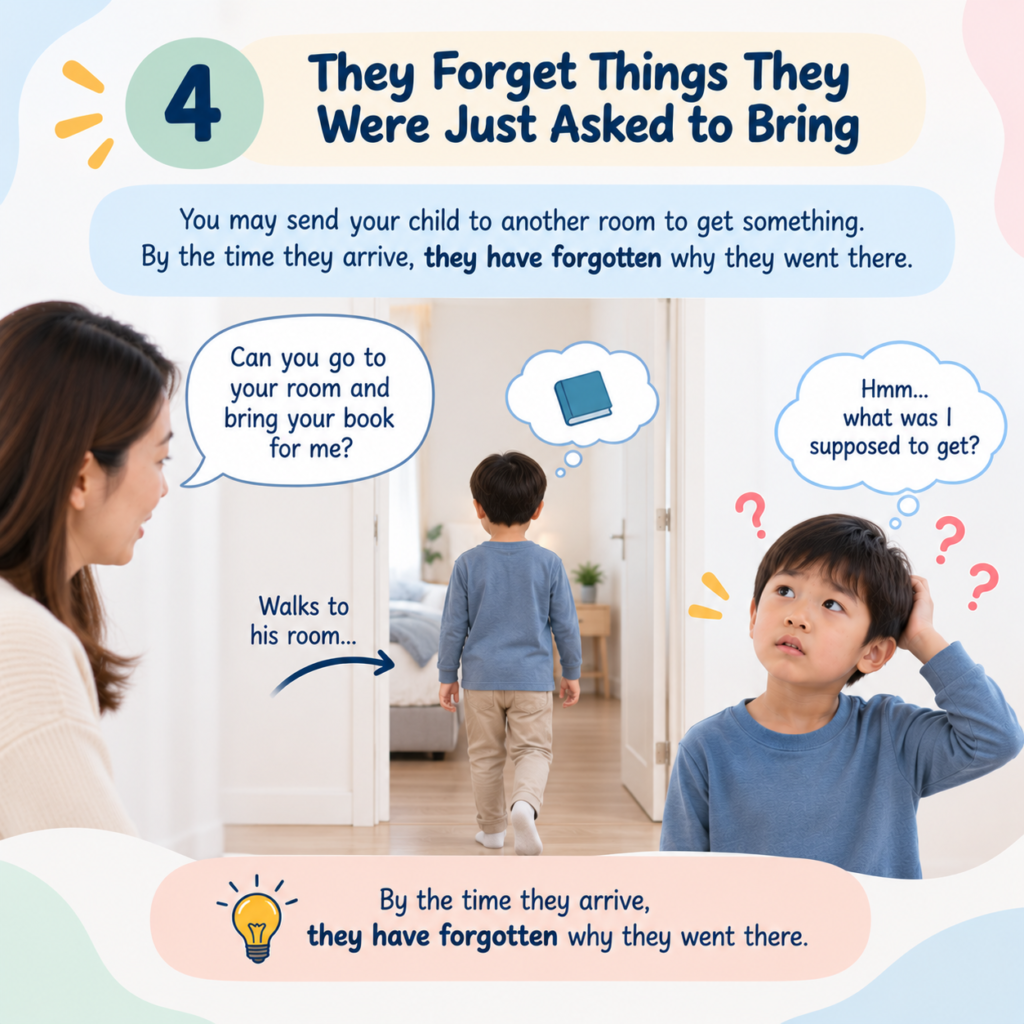
You may send your child to another room to get something.
By the time they arrive, they have forgotten why they went there.
This can happen because the child needs to hold the original instruction in mind while moving to another environment with other things competing for their attention.
5. They Struggle With Multi-Step Activities
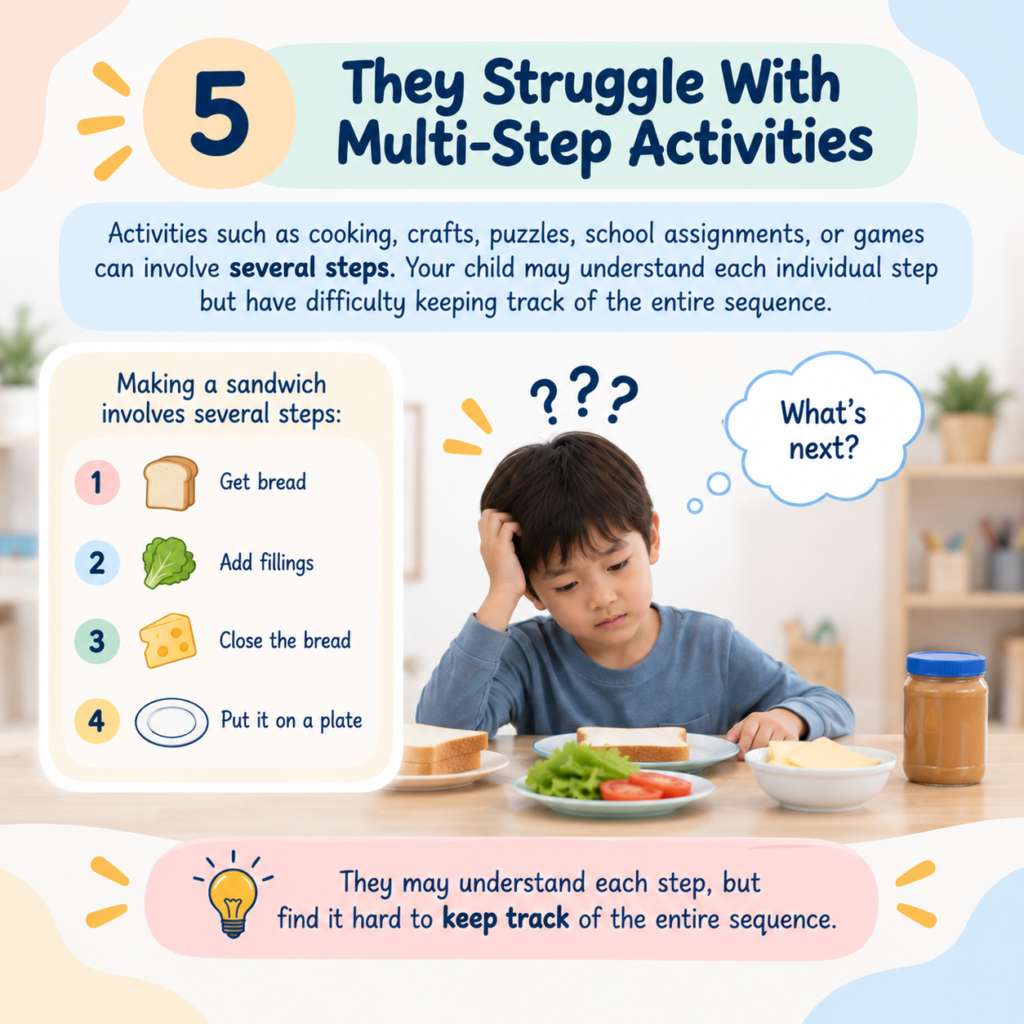
Activities such as cooking, crafts, puzzles, school assignments, or games can involve several steps.
Your child may understand each individual step but have difficulty keeping track of the entire sequence.
You may notice that they:
❃ Skip steps
❃ Repeat steps
❃ Ask what comes next
❃ Become frustrated
❃ Need frequent reminders
6. They Find It Difficult to Remember Information While Doing Something Else
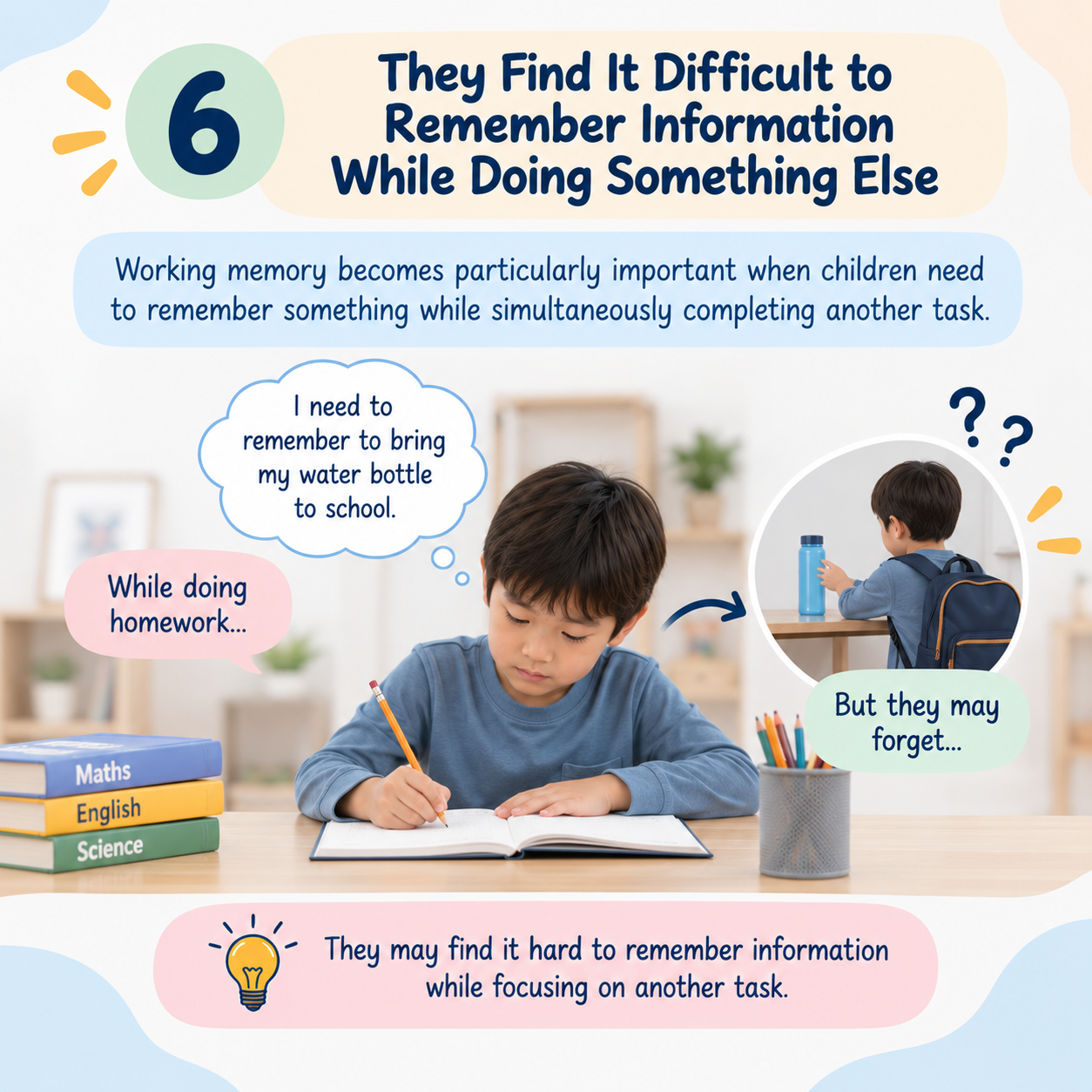
For example, they may need to remember a number while doing a calculation, or remember a spelling rule while writing a sentence.
Working memory becomes particularly important when children need to remember something while simultaneously completing another task.
This is one reason some children may appear to understand something when it is explained, but struggle when they have to use the information independently.
7. They Become Easily Frustrated When They Forget
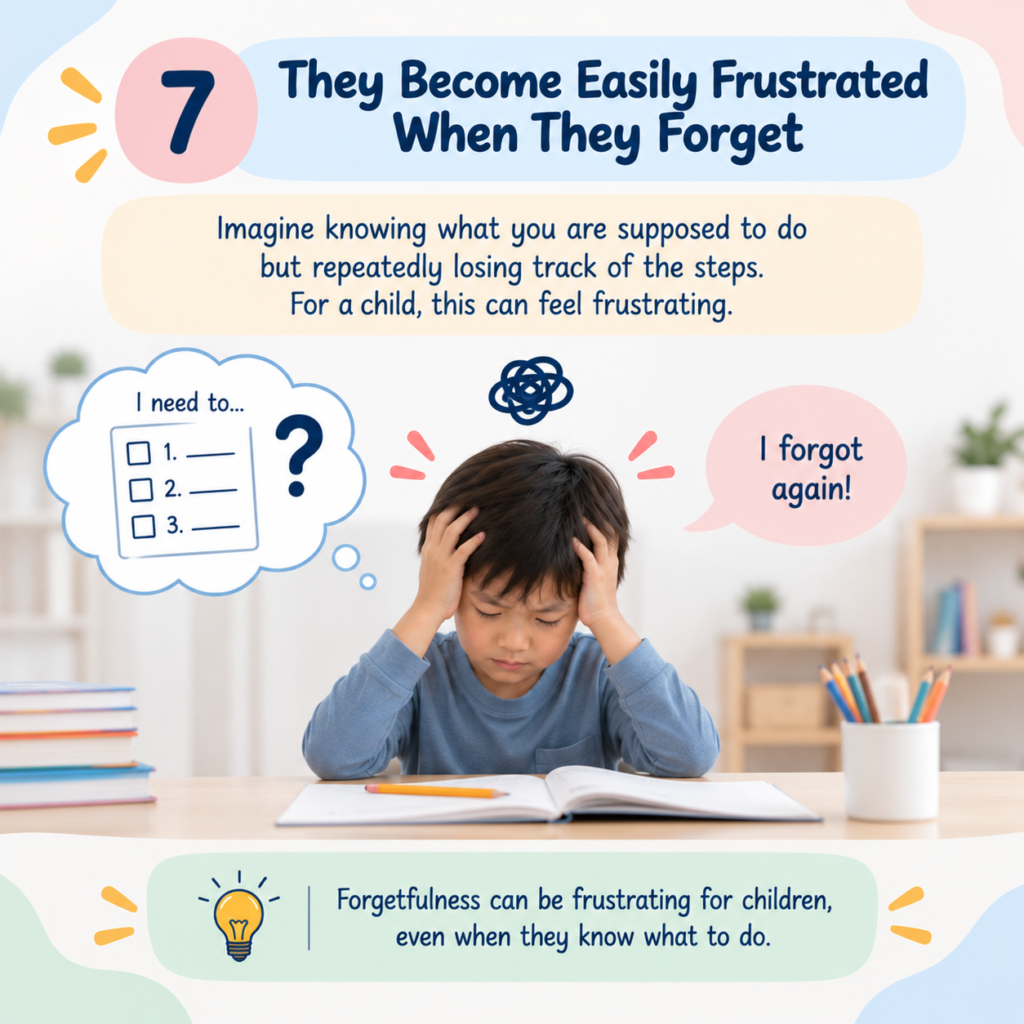
Imagine knowing what you are supposed to do but repeatedly losing track of the steps.
For a child, this can feel frustrating.
You may see them:
❃ Say “I don’t know”
❃ Give up quickly
❃ Become upset
❃ Avoid the activity
❃ Ask for help immediately
Sometimes, the frustration may be more noticeable than the working-memory difficulty itself.
Working Memory or “Not Listening”?
This is an important distinction.
It can be easy to assume that a child who forgets instructions simply wasn’t listening.
But there can be different reasons why a child does not follow an instruction.
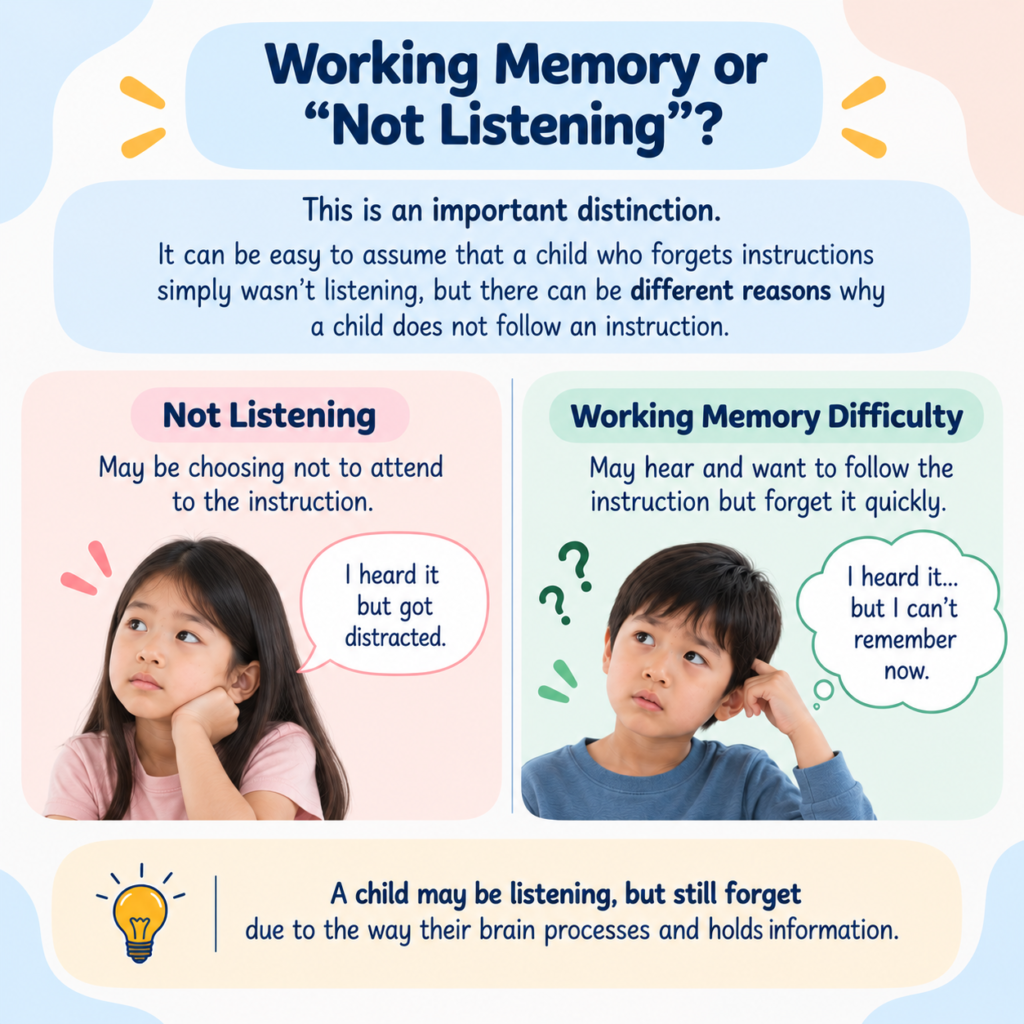
For example:
“My child wasn’t listening.”
They may have been distracted.
“My child doesn’t remember anything.”
They may have received too much information at once.
“My child is being careless.”
The task may have required several steps that were difficult to keep track of.
“I have already told them three times!”
They may benefit from shorter instructions, visual reminders, or repetition.
The goal is not to excuse every behaviour.
Instead, it is to understand what skill your child may need help practising.
How Can Parents Support Working Memory at Home?
The good news is that parents can make everyday activities more manageable.
You don’t need complicated exercises.
Small changes in how you communicate can make a difference.
1. Give One or Two Instructions at a Time
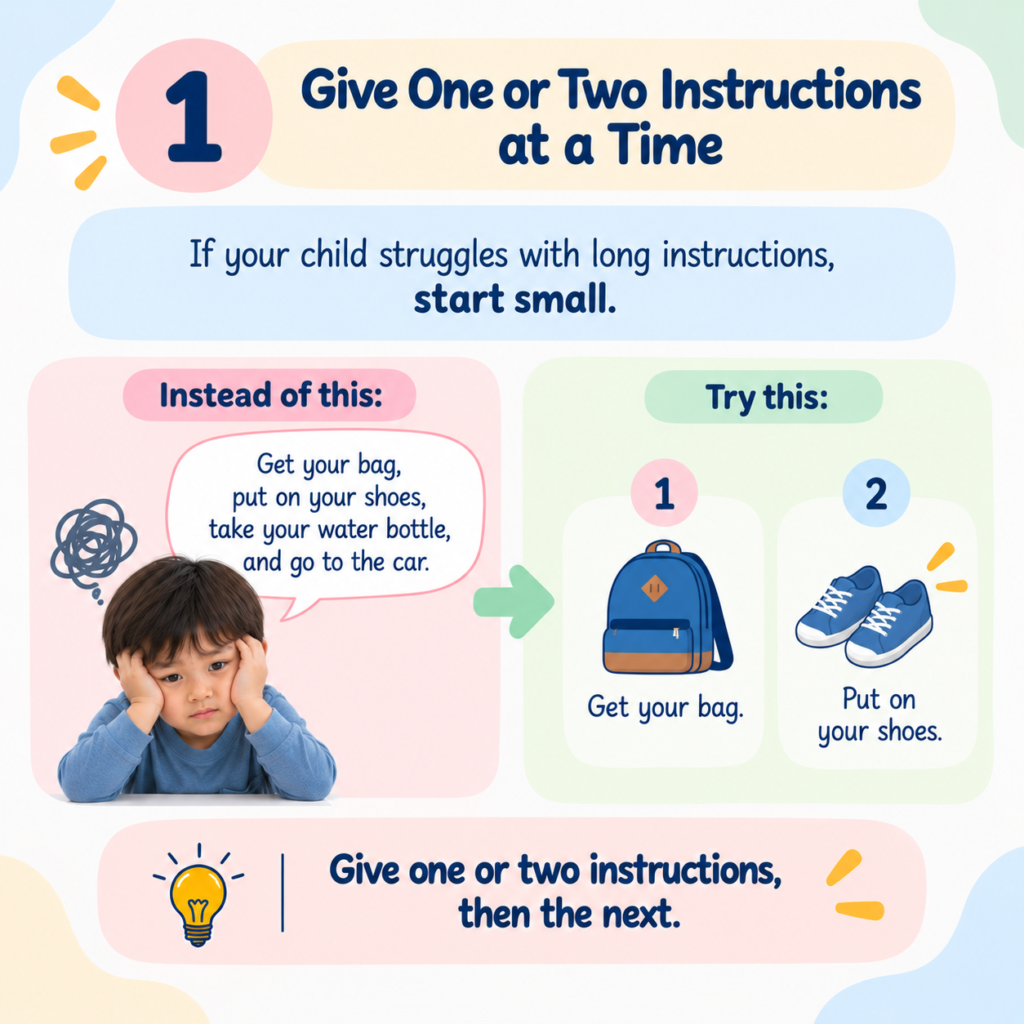
If your child struggles with long instructions, start small.
Instead of giving five instructions at once, try giving one or two.
Once your child completes them, give the next instruction.
2. Ask Your Child to Repeat the Instruction
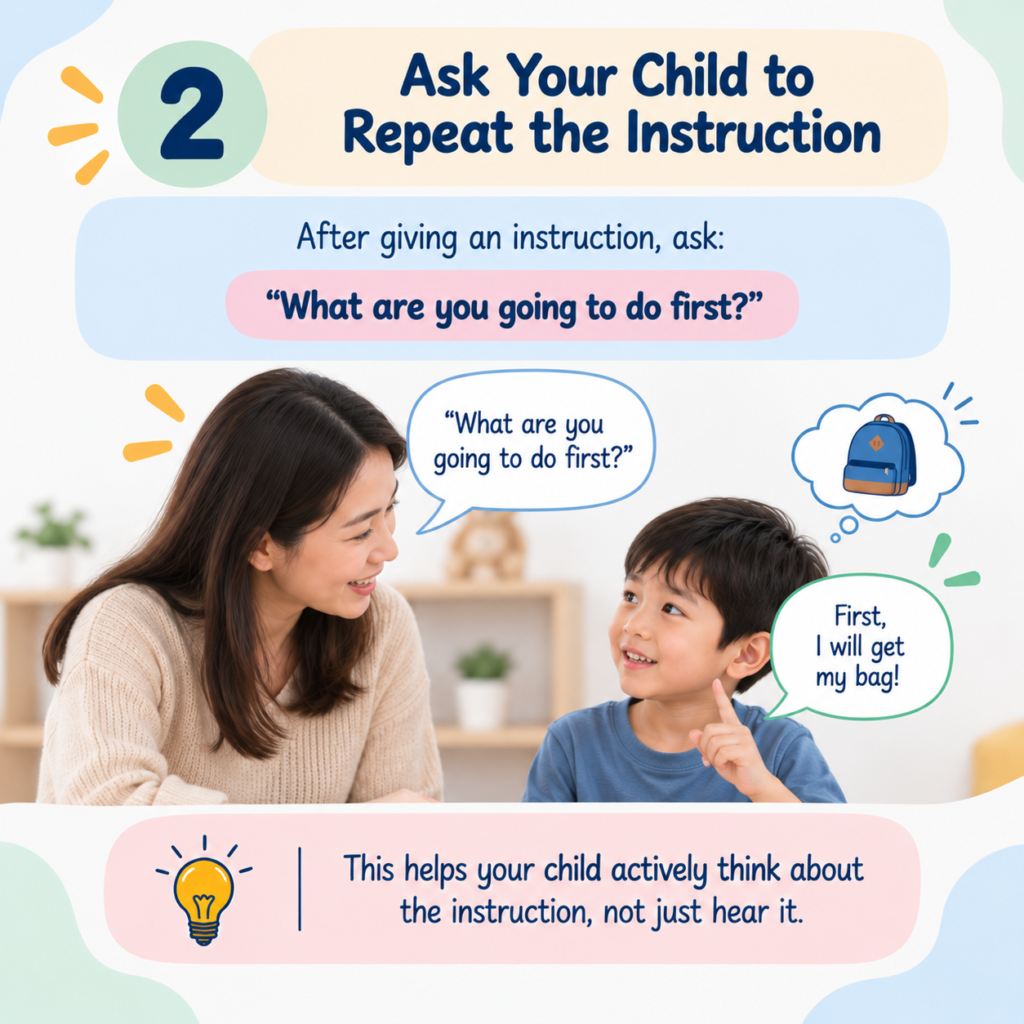
After giving an instruction, you can ask:
“What are you going to do first?”
This encourages your child to actively process the information rather than simply hearing it.
3. Use Visual Reminders
Pictures, checklists, written instructions, or visual schedules can help reduce the amount of information your child needs to remember.
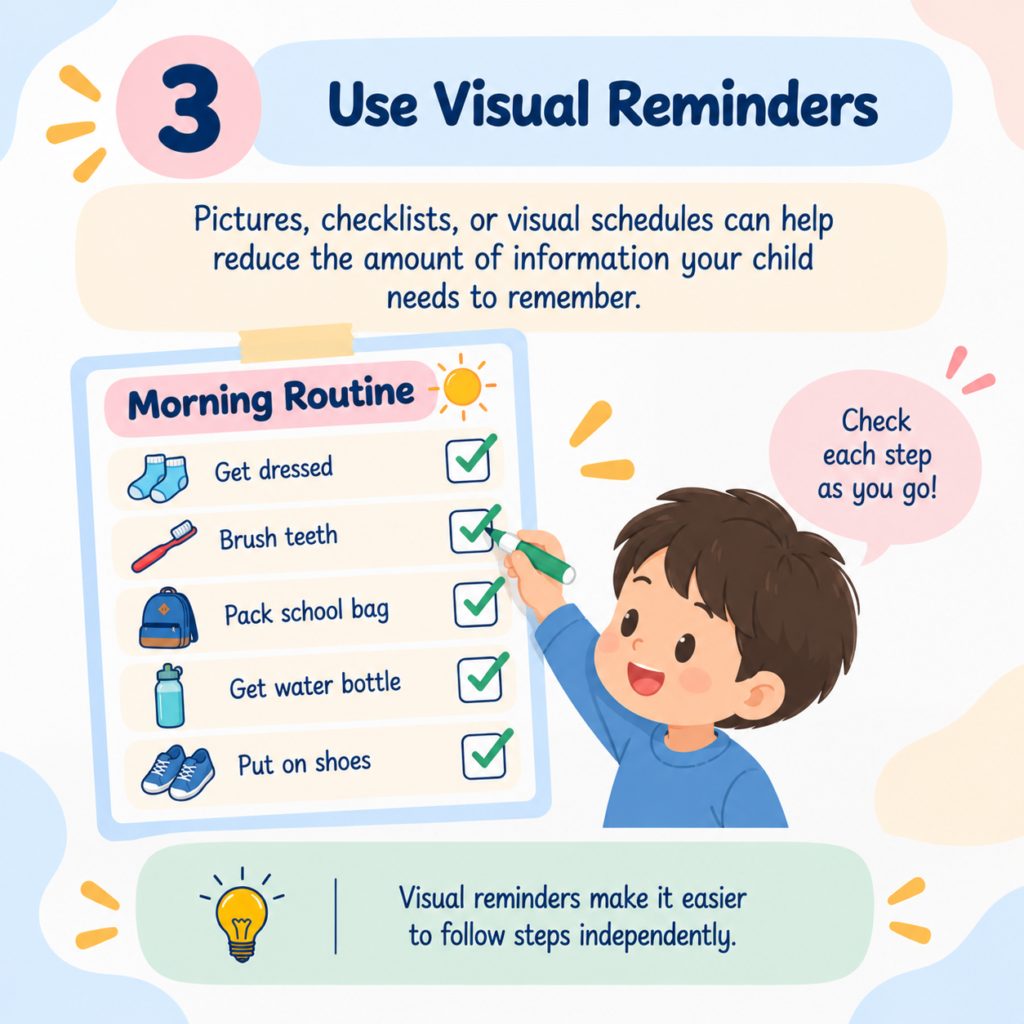
For example, a morning routine could include:
🧦 Get dressed
🪥 Brush teeth
🎒 Pack school bag
🥤 Get water bottle
👟 Put on shoes
Your child can check each step as they complete it.
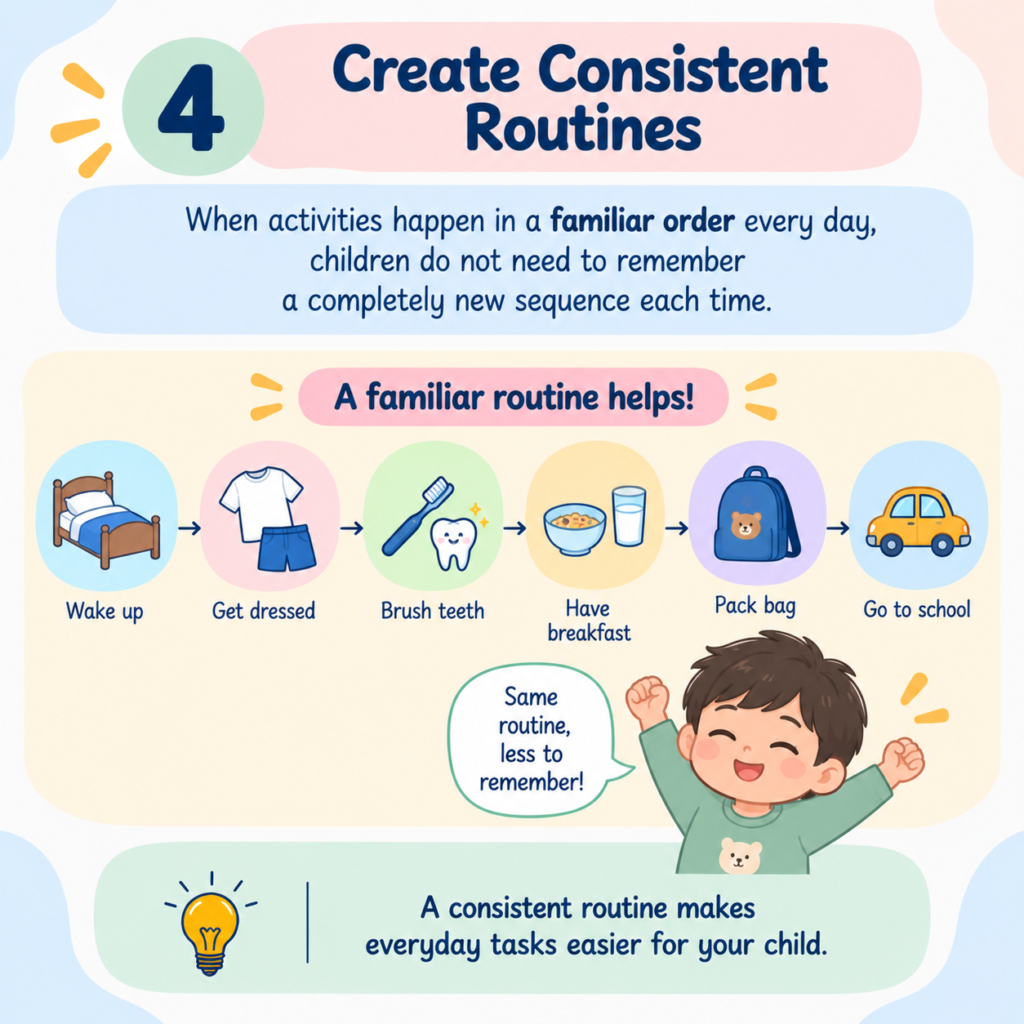
4. Create Consistent Routines
When activities happen in a familiar order every day, children do not need to remember a completely new sequence each time.
For example:
Wake up → Get dressed → Eat breakfast → Brush teeth → Pack bag → Shoes
Routines can help make everyday tasks more predictable.
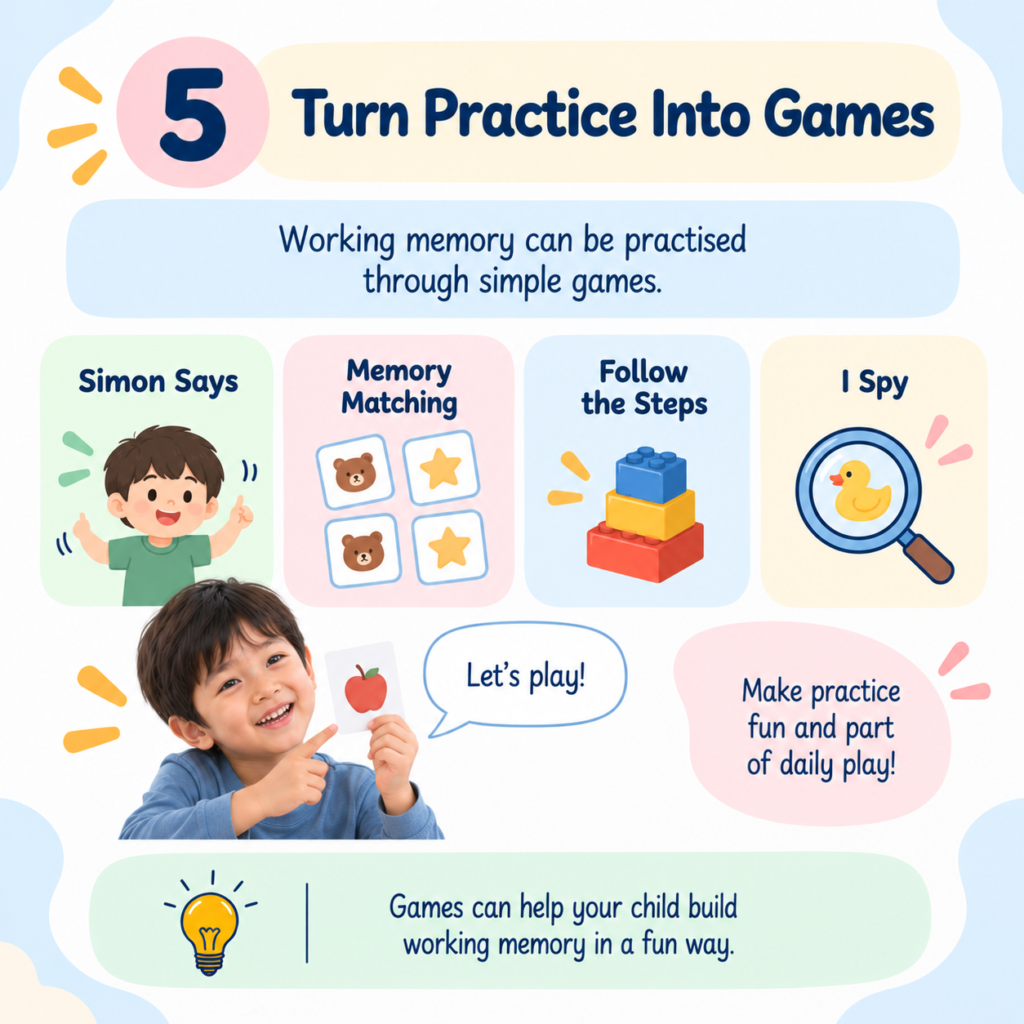
5. Turn Practice Into Games
Try:
❃ “I went to the market…” memory games
❃ Simon Says
❃ Remembering short sequences
❃ Repeating patterns
❃ Story recall
❃ Matching games
❃ Following two- or three-step instructions
❃ “What changed?” games
Keep the activities fun rather than turning them into another academic task.
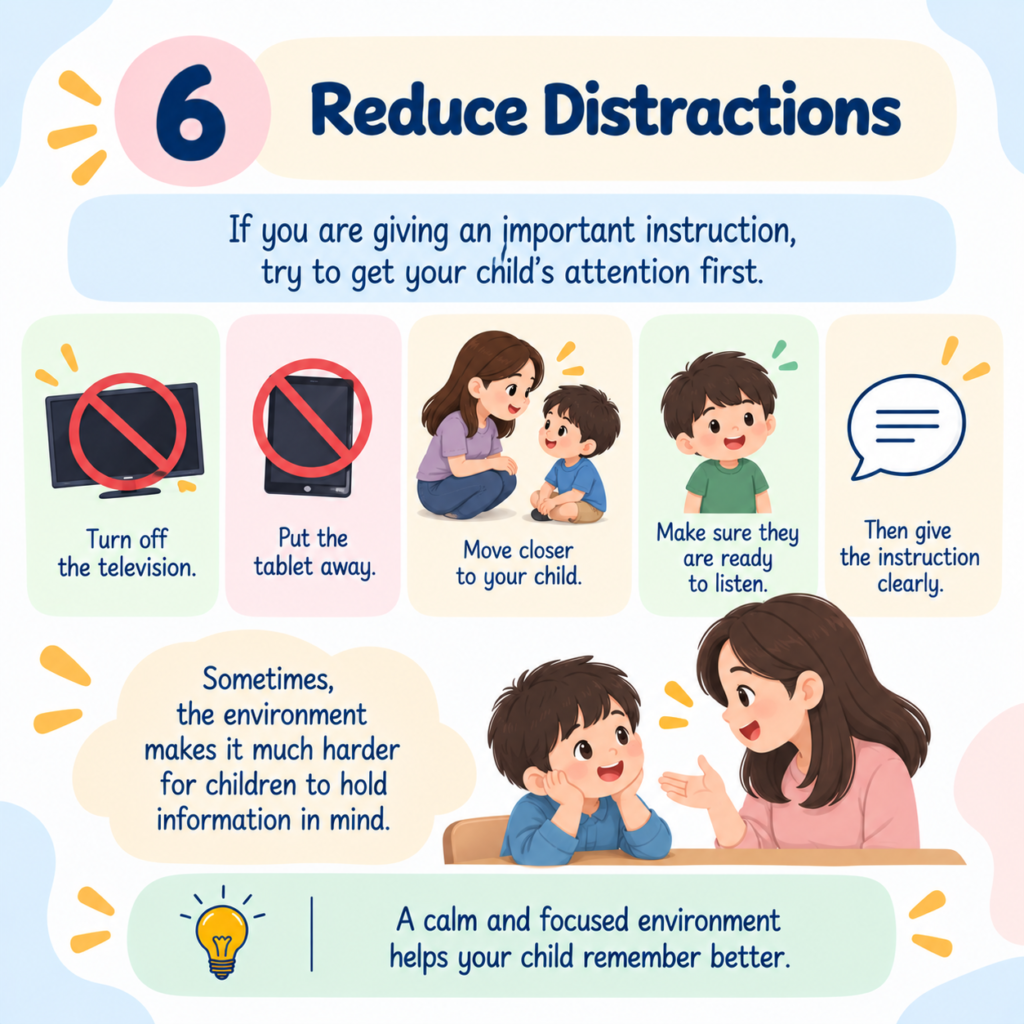
6. Reduce Distractions
If you are giving an important instruction, try to get your child’s attention first.
❃ Turn off the television.
❃ Put the tablet away.
❃ Move closer to your child.
❃ Make sure they are ready to listen.
❃Then give the instruction clearly.
Sometimes, the environment makes it much harder for children to hold information in mind.
Helping Your Child Remember Is More Than Repeating Yourself
When your child forgets something you just told them, it can be tempting to repeat the instruction louder.
But sometimes, they may need a different kind of support rather than simply hearing the same instruction again.
Try making the information:
❃ Shorter.
❃ Clearer.
❃ More visual.
❃ More predictable.
❃ More manageable.
And remember that working memory is a skill that continues to develop throughout childhood.
Your child may not be intentionally ignoring you.
They may simply be learning how to hold information, organise it, and use it.
So the next time your child says:
“What did you say again?”
take a breath.
Break the instruction down.
Give them a little support.
And remember that sometimes, helping a child learn isn’t about asking them to remember more.
It is about finding a way to make remembering easier.
🌟 Stay Connected with Us! We love sharing tips, insights, and inspiring stories about children’s growth and mental wellbeing.
💙 Follow us on Instagram and Facebook for more updates and parenting advice.
Join our community and let’s grow together. One positive step at a time!

References
Center on the Developing Child at Harvard University. (2014). Enhancing and practicing executive function skills with children from infancy to adolescence.
Harvard University. https://developingchild.harvard.edu/resources/activities-guide-enhancing-and-practicing-executive-function-skills-with-children-from-infancy-to-adolescence/
Working Hours
Tuesday to Saturday – 8.30am to 6pm
Monday & Sunday – Closed
Please also subscribe us at
Contact Us
Discover Our Team!
📞+60102502833
firststepdevelopmentcentre@gmail.com
B1-7, Plaza Damas 3, Jalan Sri Hartamas 1, 50480 Kuala Lumpur.
Copyright 2025. Firststep Child Development Sdn Bhd. All rights reserved.