



Visual-Spatial Difficulties in Children: Signs Parents Should Know
Does your child struggle to understand where things are, copy shapes, find their way around, or organise objects on a page?
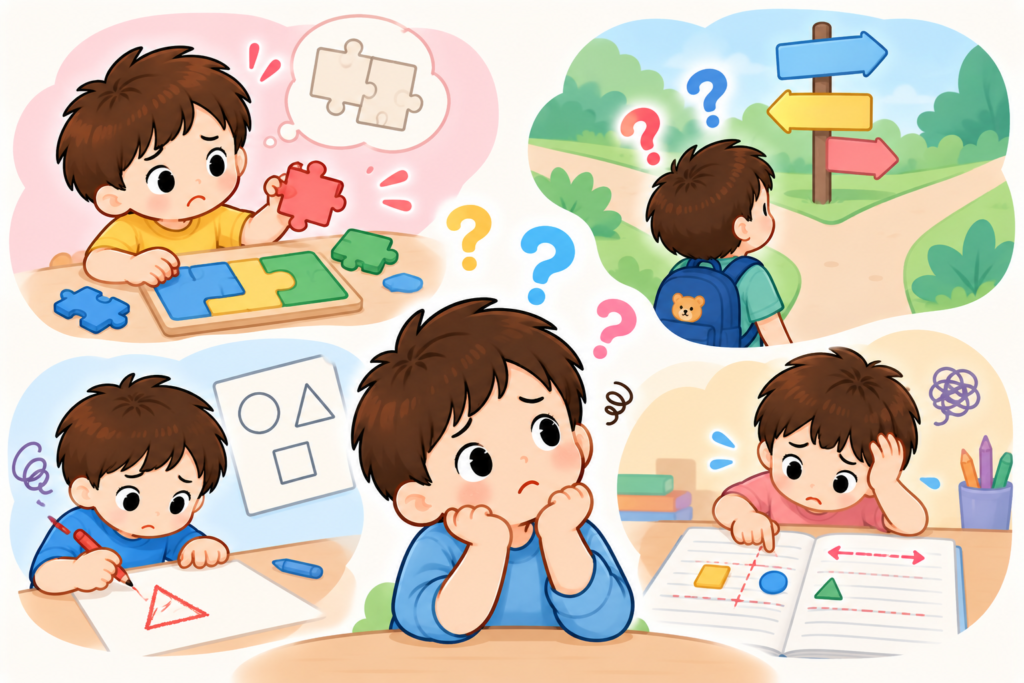
Visual-spatial skills help children understand where objects are, how they relate to each other, and how they fit within a space.
Children use these skills for everyday activities such as building with blocks, completing puzzles, drawing, getting dressed, navigating spaces, and working with numbers and shapes.
When these skills are difficult, a child may seem clumsy, become frustrated with puzzles or copying tasks, or need more help with activities that involve positioning and direction.
However, when visual-spatial difficulties happen frequently and begin to affect learning, schoolwork, coordination, daily routines, or everyday activities, it may be helpful to look more closely at what your child may be finding difficult.
What Is Visual-Spatial Ability?
Visual-spatial ability is the skill of understanding where things are, how they relate to each other, and how they fit together in space.
It helps children make sense of position, distance, direction, shape, and space.
Children use these skills every day, often without realising it. For example, they use visual-spatial skills when they:
1. 🧩 Complete a puzzle
2. 🧱 Build with blocks or LEGO
3. ✏️ Copy shapes, letters, or drawings
4. 📐 Understand shapes and patterns
5. 🧭 Find their way around familiar places
6. ⚽ Judge where a ball is going
7. 👕 Put clothes on correctly
8. 📚 Organise writing and numbers on a page
These skills develop gradually throughout childhood, and children may develop them at different rates.
1. Has Difficulty With Puzzles and Shapes
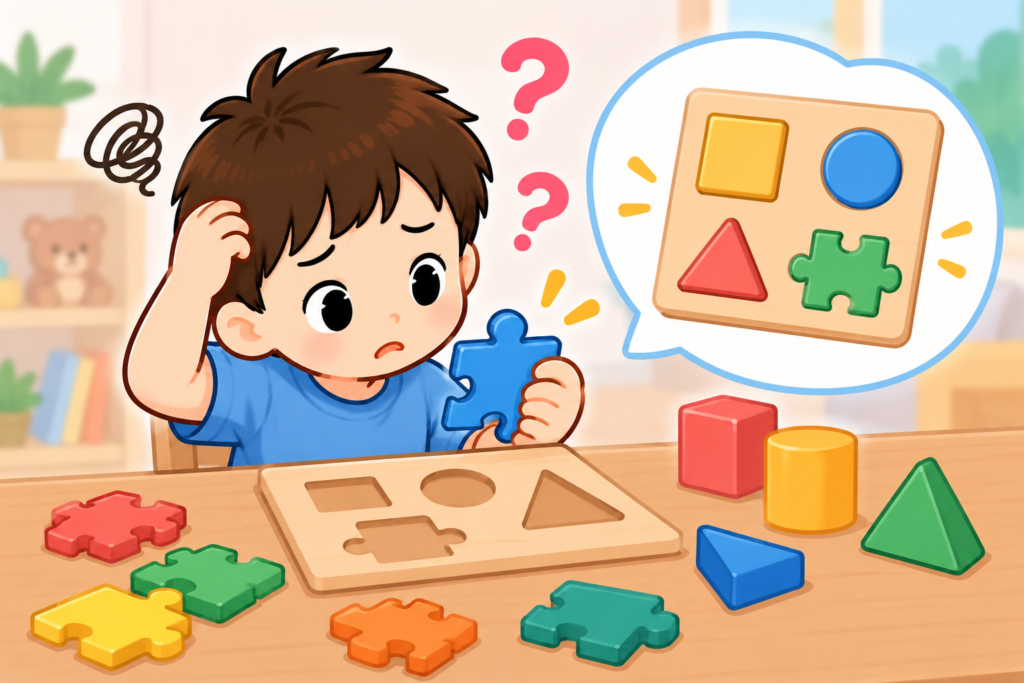
Your child may find it difficult to understand how different pieces fit together.
For example:
They may struggle with simple puzzles, copying shapes, or building a structure with blocks.
2. Struggles With Directions
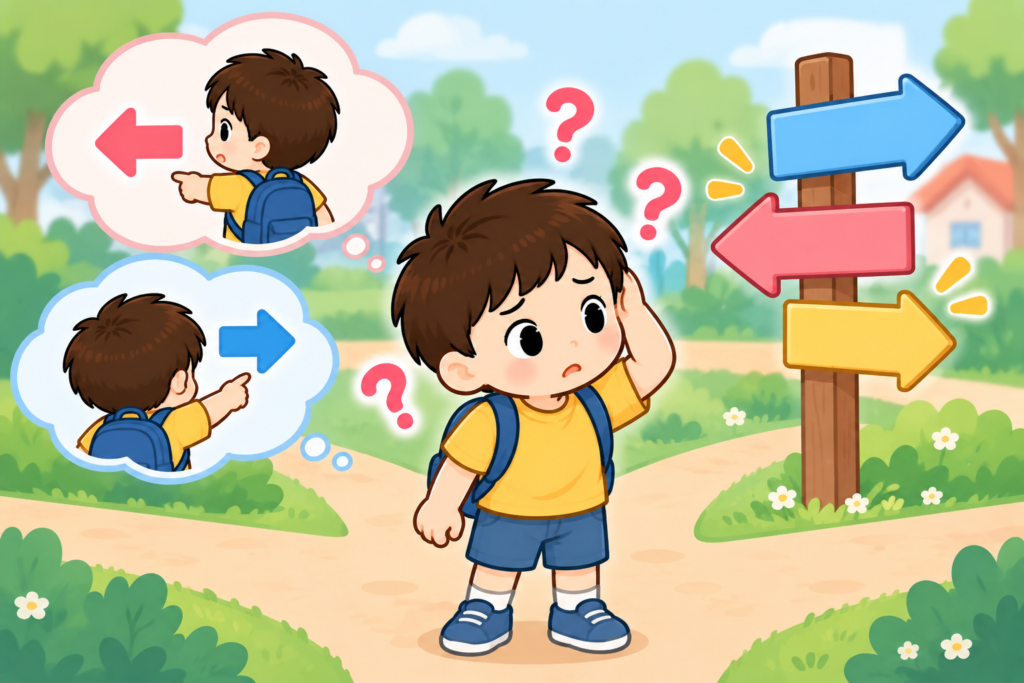
Your child may have difficulty understanding where things are in relation to themselves or others.
They may frequently confuse:
- Left and right
- Up and down
- In front and behind
- Near and far
Difficulty knowing where things are in space can affect everyday activities and navigation.
3. Finds Copying Difficult
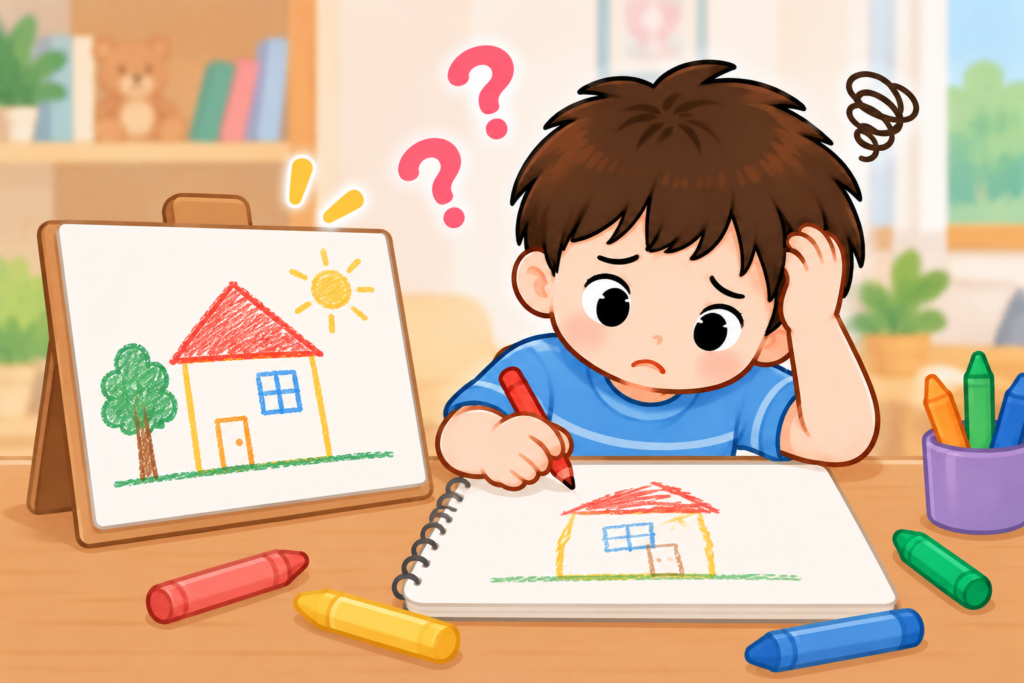
Your child may struggle to copy what they see.
For example:
They may have difficulty copying:
- Shapes
- Patterns
- Drawings
- Letters or numbers
- Designs from a model
They may understand what they are supposed to draw but find it difficult to organise the parts correctly on the page.
4. Has Difficulty With Spacing and Positioning
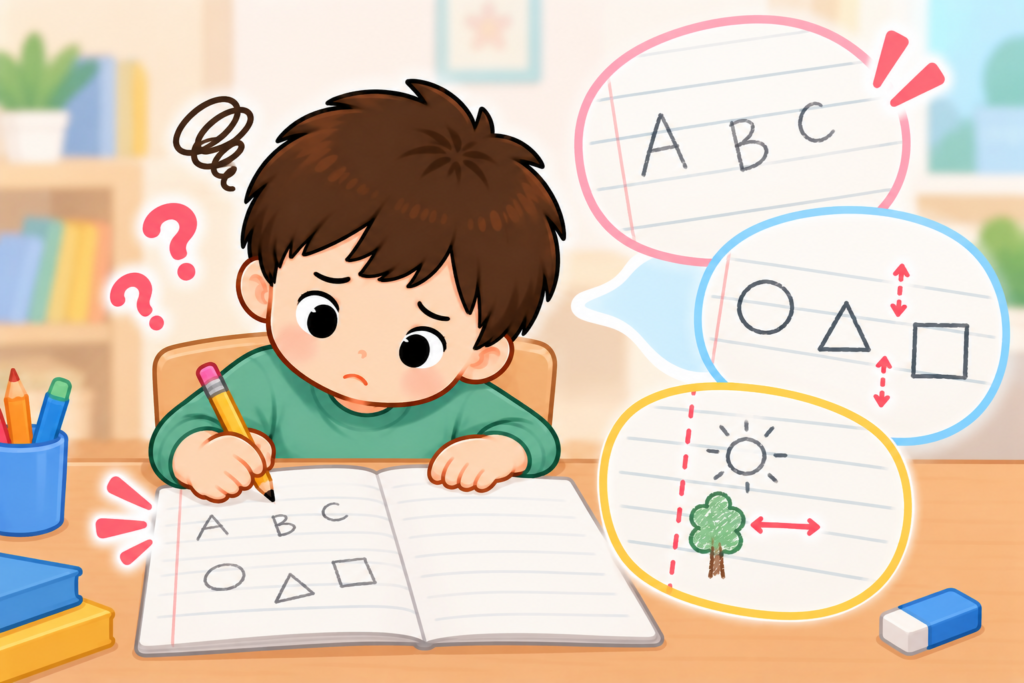
Your child may struggle to understand where things should go in relation to each other.
For example:
They may:
- Write words unevenly across a page
- Have difficulty keeping numbers lined up
- Leave unusual spaces between words
- Struggle to stay within boundaries when colouring
- Have difficulty organising information on a worksheet
Visual-spatial skills can be important when working with numbers, shapes, and information arranged on a page.
5. Seems Clumsy During Physical Activities
Visual-spatial skills also help children understand the position and movement of their bodies in relation to objects around them.
For example:
Your child may have difficulty:
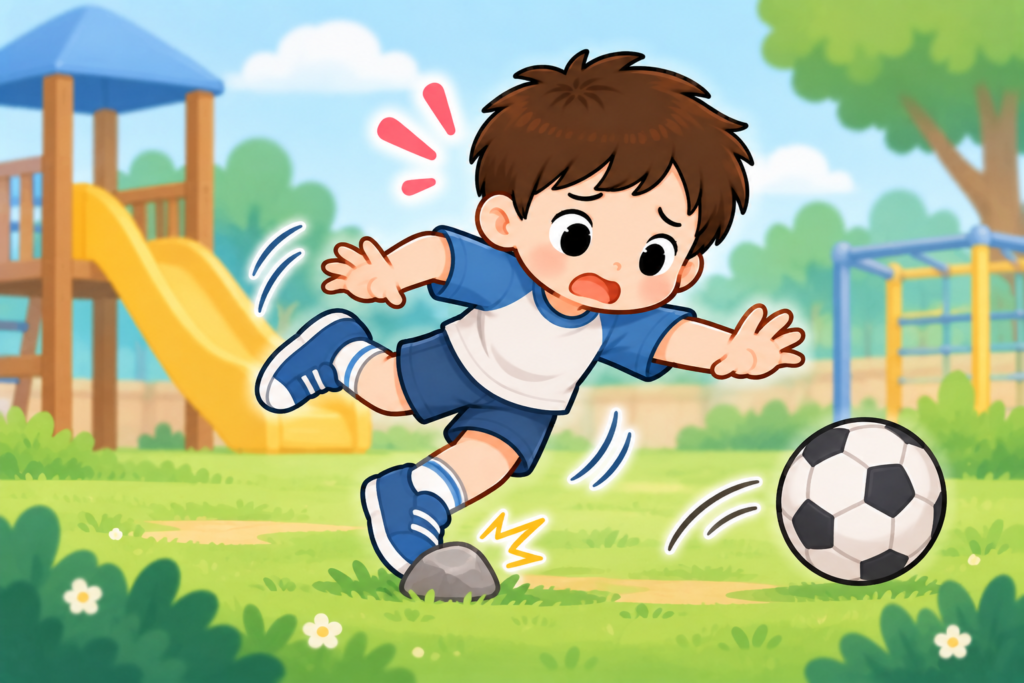
- Catching or kicking a ball
- Judging distances
- Moving around obstacles
- Navigating crowded spaces
- Completing activities that require hand-eye coordination
These difficulties can sometimes overlap with motor coordination challenges.
6. Gets Lost or Has Difficulty Finding Their Way
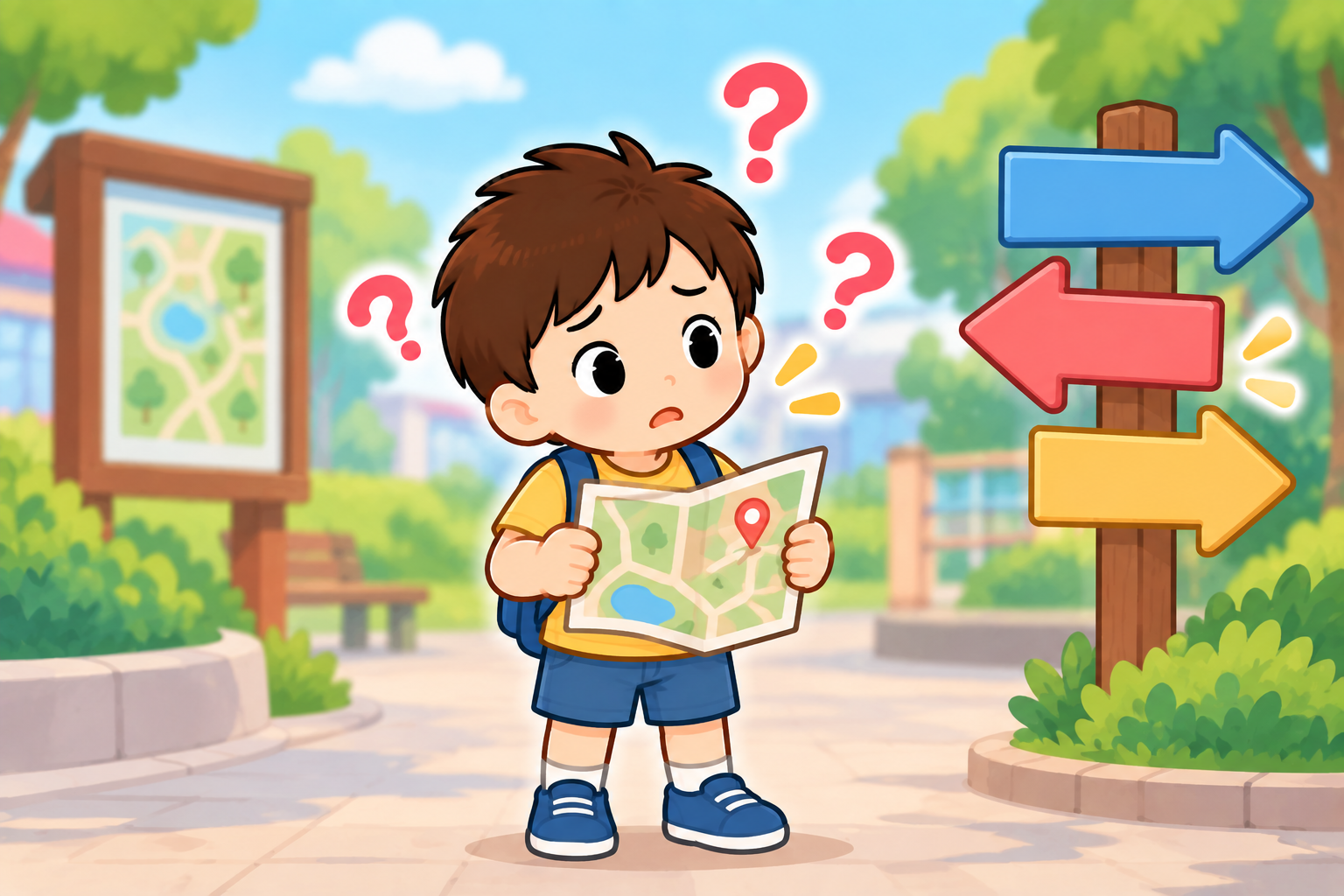
Your child may find it difficult to remember where places or objects are located.
For example:
They may:
- Get confused in familiar places
- Have difficulty following a route
- Struggle to remember landmarks
- Find maps difficult to understand
- Frequently ask where to go next
Some children with spatial difficulties may have trouble developing a mental map of their surroundings.
How Can Parents Help?
1. Use Hands-On Activities
✿ Try activities that involve building and arranging objects.
✿ For example:
1. Blocks
2. Puzzles
3. Lego
4. Shape sorters
5. Mazes
✿ These activities give children opportunities to practise understanding how objects relate to each other.
2. Use Clear Visual Examples
✿ When giving instructions, show your child what you mean whenever possible.
✿ For example:
Instead of:
“Put it over there.”
Try:
“Put the red block beside the blue block.”
✿ Visual examples and simple instructions can make tasks easier to understand.
3. Practise Directions During Everyday Activities
✿ Use everyday opportunities to practise spatial words.
✿ For example:
“Put your shoes under the chair.”
“The spoon is beside your plate.”
“Stand behind me.”
✿ This helps children connect words with positions in real-life situations.
4. Break Drawing and Writing Tasks Into Steps
✿ If your child struggles to copy a picture, break it into smaller parts.
✿ For example:
“Let’s draw the circle first.”
Then:
“Now let’s add the two eyes.”
✿ This can make a larger task feel more manageable.
5. Give Extra Time
✿ Some children may need more time to process where objects should go or how to organise information visually.
✿ Allowing extra time can reduce frustration and give your child an opportunity to work through the task.
6. Celebrate Effort
✿ Avoid focusing only on whether the final picture, puzzle, or written work looks correct.
✿ Instead, praise the process:
“You worked really hard to fit those pieces together!”
“You found the right place for that block!”
When Should Parents Seek Professional Advice?
❀ Every child develops visual-spatial skills at their own pace.
❀ However, it may be helpful to seek professional advice if your child’s difficulties are persistent and begin to interfere with everyday activities or learning.
❀ You may want to discuss your concerns if your child frequently:
1. Struggles with puzzles, shapes, or construction activities
2. Has difficulty copying drawings, letters, or patterns
3. Finds directions or positioning confusing
4. Has trouble organising work on a page
5. Struggles with activities that require hand-eye coordination
6. Becomes frustrated or avoids tasks involving visual-spatial skills
❀ A professional can look at your child’s overall development and individual strengths and difficulties to better understand what support may be helpful.
❀ The goal is not to label the difficulty, but to understand how your child learns and find the right support.
Key Takeaway
❀ Visual-spatial skills help children understand where things are and how they fit together.
❀ If your child struggles with puzzles, copying, directions, spacing, coordination, or finding their way around, it may be worth paying closer attention to the pattern.
❀ These difficulties do not necessarily mean that your child has a specific learning disorder.
❀ Every child develops differently, and difficulties may be related to different developmental, learning, or other individual factors.
❀ If concerns are persistent or affecting your child’s learning or daily activities, parents can seek an assessment from an occupational therapist to better understand your child’s strengths, challenges, and support needs.
🌟 Stay Connected with Us! We love sharing tips, insights, and inspiring stories about children’s growth and mental wellbeing.
💙 Follow us on Instagram and Facebook for more updates and parenting advice.
Join our community and let’s grow together. One positive step at a time!

References
Child Mind Institute. (n.d.). What is nonverbal learning disorder?
https://childmind.org/wp-content/uploads/2025/06/What-Is-Nonverbal-Learning-Disorder.pdf
Understood. (n.d.). What is visual-spatial processing?
https://www.understood.org/en/articles/visual-spatial-processing-what-you-need-to-know
Working Hours
Tuesday to Saturday – 8.30am to 6pm
Monday & Sunday – Closed
Please also subscribe us at
Contact Us
Discover Our Team!
📞+60102502833
firststepdevelopmentcentre@gmail.com
B1-7, Plaza Damas 3, Jalan Sri Hartamas 1, 50480 Kuala Lumpur.
Copyright 2025. Firststep Child Development Sdn Bhd. All rights reserved.