



Understanding Sensory Processing Issues in Children: A Malaysian Parent’s Guide (2026)

Imagine you are at a crowded mall in the Klang Valley on a busy Saturday afternoon. Your child suddenly covers their ears and begins to scream, seemingly overwhelmed by the bright lights or the hum of the air conditioning. It’s a moment many parents in Kuala Lumpur and Selangor know well; one that often leads to feelings of isolation and questions about sensory integration therapy Malaysia. You’ve likely wondered why certain environments feel so threatening to your little one while others seem perfectly fine, leaving you to worry if this is a matter of “bad behaviour” or something deeper.
We understand how exhausting it is to manage these daily challenges without a clear map. This guide will help you understand the complexities of your child’s nervous system and how specialised support can provide the tools they need to feel safe and focused. You’ll learn to identify common sensory “red flags” at home and discover how professional occupational therapy can transform these overwhelming experiences into moments of confidence and growth.
Key Takeaways
- Learn to distinguish between hypersensitivity and hyposensitivity to better understand why your child reacts strongly to certain sounds, textures, or lights.
- Explore all eight sensory systems, including “hidden” senses like balance and body awareness, to gain a holistic view of your child’s development.
- Identify practical sensory red flags within the Malaysian context, from the noise of local food courts to the tactile challenges of school uniforms.
- Understand how sensory integration therapy Malaysia uses evidence-based, play-focused activities to help your child feel more regulated and confident in their daily life.
What are Sensory Processing Issues in Children?

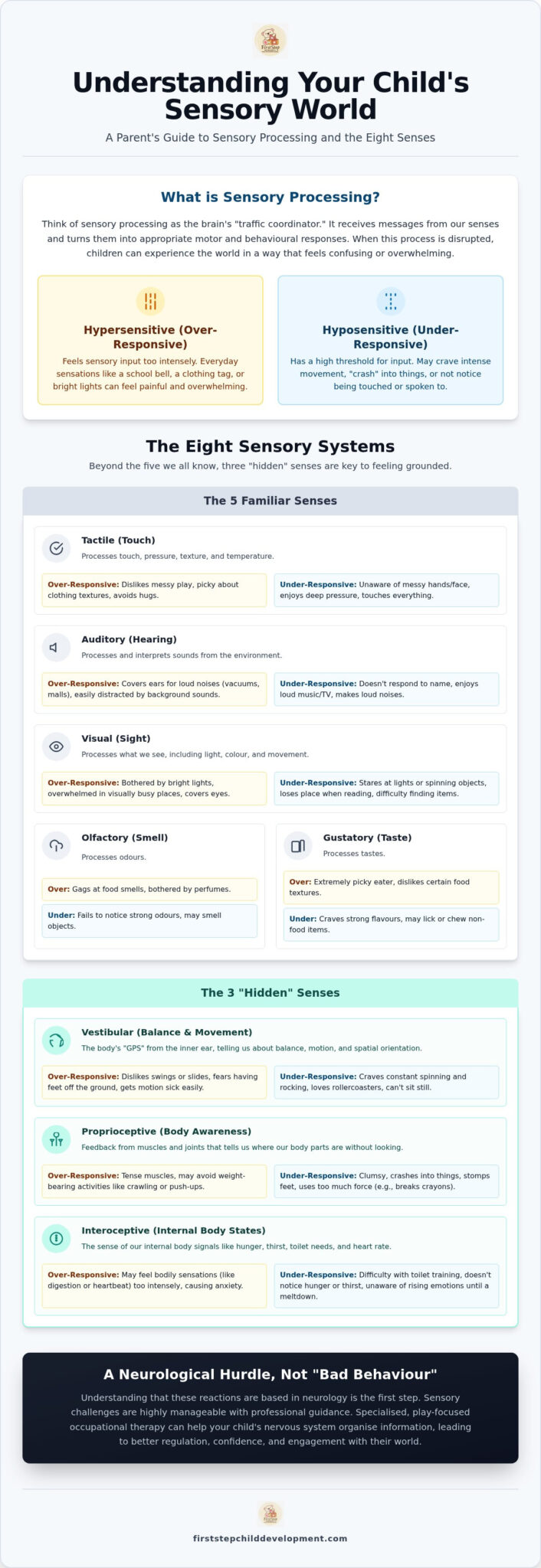
Sensory processing is the way our nervous system receives messages from the senses and turns them into appropriate motor and behavioural responses. Think of it as a traffic coordinator in the brain; it organises information so we can interact with our environment effectively. When this coordination falters, children may struggle with daily tasks that others find simple. Sensory Processing Disorder (SPD) is a condition where these sensory signals aren’t organised into appropriate responses, often leading to confusion or distress for the child.
Children typically fall into two categories of response:
- Hypersensitivity (Over-responsive): These children feel sensory input too intensely. A Malaysian school bell or the texture of a specific fabric might feel physically painful or overwhelming.
- Hyposensitivity (Under-responsive): These children have a high threshold for input. They might constantly crave movement, “crash” into furniture, or fail to notice when they are being spoken to.
It’s vital for parents in Kuala Lumpur and Selangor to know that these challenges are not a result of poor discipline. They are neurological hurdles that are highly manageable with the right professional guidance. You aren’t alone in this journey, and there are clear paths forward to help your child thrive.
Sensory Integration vs. Sensory Processing
Sensory processing refers to the entire cycle of receiving, interpreting, and responding to stimuli. In contrast, sensory integration is the specific neurobiological process of “knitting” that information together into a coherent picture. When this internal “knitting” is smooth, a child can focus on learning and play. However, when it’s disrupted, daily life can feel chaotic. Many families seeking sensory integration therapy Malaysia find that understanding this distinction helps them communicate more effectively with teachers and doctors. By focusing on these underlying connections through pediatric occupational therapy, we provide a structured path to help children regulate their reactions and engage more fully with their world.
The Eight Sensory Systems: Beyond Sight and Sound
Most of us grow up learning about the five basic senses: sight, smell, taste, touch, and hearing. While these are vital, they only tell part of the story. To feel truly grounded, a child relies on three “hidden” systems that operate beneath the surface. When these systems don’t communicate effectively, a child might feel like they are moving through a world that is constantly shifting. This often manifests as physical clumsiness or unexplained anxiety that can be addressed through sensory integration therapy Malaysia.
The Vestibular and Proprioceptive Systems
The vestibular system, found in the inner ear, acts as the body’s GPS for balance and spatial orientation. It tells a child if they’re moving, how fast, and in what direction. Proprioception is the “body awareness” sense that tells us where our limbs are without us having to look at them. A child with proprioceptive issues might press too hard on a pencil or accidentally bump into furniture. They aren’t being “naughty” or careless; their brain simply isn’t receiving clear feedback from their muscles and joints. If you notice these patterns, a pediatric occupational therapy assessment can provide the clarity you need.
Understanding Interoception
Interoception is the sense of internal body states, such as hunger, thirst, or the need to use the toilet. In this Sensory Processing Issues Explained resource, experts highlight how interoception also links to emotional regulation. If a child can’t feel their heart racing, they may not realise they’re becoming overwhelmed until a full meltdown occurs. This often makes potty training or managing big emotions much more difficult for families in the Klang Valley. Developing these internal senses is a core goal of sensory integration therapy Malaysia, helping children gain better control over their bodies and emotions.
Recognising Sensory Red Flags in Daily Malaysian Life
Living in the Klang Valley means navigating vibrant, high-energy environments. While many enjoy the bustle of a KL shopping mall or the clatter of a busy food court, these spaces can be deeply distressing for a child with sensory processing challenges. What looks like a public “meltdown” is often a physiological response to an environment that feels physically painful. According to the NIH, Sensory Integration Therapy is designed to help children manage these overwhelming inputs more effectively.
In Malaysia’s tropical climate, even the weather plays a role. A hypersensitive child might find the combination of high humidity and the coarse texture of a stiff school uniform unbearable. Similarly, “picky eating” in our food-rich culture is frequently misunderstood. It isn’t always about being difficult; it may be an oral sensory issue where certain textures feel like a threat. These sensory red flags often look like behavioural problems, but they are actually physiological responses to a nervous system in distress.
Sensory Challenges in the Classroom
A typical Malaysian classroom is rarely silent. Fans whir, chairs scrape, and background chatter persists. For a child struggling with sensory integration, this background noise makes following instructions nearly impossible. They may seem “spaced out” or unable to sit still, which can significantly impact their academic progress. If your child is struggling to keep up, a Learning Difficulties Assessment Malaysia can help determine if sensory issues are the root cause. Identifying these signs early allows for targeted sensory integration therapy Malaysia, ensuring your child has the support they need to succeed. If you’re concerned about your child’s development, consider a pediatric occupational therapy consultation to explore practical solutions.

How Sensory Integration Therapy Supports Your Child
Pediatric occupational therapy serves as the essential delivery vehicle for sensory integration therapy Malaysia. Unlike traditional clinical settings, these sessions are intentionally play-based to reduce anxiety and encourage active participation. Within a specialised “sensory gym”, children interact with equipment such as therapeutic swings, tactile brushes, and weighted blankets. These tools are purposefully selected to help the brain build more efficient pathways for organising sensory data, allowing the child to respond to their environment with greater ease and focus. Over time, these activities help bridge the gap between being overwhelmed and feeling capable.
A professional evaluation is the cornerstone of this process. It enables our therapists to map your child’s unique neurological responses and design a personalised “sensory diet”. This isn’t about food, but rather a structured schedule of sensory activities provided throughout the day to help your child maintain a regulated state, whether they are at home or navigating a busy Malaysian school environment. This proactive plan gives your child the specific inputs they crave or need to avoid, preventing the sensory overload described earlier in this guide.
The Multidisciplinary Approach at Firststep Psychology & Child Development Centre
At Firststep Psychology & Child Development Centre, our occupational therapists work in close collaboration with clinical psychologists to support every facet of a child’s growth. This partnership ensures that we address both the physical sensory processing needs and the emotional self-regulation challenges that often go hand-in-hand. Parents are vital partners in this journey; your insights help us refine goals and implement strategies that work in real-world settings. We focus on empowering families with the tools needed for long-term success. For more information on what a comprehensive evaluation entails, please refer to our Occupational Therapy Assessment Parent Guide.
Empowering Your Child’s Sensory Future
Shifting your perspective from “bad behaviour” to physiological needs is a vital milestone for your family. By recognising how sensory integration therapy Malaysia can reshape your child’s daily experience, you are providing them with the foundation for emotional stability and academic success. Early intervention ensures that these neurological hurdles become manageable milestones rather than permanent barriers to participation in school and community life in the Klang Valley.
Our multidisciplinary team at Firststep Psychology & Child Development Centre is dedicated to guiding families through these complexities with empathy and clinical precision. If you’ve observed sensory red flags, we invite you to learn more about our pediatric occupational therapy services or book a professional consultation at our centres in Kuala Lumpur and Selangor. You don’t have to navigate this path alone; we’re here to help your child find their confidence and comfort in the world.
Frequently Asked Questions
What is sensory integration therapy and how does it work?
Sensory integration therapy is a specialised, play-based intervention that uses activities like swinging or climbing to help the brain organise sensory information. It works by gradually challenging a child’s nervous system to process inputs more effectively. This structured approach helps children learn to filter out irrelevant signals, such as background noise, so they can focus on meaningful tasks without feeling overwhelmed by their environment.
Is sensory processing disorder the same as autism?
No, these are different conditions, though they frequently occur together. While sensory challenges are a common feature of autism, many children experience them as a standalone issue. It’s essential to understand that sensory processing relates to how the brain handles information from the body and environment. A multidisciplinary assessment can provide the clarity needed to support your child’s specific developmental path.
How can I tell if my child is over-sensitive or just being difficult?
Look for consistency and specific triggers in their environment. If your child has a meltdown every time they enter a loud food court or wear a specific fabric, it’s likely a physiological response rather than a choice. Unlike “bad behaviour”, sensory distress is involuntary. Seeking sensory integration therapy Malaysia allows experts to identify these neurological patterns and provide strategies to help your child feel more comfortable.
What are the benefits of occupational therapy for sensory issues?
The primary benefit is improved self-regulation, which allows children to participate more fully in daily life. Occupational therapy helps reduce the “fight or flight” response triggered by sensory overload, leading to better sleep, improved motor skills, and lower anxiety levels. By strengthening these neural pathways, children become more adaptable and confident when facing new experiences in busy public spaces across Kuala Lumpur and Selangor.
Can sensory integration therapy help with my child’s school performance?
Absolutely, as it addresses the underlying issues that often hinder learning. When a child’s brain is no longer struggling to process the hum of a classroom fan or the movement of peers, they can dedicate their energy to academic tasks. Improving sensory integration helps with concentration, following multi-step instructions, and developing the fine motor skills required for writing and other essential school activities.

Article by
Firststep Child Development Team
Firststep Child Development Team provides evidence-informed educational resources to help parents better understand child development, behaviour and learning. Our multidisciplinary services include clinical psychology, occupational therapy, speech and language therapy, developmental assessments and other child development support in Kuala Lumpur and Selangor.
Disclaimer
This article is for general educational and informational purposes only and is not a substitute for professional medical, psychological or therapeutic advice, diagnosis or treatment. Every child develops differently. If you have concerns about your child’s development, behaviour, learning or wellbeing, please consult an appropriately qualified healthcare or allied health professional.