



Understanding Joint Attention in Children: Why Sharing Attention Matters
Does your child look at something interesting but rarely try to share it with you?
Perhaps your child sees a colourful toy, points at it, or notices something happening around them.
But instead of looking towards you to share the experience, they continue focusing on the object alone.
You may wonder, “Is my child just not interested in interacting with me?”
This may be related to joint attention.
Joint attention is the ability to share attention with another person towards the same object, activity, or event.
It is an important part of early social communication and begins developing during infancy.
For example, a child may look at a toy, look towards their parent, and then look back at the toy.
The child is not simply looking at the toy — they are sharing the experience with another person.
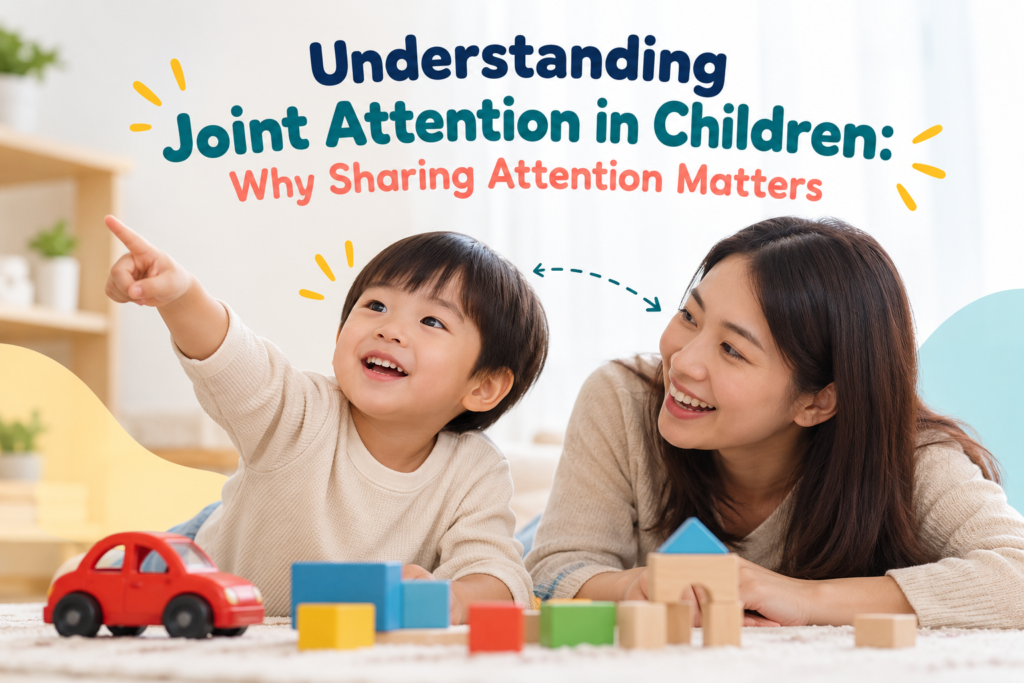
Joint attention happens when two people intentionally focus on the same thing and are aware that they are sharing that experience.
It can happen through:
🌸 Looking between a person and an object
🌸 Pointing to something interesting
🌸 Showing a toy to someone
🌸 Looking towards a parent when something exciting happens
🌸 Following another person’s point or gaze
🌸 Bringing an object to someone to share interest
Joint attention can involve both initiating and responding.
1. Initiating Joint Attention
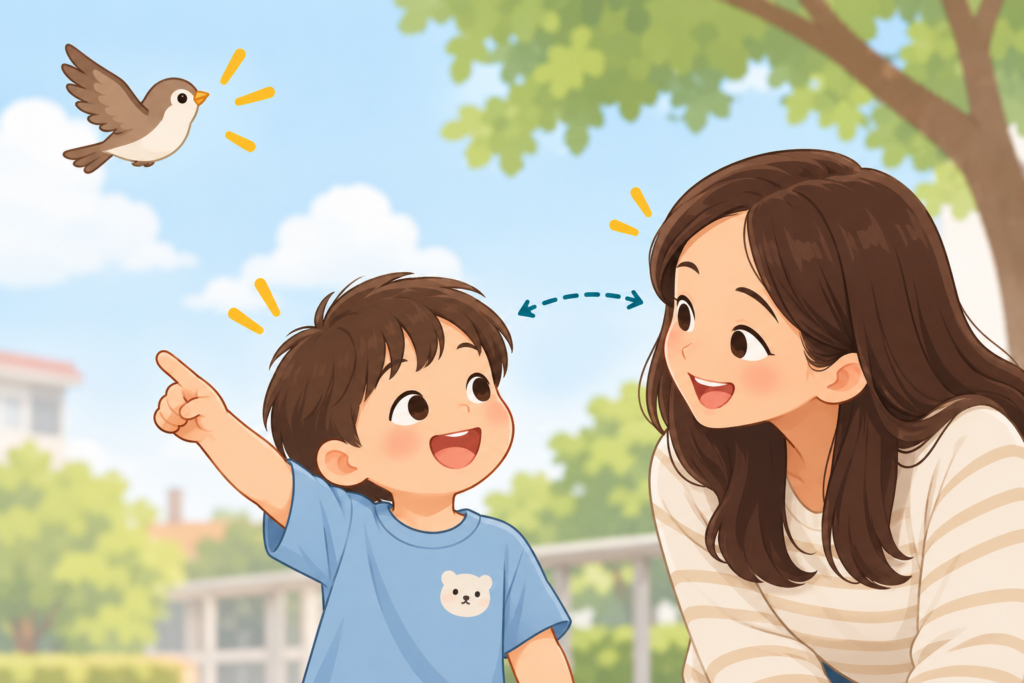
This happens when a child tries to get another person’s attention to share something.
For example:
Your child sees a bird outside and points towards it while looking at you.
They may be communicating:
“Look! There is a bird!”
The goal is not necessarily to get the bird or ask for something. The child is trying to share an experience.
2. Responding to Joint Attention
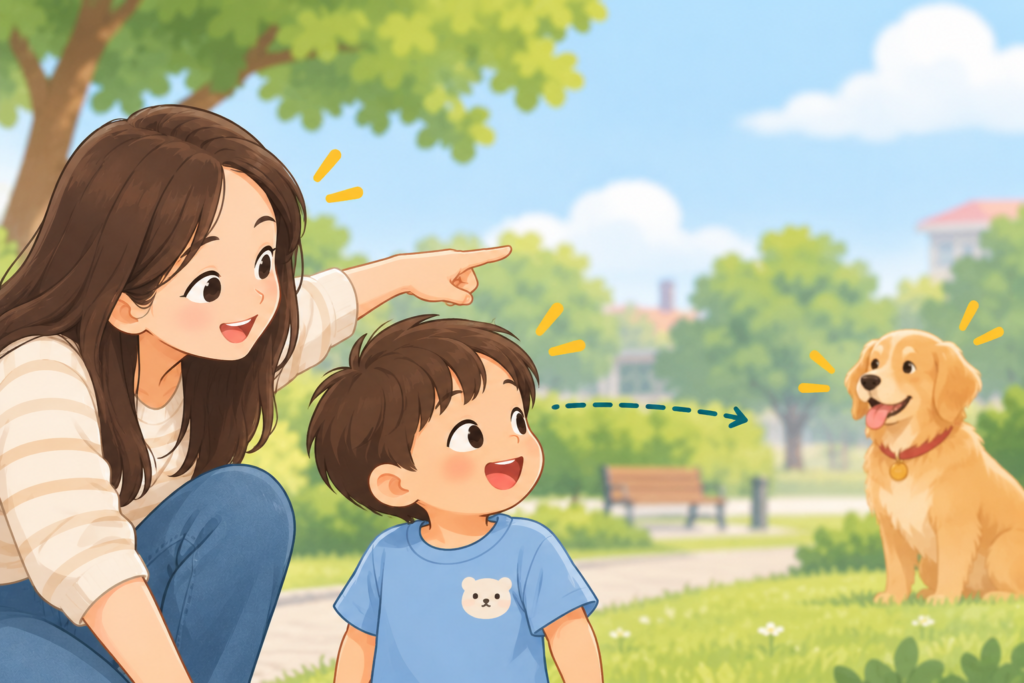
This happens when a child follows another person’s attempt to direct their attention.
For example:
You point towards a dog and say, “Look at the dog!”
Your child looks towards the dog.
This shows that your child is responding to your attempt to share attention.
Why Is Joint Attention Important?
Joint attention is more than simply looking at the same thing.
It creates opportunities for children to learn from other people and participate in social interactions.
Joint attention is closely connected with early communication and language development.
Research has found relationships between joint attention, engagement and language skills, including vocabulary development.
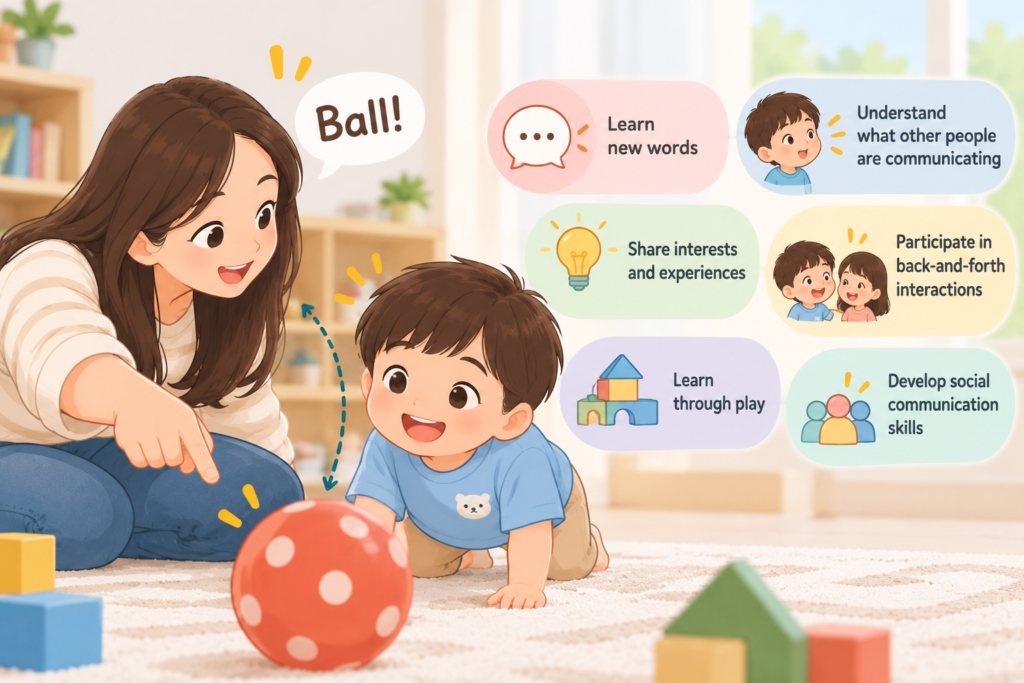
When children share attention with others, they have more opportunities to:
🌸 Learn new words
🌸 Understand what other people are communicating
🌸 Share interests and experiences
🌸 Participate in back-and-forth interactions
🌸 Learn through play
🌸 Develop social communication skills
For example, when a parent points to a ball and says “ball,” the child can connect the spoken word with the object they are both looking at.
What Does Joint Attention Look Like in Everyday Life?
Joint attention can happen during simple daily activities.
For example:
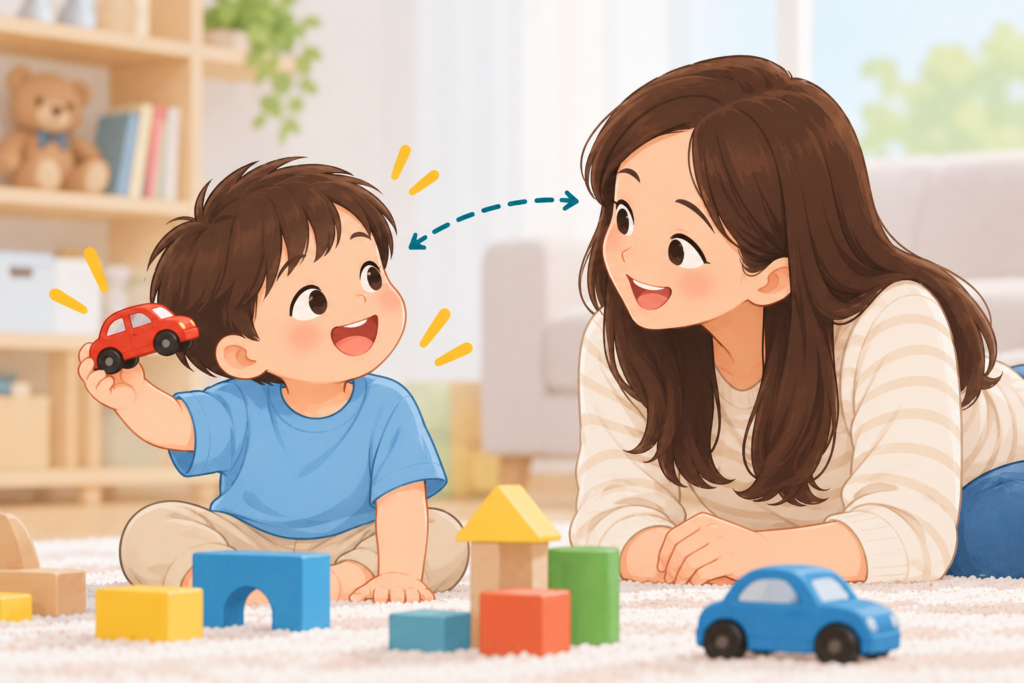
During Play
Your child picks up a toy car, looks at you and smiles before continuing to play.
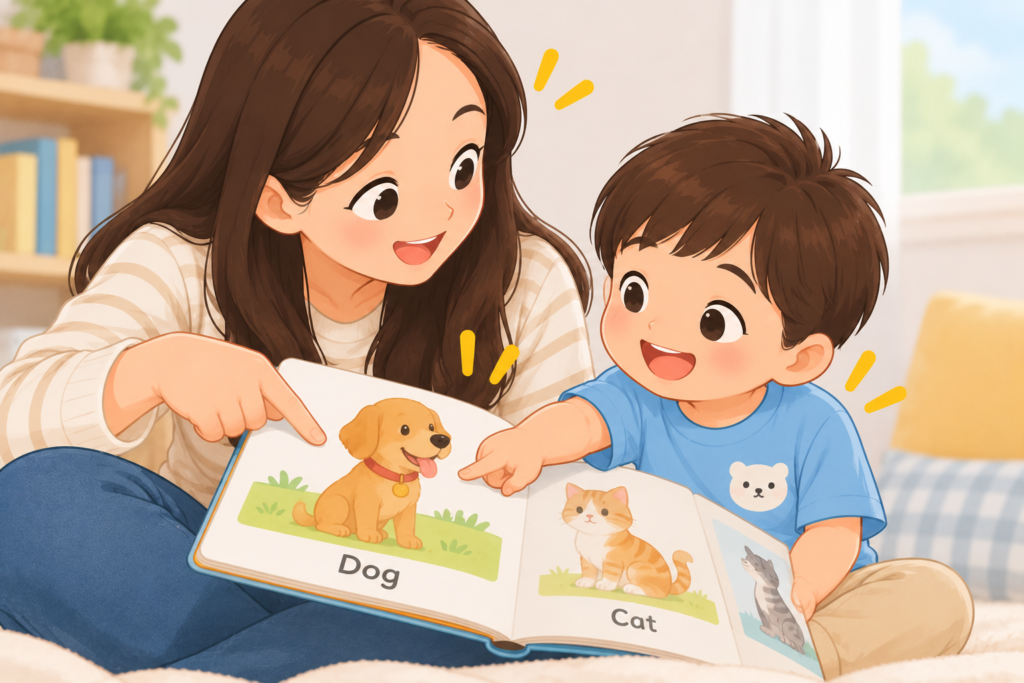
While Reading
You point to a picture of a dog and your child looks at the picture.
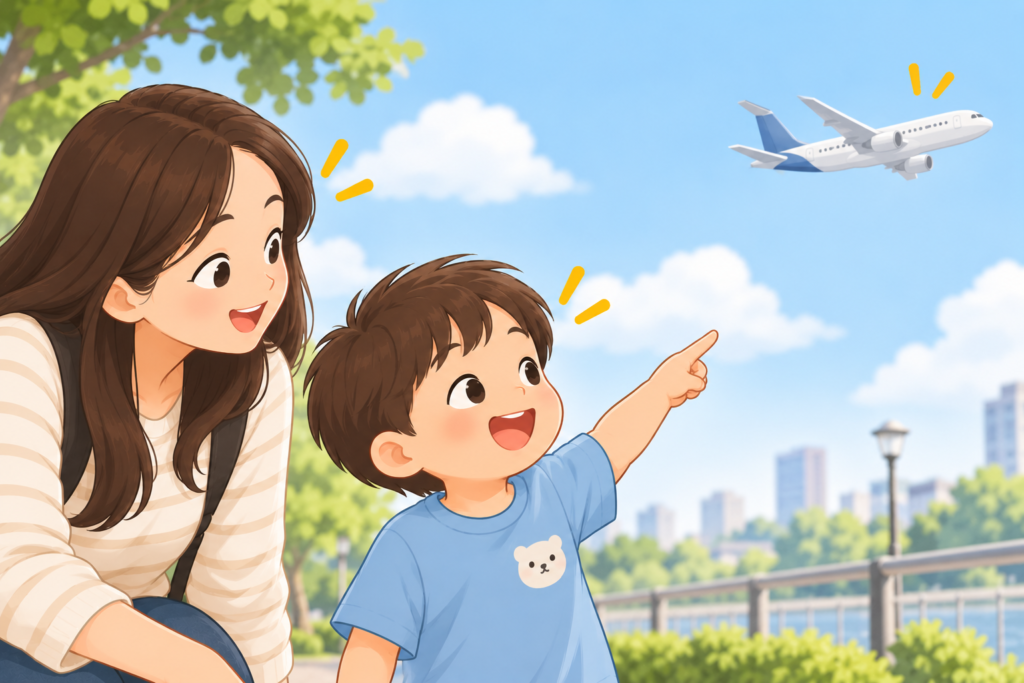
During a Walk
Your child notices an aeroplane, points towards it and looks at you.
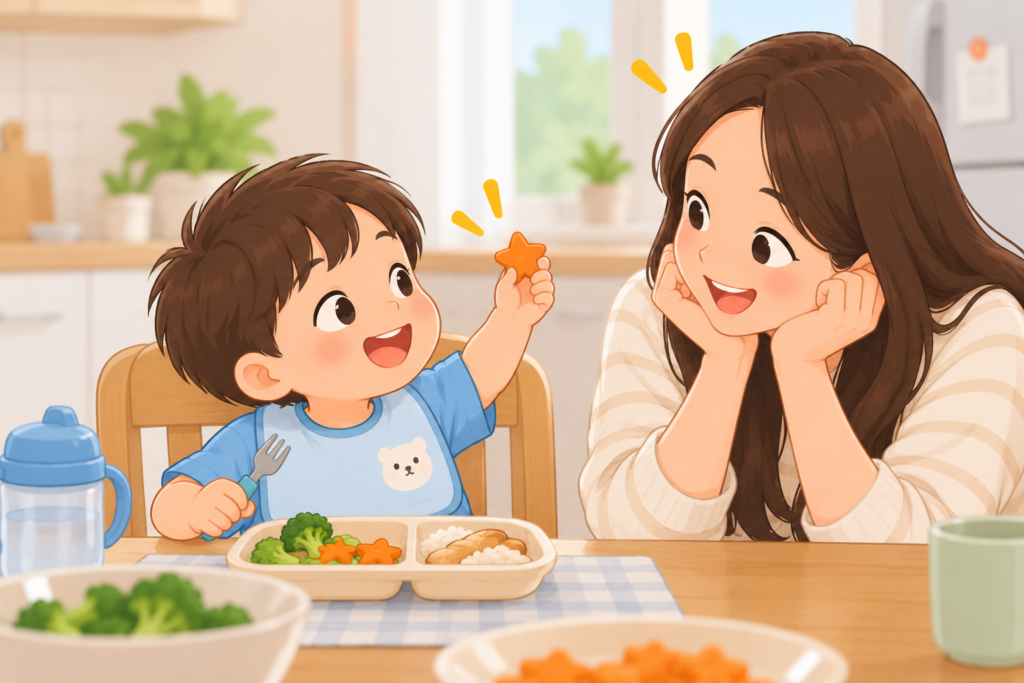
During Meals
Your child sees something interesting and looks towards you as if to share your reaction.
During Play With Others
Your child brings a favourite toy to you and waits for you to notice it.
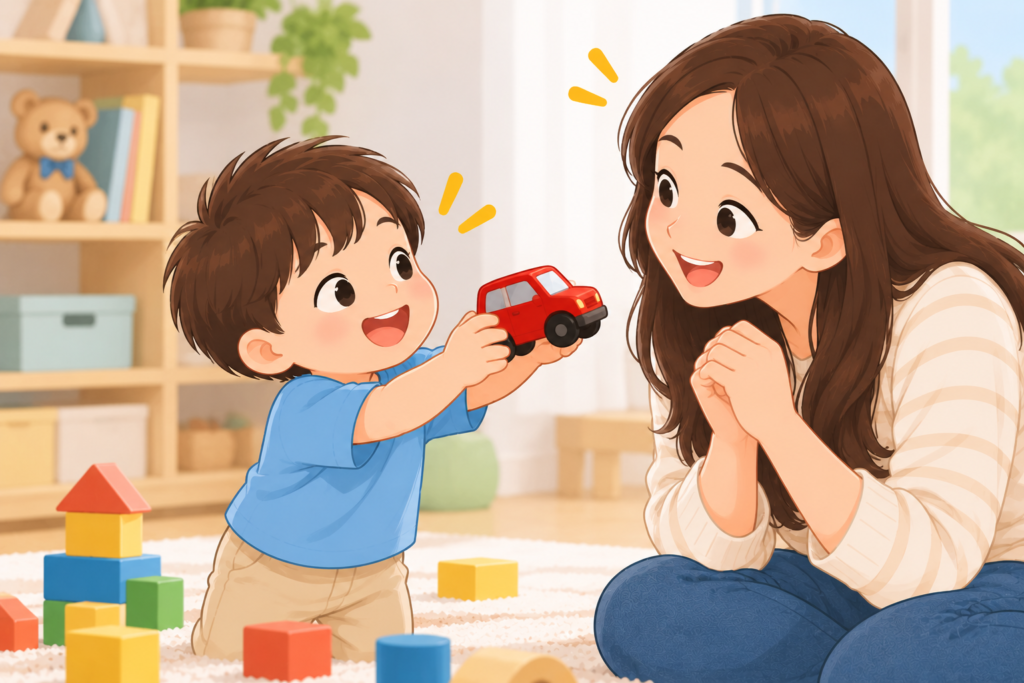
These small moments can be important opportunities for social communication.
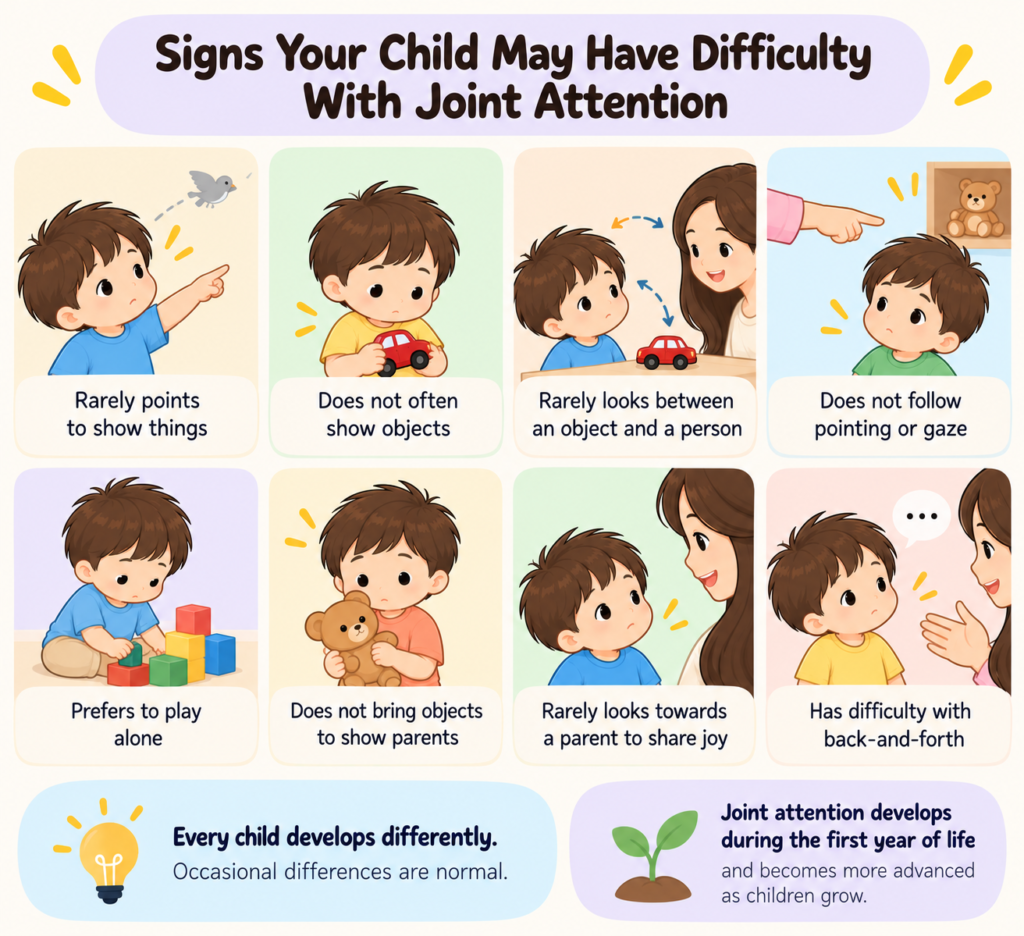
Signs Your Child May Have Difficulty With Joint Attention
Every child develops differently, and occasional differences do not necessarily indicate a problem.
However, parents may notice that a child:
🌺Rarely points to show something interesting
🌺Does not often show objects to others
🌺Rarely looks between an object and another person
🌺Does not usually follow another person’s pointing or gaze
🌺Prefers to play alone without sharing experiences
🌺Does not bring objects to parents to show them
🌺Rarely looks towards a parent to share enjoyment
🌺Has difficulty participating in back-and-forth interactions
It is important to look at your child’s overall development rather than focusing on one behaviour alone.
Joint attention develops during the first year of life and continues to become more sophisticated as children grow.
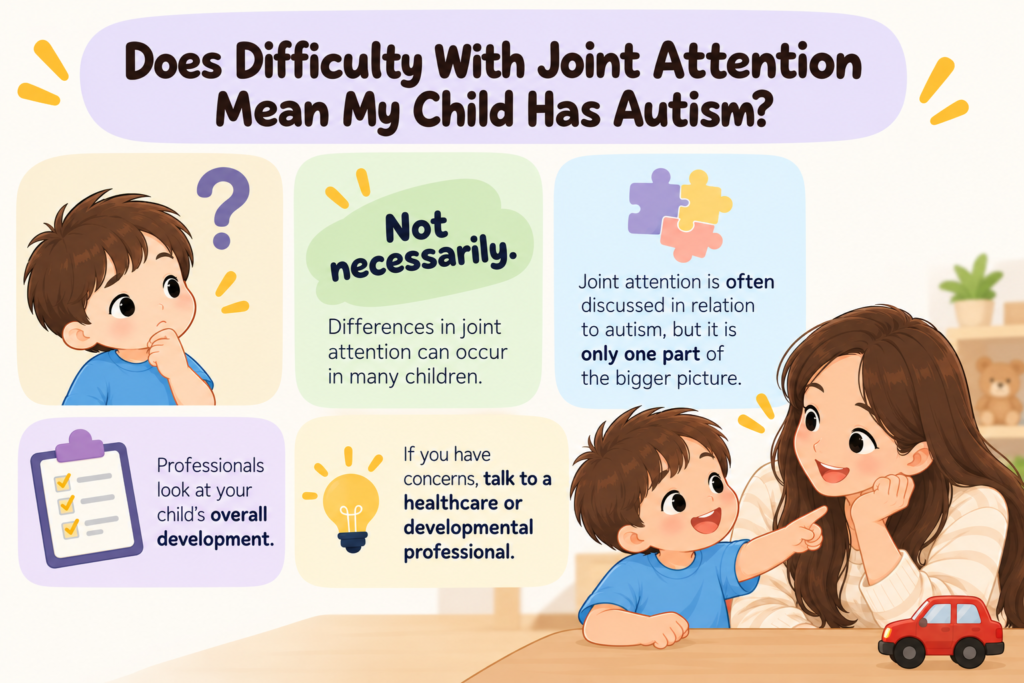
Does Difficulty With Joint Attention Mean My Child Has Autism?
Not necessarily.
Differences in joint attention can occur in children with a range of developmental and communication profiles.
Joint attention is often discussed in relation to autism because differences in social communication, including sharing attention, can be observed in autistic children.
However, difficulty with joint attention alone does not mean that a child is autistic.
Professionals consider a child’s overall development, including communication, language, social interaction, play, behaviour and other developmental characteristics.
If you have concerns about your child’s development, discussing them with a healthcare or developmental professional can help you understand the bigger picture.
How Can Parents Encourage Joint Attention?
You do not need complicated activities to encourage joint attention.
Simple everyday interactions can provide many opportunities.
1. Follow Your Child's Interests
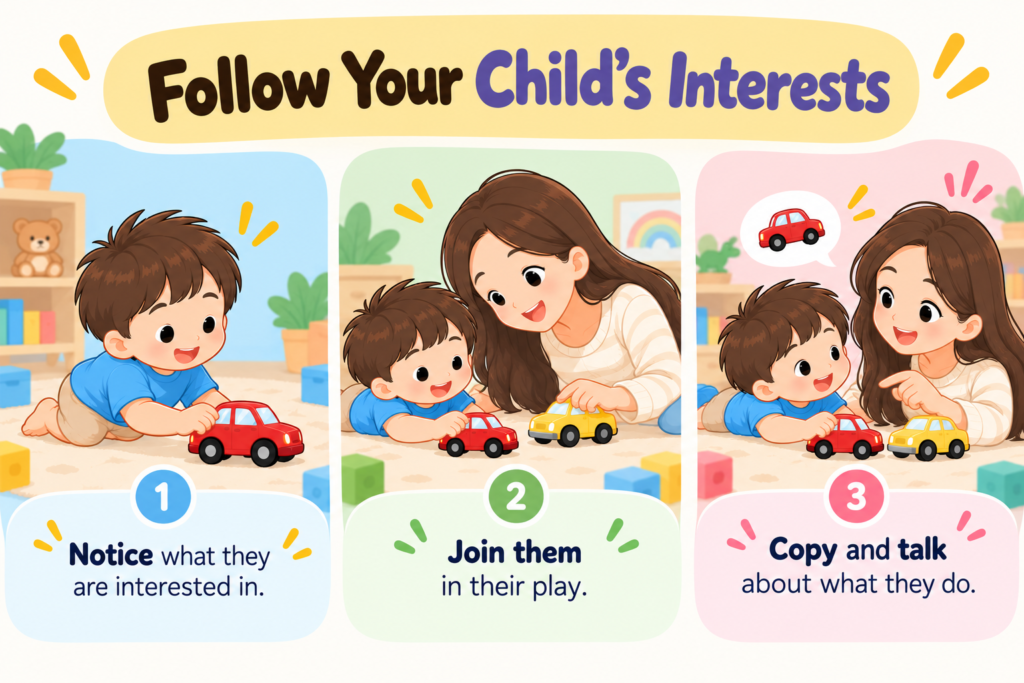
Pay attention to what your child is already interested in.
If they are playing with a car, join them rather than immediately introducing a different activity.
You can sit nearby, copy their actions and talk about what they are doing.
For example:
“The car is going!”
This creates opportunities for shared interaction around something your child already enjoys.
2. Use Gestures
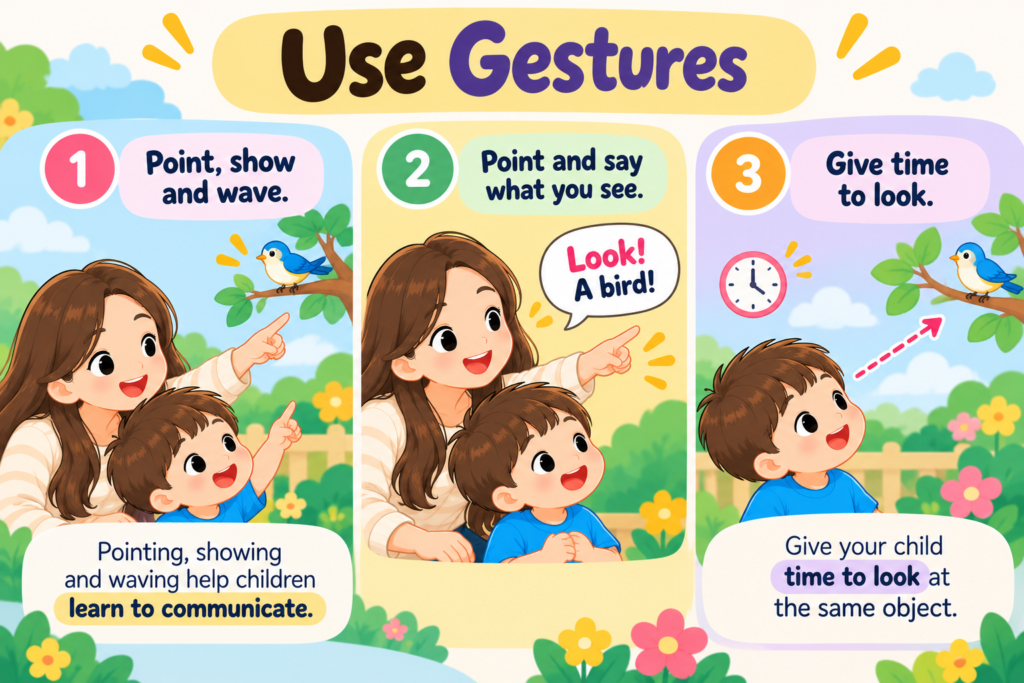
Pointing, showing and waving can help children understand how gestures are used to communicate.
When you notice something interesting, point towards it and say:
“Look! A bird!”
Give your child time to look towards the same object.
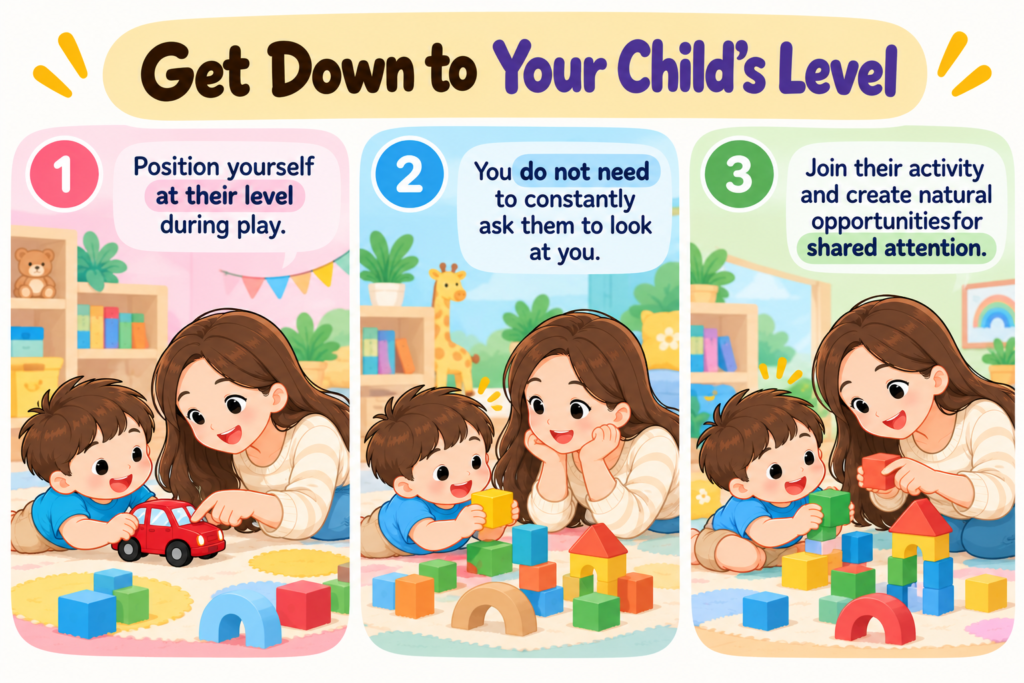
3. Get Down to Your Child's Level
During play, position yourself where your child can easily see you.
You do not need to constantly ask your child to look at you.
Instead, join their activity and create natural opportunities for shared attention.
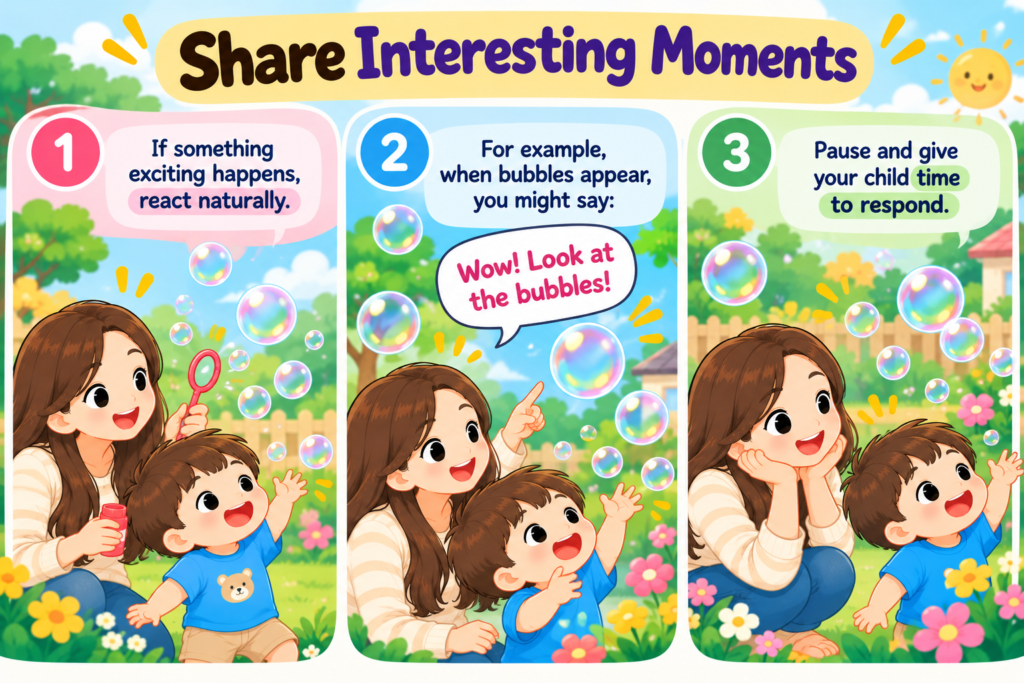
4. Share Interesting Moments
If something exciting happens, react naturally.
For example, when bubbles appear, you might say:
“Wow! Look at the bubbles!”
Pause and give your child time to look, smile, gesture or respond.
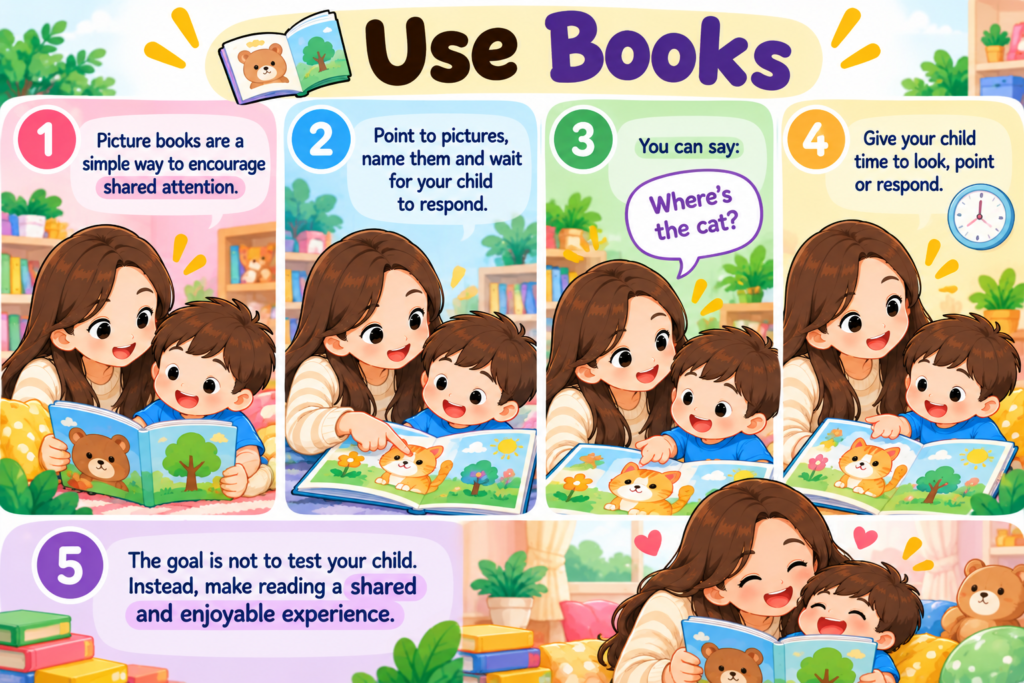
5. Use Books
Picture books are a simple way to encourage shared attention.
Point to pictures, name them and wait for your child to respond.
You can say:
“Where’s the cat?”
Then give your child time to look, point or respond.
The goal is not to test your child. Instead, make reading a shared and enjoyable experience.
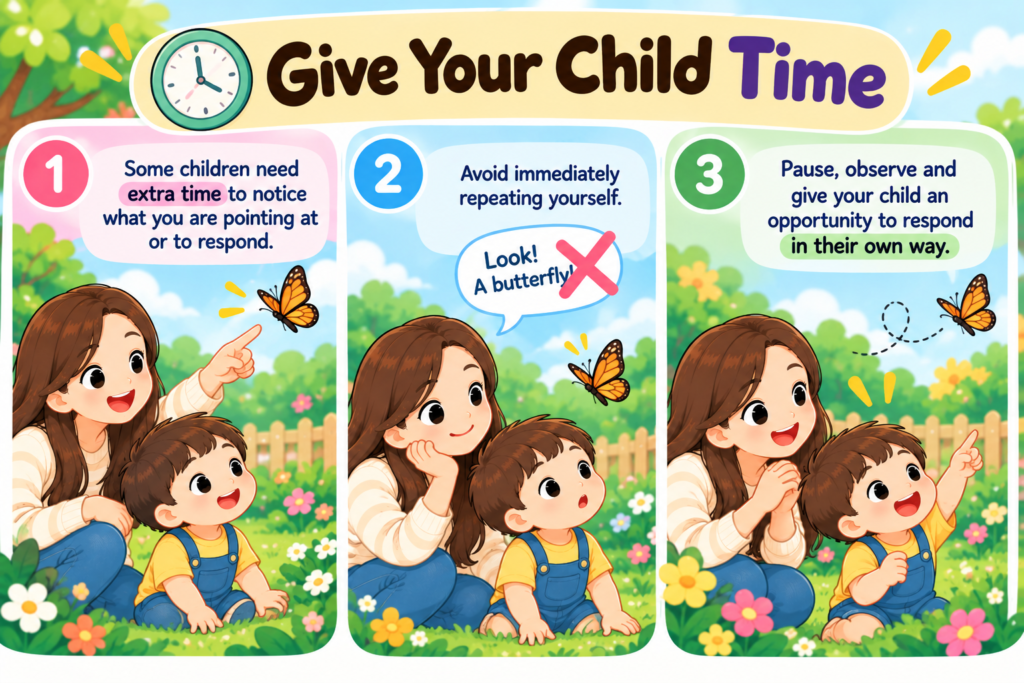
6. Give Your Child Time
Some children need extra time to notice what you are pointing at or to respond to an interaction.
Avoid immediately repeating yourself.
Pause, observe and give your child an opportunity to respond in their own way.
When Should Parents Seek Professional Help?
Parents may want to consider speaking with a developmental professional or speech-language therapist if:
🌺 Your child rarely shares attention or experiences with others
🌺 Your child does not usually point or show objects to communicate
🌺 Your child has difficulty following another person’s pointing or gaze
🌺 Your child has limited gestures or other nonverbal communication
🌺 Your child has difficulty communicating their wants, needs or interests
🌺 Your child has concerns with speech, language or social communication
🌺 You notice several developmental concerns occurring together
🌺 Your child’s communication difficulties are affecting everyday interactions
A developmental or speech-language assessment can help professionals understand how your child communicates, interacts and uses different forms of communication.
If you are concerned about your child’s development, it is generally better to discuss your concerns early rather than waiting for difficulties to become more noticeable.
What Should Parents Remember?
Joint attention is about sharing an experience, not simply getting your child’s attention.
🌺 Joint attention begins developing during infancy.
🌺 It involves sharing attention towards an object, activity or event.
🌺 Children can initiate or respond to joint attention.
🌺 Joint attention provides important opportunities for communication and language learning.
🌺 Pointing, showing, looking and sharing enjoyment can all be part of joint attention.
🌺 Difficulty with joint attention does not automatically mean that a child has autism.
🌺 Simple activities such as playing, reading and following your child’s interests can encourage shared attention.
🌺 If you have concerns about your child’s communication or development, early professional guidance can be helpful.
Every shared glance, point, gesture and moment of connection gives your child another opportunity to communicate and learn with the people around them.
🌟 Stay Connected with Us! We love sharing tips, insights, and inspiring stories about children’s growth and mental wellbeing.
💙 Follow us on Instagram and Facebook for more updates and parenting advice.
Join our community and let’s grow together. One positive step at a time!

References
Dinello, A., & Gladfelter, A. (2025). Intervention techniques targeting echolalia: A scoping review.
American Journal of Speech-Language Pathology, 34(3), 1528–1543.
https://childmind.org/article/understanding-academic-anxiety/
Working Hours
Tuesday to Saturday – 8.30am to 6pm
Monday & Sunday – Closed
Please also subscribe us at
Contact Us
Discover Our Team!
📞+60102502833
firststepdevelopmentcentre@gmail.com
B1-7, Plaza Damas 3, Jalan Sri Hartamas 1, 50480 Kuala Lumpur.
Copyright 2025. Firststep Child Development Sdn Bhd. All rights reserved.