



What if the most productive teacher meeting isn’t about finding fault, but about sharing what you’ve noticed and agreeing on one practical way forward? If you’re wondering how to talk to teachers about my child’s ADHD, it’s understandable to feel unsure about what to say or worry that your child’s behaviour might be misunderstood.
A constructive conversation starts with clear examples of what your child finds difficult and what seems to help. You don’t need to have every answer before you meet. Listening to the teacher’s observations can give you a fuller picture of your child’s experience at school.
This guide explains how to prepare relevant information, raise concerns calmly and agree on practical ways to communicate and review progress. It also covers when professional guidance may be useful. Assessment and school communication are separate processes, but both can offer information as you consider how best to support your child.
Key Takeaways
- Learn how to talk to teachers about my child’s ADHD by framing the meeting around shared goals and your child’s support.
- Choose relevant information to share, including your child’s strengths and clear observations about when challenges arise and what helps.
- Use a simple meeting plan to hear the teacher’s perspective, identify a priority and agree on a practical review point.
- Keep brief, factual notes on agreed actions and changes so follow-up conversations can focus on what you’re both observing.
Talking to Teachers About ADHD: Start with Shared Goals
Speaking with your child’s teacher can feel daunting, particularly if you’re concerned that ADHD-related behaviour may be misunderstood. Preparation can help you approach the conversation calmly. The aim isn’t to assign blame to your child, yourself or the teacher. It’s to share what you’ve observed, understand what the school day is like for your child, and agree on a manageable way forward.
ADHD can affect children differently, so focus on your child’s experience rather than assumptions. For general background, read about Attention deficit hyperactivity disorder. Comparing observations from home and school can help you notice patterns and discuss practical next steps.
What should you decide before contacting the teacher?
Choose one or two goals for your first conversation. You might want to understand when your child finds classroom tasks difficult, or agree on a simple way to share updates. Think about strengths and interests to mention as well. For example, your child may feel more settled during hands-on activities or find it easier to follow instructions when they’re given one step at a time.
Decide what information is relevant to share, including an assessment or diagnosis if applicable. Consider your child’s preferences about personal details. Share enough to help the teacher understand your child’s needs while respecting their privacy. You can explain the practical impact without automatically sharing a full report.
How can you ask for a meeting calmly?
Request a private conversation at a time that suits both of you, rather than raising a sensitive concern in passing. You might write: “I’d like to understand how things are going for Sam in class and share a few observations from home. Could we arrange a time to discuss what might help?”
This wording acknowledges the teacher’s classroom perspective and invites collaboration. School procedures and available support can vary across Malaysian schools. Ask what options are relevant in your child’s setting rather than assuming a particular process.
What to Share About ADHD: Specific Examples, Strengths, and Helpful Context
Useful information helps the teacher understand your child as an individual, not only through a diagnosis or assessment report. If you have a report, share findings that relate to learning, routines, communication or wellbeing. An assessment is one part of the picture, and your child’s everyday experiences matter too. For background on what an assessment may involve, read about how child assessments work.
Concrete observations are more useful than broad labels because they describe what happens and help you consider what might support your child. Note when a difficulty occurs, what happened just before it, and what seemed to help afterwards. For example: “After recess, Maya found it hard to begin written work. She started after the teacher gave her the first instruction individually.” Avoid assuming that every challenge is caused by ADHD. Other factors may be relevant, too.
How do you describe classroom concerns without blame?
Describe what you see instead of judging your child’s character. Rather than saying “He’s lazy”, explain that he sometimes needs reminders to start independent work. Then ask what the teacher notices. Do the same difficulties arise in every lesson, or mainly during transitions, longer tasks or particular activities? A curious question can open a discussion without implying fault.
What information about ADHD is useful to share?
Balance challenges with your child’s strengths, interests, effort and successful routines. Mention what helps them feel settled, such as written instructions, if you’ve observed this. You could keep a short list before the meeting: one strength, one or two situations that are difficult, and anything that has helped so far. Ask your child, in an age-appropriate way, what they’d like their teacher to understand and which personal details they’d prefer to keep private. CHADD’s Tips for Talking to Teachers also offers parent-focused communication guidance.
If you’d value help understanding assessment observations or preparing questions, the guide to how child assessments work may help you decide what information is relevant to share.
How to Plan the Teacher Meeting and Agree on Practical Next Steps
A simple agenda can keep the meeting focused and collaborative. Aim to understand each other’s observations and agree on a realistic next step, rather than trying to solve every concern at once. Understood’s 7 tips for talking to your child’s teacher also offers ideas for preparing questions and discussing possible strategies.
- Share your concern. Briefly describe what you’ve noticed and how it affects your child’s learning or wellbeing. Give one specific example rather than a general label.
- Listen to the teacher. Ask what they observe and which approaches, if any, have already been helpful.
- Choose a priority. Agree on one situation to focus on first, such as starting independent work or moving between activities.
- Set a review point. Decide how you’ll share updates and when to discuss what you’ve both observed.
What questions can parents ask the teacher?
Open questions can help you understand what happens in class. Ask, “When do you notice this most?” or “What seems to help my child re-engage?” You could also ask which situations remain challenging, whether the pattern changes by lesson or activity, how the school prefers to share updates, and who should be included in follow-up discussions. Agree on a suitable time to review whether the approach is useful.
How can you keep the discussion collaborative?
Listen to the teacher’s perspective and clarify anything you’re unsure about before suggesting strategies. Keep the focus on your child’s learning, participation and wellbeing. Options such as breaking instructions into smaller steps may be worth discussing, but what’s practical depends on the child and the school. Support arrangements and procedures vary, so ask what applies in your child’s school.
After the meeting, send a brief message confirming the agreed actions, who is responsible for each one and when you’ll review progress. If you’d like professional guidance as you prepare, learn more about Firststep Psychology & Child Development Centre.
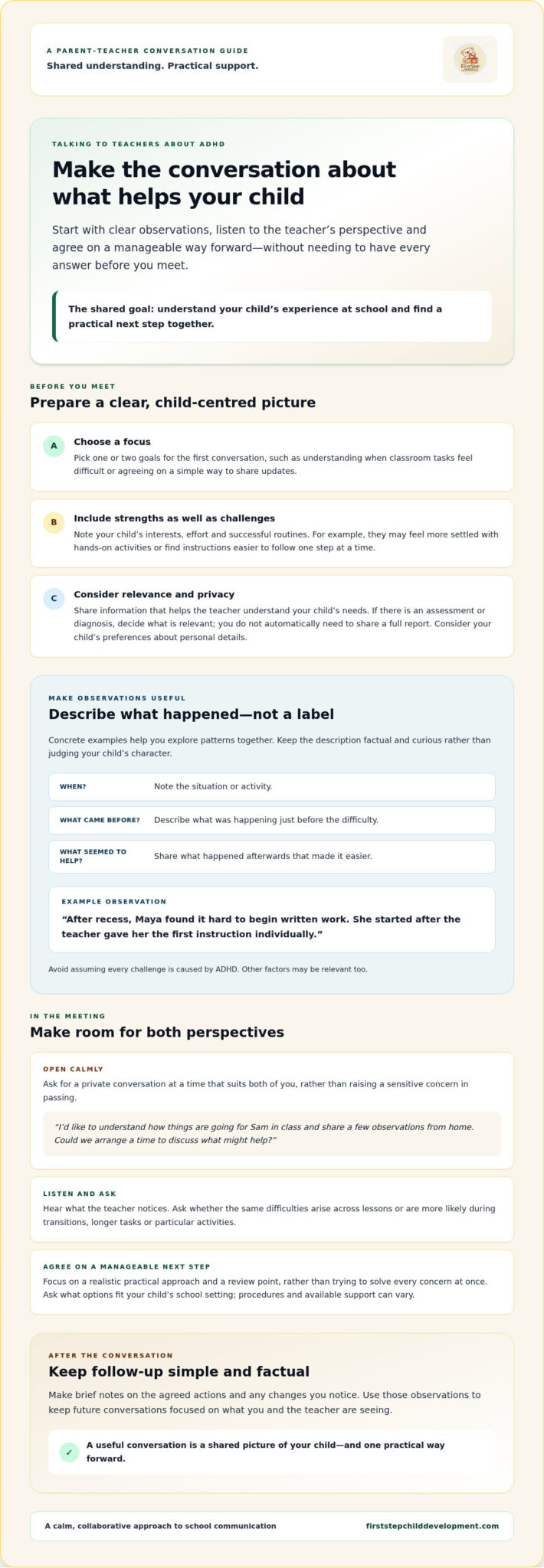
Next Steps After Talking to Teachers About ADHD
After the meeting, send a short message confirming what you agreed, who will take each action and when you’ll review it. Keep brief, factual notes on what you notice over time. For example, record whether your child finds it easier to begin tasks or feels more settled during a particular part of the school day. Note what helps as well as what remains difficult.
Arrange a reasonable follow-up with the teacher and compare observations rather than expecting a particular result by a set date. If concerns continue, ask what the school recommends and what support may be available through its own process. A conversation with the teacher and a clinical assessment are separate processes, and neither guarantees a specific classroom change.
When might a parent seek professional guidance?
You might consider professional guidance if concerns persist across home and school, or appear to affect learning, relationships or your child’s daily wellbeing. A qualified professional can help you make sense of your observations and consider possible next steps. This article can’t determine whether a child has ADHD; that requires an appropriate clinical process.
Firststep Psychology & Child Development Centre serves families in Kuala Lumpur and Selangor, including Petaling Jaya. Its services include ADHD assessment, clinical psychologist consultation, and parent consultation and guidance. An ADHD assessment is a separate clinical process, not a school meeting or a promise of particular support at school.
How can Firststep support parents in Kuala Lumpur and Selangor?
If you’re uncertain how best to support your child or make sense of ongoing concerns, professional guidance may help you prepare questions and understand your observations. Assessment isn’t necessary for every school concern. Firststep offers clinical psychologist consultations and ADHD assessments for families in Kuala Lumpur, Petaling Jaya and Selangor. You can explore the ADHD assessment service or visit the Firststep Psychology & Child Development Centre homepage to learn more.
Take the Next Step with Confidence
A constructive conversation with your child’s teacher can begin with a shared goal: understanding what your child experiences at school and agreeing on practical next steps. Specific observations, attention to your child’s strengths and a simple follow-up plan can help keep discussions focused and collaborative.
If you’re still wondering how to talk to teachers about my child’s ADHD, remember that you don’t need to have every answer before reaching out. Keep communication open, note what you and the teacher observe, and ask about further guidance if concerns persist. School conversations and clinical assessment are separate processes, and seeking advice does not mean that every school concern requires an assessment.
Firststep offers ADHD assessment, clinical psychologist consultation and parent guidance for families in Kuala Lumpur, Petaling Jaya and Selangor. If professional input would help you make sense of your observations, contact Firststep Psychology & Child Development Centre to learn more about its services.
Frequently Asked Questions
Should I tell my child’s teacher that my child has ADHD?
You can share the diagnosis if you feel it’s relevant to your child’s learning or wellbeing, but you can decide what information to disclose. Explain briefly how ADHD affects your child in specific situations and what has helped. If your child is old enough, ask what they’re comfortable sharing. You can also discuss relevant information with the teacher without presenting a full assessment report.
What should I say to my child’s teacher about ADHD?
Focus on information that can help the teacher understand your child’s school experience. Describe a specific situation, such as finding it hard to begin independent work, and mention what seems to help. Include your child’s strengths and interests, too. If you’re unsure how to talk to teachers about my child’s ADHD, prepare a few observations and questions, then invite the teacher to share what they notice.
How can I ask my child’s teacher for support without sounding confrontational?
Request a private conversation and frame it around working together. You might say, “I’d like to understand what you’re noticing in class and discuss what could help my child take part in learning.” Ask open questions, listen to the teacher’s perspective and agree on a practical next step. School procedures and available support can differ, including between schools in Kuala Lumpur and Selangor, so ask about your child’s school process.
What if my child’s teacher does not agree that ADHD affects them at school?
Try to understand the difference in perspective before drawing conclusions. Ask what the teacher observes during lessons, transitions or group activities, and share specific examples from home or other settings. A child may experience difficulties differently across situations, and not every challenge is necessarily related to ADHD. If concerns persist or affect learning and wellbeing, ask about the school’s next steps and consider discussing your observations with a qualified professional.

Article by
Firststep Child Development Team
Firststep Child Development Team provides evidence-informed educational resources to help parents better understand child development, behaviour and learning. Our multidisciplinary services include clinical psychology, occupational therapy, speech and language therapy, developmental assessments and other child development support in Kuala Lumpur and Selangor.
Disclaimer
This article is for general educational and informational purposes only and is not a substitute for professional medical, psychological or therapeutic advice, diagnosis or treatment. Every child develops differently. If you have concerns about your child's development, behaviour, learning or wellbeing, please consult an appropriately qualified healthcare or allied health professional.