



Speech Delay vs Autism: How Can Parents Tell the Difference? When a young child uses few words, it’s natural to wonder whether the concern is about speech alone or part of a wider developmental pattern. These can look similar, and no single sign can confirm a diagnosis.
If you’re worried, you’re not alone in wanting to know which observations may help a professional understand your child. Speech delay describes a difficulty with spoken communication, while autism involves a broader developmental profile that can include differences in social communication and repetitive behaviours or interests. Children develop in their own ways, so these patterns are not a home checklist or a substitute for assessment.
This guide explains how speech delay and autism can overlap, what you might observe in everyday interactions, and what to share when seeking guidance. It also outlines how a professional assessment can help clarify your child’s individual needs and support options for families in Kuala Lumpur and Selangor.
Key Takeaways
- Speech delay alone can’t establish whether a child is autistic; professionals consider a broader developmental picture.
- Notice how your child uses gestures, shares attention and interacts, alongside their spoken language.
- For Speech Delay vs Autism: How Can Parents Tell the Difference?, look for patterns to discuss with a professional, not signs to use as a home diagnosis.
- Keep brief examples from everyday routines and settings to help guide a professional discussion about your child’s needs.
Speech Delay vs Autism: What Do These Terms Mean?
Delayed speech alone cannot establish whether a child is autistic. Speech delay describes slower progress or difficulty with spoken communication; it’s a description of a developmental concern, not a diagnosis. A child may have a speech delay, autism, both, or another developmental difference, so spoken words are only one part of understanding their needs.
Autism is a neurodevelopmental condition associated with differences in social communication and interaction, alongside restricted or repetitive patterns of behaviour, interests or activities. These differences vary from child to child. Professionals consider the wider developmental picture rather than drawing a conclusion from one behaviour or a particular number of spoken words.
Speech delay, language development, and autism are not the same thing
Speech is the production of sounds and spoken words. Language is broader: it includes understanding what others say and expressing meaning through words, gestures, signs or other forms of communication. A child might understand familiar instructions but use few spoken words, or may need support with understanding as well as expression.
Autistic children have varied communication profiles. Some use spoken language fluently, some use a small number of words, and some communicate in other ways. A child’s speech level shouldn’t be treated as a measure of intelligence or of how connected they feel to people around them. Their ways of expressing interest, comfort, needs and connection may differ from what adults expect.
For parents asking, “Speech Delay vs Autism: How Can Parents Tell the Difference?”, the useful starting point is to notice the whole pattern, not to reach a conclusion at home. A professional discussion can explore communication alongside other aspects of development. A child autism assessment can help clarify an individual developmental profile and guide consideration of suitable support.
Which Patterns May Help Distinguish Speech Delay from Autism?
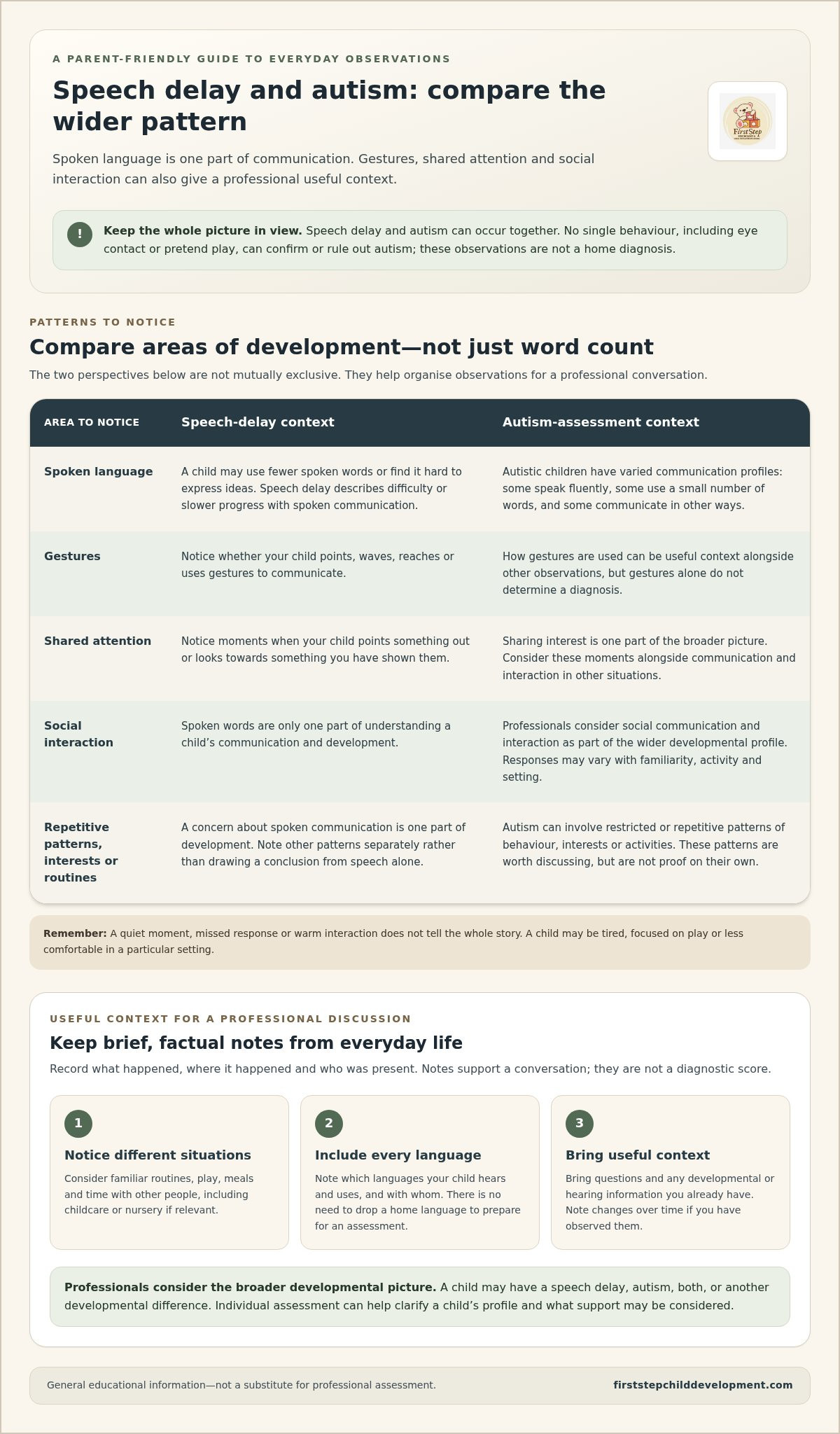
Communication involves more than spoken words. The patterns below can help you organise observations, but they aren’t a checklist: no single behaviour, including eye contact or pretend play, can confirm or rule out autism. Speech delay and autism can also occur together.
| Area to notice | What you might observe |
|---|---|
| Spoken language | A child may use fewer words or find it hard to express ideas. Autistic children have varied communication profiles, including fluent speech, limited speech or other ways of communicating. |
| Gestures | Notice whether your child points, waves, reaches or uses gestures to communicate. How they use these can be useful context, but gestures alone don’t determine a diagnosis. |
| Shared attention | Does your child sometimes point out a passing bus or look towards something you’ve shown them? These moments of sharing interest are worth noting alongside other interactions. |
| Social interaction | Observe how your child responds to others and takes turns in play or conversation. Their responses may vary with familiarity, activity and setting. |
Look at communication and interaction together
One quiet moment, missed response or warm interaction doesn’t tell the whole story. A child may be tired, focused on play or less comfortable in a particular setting. Notice what happens across routines and with different people: for example, whether your child responds when called at home and at nursery, or takes turns during a familiar game.
Some children also have repetitive movements, strong interests or a preference for familiar routines. These patterns are worth discussing with a professional, but they aren’t proof of autism on their own. The American Speech-Language-Hearing Association’s Speech and Language Developmental Milestones can offer general context about communication development; it isn’t a diagnostic tool.
The question “Speech Delay vs Autism: How Can Parents Tell the Difference?” is best approached by considering the broader pattern, rather than treating one sign as an answer. If you’re concerned, a professional autism assessment can help explore your child’s individual communication and development.
What Can Parents in Kuala Lumpur and Selangor Do Next?
You don’t need to work out the reason for a communication concern before asking for guidance. A few clear examples can help a professional understand what you’re noticing and decide what further discussion or support may be useful.
Prepare observations that help a professional understand your child
Keep brief, factual notes rather than scoring behaviours or comparing your child with others. For example, record what happened, where it happened and who was present. Note whether your child communicated a request, shared an interest, responded to someone or used a gesture, and whether you’ve noticed any changes over time.
- Notice different situations: Consider familiar routines, play, meals and time with other people, including at childcare or nursery if relevant.
- Include every language: In multilingual households, note which languages your child hears and uses, and with whom. There’s no need to drop a home language to prepare for an assessment.
- Gather useful context: Bring questions and any developmental or hearing information you already have. You could ask what the observations may mean and what support could be considered.
Then arrange a professional discussion and follow the guidance that fits your child’s needs. Notes are there to support the conversation, not to produce a diagnostic score. If you’re also looking for general information about communication, use reliable resources as background rather than as a substitute for individual advice.
For families in Kuala Lumpur and Selangor, a conversation about speech therapy for children may help explore communication needs and appropriate next steps. You can also learn about Firststep Psychology & Child Development Centre and its support for children and families.
How Assessment and Support Can Clarify Speech Delay vs Autism
Assessment brings together information from different parts of a child’s development. A professional may ask about developmental history, how the child understands and communicates, and what they observe during interaction. They also consider the child’s wider profile, rather than relying on spoken words or one behaviour alone.
There isn’t one observation or test that settles every question. Assessment helps build a clearer understanding of a child’s strengths and support needs. If more information is needed, the professional can explain what further discussion or assessment may help.
Assessment can guide support without defining a child’s potential
A clearer picture can help families consider relevant developmental support, whether the main concern relates to speech, broader communication or other areas. An assessment is not a measure of a child’s worth or future. It’s a way to understand their needs and make informed decisions about appropriate next steps.
Firststep Psychology & Child Development Centre serves families in Kuala Lumpur and Selangor, offering autism assessment and speech therapy. Its assessments use a play-based approach, with clear feedback for parents. You can explore the autism assessment process to learn how it may help clarify your child’s developmental profile.
Speech and developmental support can be considered in light of what an assessment and family discussions identify. If you’d like to explore speech therapy for your child, or learn more about the centre, visit Firststep Psychology & Child Development Centre.
Take a Steady Next Step for Your Child
There’s no need to have every question answered before beginning. You can approach support as an ongoing conversation, sharing what matters to your family and asking for explanations that help you feel comfortable with the next step. Speech Delay vs Autism: How Can Parents Tell the Difference? is a question you can explore with professional guidance, at a pace that works for you and your child.
Firststep offers a play-based assessment approach with clear feedback for parents, as well as speech therapy for children. If you’d like to explore support, visit Firststep’s autism assessment page or learn more about Firststep Psychology & Child Development Centre. A thoughtful conversation can be a positive way to move forward together.
Frequently Asked Questions
Does speaking more than one language cause speech delay?
No, growing up with more than one language does not itself cause speech delay. A multilingual child may mix words from different languages in the same sentence; this can be part of learning to communicate across languages. If you’re concerned, describe examples from everyday conversation and explain which languages your child understands or uses most comfortably. This context can help make professional discussions more accurate.
Can hearing difficulties affect a child’s speech development?
Yes, hearing difficulties can affect how a child picks up speech sounds and spoken words. A child may respond to some sounds but still find parts of speech hard to hear clearly. If you notice frequent requests for repetition, difficulty following spoken instructions or changes in response to sound, mention these examples to a healthcare professional. They can advise whether a hearing check is appropriate.
Can autism be identified with one screening test?
No, a screening test can flag whether follow-up may be useful, but it doesn’t provide a diagnosis. If your child completes a screening questionnaire, answer according to their usual behaviour rather than focusing on an unusually easy or difficult day. Ask the professional to explain what the result means, whether further evaluation is appropriate and how to follow up if concerns continue.
Should parents stop speaking their home language if a child has delayed speech?
No, you don’t need to stop using your home language. Speak naturally in the language you’re most comfortable using, such as during meals, play or bedtime stories. Children benefit from meaningful, responsive conversation, so parents shouldn’t feel they must switch to a language they speak less confidently. If you’re unsure how language use relates to your child’s communication, raise it during a professional discussion.
Can a child have a speech delay without being autistic?
Yes, a child can have delayed speech without being autistic. A professional may explore whether the difficulty is mainly with producing speech sounds, finding words, or understanding and using language. These are different parts of communication and can call for different kinds of support. Sharing examples of what your child understands as well as what they say can help clarify which areas may need attention.

Article by
Firststep Child Development Team
Firststep Child Development Team provides evidence-informed educational resources to help parents better understand child development, behaviour and learning. Our multidisciplinary services include clinical psychology, occupational therapy, speech and language therapy, developmental assessments and other child development support in Kuala Lumpur and Selangor.
Disclaimer
This article is for general educational and informational purposes only and is not a substitute for professional medical, psychological or therapeutic advice, diagnosis or treatment. Every child develops differently. If you have concerns about your child's development, behaviour, learning or wellbeing, please consult an appropriately qualified healthcare or allied health professional.