



You’re at a playgroup in Kuala Lumpur, watching other toddlers chatter while your little one remains quiet or relies on simple gestures. If you’ve been searching for the signs of speech delay in 3 year old Malaysia, you’re likely feeling that familiar mix of love and concern that comes with wanting the best for your child’s future.
It’s natural to feel anxious when comparing your child’s progress to their peers, especially in our multilingual environment where we often wonder if hearing several languages is causing a temporary confusion. With approximately 2.7% of children in Malaysia currently identified with speech delays, you aren’t alone in this journey. You want clear answers, yet the path to finding professional support in Selangor or KL can feel overwhelming. We’re here to provide the gentle guidance you need to move from uncertainty to a proactive plan of care.
This guide will explore a practical milestone checklist, explain the vital difference between speech and language delays, and outline the exact steps for seeking a professional assessment with a clinical specialist to support your child’s unique developmental path.
Key Takeaways
- Identifying the specific signs of speech delay in 3 year old Malaysia helps you distinguish between natural developmental variations and areas that may benefit from professional support.
- Clarify common myths about multilingualism to understand how your child’s vocabulary develops across multiple languages without causing long-term communication delays.
- Learn the clinical distinction between speech and language delays to better communicate your observations during a professional consultation or assessment.
- Discover how a multidisciplinary approach involving speech therapy and clinical psychology provides a clear, supportive roadmap for your child’s early intervention and school readiness.
What is Speech Delay and Why Does Early Detection Matter?
Understanding your child’s communication journey involves distinguishing between different developmental milestones. When parents ask, What is speech delay?, they’re often seeking clarity on whether their toddler’s progress is typical for our local context. While some children are “late talkers” who eventually catch up, others show specific signs of speech delay in 3 year old Malaysia that benefit from a structured, professional approach.
The Difference Between Speech and Language
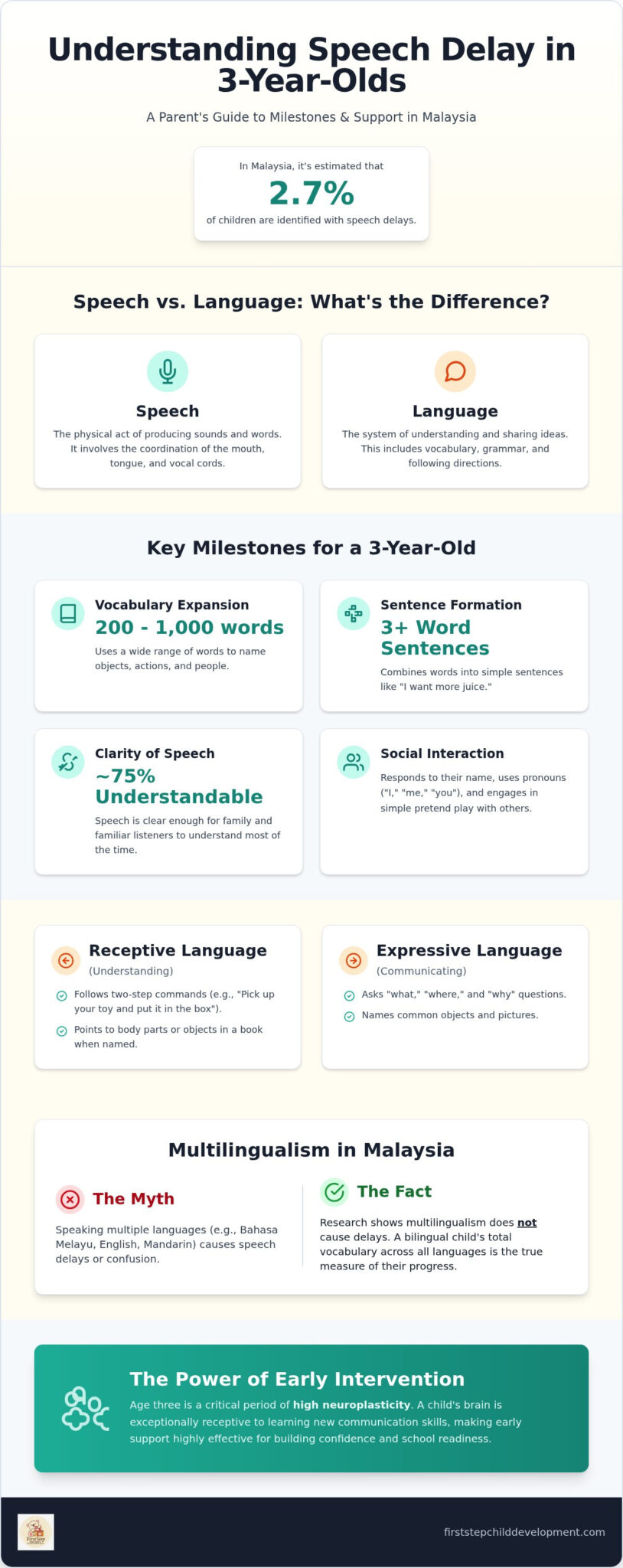
Clinical specialists categorise communication into two distinct areas to provide an accurate assessment. Speech refers to the physical act of producing sounds, involving the coordination of breath, vocal cords, and mouth movements. In contrast, language is the system of understanding and sharing ideas. A child might have clear speech but struggle with language, such as finding it difficult to follow instructions or combine words into meaningful sentences. Professional speech therapy can help address both areas effectively.
The Power of Early Intervention in Malaysia
Age three represents a critical window for development due to high neuroplasticity. At this stage, a child’s brain is exceptionally receptive to learning new communication patterns. Identifying the signs of speech delay in 3 year old Malaysia early allows families to access help before the transition to primary school. Proactive support strengthens social confidence and academic readiness, ensuring children can navigate the social demands of Malaysian classrooms with ease.
If you’re concerned about your child’s progress, seeking professional guidance provides a clear path forward. You can learn more about long-term support in our Early Intervention Program (EIP) guide, which explains how multidisciplinary care helps children reach their full potential through gentle, play-based strategies.
The 3-Year-Old Speech Delay Checklist: Key Red Flags
Watching your toddler grow is a journey of small victories and occasional questions. When identifying the signs of speech delay in 3 year old Malaysia, it helps to have a clear baseline for typical development. By age three, most children have moved beyond single words and are beginning to use language to share their thoughts and needs more complexly.
Key indicators to monitor include:
- Vocabulary expansion: A typical 3-year-old uses between 200 and 1,000 words.
- Sentence formation: They should consistently combine three or more words into sentences.
- Clarity of speech: Family members and even strangers should understand roughly 75% of what the child says.
- Social responsiveness: They should respond immediately when called by name and follow simple instructions.
Understanding Receptive Language Milestones
Receptive language involves how a child understands the world around them. At this age, your child should be able to follow two-step commands, such as “Pick up your shoes and put them by the door.” They should also accurately point to common household objects or body parts when you name them during play or daily routines. If your child seems to struggle with these instructions, it may indicate a need for professional assessment and support for speech delay.
Expressive Language and Social Interaction
Expressive skills focus on how children use words and gestures to communicate. You should notice your child using pronouns like “I,” “me,” and “you” correctly in conversation. Socially, they should show interest in other children and engage in simple pretend play, like feeding a doll or “driving” a cardboard box. If you notice consistent gaps in these milestones, a personalised speech therapy consultation can provide the clarity and support your family deserves.
Navigating Multilingualism: Does Speaking Multiple Languages Cause Delay?
In Malaysia, it’s common for a household to hum with the sounds of Bahasa Melayu, English, and Mandarin. Many parents worry that this rich exposure causes confusion, but research consistently shows that multilingualism does not cause speech delay. While a “silent period” may occur as a child absorbs multiple linguistic structures, it shouldn’t stop them from hitting core milestones. It’s a natural phase of absorption, not a sign of a developmental hurdle.
The “Total Vocabulary” Rule for Malaysian Toddlers
Specialists use the “conceptual vocabulary” approach to track progress. If your child knows the word for “cat” in English and “kucing” in Bahasa, they’ve mastered two words for one concept. We count their total knowledge across all languages spoken at home. Mixing languages, or code-switching, is actually a sign of sophisticated linguistic processing. It shows they’re choosing the most accessible word to express their thoughts clearly.
When to Worry in a Multilingual Household
It’s time to seek professional guidance if your child struggles to communicate even in their most used language. Watch for a lack of non-verbal cues like pointing or gesturing, as these are foundational to all communication. If you observe Speech and language delay symptoms that persist across all environments, it’s a signal for further investigation. Identifying the signs of speech delay in 3 year old Malaysia involves looking at the child’s overall ability to connect with others, regardless of the specific language used.
If you’re unsure whether your child’s progress is typical for a multilingual home, our team can help you schedule a speech therapy assessment to gain professional clarity and peace of mind.
Taking the First Step: Assessment and Support in Malaysia
Deciding to seek professional help is a significant and positive step for your family. In Malaysia, the journey often begins with a visit to your family paediatrician, who can perform an initial screening to rule out physical concerns like hearing issues. If the signs of speech delay in 3 year old Malaysia persist, the next step involves a more detailed professional speech therapy assessment. At Firststep, we believe in a multidisciplinary approach. Combining speech support with a clinical psychologist consultation ensures we understand your child’s emotional and cognitive profile alongside their communication skills. This holistic view is essential because communication is often linked to social and emotional development.
What Happens During a Professional Assessment?
A typical session is designed to feel like play rather than a test. Our specialists observe how your child interacts with toys and people while using standardised tools to measure their milestones. We also spend time gathering a detailed developmental history from you to understand their progress at home. To feel fully prepared for this session, you can read our guide on how does an assessment work, which covers what to expect in detail.
Choosing the Right Support in KL and Selangor
When looking for a centre in Kuala Lumpur or Selangor, prioritise those that offer integrated care. Having speech therapists, occupational therapists, and psychologists under one roof ensures your child receives holistic support. For your first visit, it’s helpful to bring any previous medical reports and a few notes on your child’s daily communication habits. This collaborative start helps us create a tailored roadmap that celebrates your child’s potential while addressing their specific needs with quiet confidence and professional clarity.
Empowering Your Child’s Communication Journey
Recognising the signs of speech delay in 3 year old Malaysia is a vital first step toward unlocking your child’s full potential. We’ve explored how understanding the difference between speech and language, as well as debunking myths about multilingualism, provides a clearer perspective on your toddler’s progress. Early intervention isn’t simply about meeting milestones; it’s about building the social confidence your child needs to thrive in playgroups and future classrooms.
Our multidisciplinary team offers play-based, child-friendly assessments conveniently located in Kuala Lumpur and Selangor. By focusing on a holistic view of development, we ensure every child receives the personalised care they deserve in a nurturing environment. If you’re concerned about your child’s development, learn more about our Speech Therapy services or visit Firststep Psychology & Child Development Centre to schedule a consultation. Your child’s voice is unique, and with professional guidance, they can learn to share it with the world with confidence.
Frequently Asked Questions
Is it normal for a 3-year-old to still use “baby talk” in Malaysia?
While toddlers occasionally use “baby talk” for comfort, it should not be their main way of communicating by age three. By this stage, you should notice a transition toward using more mature speech patterns and clearer pronunciation. If your child primarily relies on simplified sounds or gestures instead of words, it might be one of the signs of speech delay in 3 year old Malaysia that warrants a gentle professional review.
Can screen time cause speech delay in toddlers?
Excessive screen time can limit the vital face-to-face interactions your child needs to develop communication skills. The World Health Organisation recommends no more than one hour of sedentary screen time for toddlers. Passive viewing often replaces the conversational practice found in active play. Reducing screen use and increasing interactive play in your KL home can significantly support your child’s natural language growth and social engagement during these critical years.
How many words should a 3-year-old be able to say?
A typical three-year-old should have a vocabulary ranging from 200 to 1,000 words. More importantly, they should be combining these words into three or four-word sentences to express their needs and thoughts. If your toddler’s vocabulary is significantly smaller or they struggle to form basic sentences, it is helpful to consult a specialist. This ensures they receive the right support for their specific developmental stage and school readiness.
What is the difference between a speech delay and autism?
A speech delay specifically focuses on the child’s ability to produce sounds or use language correctly. Autism is a broader neurodevelopmental condition that also involves social interaction and repetitive behavioural patterns. Identifying the specific signs of speech delay in 3 year old Malaysia requires a careful, multidisciplinary evaluation. At our centre, clinical psychologists and speech therapists work together to provide a comprehensive understanding of your child’s unique communication and social profile.
Where can I find a speech therapist in Kuala Lumpur or Petaling Jaya?
You can find specialised support at Firststep Psychology & Child Development Centre, which serves families across Kuala Lumpur, Petaling Jaya, and the wider Selangor area. Our facility offers a multidisciplinary team, including clinical psychologists and speech therapists, to provide a holistic approach to care. We focus on play-based assessments in a child-centred environment, ensuring that your little one feels comfortable and supported throughout their developmental journey toward clearer communication.

Article by
Firststep Child Development Team
Firststep Child Development Team provides evidence-informed educational resources to help parents better understand child development, behaviour and learning. Our multidisciplinary services include clinical psychology, occupational therapy, speech and language therapy, developmental assessments and other child development support in Kuala Lumpur and Selangor.
Disclaimer
This article is for general educational and informational purposes only and is not a substitute for professional medical, psychological or therapeutic advice, diagnosis or treatment. Every child develops differently. If you have concerns about your child's development, behaviour, learning or wellbeing, please consult an appropriately qualified healthcare or allied health professional.