



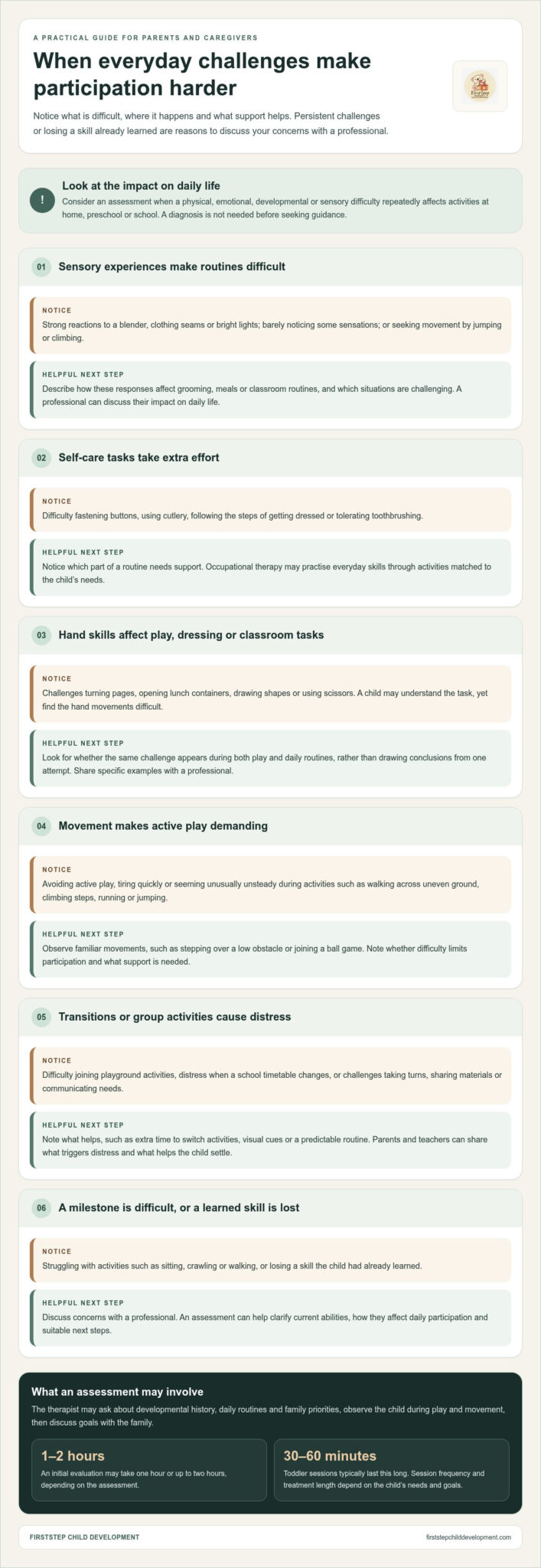
A child doesn’t need to wait until a difficulty becomes severe to benefit from support. Parents can consider when a child should see an occupational therapist if challenges with movement, sensory experiences, emotions or everyday tasks are making home, preschool or school harder. A professional assessment can help clarify what’s getting in the way and what support may help.
It’s understandable to wonder whether your child is simply developing at their own pace. Children develop differently, but persistent difficulties, missed milestones or losing skills they had already learned are reasons to discuss your concerns with a professional. You don’t need a diagnosis before seeking guidance.
This guide explains signs to look for in fine and gross motor development, daily routines, play and sensory responses. It also explores how early support may help and how developmental conditions can affect participation, so you can consider a practical next step for your family in Kuala Lumpur, Petaling Jaya or Selangor.
Key Takeaways
- Consider professional guidance when developmental concerns persist, skills regress, or daily routines become difficult for your child.
- Notice how your child responds to sounds, textures and movement, as well as how they manage dressing, eating and play.
- Look at fine and gross motor skills together, from using scissors or holding a pencil to balance, running and jumping.
- Early support can help identify practical ways to build participation at home, in school and during social activities.
Does My Child Need Occupational Therapy?
Parents often ask when a child should see an occupational therapist. Consider discussing an assessment when a physical, emotional, developmental or sensory difficulty repeatedly affects activities at home, preschool or school.
Sensory Processing Differences
Sensory processing is how the brain interprets information from the body and surroundings, including sight, sound, touch, smell and taste. A child may react strongly to a blender, clothing seams or bright lights, or barely notice some sensations. Other children may seek movement by jumping or climbing. If these responses make grooming, meals or classroom routines difficult, describe their impact on daily life to a professional.
Children’s Physical and Developmental Needs
A child’s needs may involve movement, emotions, development and sensory responses, sometimes together. For example, difficulty joining playground activities may affect friendships or cause distress during group games. Note which situations are challenging and what helps, such as extra time to switch activities. A paediatric occupational therapist can observe everyday tasks and discuss goals with caregivers.
Everyday Skills and Self-Care
Everyday skills combine hand control, thinking, sensory comfort and self-care. A child might struggle to fasten buttons, use cutlery, follow the steps of getting dressed or tolerate toothbrushing. Therapy can help build skills for these routines through activities matched to the child’s needs. Session frequency and treatment length depend on the child’s needs and goals; toddler sessions typically last 30 to 60 minutes.
Developmental Milestones and Delays
Milestones are abilities children develop over time, including movement, play and self-care. Discuss your concerns if your child struggles with age-expected activities such as sitting, crawling or walking, or loses a skill they had learned. An assessment can help clarify current abilities, their effect on daily participation and suitable next steps.
Fine and gross motor skills
Motor skills shape how children explore, manage tasks and take part in play. Notice how hand movements and whole-body movement affect activities at home, preschool and school.
Fine Motor Skills
Fine motor skills are the small, controlled hand and finger movements used to handle objects. They support tasks such as turning pages, opening lunch containers, drawing shapes and using scissors. Difficulty with these actions may make classroom work or dressing take longer, even when a child understands the task. Look for whether the same challenge appears during play and daily routines, rather than drawing conclusions from one attempt.
Gross Motor Skills
Gross motor skills use larger muscles for movement, strength, balance and coordination. They help children walk across uneven ground, climb steps, run, jump and join playground games. A child who avoids active play, tires quickly or seems unusually unsteady may find these activities demanding. Observe familiar movements, such as stepping over a low obstacle or joining a ball game, and whether difficulty limits participation.
Balance, Coordination, and Independence
Balance and coordination help children combine movements smoothly, while independence means managing everyday tasks with less assistance. These skills work together when a child carries a school bag, gets dressed while standing or moves through a busy classroom. Challenges can affect confidence and make transitions harder. Note which parts of a task need support: starting, keeping balance, using both hands or completing the final step.
Motor development is also connected with attention and planning. A child may know how to pack a bag but lose track of the steps, or struggle to sit comfortably during table activities. Share specific examples with a professional, including the task, setting and support needed. An assessment can help clarify how movement and related skills affect everyday participation.
Early intervention
Early intervention responds to a child’s needs before daily difficulties become harder to manage. Support can focus on participation at home, preschool, school and in the community.
Support for Everyday Activities
Occupational therapy builds practical skills through activities children encounter in daily life. A therapist might break handwashing into turning on the tap, using soap and drying hands, then practise each step through play. Support may also help a child join a simple game, manage classroom materials or follow a familiar morning routine. These relevant goals connect practice with the places where the child needs it.
Emotional Regulation and Social Interaction
Self-regulation means managing emotions and behaviour, while social interaction involves engaging with other people. A child who struggles with a change in the school timetable may benefit from practising transitions with visual cues or a predictable routine. Play can also create opportunities to take turns, share materials and communicate needs. Parents and teachers can share which situations trigger distress and what helps the child settle.
Evaluation and Parent Interviews
An initial evaluation helps the therapist understand a child’s abilities, challenges and family priorities. A parent interview may cover developmental history, daily routines and specific concerns, such as distress during toothbrushing or difficulty joining group play. The therapist may observe the child during play and movement, then discuss goals with the family. An initial evaluation may take one hour or up to two hours, depending on the assessment.
Why Early Intervention Matters
Early intervention gives children opportunities to practise useful skills during everyday routines. A plan may use play-based activities to support motor skills, communication, regulation or self-care, adapting as the child’s needs change. Parents can reinforce strategies at home and share relevant goals with the school. This consistent approach helps adults understand how to support the child across settings.
Conditions that may benefit from pediatric occupational therapy
A diagnosis alone doesn’t show which daily activities are difficult for a child. Occupational therapy focuses on participation, such as dressing, writing, playing or managing classroom routines. Children with autism, ADHD, cerebral palsy, Down syndrome, developmental coordination disorder or developmental delays may benefit when these activities are affected. The practical question is what the child finds hard, and where.
For a child with autism, sensory sensitivities or difficulty switching activities may affect school transitions and play with peers. A child with ADHD may struggle to organise materials, follow multi-step routines or stay engaged with a task. Occupational therapy can address these functional challenges through individual goals, rather than assuming every child with the same diagnosis needs identical support.
Physical and developmental conditions can affect movement, hand use and independence in different ways. Cerebral palsy may make balance or using both hands for a task more challenging. Developmental coordination disorder can affect activities such as catching a ball, fastening clothes or writing legibly. For a child with Down syndrome or a developmental delay, a therapist may consider current strengths and the everyday tasks requiring more support.
Sensory processing difficulties may occur alongside other conditions or on their own. A child might avoid noisy assemblies, find certain clothing uncomfortable or seek intense movement during play. Emotional responses, behaviour and social participation matter too: difficulty coping with change may make group activities or classroom routines harder. These examples are reasons to discuss the impact on daily life, not a way to diagnose a condition.
Note specific situations, such as difficulty completing written work, managing transitions or joining playground games. A paediatric occupational therapy assessment can help clarify which functional skills need attention and shape appropriate goals. Explore paediatric occupational therapy support if these challenges are affecting your child’s everyday participation.
Firststep Psychology & Child Development Centre: Clinical Psychologist Consultation
Firststep Psychology & Child Development Centre supports families with developmental or emotional concerns affecting a child’s daily life. If you’re unsure how attention, behaviour or learning challenges relate to your child’s difficulties, a Clinical Psychologist Consultation can help you explore your concerns and possible next steps.
Depending on your concerns, support may include an ADHD Assessment, Autism Assessment or Learning Difficulties Assessment. These assessments can help clarify a child’s needs and inform discussions about suitable support. They do not replace occupational therapy when the main concern is performing everyday tasks, but can contribute to understanding a broader developmental picture.
To discuss whether a consultation may suit your family, learn about Clinical Psychologist Consultation, or visit Firststep’s website.
Take the Next Step with Confidence
Deciding when a child should see an occupational therapist can start with noticing how a difficulty affects participation. You don’t need to have all the answers. If you’re unsure what your observations mean, write down the situations that concern you and the support your child needs. This can make a conversation with a professional more focused.
Firststep Psychology & Child Development Centre offers Clinical Psychologist Consultation, ADHD Assessment and Autism Assessment. These services help families explore developmental or behavioural concerns alongside questions about a child’s everyday functioning. A consultation can clarify which concerns to discuss and what further support may be appropriate.
For a calm next step, contact Firststep Psychology & Child Development Centre to discuss your concerns. Your careful observations can be a useful starting point for understanding how to support your child.
Frequently Asked Questions
What’s the Next Step?
Write down what happens, where it happens and what support your child needs. For example, note whether getting ready for school becomes difficult when several instructions are given at once. Share these observations with a paediatric occupational therapist or your child’s paediatrician. If possible, include examples from home and school, so the discussion reflects more than one routine or setting.
What does a paediatric occupational therapist do?
A paediatric occupational therapist helps children take part in activities they need or want to do. They consider the child, the task and the surroundings, then identify practical ways to reduce barriers. For example, they may explore whether changing how a classroom task is presented could help a child participate. The focus is on meaningful daily activities, not simply practising a skill in isolation.
What signs suggest a child may benefit from occupational therapy?
Consider discussing an assessment if a difficulty repeatedly prevents your child from joining everyday activities. For instance, a child might avoid birthday parties because noise feels overwhelming, or need extensive help with routines that peers manage more independently. Focus on the effect on participation and confidence, rather than one isolated incident. An assessment can help clarify the functional difficulty without treating a sign as a diagnosis.
At what age can a child start occupational therapy?
Children may receive occupational therapy from birth through 18 years, depending on their needs. An infant’s support may relate to a congenital or developmental condition, while a teenager may need help with school tasks or independence. Age alone doesn’t determine suitability. The relevant questions are which activities are difficult, how this affects the child, and what goals would make daily participation easier.
How can occupational therapy help with sensory processing, motor skills, self-care, and school participation?
Therapy can connect practice with activities a child finds challenging. For example, support might focus on strategies for taking part in school routines when noisy assemblies are difficult, or on the hand movements needed to manage classroom materials. Self-care goals could focus on completing a dressing routine. The therapist and family identify priorities, then review whether strategies support participation.
What happens during a child’s first occupational therapy assessment?
An initial assessment gathers information about your child’s routines, development and specific challenges. The therapist may observe play or movement and use standardised assessments to consider abilities in relation to age-related milestones. Bring concrete examples, such as a school task your child avoids or a routine that needs repeated adult help. This helps the discussion focus on strengths, difficulties and useful goals for support.

Article by
Firststep Child Development Team
Firststep Child Development Team provides evidence-informed educational resources to help parents better understand child development, behaviour and learning. Our multidisciplinary services include clinical psychology, occupational therapy, speech and language therapy, developmental assessments and other child development support in Kuala Lumpur and Selangor.
Disclaimer
This article is for general educational and informational purposes only and is not a substitute for professional medical, psychological or therapeutic advice, diagnosis or treatment. Every child develops differently. If you have concerns about your child's development, behaviour, learning or wellbeing, please consult an appropriately qualified healthcare or allied health professional.