



You have spent weeks observing your child’s milestones, perhaps noticing they aren’t speaking as clearly as their peers or they struggle with sensory transitions. The decision to seek professional help is a brave first step, but it often comes with a heavy cloud of uncertainty. Knowing the right questions to ask a pediatric therapist is the most effective way to clear that fog and ensure you don’t waste precious time on an approach that isn’t quite right for your family.
It is completely normal to feel overwhelmed by the differences between Speech Therapy, Occupational Therapy, and Clinical Psychology. You want more than just a provider; you want a partner who understands your child’s unique personality and provides a clear roadmap for progress. This guide empowers you with a curated checklist to vet credentials, understand therapeutic methods, and establish a collaborative relationship.
We will explore how to verify registration with the Malaysian Allied Health Professionals Council and what to look for in a therapist’s communication style. By the end of this article, you’ll have the confidence to choose a specialist who transforms your child’s potential into tangible growth.
Key Takeaways
- Learn how to verify clinical credentials under the Allied Health Professions Act to ensure your therapist is properly registered and experienced in your child’s specific area of need.
- Use our curated list of questions to ask a pediatric therapist to evaluate their specific methodologies, such as play-based techniques or evidence-based interventions.
- Gain clarity on how to define shared developmental goals and request a clear timeline for tracking your child’s progress through every stage of care.
- Discover practical ways to integrate therapeutic strategies into your daily routine at home to ensure your child’s progress continues beyond the clinic walls.
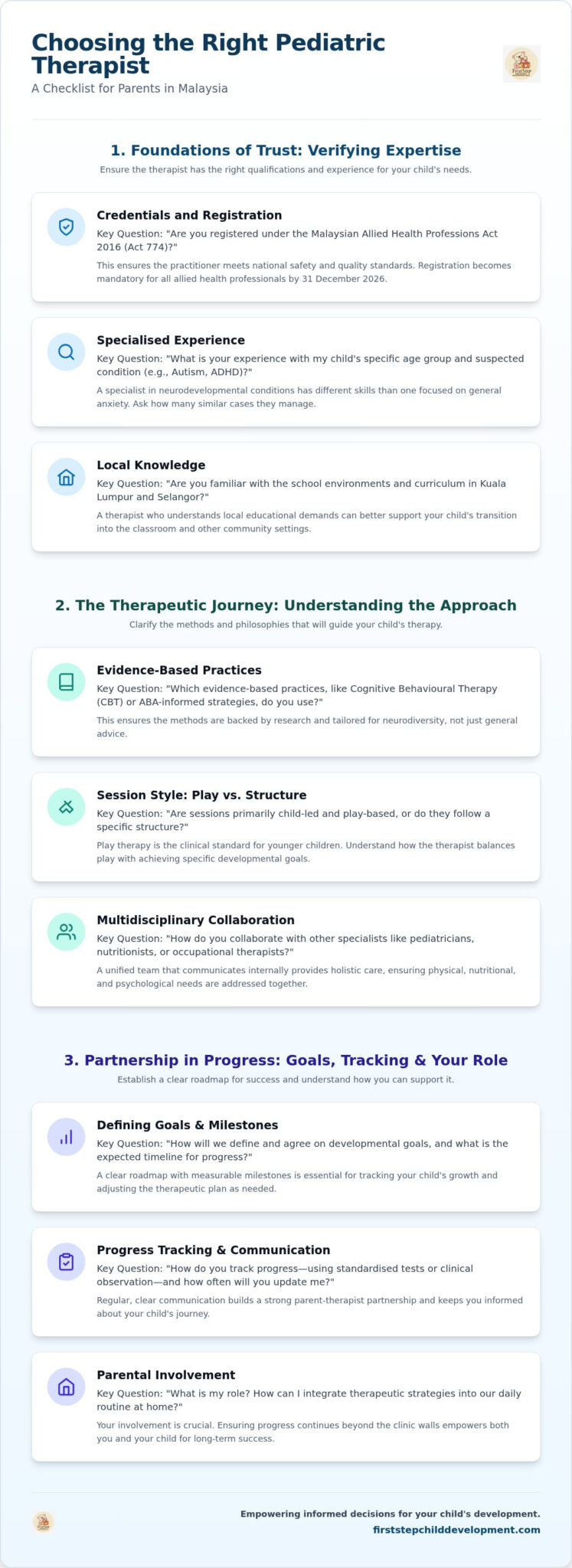
Evaluating Clinical Expertise: Questions to Ask a Pediatric Therapist
Finding the right fit starts with looking beyond a general title. A therapist who excels at treating anxiety might not have the same depth of experience in neurodevelopmental conditions. When preparing your list of questions to ask a pediatric therapist, prioritise their specific history with your child’s suspected condition and age group. A toddler’s needs differ vastly from those of a primary school student. Understanding Child Psychotherapy helps clarify that the therapeutic relationship is built on this specific clinical alignment.
In the Malaysian clinical landscape, a multidisciplinary approach is the gold standard. This means your therapist should work alongside specialists like pediatricians or nutritionists to view your child’s growth holistically rather than in isolation. This collaborative model ensures that physical, nutritional, and psychological needs are addressed simultaneously.
Credentials and Local Experience in Malaysia
Parents should verify that their provider is registered under the Allied Health Professions Act 2016 (Act 774). Registration becomes mandatory for all allied health professionals by 31 December 2026, ensuring practitioners meet national safety and quality standards. Additionally, ask if the therapist is familiar with the school environments in Kuala Lumpur and Selangor. A therapist who understands local curriculum demands can better support your child’s transition into the classroom environment.
Specialised Focus Areas
There is a significant difference between general support and specialised autism assessments or ADHD evaluations. A clinical psychologist in a child development centre is a mental health professional who specialises in assessing and treating developmental, emotional, and behavioural disorders in children. Ask how many similar cases they manage monthly and what specific tools they use. This clarity ensures you aren’t just getting general help, but the right kind of expert guidance for your family’s journey.
Understanding the Therapeutic Approach and Methodology
Choosing a therapist involves understanding their clinical toolkit. When considering questions to ask a pediatric therapist, inquire whether they use evidence-based practices such as Cognitive Behavioural Therapy (CBT) or ABA-informed strategies tailored for neurodiversity. It’s equally important to know if they rely on standardised assessments or clinical observation to track progress. While tests provide objective data, observation captures a child’s natural behaviour in a real-world context. Ask how they integrate pediatric occupational therapy or speech therapy if your child requires support across multiple domains. Referencing a comprehensive checklist of questions can help you cover these technical details during your initial consultation.
Play-Based vs. Structured Sessions
For younger children, “Play Therapy” is the clinical standard because it meets them at their developmental level. You should ask how the therapist keeps your child motivated through play while still targeting specific developmental goals. A “gentle and professional” environment is vital for success, as it helps children feel safe enough to explore new skills. Ask if the sessions are child-led or if there is a specific structure to each hour. If you are unsure which approach fits your child’s personality, you can learn more about how our assessments work to find clarity.
Multidisciplinary Collaboration
Effective therapy shouldn’t happen in a silo. Ask how the psychologist collaborates with pediatricians or nutritionists to provide holistic care. When specialists at the same centre communicate internally, they share critical insights that lead to more accurate adjustments in treatment. This collaborative spirit ensures that every aspect of your child’s development, from physical health and nutrition to emotional regulation, is being monitored by a unified team. This internal communication often results in more consistent progress and a more supportive experience for the whole family.
Defining Goals, Milestones, and Progress Tracking
Progress in therapy is a journey of small, consistent steps rather than overnight shifts. One of the most vital questions to ask a pediatric therapist is how they distinguish between the initial diagnostic phase and the long-term intervention programme. You need to know what “success” looks like for your specific child, as this ensures your family and the clinic are moving in the same direction. Using structured questions for therapy providers helps you pin down how milestones are measured, whether through social engagement, emotional regulation, or motor skill mastery.
A typical clinical psychologist consultation usually lasts between 45 to 60 minutes, with the frequency of visits depending on your child’s unique profile. Ask how often you’ll receive formal feedback sessions to review these goals and adjust the plan as your child grows.
Setting Realistic Expectations
Developmental progress is rarely a straight line. It’s helpful to ask how the therapist manages “plateaus,” which are periods where progress seems to stall. Understanding this helps reduce parental anxiety and sets a realistic pace for the family. You should also discuss the transition from intensive support to maintenance as your child approaches milestones like school readiness.
Formal Reports and Documentation
In Malaysia, a comprehensive diagnostic feedback report is essential for securing school placements or Early Intervention Programme (EIP) applications. Ensure your therapist’s reports include detailed clinical observations and actionable recommendations. These documents serve as a vital bridge between the clinic and the classroom, helping teachers support your child’s specific needs in Kuala Lumpur or Selangor.
If you are ready to establish a clear roadmap for your child’s development, you can book a consultation with our clinical psychologists today to begin setting meaningful goals.
Parental Involvement and Practical Logistics
Therapy is most effective when it extends beyond the clinical setting and into your child’s daily life. When refining your questions to ask a pediatric therapist, focus on how you can support your child’s progress at home. Ask for specific strategies or “home components” that align with the week’s therapeutic goals. Clear communication is also essential; find out the best way to reach the therapist if a behavioural crisis occurs or if you have urgent questions between scheduled sessions.
Preparing your child for their first visit helps reduce anxiety for the whole family. Ask the clinic for a simple explanation or a visual guide of what to expect during the initial meeting. Transparency regarding logistics is equally important. Inquire about the structure of diagnostic assessment packages to ensure you understand exactly what is included, from the first interview to the final feedback session, to avoid any hidden costs.
Training and Support for Caregivers
Inquire if the centre offers dedicated parent guidance or coaching sessions. Evidence suggests that parental involvement is a leading predictor of success in early intervention. A therapist who empowers you with the tools to manage daily challenges becomes a mentor, ensuring that developmental progress continues naturally throughout the week rather than just during the hour spent at the clinic.
Scheduling and Continuity of Care
High-demand areas like Petaling Jaya or Kuala Lumpur often have limited slots, so it is wise to ask about long-term session availability early in the process. You should also check the clinic’s policy on continuity. Ask what happens if a primary therapist is unavailable and how they ensure a seamless transition between specialists if your child’s needs evolve. This methodical approach ensures your child stays on a steady path without unnecessary disruption.
Empowering Your Child’s Next Developmental Chapter
Choosing the right specialist is about building a bridge between clinical expertise and your child’s unique personality. By using this curated list of questions to ask a pediatric therapist, you can move from a place of uncertainty to a position of informed confidence. Remember that successful therapy relies on clear milestones, verified professional registration, and a collaborative approach that includes you as an active partner in the process.
At Firststep Psychology & Child Development Centre, our multidisciplinary team of pediatricians and psychologists provides a safe haven for families across Kuala Lumpur and Selangor. We offer specialised assessments for ADHD and Autism, ensuring that every child’s developmental path is handled with sensitivity and scientific clarity. If you are ready to take the first step toward understanding your child’s unique needs, book a consultation with our multidisciplinary team or visit our homepage to learn more about our gentle, professional approach. You don’t have to navigate this journey alone; expert guidance is just a conversation away.
Frequently Asked Questions
How do I know if my child needs a psychologist or a speech therapist?
Speech therapists focus specifically on communication, articulation, and swallowing difficulties. Clinical psychologists address emotional regulation, social skills, and neurodevelopmental concerns like ADHD or autism. If your child struggles with making sounds or following verbal instructions, a speech therapist is the priority. If they experience behavioural challenges or social anxiety, a psychologist is appropriate. Our multidisciplinary team in KL often combines these services to provide holistic support for your child’s growth.
What qualifications should a pediatric therapist in Malaysia have?
All allied health professionals must be registered with the Malaysian Allied Health Professionals Council under the Allied Health Professions Act 2016. By December 2026, this registration is a mandatory legal requirement for practice. Clinical psychologists should hold a recognised Master’s or PhD in Clinical Psychology. These credentials ensure the provider follows strict ethical guidelines and possesses the expertise required to conduct complex neurodevelopmental assessments for children in Selangor and Petaling Jaya.
Can I stay in the room during my child’s therapy session?
Parental presence depends on the specific therapy goals and your child’s age. For play therapy or parent guidance sessions, your involvement is often encouraged to help you learn strategies for home. However, during formal standardised testing, therapists might ask you to wait outside to ensure the results accurately reflect your child’s independent abilities. This is a vital topic to include in your questions to ask a pediatric therapist during the initial intake.
How long does a typical pediatric assessment take from start to finish?
A comprehensive pediatric assessment is a thorough process that typically spans several weeks. It usually begins with a parent intake interview, followed by several hours of direct testing and clinical observation across one or more sessions. Finally, a feedback session is scheduled to discuss the results and the detailed report. This methodical timeline ensures every aspect of your child’s development is carefully evaluated by our specialists in Kuala Lumpur or Petaling Jaya.
What is the difference between a screening and a full diagnostic assessment?
A screening is a brief check used to identify if a child is at risk for developmental delays, often taking less than 30 minutes. In contrast, a full diagnostic assessment is a deep dive using standardised tools to provide a definitive profile of conditions like ADHD or autism. While screenings are helpful for early detection, only a full assessment provides the actionable data and formal documentation needed for school placements and EIP applications.

Article by
Firststep Child Development Team
Firststep Child Development Team provides evidence-informed educational resources to help parents better understand child development, behaviour and learning. Our multidisciplinary services include clinical psychology, occupational therapy, speech and language therapy, developmental assessments and other child development support in Kuala Lumpur and Selangor.
Disclaimer
This article is for general educational and informational purposes only and is not a substitute for professional medical, psychological or therapeutic advice, diagnosis or treatment. Every child develops differently. If you have concerns about your child's development, behaviour, learning or wellbeing, please consult an appropriately qualified healthcare or allied health professional.