



Imagine starting your morning not with a battle of wills, but with a sense of calm cooperation. For many families across Malaysia, the daily reality of parenting a child with ADHD often involves a cycle of forgotten instructions, school complaints, and the heavy weight of feeling like an ineffective parent. It’s truly exhausting to worry about your child’s future potential while managing immediate behavioural outbursts. You aren’t alone in these feelings, and your child’s struggles aren’t a reflection of your commitment as a caregiver.
Implementing specific parenting a child with ADHD strategies is less about increasing discipline and more about externalising executive functions through structure and empathy. This article provides practical, evidence-based guidance to help you support your child’s journey so they can thrive both at home and in the classroom. We’ll explore how to build a calmer home environment, improve school performance, and create a clear roadmap for professional support through clinical assessments and specialist consultations.
Key Takeaways
- Understand ADHD as a neurodevelopmental difference in executive functions, helping you bridge the gap between what your child knows and what they can do.
- Implement effective parenting a child with ADHD strategies by establishing predictable routines and using positive reinforcement to reduce daily power struggles.
- Learn how to collaborate with teachers in Kuala Lumpur and Selangor to ensure your child receives the right support and accommodations in the classroom.
- Identify when to seek a multidisciplinary assessment to provide a clear, professional roadmap for your child’s long-term development and emotional well-being.
Understanding the ADHD Brain: Why Traditional Parenting Often Struggles
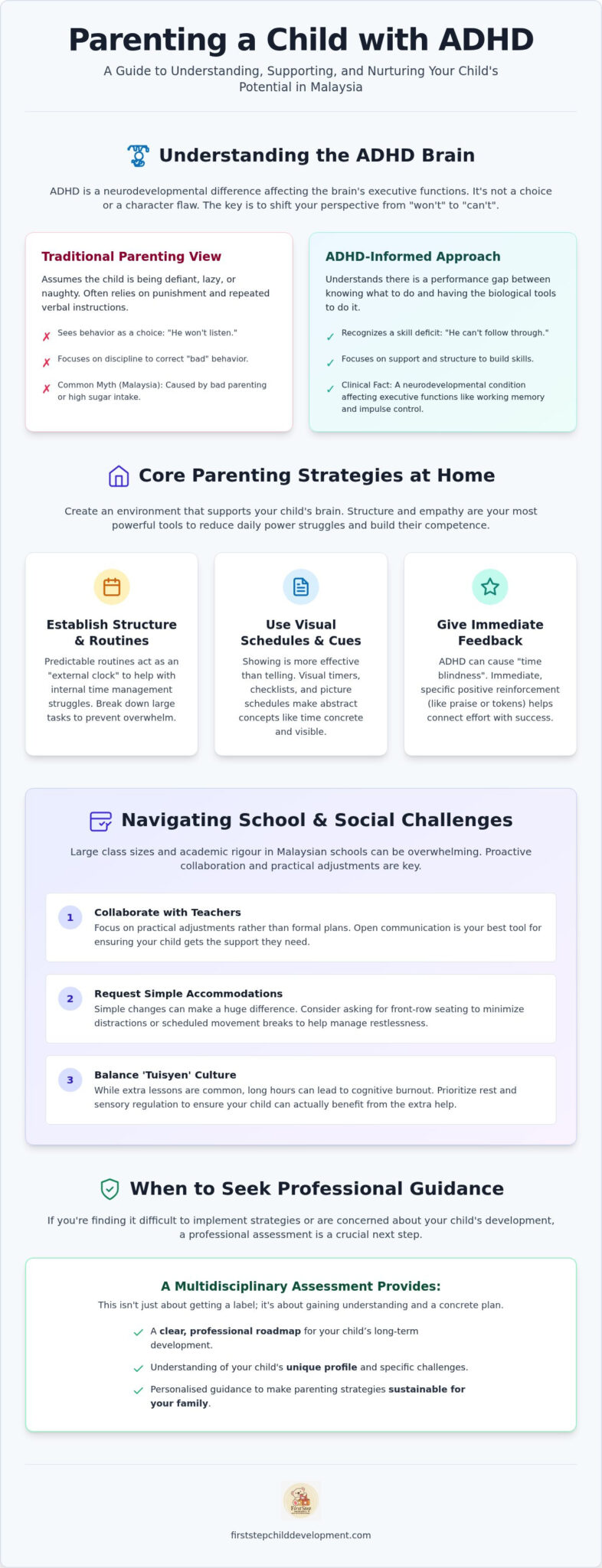
Traditional discipline often relies on the assumption that a child is choosing to be defiant. However, ADHD is actually a neurodevelopmental difference affecting the brain’s executive functions, specifically working memory and impulse control. This creates a performance gap where your child might understand a rule but lacks the biological tools to follow it in the moment. Shifting your perspective from “won’t” to “can’t” is the first of many essential parenting a child with ADHD strategies that reduces guilt for both you and your child.
The Role of Executive Function in Daily Tasks
Think of executive function as the brain’s management system. It’s responsible for planning, focusing, and juggling multiple pieces of information. When you tell your child to get ready for school, their brain must sequence several complex steps. For a child with ADHD, this management system often stalls. They aren’t ignoring you; they are simply struggling with the management of ADHD symptoms that make sequencing tasks feel overwhelming.
Common Misconceptions in the Malaysian Context
In Malaysia, cultural values often place a high premium on immediate obedience and quiet behaviour. This can lead to the harmful myth that ADHD is merely the result of bad parenting or a diet high in sugar. These misconceptions add unnecessary pressure on families in Kuala Lumpur and Selangor. It’s vital to recognise that ADHD is a clinical condition, not a character flaw. Gaining clarity starts with a professional clinical psychologist assessment to understand your child’s unique profile. Effective parenting a child with ADHD strategies begin with this scientific understanding, allowing you to replace frustration with targeted, compassionate support.
Core Parenting Strategies for Managing ADHD at Home
Creating a structured environment is the cornerstone of effective parenting. Children with ADHD often struggle with internal time management, so establishing predictable routines acts as an essential external clock. By breaking down complex tasks, such as cleaning a bedroom, into specific micro-steps, you prevent the cognitive overwhelm that often leads to defiance. It’s also vital to create a dedicated, distraction-free space for focused tasks like homework. These practical parenting a child with ADHD strategies help lower daily tension and foster a sense of competence in your child.
Implementing Visual Schedules and Cues
For children with working memory challenges, verbal instructions often evaporate before they can be acted upon. Showing is significantly more effective than telling. Using visual timers, colour-coded checklists, and picture schedules helps externalise the passing of time and task sequences. This makes abstract concepts like “ten more minutes” visible and concrete. This approach reduces the need for constant verbal reminders and preserves a more positive parent-child bond.
The Power of Immediate Feedback
ADHD often involves “time blindness”, a phenomenon where future consequences or rewards feel disconnected from the present moment. To be effective, positive reinforcement must be immediate and specific. Simple token economies or praise-based systems help bridge this gap, reinforcing the connection between effort and success. These behavioural techniques are core components of various ADHD treatment options. If you find these systems difficult to maintain alone, seeking a clinical psychologist consultation can provide the personalised guidance needed to make these routines sustainable for your family.
Navigating School and Social Challenges in Malaysia
Schools in Kuala Lumpur and Selangor often feature large class sizes and intense academic rigour. This environment can be overwhelming for a child with ADHD. Communicating effectively with teachers is a vital part of your parenting a child with ADHD strategies. Rather than asking for an American-style IEP, focus on practical classroom adjustments. Requesting front-row seating or scheduled movement breaks can help manage physical restlessness. In private or international school settings, a shadow aide might be a viable option to provide the individualised support your child requires.
The local tuisyen culture presents a unique challenge. While extra academic help is standard in Malaysia, the long hours can lead to cognitive burnout for ADHD students. It’s often more beneficial to prioritise sensory regulation and rest. If your child frequently feels overstimulated by classroom noise or struggles with fine motor tasks, pediatric occupational therapy can offer specific techniques to help them stay calm and focused.
Advocating for Classroom Accommodations
Building a strong alliance with your child’s teacher is essential for success. Propose simple, low-cost modifications like providing written instructions or using a visual timer during exams. These small changes reduce the executive function load on your child. Consistent advocacy ensures that the school environment remains a place where they can feel capable and supported.
Supporting Social Skill Development
Social interactions require quick processing of cues, which can be difficult for children with ADHD. You can help by using social stories to rehearse playdates or school assemblies. This preparation allows them to practice turn-taking and empathy in a low-pressure setting. For tailored advice on social development, a clinical psychologist consultation can help you refine your parenting a child with ADHD strategies. Discover how our ADHD assessment in Malaysia can provide the clarity your child needs to thrive.
When to Seek Professional Guidance: A Multidisciplinary Approach
While home-based parenting a child with ADHD strategies are essential, professional guidance provides the objective clarity needed to move forward confidently. A formal ADHD assessment in Malaysia serves as the vital foundation for any long-term support plan. It helps distinguish between ADHD and other developmental overlaps that might mimic similar symptoms. A multidisciplinary team offers a holistic view of your child’s unique needs. Clinical psychologists focus on emotional regulation and diagnosis, while occupational therapists address sensory processing and motor skills. Speech therapists can support social communication and language development. Parent consultations are equally important, as they allow you to fine-tune your approach with expert advice tailored specifically to your family’s daily life.
The Benefits of Early Intervention
Starting an early intervention programme can significantly reduce the risk of secondary emotional issues, such as anxiety or low self-esteem. Children with ADHD often face repeated negative feedback in traditional classroom settings, which can lead to a “failure” mindset. Early support helps them understand their brain earlier and focus on their strengths. This proactive approach ensures they develop healthy coping mechanisms before academic pressures intensify in secondary school. It’s about giving them the tools to navigate their environment with confidence.
What to Expect in a Consultation
Many parents feel anxious about their first visit, fearing a cold or overly clinical environment. Our clinical psychologist consultations utilise a gentle, play-based approach that puts your child at ease. This ensures your child feels safe and engaged, allowing for a more accurate understanding of their natural behaviours. The feedback session is a collaborative space. We don’t just provide a report; we work with you to refine your parenting a child with ADHD strategies. We aim to provide a clear, actionable roadmap that empowers you as a parent and supports your child’s long-term potential.
Empowering Your Child’s Unique Journey
Supporting a child with ADHD requires a fundamental shift in perspective. It’s about moving from daily frustration to proactive management. By understanding that executive function challenges are biological, you can implement effective parenting a child with ADHD strategies such as visual routines and immediate feedback. Navigating the Malaysian school system also becomes more manageable when you advocate for practical accommodations and prioritise your child’s emotional well-being over academic pressure alone.
If you are concerned about your child’s development, learn more about our ADHD assessment services or visit Firststep Psychology & Child Development Centre to explore how we can support your family’s journey. Our specialised multidisciplinary team and expert clinical psychologists in KL and Selangor use a compassionate, play-based diagnostic approach to help you find professional clarity. You don’t have to navigate this path alone; seeking support is a powerful first step toward unlocking your child’s true potential.
Frequently Asked Questions
What are the first signs of ADHD I should look for in my child?
Signs often include difficulty sustaining attention during play, frequent careless mistakes in schoolwork, and excessive fidgeting or squirming. You might notice your child struggling to follow multi-step instructions or frequently losing items like stationery. These behaviours must be persistent across different settings, such as both home and school. They should also appear more frequently than in other children of the same age, indicating a need for a professional review.
Can diet and nutrition help manage ADHD symptoms?
While diet alone isn’t a cure, proper nutrition plays a supportive role in managing energy levels and focus. Some parents find that reducing processed sugars and ensuring a balance of protein and complex carbohydrates helps stabilise their child’s mood. Consulting a nutritionist can help identify specific dietary patterns that complement your broader parenting a child with ADHD strategies. This ensures your child has the physical fuel needed for cognitive tasks.
Is an ADHD assessment necessary if my child is already receiving school support?
Yes, a formal assessment is vital because it provides a precise clinical profile that informal school support cannot offer. It ensures that the interventions used are targeted to your child’s specific executive function deficits rather than general behavioural issues. In Malaysia, a formal diagnosis is also the first step to accessing specific government resources. It turns guesswork into a clear, professional roadmap for your child’s long-term development and school success.
How do I explain ADHD to my child without making them feel ‘different’?
Focus on the concept of a “different” brain rather than a “broken” one. Explain that their brain is like a fast race car with bicycle brakes; it’s powerful and creative, but sometimes needs extra help to slow down. Using positive framing helps maintain their self-esteem. This conversation is an essential part of your parenting a child with ADHD strategies, helping them feel empowered rather than discouraged by their unique neurodiversity.
What is the difference between ADHD and normal toddler ‘high energy’?
The primary difference lies in the intensity and impact of the behaviour on daily life. While most toddlers are naturally energetic, a child with ADHD often lacks the ability to redirect that energy even when prompted. If the hyperactivity interferes with their ability to learn, play safely with others, or follow simple routines consistently across different environments, it may be time to consult a clinical psychologist for a professional developmental review.

Article by
Firststep Child Development Team
Firststep Child Development Team provides evidence-informed educational resources to help parents better understand child development, behaviour and learning. Our multidisciplinary services include clinical psychology, occupational therapy, speech and language therapy, developmental assessments and other child development support in Kuala Lumpur and Selangor.
Disclaimer
This article is for general educational and informational purposes only and is not a substitute for professional medical, psychological or therapeutic advice, diagnosis or treatment. Every child develops differently. If you have concerns about your child's development, behaviour, learning or wellbeing, please consult an appropriately qualified healthcare or allied health professional.