



Did you know that approximately 7.4% of Malaysian children under the age of five experience some form of developmental delay? As a parent, you might notice your child struggling with tasks that seem to come naturally to others, such as holding a pencil, staying calm in noisy environments, or following simple instructions. It’s completely normal to feel overwhelmed or confused, especially when the term occupational therapy sounds more like a service for adults than for a child whose main “job” is simply to play and learn.
You want the most effective support for your child’s unique journey, and understanding how paediatric occupational therapy can help is the first step toward peace of mind. This guide explains how professional support addresses motor skills, sensory processing, and school readiness. We’ll explore the specific signs that indicate your child might benefit from an assessment and provide a clear roadmap for accessing expert care within the KL and Selangor region.
Key Takeaways
- Learn how occupational therapy helps children master their daily “occupations,” including play, school participation, and essential self-care tasks.
- Understand the three pillars of development—sensory processing, fine motor skills, and gross motor skills—that support your child’s independence.
- Recognise actionable signs that your child might need support, such as struggling with classroom instructions or being overwhelmed by sensory environments.
- Discover how a play-based, multidisciplinary approach ensures your child feels comfortable and engaged during their developmental assessment.
What is Paediatric Occupational Therapy?
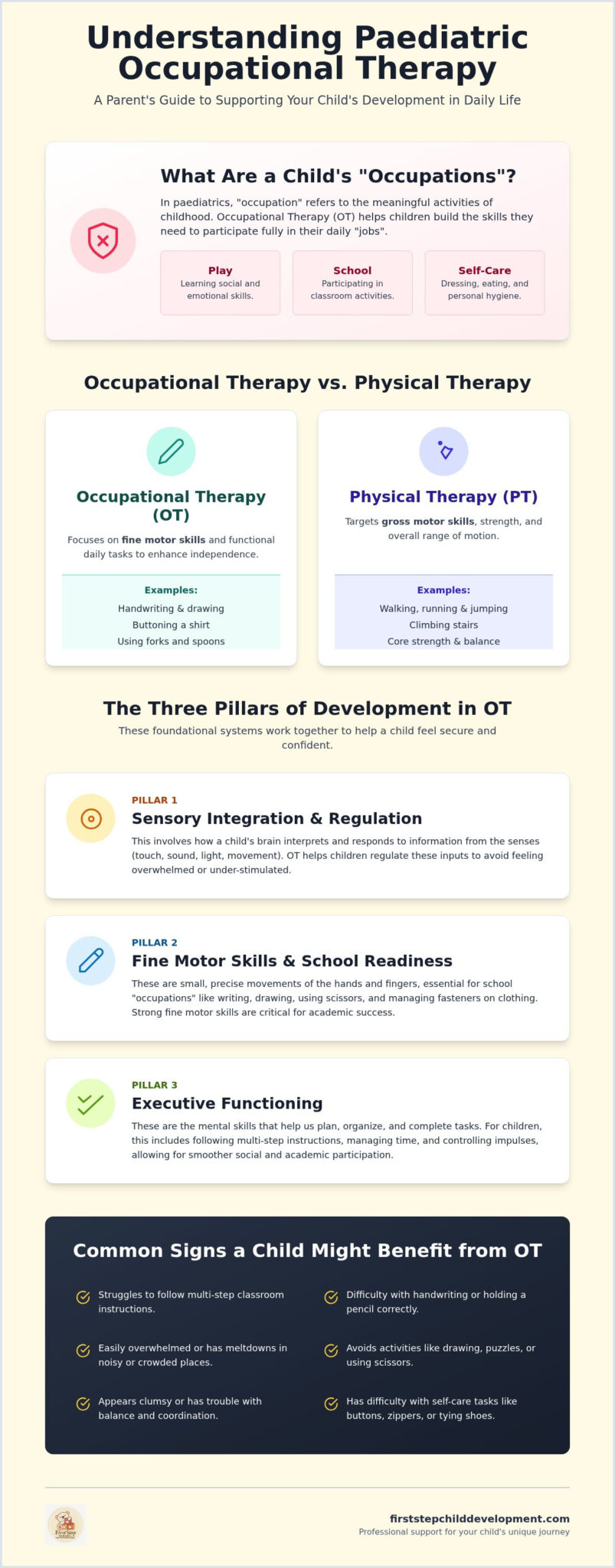
While the term often suggests vocational training, What is Occupational Therapy? in a paediatric context refers to the “occupations” of childhood. These include play, school participation, and essential self-care tasks like dressing, eating, or brushing teeth. The core goal is to foster independence and confidence, helping your child engage fully in their daily environments. Play is not just a distraction here; it’s the primary medium through which children develop social, emotional, and physical skills.
Unlike adult rehabilitation, which often focuses on regaining lost abilities after an injury, paediatric occupational therapy is developmental. It meets children where they are, using purposeful activities to build skills they haven’t mastered yet. At Firststep, we integrate this into a multidisciplinary approach. This means our therapists work alongside psychologists and speech therapists in KL and Selangor to provide a comprehensive support system tailored to your family’s needs.
The Difference Between OT and Physical Therapy
Parents often wonder how these two fields differ. Occupational therapy primarily focuses on functional daily tasks and fine motor skills, such as handwriting, buttoning a shirt, or using cutlery. In contrast, physical therapy (PT) targets gross motor movement, overall strength, and range of motion, such as walking, jumping, or climbing stairs. Both are vital, but they address different aspects of a child’s physical journey.
While their methods vary, they often work together for holistic child development. For example, a physical therapist might help a child build the core strength needed to sit upright at a classroom table. Meanwhile, an occupational therapist works on the hand-eye coordination required for that child to follow the teacher’s instructions and write in their workbook. This collaborative effort ensures every developmental gap is addressed with precision and care.
The Three Pillars of Child Development in OT
Success in a child’s daily life relies on three foundational pillars: sensory processing, motor coordination, and executive functioning. These systems work together to help a child feel secure in their body and confident in their surroundings. When one area is out of sync, it often manifests as frustration at school or during play. Recognising the signs your child might need OT is the first step in providing the targeted support they need to thrive.
Sensory Integration and Regulation
Sensory processing involves how a child’s brain interprets information from touch, sound, and light. Some children are “sensory seekers” who crave constant movement, while others are “sensory avoiders” who may experience meltdowns in noisy environments. Occupational therapy uses a “sensory diet”—a customised plan of physical activities—to help children regulate these inputs. For families in KL and Selangor, a specialised Autism Assessment can often provide deeper insights if sensory challenges are a primary concern.
Fine Motor Skills and School Readiness
Fine motor skills are essential for “school occupations” like writing, drawing, and using scissors. These tasks require significant hand strength and coordination. If your child struggles with their pencil grasp or avoids creative activities, they may be experiencing fine motor delays. Our therapists often work alongside our Learning Difficulties Assessment team to ensure that physical hurdles don’t hold back a child’s academic potential.
The final pillar, executive functioning, helps children plan tasks and follow social routines. This allows for smoother social participation, making it easier for them to interact with peers and follow classroom instructions. If you feel your child is struggling to keep up with their daily “jobs,” exploring pediatric occupational therapy can offer the clarity and support your family deserves.
When Should a Child See an Occupational Therapist?
Many parents notice subtle signs before a formal concern arises. Occupational therapy is often the missing piece for children with ADHD or Autism, helping them navigate a world that isn’t always built for their specific sensory or cognitive needs. Whether it’s an inability to sit still during a meal or a struggle to follow multi-step instructions at school, these hurdles aren’t just “phases” if they consistently prevent a child from participating in their own life. If your child’s developmental challenges lead to persistent daily struggle during routine activities, seeking professional guidance is a constructive next step.
Red Flags at Different Ages
Developmental milestones provide a helpful baseline, but red flags often appear in the way a child interacts with their environment. Toddlers might show delayed crawling, avoid certain food textures, or pull away from physical touch. Preschoolers often struggle with the fine motor precision needed for buttons and zippers; they may also appear consistently clumsy on the playground compared to their peers. By primary school, look for social withdrawal, poor handwriting, or a child who becomes visibly overwhelmed by the hum of a busy classroom.
The Impact on Daily Family Life in Malaysia
Living in urban areas like KL or PJ presents unique sensory challenges. Busy shopping centres, festive crowds, and loud, open-plan classrooms can be exhausting for a child with sensory sensitivities. Professional support provides practical strategies to reduce stress during these times, turning chaotic morning routines into manageable moments for the whole family. By addressing these triggers early, you help your child build the resilience needed for the fast-paced Malaysian school environment.
If you’ve noticed these red flags in your child’s daily routine, consider booking a Pediatric Occupational Therapy consultation to gain professional clarity and support.
What to Expect: The OT Process at Firststep
The journey begins with a comprehensive initial consultation where we build an “occupational profile” of your child. Our approach to occupational therapy isn’t just a clinical checklist; it’s a holistic look at their strengths, interests, and the specific hurdles they face in their daily environments. We use purposeful, play-based assessments to keep children engaged and comfortable. By observing how a child interacts with toys and structured activities, our therapists can identify underlying challenges in a way that feels like a natural play session rather than a formal test.
Collaboration is the heart of our practice. We work closely with you and your child’s teachers to set realistic, meaningful goals that translate to real-world success. You’ll receive regular feedback sessions and practical, home-based strategies to ensure progress continues outside our centre. This ensures that the skills learned during therapy become a permanent part of your child’s daily life.
The Multidisciplinary Advantage
Developmental hurdles rarely exist in isolation. At Firststep, our occupational therapy team works alongside Clinical Psychologists to address emotional or cognitive barriers that might affect a child’s progress. We also integrate Speech Therapy to support children who face both communication and motor-sensory challenges. This team-based approach ensures that every facet of your child’s growth is supported by a specialist, leading to more cohesive and sustainable outcomes.
Starting Your Journey in KL or Selangor
Beginning therapy can feel like a big step, so we’ve streamlined our process to be as supportive as possible for families in the Klang Valley:
- Step 1: Book an initial screening or developmental assessment to identify your child’s current needs and priorities.
- Step 2: Participate in a play-based evaluation where our therapists observe your child’s functional skills in a safe, welcoming environment.
- Step 3: Review a detailed feedback report and therapy plan that outlines the path forward for your child’s development and independence.
Empowering Your Child’s Journey Toward Independence
Understanding the unique “occupations” of childhood, play, learning, and self-care, is the first step in unlocking your child’s full potential. By focusing on the foundational pillars of sensory processing and motor coordination, occupational therapy provides a structured yet gentle path forward for children facing developmental hurdles. Our multidisciplinary team in KL and Selangor is dedicated to providing a nurturing environment where play-based assessments lead to clear, actionable insights for your family. With reassuring parental feedback and a collaborative approach, we ensure that every milestone is celebrated and every challenge is met with professional expertise.
If you are concerned about your child’s development, learn more about our Paediatric Occupational Therapy or visit our homepage to connect with our specialists in KL and Selangor. We are here to be your trusted partner, providing the clarity and support your child needs to thrive with confidence in their daily life.
Frequently Asked Questions
How long does a typical paediatric occupational therapy session last?
A typical paediatric occupational therapy session usually lasts between 45 and 60 minutes. This specific timeframe allows the therapist to engage your child in play-based activities while maintaining their focus and energy levels. During this window, we work on developmental goals like fine motor coordination or sensory regulation. We also dedicate time at the end to provide you with clear feedback and practical strategies to use at home in PJ or KL.
Can occupational therapy help my child with picky eating?
Yes, our specialised therapy can significantly support children with picky eating, especially when it’s related to sensory processing challenges. Many children avoid certain foods because they are sensitive to specific textures, smells, or temperatures. Our therapists use a gentle, systematic approach to help your child become more comfortable with a wider variety of foods. We often collaborate with our nutritionist to ensure your child receives balanced support for their growth and mealtime participation.
Is occupational therapy only for children with a diagnosis like Autism or ADHD?
Occupational therapy is not limited to children with a formal diagnosis like Autism or ADHD. It’s beneficial for any child who struggles with daily functional tasks, such as handwriting, dressing, or following instructions. Whether your child has a known developmental delay or simply needs help catching up with milestones, OT provides targeted support. We focus on building independence and confidence in every child, regardless of whether they have a specific medical label or diagnosis.
How many sessions of OT will my child need before seeing progress?
The number of sessions required varies for every child because progress depends on their unique needs and the complexity of their goals. While some parents in Selangor notice small improvements after a few weeks, more significant developmental changes typically occur over three to six months of consistent therapy. We conduct regular reviews to track your child’s journey and adjust the therapy plan. Your involvement with home-based strategies is a key factor in accelerating this progress.
What is the difference between a school-based OT and a private clinic OT in Malaysia?
In Malaysia, school-based OT primarily focuses on a child’s ability to function within the classroom, such as sitting still or using school tools. A private clinic like Firststep offers a more comprehensive, multidisciplinary approach. We address broader life skills beyond the school gate, including self-care and sensory regulation at home. Private clinics also provide more frequent parental feedback and access to a team of psychologists and speech therapists for holistic developmental support.

Article by
Firststep Child Development Team
Firststep Child Development Team provides evidence-informed educational resources to help parents better understand child development, behaviour and learning. Our multidisciplinary services include clinical psychology, occupational therapy, speech and language therapy, developmental assessments and other child development support in Kuala Lumpur and Selangor.
Disclaimer
This article is for general educational and informational purposes only and is not a substitute for professional medical, psychological or therapeutic advice, diagnosis or treatment. Every child develops differently. If you have concerns about your child's development, behaviour, learning or wellbeing, please consult an appropriately qualified healthcare or allied health professional.