



A late talker usually has a limited spoken vocabulary for their age but understands language and develops in other areas as expected; a broader speech or language delay can also affect understanding, pronunciation or communication with others. By 24 months, children are generally expected to combine two words, so difficulty doing so is a reason to pay attention. Understanding the difference between a late talker and a child with a speech delay can help you decide what to observe and when to seek guidance.
It’s natural to wonder whether a child simply needs more time, especially when they communicate in other ways or seem to understand you. Milestones offer useful reference points, but children develop at different rates, and one sign alone cannot explain why a child is speaking less.
This guide explains what speech and language delays can involve, how late talking differs from broader communication difficulties, and what else may affect development. You’ll also learn which signs may warrant an evaluation and how to support communication at home while seeking clarity.
Key Takeaways
- Notice whether your child’s difficulty is mainly with saying words, understanding language, or both, as these patterns can point to different communication needs.
- Use developmental milestones as helpful reference points, and keep track of the words, gestures and directions your child uses or understands.
- Consider that hearing differences and other developmental factors can affect communication, so limited speech does not explain the cause on its own.
- Seek professional guidance if communication concerns persist or your child has difficulty understanding, using gestures or combining words; an assessment can help clarify what support may be useful.
What is Speech and Language Delay?
A speech or language delay means a child’s communication skills are developing differently from expected milestones. The areas affected can include speaking, understanding, or both.
Speech and Language Milestones
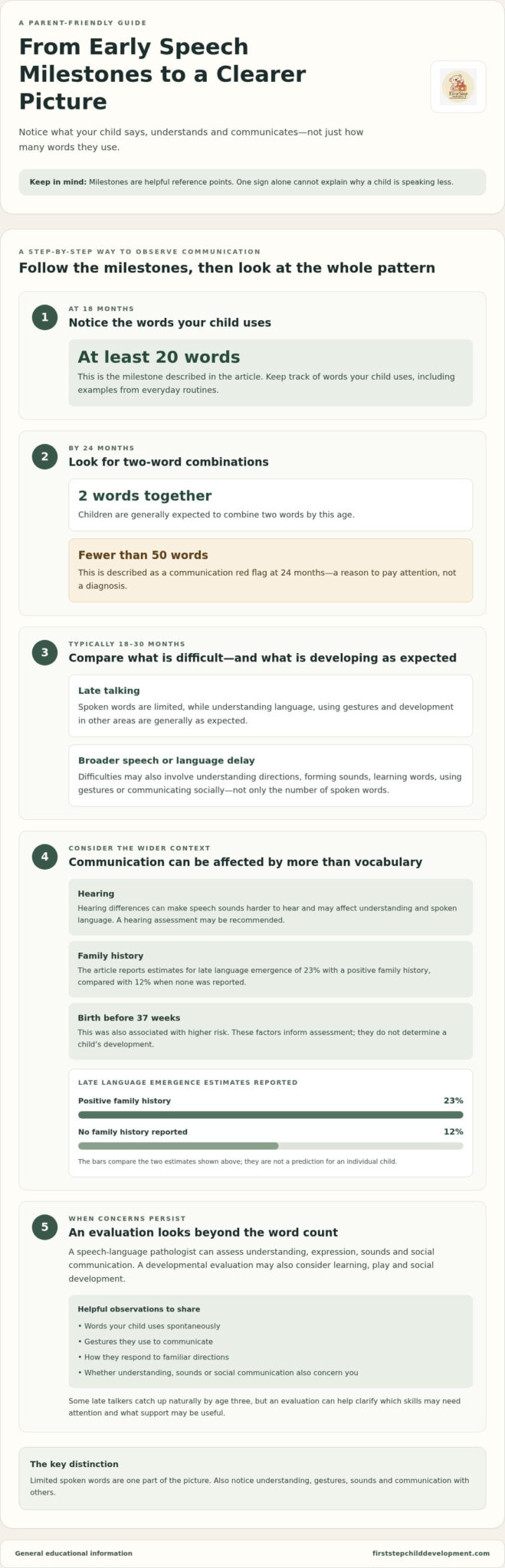
Milestones are communication skills children commonly develop as they grow, giving families reference points for noticing progress. At 18 months, children are expected to use at least 20 words; by 24 months, they should combine two words. Fewer than 50 words at 24 months is a communication red flag. These markers help parents describe specific observations, such as a child using gestures but few spoken words.
Speech Delay and Language Delay
Speech delay affects spoken expression, including how a child forms sounds and words; language delay affects understanding or sharing meaning. A child might understand “bring your shoes” but struggle to pronounce the words clearly. Another might say “shoe” clearly but find it hard to understand directions or combine words. These examples can help identify which communication skills may need attention.
Late Talking and Broader Delays
Late talking usually describes a toddler aged 18 to 30 months with few spoken words, while broader delays may also affect understanding, sounds or social communication. One child may understand familiar directions and use gestures; another may also struggle to follow simple instructions. Looking beyond vocabulary helps show how communication works in daily situations.
A speech-language pathologist can assess understanding, expression, sounds and social communication. Share examples of words used spontaneously and responses to familiar directions; a hearing assessment may also be recommended. Findings help clarify whether speech therapy support may be appropriate and which communication goals to prioritise.
How late talkers differ from children with broader speech delays
A late talker is typically between 18 and 30 months, with limited spoken words but otherwise expected development. They generally understand spoken language and use gestures, while social, thinking and motor skills develop as expected. A broader delay may affect understanding, learning new words, using gestures or communicating socially, not only the number of words spoken. For example, a child may say few words and also struggle to follow familiar directions.
Hearing loss can make speech sounds harder to hear, while autism may involve differences in social communication alongside language delay. Developmental language disorder involves persistent difficulty understanding or using language, rather than limited talking alone. These patterns can overlap, so an evaluation considers how a child communicates in daily situations, not just their spoken vocabulary.
Some late talkers catch up naturally by age three, but waiting without assessing communication can delay useful support. Early intervention means identifying needs and offering timely support, which can include speech therapy and practical guidance for everyday interactions. If your child’s words remain limited, or you’re also concerned about understanding or gestures, an evaluation can clarify which skills need attention.
A developmental evaluation for a child from birth to age three can consider communication alongside learning, play and social development. It may include caregiver observations, examples of the child’s gestures and responses, and an assessment of understanding and spoken language. Family history is one risk factor: late language emergence estimates were 23% for children with a positive family history, compared with 12% when none was reported. Birth before 37 weeks was also associated with higher risk. These factors inform assessment; they do not determine a child’s development. In Malaysia, discuss concerns with a qualified professional to understand what evaluation and early support may be appropriate.
Other possible causes of speech delay
Hearing differences can affect how a toddler picks up speech sounds and learns words. A child may not respond consistently when a parent calls from another room, yet turn towards a familiar sound nearby. Hearing should be considered when communication concerns arise, because difficulty hearing speech can affect both understanding and spoken language. A hearing assessment can clarify whether access to sound may be part of the picture.
Some developmental conditions can also affect communication. Autism may involve differences in social communication, such as pointing less often to share interest or difficulty responding to another person’s gestures. Cerebral palsy can affect the muscle movements used for speech. Delays in broader development may influence learning and communication together, rather than affecting talking alone.
Research cited in the topic brief indicates that 40% to 70% of autistic children have language delays, while up to 30% may never develop functional spoken language. These figures describe groups, not an individual toddler. Limited phrases or repeated actions alone cannot establish autism; professionals consider a child’s communication and development across situations.
Expressive language disorder can make it difficult to find words or combine them into phrases, even when a child understands familiar instructions. Oral impairments, including tongue or palate problems, may affect the movements needed to form sounds clearly. For example, parents might notice persistent difficulty producing certain sounds, as well as trouble being understood.
A child’s social environment can also shape communication. Psychosocial deprivation may limit opportunities for responsive interaction, such as taking turns during play or hearing adults name everyday actions. This is one possible factor, not a conclusion parents should draw from speech alone. Note what your child understands, how they respond to their name, whether they point, and how they communicate their needs. These observations help an assessment consider hearing, language, social communication and physical factors together.
When to seek speech or autism evaluations
Consider professional advice when communication difficulties affect everyday interactions or remain a concern over time. Specific examples can help clarify what support or assessment may be useful.
Evaluation Warning Signs
Warning signs are communication patterns that may warrant assessment, particularly when they affect participation with family or others. By age three, discuss persistently unclear speech with a professional. By age four, children should be mostly understood even by people who do not know them. These reference points can help parents describe concerns without trying to diagnose the cause.
A hearing evaluation is also relevant when a child has trouble responding to spoken communication. A clinician can consider whether hearing, speech production or broader communication skills may affect understanding. If social communication differences accompany language concerns, an autism evaluation may help explore the wider developmental picture. One behaviour alone does not establish autism; professionals consider patterns across interactions and settings.
Signs of Late Talking
One useful distinction is whether a toddler produces words and phrases spontaneously or mainly repeats speech they hear. If a two-year-old only imitates speech or actions, without producing words or phrases independently, discuss this with a doctor. This is a clearer observation than simply describing a child as quiet.
Before an appointment, note a few real examples: what your child says without prompting, how they communicate a new idea, and whether their communication changes with familiar people. A speech-language pathologist can use these observations to understand communication in context and discuss appropriate next steps. Seek advice when concerns arise rather than waiting for one milestone to explain them.
Firststep Psychology & Child Development Centre: Clinical Psychologist Consultation
Firststep Psychology & Child Development Centre offers Clinical Psychologist Consultation for parents seeking guidance about a child’s communication and wider development. If limited talking occurs alongside concerns about social interaction, learning or behaviour, a consultation can help you discuss what you have observed and consider whether further assessment may be useful. An Autism Assessment may be relevant when communication concerns appear alongside differences in social engagement; it does not replace a speech and language evaluation when that is needed. Bring examples such as words your child uses, how they respond to requests, and gestures they use to communicate. To discuss your concerns, you’re welcome to contact Firststep Psychology & Child Development Centre or visit Firststep Child Development.
Take the Next Step with Confidence
Understanding “Late Talker vs Speech Delay: What’s the Difference?” can provide a clearer starting point, but your child’s everyday communication matters more than a label. Keep brief notes on what they say, understand and communicate through play. Sharing these observations can help a professional understand your concerns and discuss suitable assessment or support.
Firststep Psychology & Child Development Centre offers Clinical Psychologist Consultation, ADHD Assessment and Autism Assessment for families seeking guidance about developmental concerns. A consultation can help you discuss your child’s needs and consider possible next steps, without assuming that one behaviour explains everything.
If you’d like to talk through your concerns, contact Firststep Psychology & Child Development Centre. A thoughtful next step can help you feel more informed as you support your child’s communication and development.
Frequently Asked Questions
Is My Toddler a Late-Talker?
Your toddler may be a late talker if spoken words are limited, but the label alone cannot explain why. Consider the whole communication picture: does your child try to share attention, respond to familiar people, or communicate through facial expressions and actions? Write down examples from play, meals and outings. A professional can consider these observations alongside your child’s understanding and broader development.
At what age should I be concerned if my toddler is not talking yet?
Raise concerns if your child has no spoken words by 18 months or is not combining two words by age two. Don’t wait for a birthday if your child also struggles to understand simple requests or communicate socially. Note when the difficulty happens, such as during play or familiar routines. These details help a professional decide what to assess, including whether hearing needs attention.
How Can Parents Help?
Make everyday moments opportunities for interaction. Talk about what you’re doing while preparing food, pause during a favourite book so your child can respond, and follow their interests in play. Use the languages you naturally speak with your child; multilingual communication does not mean you need to stop using a home language. Shared, engaging play offers more opportunities to communicate than passive screen viewing.
Should I Be Worried?
Concern is a reason to seek information, not proof that your child has a disorder. Consider whether communication difficulties affect everyday routines, such as asking for help, sharing interest or following a familiar request. A single behaviour cannot establish a diagnosis. If you’re unsure what you’re seeing, record specific examples and discuss them with a professional rather than comparing your child with others.
What Should I Do?
Start by noting your child’s age, the words they use without prompting, the languages spoken at home, and how they communicate their needs. Include examples of what they understand and how they respond in different settings. Share these observations with a professional and discuss hearing as part of the evaluation. If support is recommended, ask how to practise its goals during ordinary family routines.
What are typical communication milestones for babies and toddlers?
Between 6 and 9 months, babies often recognise familiar people, enjoy social games and babble. Around 12 months, babbling, waving and responding to their name are useful signs to notice. By 36 months, children typically use three-word phrases; by age three, they often answer questions and follow two-step directions. These milestones offer reference points, not a diagnosis on their own.
Article by
Firststep Child Development Team
Firststep Child Development Team provides evidence-informed educational resources to help parents better understand child development, behaviour and learning. Our multidisciplinary services include clinical psychology, occupational therapy, speech and language therapy, developmental assessments and other child development support in Kuala Lumpur and Selangor.
Disclaimer
This article is for general educational and informational purposes only and is not a substitute for professional medical, psychological or therapeutic advice, diagnosis or treatment. Every child develops differently. If you have concerns about your child's development, behaviour, learning or wellbeing, please consult an appropriately qualified healthcare or allied health professional.