



Language Modeling in Speech Therapy: 5 Powerful Techniques for Supporting Early Communication in Children
Why Early Communication Matters?
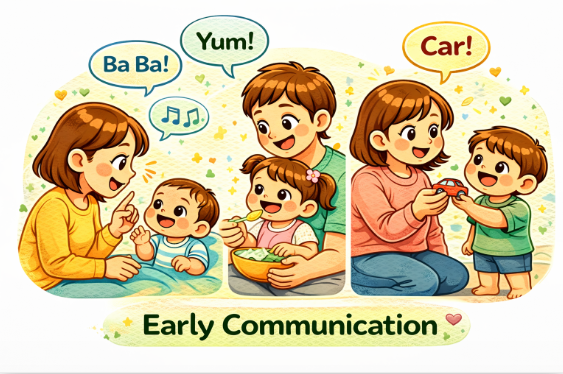
Language Modeling in speech therapy is a simple yet powerful strategy that helps children build strong communication skills.
Communication is one of the most important skills children develop in their early years.
Through communication, children learn to express their needs, share ideas, build relationships, and understand the world around them.
Research shows that the first three years of life are a critical period for language development.
During this time, the brain is highly sensitive to language input, making early experiences especially important.
Even before children speak their first words, infants are already learning how communication works.
In fact, early communication starts much earlier than many parents expect:
- Around 3 months, infants begin making sounds such as cooing and babbling.
- They start using these sounds to interact with their caregivers.
- By around 12 months, many children say their first meaningful word.
(The Impact of Early Speech Therapy on Language Acquisition in Children – Kids First, 2025)

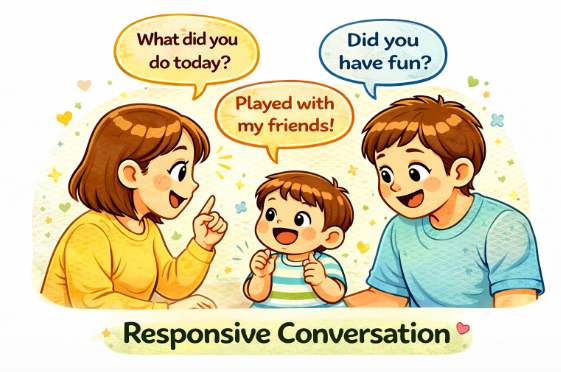
During this stage, children learn language mainly through interactions with the people around them.
According to Speakeasymin (2025), when parents and caregivers provide rich and responsive conversations, they help build the foundation for important skills such as:
- Language and communication
- Social interaction
- Cognitive development
- Early literacy and learning
These early experiences create the foundation for later communication skills.
What Is Language Modeling in
Speech Therapy?
Language modeling in speech therapy is a strategy commonly used by speech therapists and parents to support children’s language development.
It refers to adults intentionally demonstrating clear and meaningful language while interacting with a child.
Instead of correcting a child’s speech directly, language modeling focuses on showing the child how language works through natural conversation (Foundation, 2023).
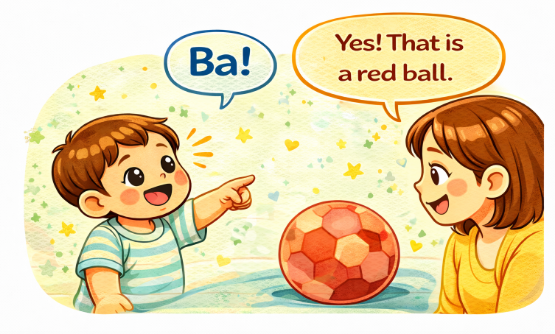
For example:
Child: “Ba!” (pointing to a ball)
Adult: “Yes! That is a red ball.”
In this example, the adult does not correct the child.
Instead, they model a complete sentence, giving the child to hear richer vocabulary and sentence structure.
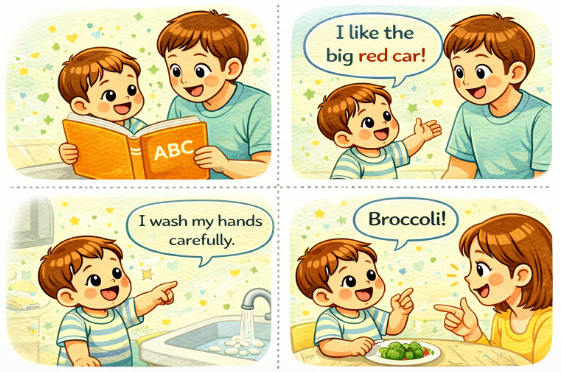
Over time, repeated exposure to these natural language models helps children gradually:
- Expand their vocabulary
- Build longer sentences
- Learn correct grammar
- Improve speech clarity
- Develop better conversational skills
Because language modeling happens during everyday interactions, it is one of the most natural and effective ways for children to learn language.
5 Language Modeling Techniques Parents Can Use
Parents and caregivers can use several language modeling in speech therapy strategies during daily activities.
These techniques can easily be practiced during playtime, meals, or daily routines.
(Gavin, 2019; Ashleighfugate, 2025)
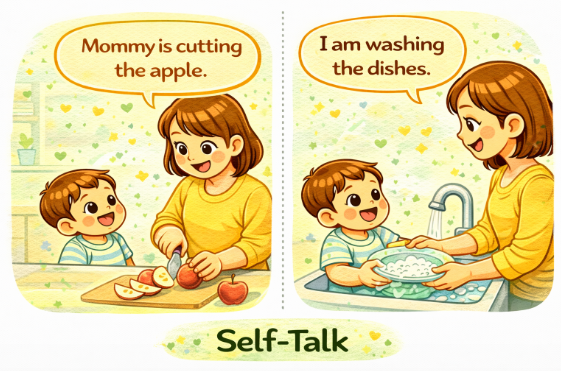
1. Self-Talk
Self-talk means describing what you are doing while the child is nearby.
- This helps children hear language connected to real-life actions.
- Example:
- “Mommy is cutting the apple.”
- “I am washing the dishes.”
- By hearing these descriptions, children begin to understand how words relate to everyday experiences.
2. Parallel Talk
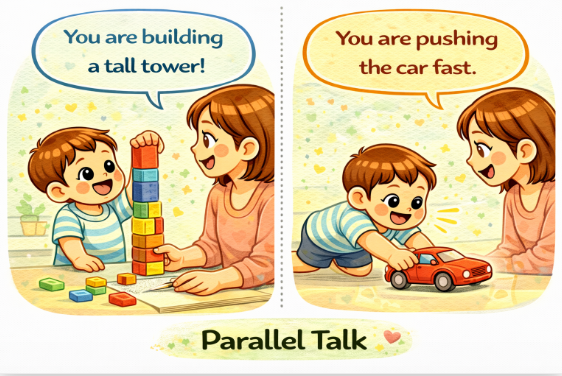
Parallel talk is when you describe what the child is doing.
- Example:
- “You are building a tall tower!”
- “You are pushing the car fast.”
- This helps children connect language to their own actions and experiences, making it easier for them to understand and learn new words.
3. Expansion and Recasting
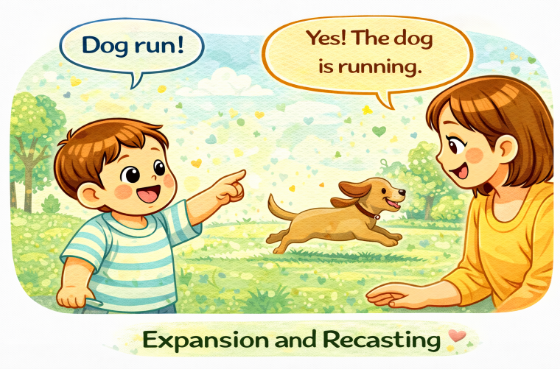
This technique involves building on what the child says by expanding it into a more complete sentence.
- Example:
- Child: “Dog run.”
- Adult: “Yes! The dog is running.”
- Instead of correcting the child, the adult provides a clear and natural model of correct grammar.
- Over time, children begin to learn longer and more accurate sentence structures.
4. Toy Talk
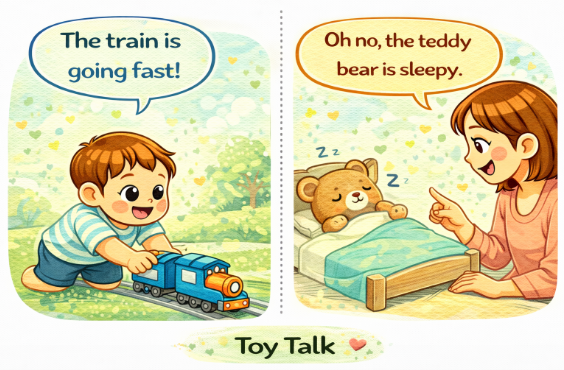
Children often learn best during play. Toy talk involves using toys or pretend play to model language.
- Example:
- “The train is going fast!”
- “Oh no, the teddy bear is sleepy.”
- Research shows that play-based language modeling can help children develop a wider variety of sentence structures and vocabulary.
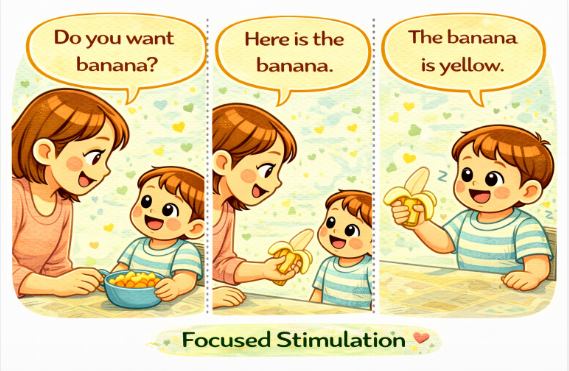
5. Focused Stimulation
Focused stimulation involves repeating a target word or phrase multiple times during an activity.
- Example during snack time:
- “Do you want banana?”
- “Here is the banana.”
- “The banana is yellow.”
- Repeated exposure helps children notice, remember, and eventually use new words themselves.
Why Language Modeling in Speech Therapy Works?
Language modeling works because it matches how children naturally learn language.
1. Children’s Brains Are Built for Learning Language
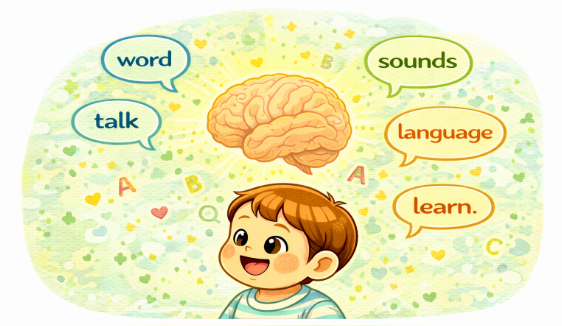
- In the early years, children’s brains are highly adaptable. This ability is known as brain plasticity.
- During this time, repeated exposure to language helps the brain build strong connections for understanding and producing speech.
- The more meaningful language children hear during daily interactions, the stronger these connections become.
2. Children Learn Through Observation and Interaction
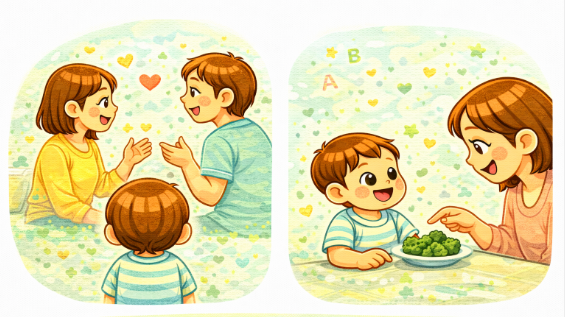
- Young children learn language by listening, observing, and imitating the people around them.
- When adults consistently model clear and meaningful sentences, children begin to notice patterns in:
- Words
- Sentence structure
- Grammar
- Over time, they start using these patterns in their own speech.
3. Safe and Responsive Conversations Matter
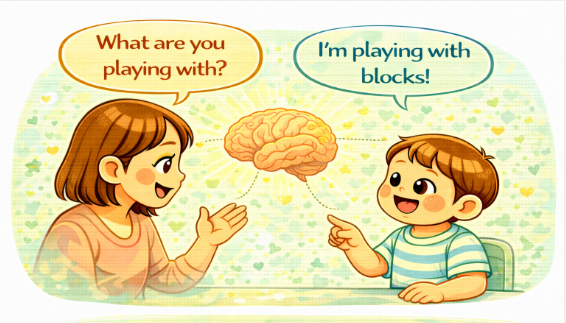
- Children learn best when communication feels natural, supportive, and pressure-free.
- Language modeling avoids constant correction.
- Instead, it focuses on gentle guidance through everyday conversation, which helps children feel more confident to communicate.
- Research also shows that back-and-forth interactions between adults and children are especially important.
- These conversational turns help stimulate the parts of the brain involved in language learning.
When Should Parents Seek Professional Help?
While every child develops at their own pace, certain signs may indicate that a child could benefit from professional support.
Parents may consider consulting a speech-language therapist if a child:
- Does not babble by around 12 months
- Says very few or no words by 18 months
- Has difficulty understanding simple instructions
- Rarely attempts to communicate using gestures, sounds, or words
- Struggles to combine two words by around 2 years old
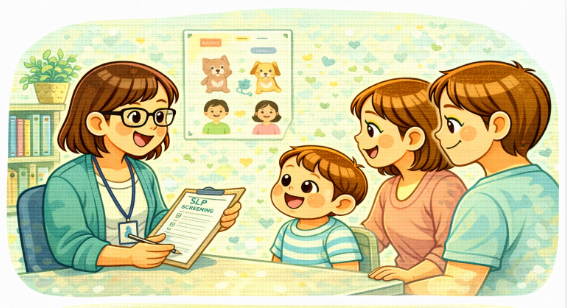
Early identification is important. Research consistently shows that early intervention, especially before age three can significantly improve language outcomes.
Speech-language therapists are trained to assess a child’s communication development and provide individualized strategies to support both the child and their family.
If parents have concerns about their child’s speech or language development, seeking guidance early can make a meaningful difference.
Language modeling in speech therapy is a simple yet powerful strategy that supports early communication development in children.
Through everyday interactions, parents can support their child’s vocabulary, sentence development, and confidence in communication.
When combined with guidance from a speech therapist, these strategies create a strong support system for a child’s language development.
If you have concerns about your child’s speech or communication, early support can make a meaningful difference.
Our team is here to support your child’s communication journey!
🌟 Stay Connected with Us! We love sharing tips, insights, and inspiring stories about children’s growth and mental wellbeing. 💙 Follow us on Instagram and Facebook for more updates and parenting advice.
Join our community and let’s grow together. One positive step at a time!

References
Ashleighfugate. (2025, July 11). Toy Talk – Discover Speech Therapy. Discover Speech Therapy. https://discoverspeechtherapy.com/toy-talk/
Foundation, C. S. R. (2023, November 29). How to Use Modeling as Part of Speech Therapy. CASRF. https://www.casrf.org/post/how-to-use-modeling-as-part-of-speech-therapy
Gavin, L. (2019, March 18). Modeling: A Super-Strategy for Language Growth. LG Speech Therapy. https://www.lgspeechtherapy.com/blog/2019/3/18/modeling-a-super-strategy-for-language-growth
Speakeasymin. (2025, May 28). Simple Language Modeling Helps Young Communicators – Speak Easy Rehabilitation. Speak Easy Rehabilitation – Speech and Language Therapy That Works. https://speakeasyrehab.com/simple-language-modeling-helps-young-communicators/
The Impact of Early Speech Therapy on Language Acquisition in Children – Kids First. (2025). Kidsfirstservices.com. https://www.kidsfirstservices.com/first-insights/the-impact-of-early-speech-therapy-on-language-acquisition-in-children
Working Hours
Tuesday to Saturday – 8.30am to 6pm
Monday & Sunday – Closed
Please also subscribe us at
Contact Us
Discover Our Team!
📞+60102502833
firststepdevelopmentcentre@gmail.com
B1-7, Plaza Damas 3, Jalan Sri Hartamas 1, 50480 Kuala Lumpur.
Copyright 2025. Firststep Child Development Sdn Bhd. All rights reserved.