



Knowing whether your child is ready for primary school takes more than checking their age or early academic skills. Readiness develops across learning, social interaction, self-care and independence, as well as a child’s familiarity with the school environment. A child doesn’t need to arrive already reading or writing; feeling more comfortable with routines, people and new surroundings can matter too.
It’s natural to wonder whether your child will manage the move to Standard 1, especially if they seem confident at home but unsure about school. A practical checklist can help you notice what they already do and where gentle practice may help, without treating every skill as a pass-or-fail test.
This guide covers learning and communication, getting along with others, everyday self-care, and ways to make school and its staff feel more familiar. You’ll also find simple ideas to practise at home, helping your child approach this new stage with growing confidence and support.
Key Takeaways
- Look beyond early reading and counting: notice how your child explores, listens and responds to small learning challenges.
- Use shared play and everyday interactions to practise turn-taking, communication and building friendships.
- Give your child chances to manage simple routines, such as dressing, meals and bathroom needs, with growing independence.
- Make school feel less unfamiliar by talking through the journey, visiting when possible and helping your child know who they can approach for support.
Academic Readiness: Is Your Child Prepared to Learn?
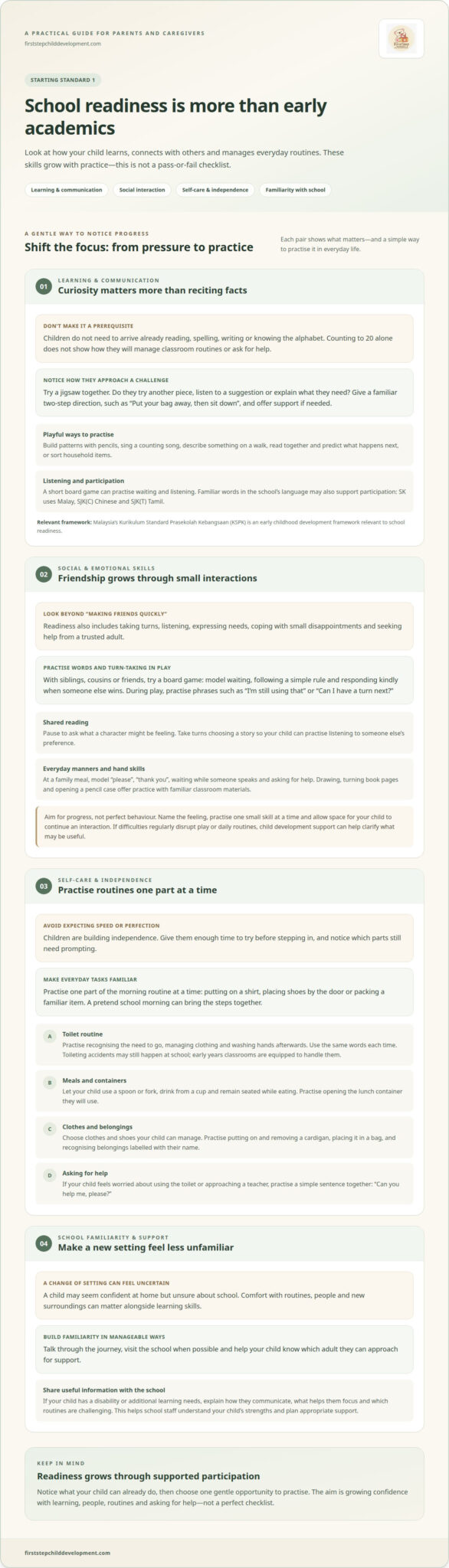
Look for curiosity and willingness to try, not a completed set of academic skills. Children don’t need to read, spell, write or know the alphabet before starting primary school. Counting to 20 alone also doesn’t show whether a child can manage classroom routines or ask for help. If you’re asking whether your child is ready for primary school, notice how they approach learning, not just what they can recite.
Try a small challenge together, such as completing a jigsaw. Does your child try another piece, listen to a suggestion, or explain what they need? These everyday moments can show how they respond to difficulty and whether they feel confident enough to keep going.
Learning through play supports early development. Build patterns with pencils, sing a counting song, or ask your child to describe something they see on a walk. Malaysia’s Kurikulum Standard Prasekolah Kebangsaan (KSPK) is an early childhood development framework relevant to school readiness.
Give a familiar two-step direction, such as “put your bag away, then sit down”. Notice whether your child follows both steps, offering support if needed. A short board game can also show how they manage waiting and listening.
Read together and invite your child to predict what happens next or describe a picture. Involve them in writing a shopping list or sorting household items, then encourage them to try some parts themselves. These shared activities build language and confidence without turning learning at home into a test.
SK, SJK(C) and SJK(T) schools differ mainly in their language of instruction: Malay, Chinese and Tamil, respectively. Readiness skills are similar, but familiar words in the school’s language can support listening and participation.
If your child has a disability or additional learning needs, share useful details with the school before they start. Explain how your child communicates, what helps them focus, and which routines are challenging. This gives school staff a clearer understanding of your child’s strengths and helps them plan appropriate support.
How can a caregiver encourage children’s social skills?
School readiness includes managing everyday interactions, not simply making friends quickly. Social and emotional skills include taking turns, listening, expressing needs, coping with small disappointments, and seeking help from a trusted adult. For example, notice whether your child can tell a playmate, “I’m still using that,” or accept a short wait for a toy.
Practise these skills through play with siblings, cousins or friends. During a board game, model waiting, following a simple rule, and responding kindly when someone else wins. At a playdate, help your child try a greeting or ask, “Would you like to build together?” Then give them space to continue the interaction themselves.
Shared reading also supports listening and language. Make a book part of a daily routine, pause to ask what a character might be feeling, and let your child answer in their own words. Taking turns to choose a story gives them practice listening to someone else’s preference, just as they will need to listen to teachers and classmates.
Practise manners during everyday routines rather than only reminding your child before school. At a family meal, model saying “please” and “thank you”, waiting while someone speaks, and asking for help with a container. These moments help children understand classroom expectations and communicate politely when emotions rise.
Classroom activities also involve fine motor skills. Invite your child to draw a picture, turn book pages, use child-safe scissors with supervision, or open and close a pencil case. These tasks build hand control and confidence with familiar materials, without turning practice into a test.
During the transition to school, look for progress rather than perfect behaviour. A child who sometimes needs help to join a game may still be learning how to read social cues. Practise one small skill at a time, name the feeling, and suggest a phrase such as, “Can I have a turn next?” If social or emotional difficulties regularly disrupt play or daily routines, child development support can help clarify what may be useful.
How can a caregiver support self-care and independence?
Practise one part of the morning routine at a time. Your child might put on a shirt, place their shoes by the door, then pack a familiar item. Give them enough time to try before stepping in. These small tasks build independence and show which parts still need prompting.
For toilet routines, encourage your child to recognise when they need the bathroom, manage their clothing, and wash their hands afterwards. Practise the sequence at home using the same words each time. Children may still have toileting accidents at school, and early years classrooms are equipped to handle them.
At mealtimes, let your child use a spoon or fork, drink from a cup, and remain seated while eating. Start with a familiar meal and manageable portions. If opening a lunch container is difficult, practise with that container at home so it feels less unfamiliar at school.
Practising how to dress can also build confidence. Choose clothes with elastic waists, simple fastenings, and shoes your child can manage. Ask them to put on and remove a cardigan, then place it in a bag. Labelling clothes and equipment can help them recognise their belongings.
Use a positive, predictable routine for getting ready and winding down. A bedtime chat and story give your child a chance to describe their feelings about the day. If they feel worried about using the toilet or asking a teacher for help, practise a simple sentence together, such as, “Can you help me, please?”
Focus on participation, not speed or perfection. During a pretend school morning, invite your child to get dressed, wash their hands, eat breakfast, and put a bag by the door. Notice what they manage themselves and where a visual reminder or calm prompt helps. Repeated practice makes early years routines more familiar.
Children build skills at different rates, so use daily tasks to identify useful next steps. If dressing, eating or bathroom routines remain difficult across settings, a child development assessment can help clarify strengths and support needs.
Familiarising children with the school and its staff
A school visit can help your child picture the day ahead. If visits are possible, point out the entrance, classroom, toilets, and family drop-off area. On another day, walk or drive past the school and describe what your child might see when starting school. These small previews can make the setting feel less unfamiliar.
Malaysia’s previous requirement was for children to enter Standard 1 at age seven. From 2027, parents can choose entry at age six or seven. As you consider when to start, include your child’s comfort with routines, new people and group learning in the discussion.
Preschool can provide practice with group routines, but children also learn through everyday experiences at home. Try a pretend classroom activity: listen to a short story, draw with a pencil, then put the book away. This gives your child a low-pressure way to experience a sequence of learning activities.
Enrolment documents vary by school. Ask the school for its document checklist, then gather the requested identity and enrolment records in one folder. Keeping them together can make it easier to complete forms and find information during enrolment.
If you’re wondering whether your child is ready for primary school, find out what feels unfamiliar to them. They might ask who will help if they feel lost, where to put their bag, or how to join a game. Listen without interrupting, then practise a useful phrase together, such as, “Could you show me where to go?”
Starting school can feel difficult when a child doesn’t know the adults around them. If there’s an opportunity to meet a teacher beforehand, help your child learn the teacher’s name and practise saying hello. You can also agree on how to share concerns with staff after school begins.
Recognising the building and knowing who to approach can make the first days feel more familiar. If you’d like a clearer picture of your child’s strengths and support needs, a School Readiness Assessment can help inform your preparation.
Firststep Psychology & Child Development Centre: Clinical Psychologist Consultation
Firststep Psychology & Child Development Centre offers Clinical Psychologist Consultation for parents who want to discuss concerns about their child’s learning, behaviour, or adjustment to school. A consultation can help you organise your observations and consider what support may be appropriate. The centre also offers ADHD Assessment, Autism Assessment, and Learning Difficulties Assessment.
A child doesn’t need to have difficulty in every area for a conversation to be helpful. You might seek guidance if classroom expectations, emotional responses, or daily learning tasks remain challenging across settings. Sharing examples from home and school can help build a clearer picture of your child’s needs.
To explore whether a Clinical Psychologist Consultation may suit your family, contact Firststep Psychology & Child Development Centre or visit the Firststep website.
Take the next step at your child’s pace
Readiness isn’t a single pass-or-fail decision. It’s a developing picture of how your child learns, manages everyday routines, and responds to unfamiliar situations. If you’re still asking, “Is my child ready for primary school?”, note the moments that prompted the question and consider what support could make the transition more manageable.
A calm, professional conversation can help you organise your observations and think through practical next steps for your family. You don’t need to wait until school begins to seek guidance, and asking for support doesn’t define your child’s potential. It can simply offer a clearer way to understand their needs.
Contact Firststep Psychology & Child Development Centre to discuss your concerns and explore a suitable next step. With thoughtful preparation and support, your child can approach this new chapter with growing confidence.
Frequently Asked Questions
School Readiness Malaysia: Is Your Child Ready for Standard 1?
Readiness is a developing mix of learning, communication, social confidence, and everyday independence, rather than one academic test. Consider how your child responds in different settings, such as home, preschool, or a group activity. Patterns across familiar and less familiar situations give you a more useful picture than one difficult morning or one successful task.
Starting Primary School Checklist: What Are Children Expected to Know?
Children don’t need to arrive reading, writing, or counting independently. Rather than testing academic knowledge, notice practical starting points: can your child communicate a need, follow a familiar instruction, and show an adult when something feels confusing? These are observations, not pass-or-fail requirements. Children continue developing learning skills and confidence in primary school.
How Can I Help My Child Prepare Socially for School?
Practise short social scripts through pretend play. Take turns being classmates and rehearse joining a game, asking to borrow a coloured pencil, or telling someone, “I don’t like that.” If play becomes tense, help your child name what happened and try a different phrase. This builds flexible communication, not just polite greetings.
How Can Caregivers Prepare Children for Appropriate Classroom Behaviour?
Make expectations concrete by acting out ordinary classroom moments at home. Practise putting away an activity before starting another, raising a hand to speak, and waiting while someone finishes. Praise the specific behaviour you noticed, such as listening until an instruction ended. Children learn routines through repeated examples, not by being expected to behave perfectly from day one.
Should You Start Early or Wait?
Consider your child’s overall readiness and the applicable entry option, rather than relying on age or strong academic skills alone. From 2027, parents in Malaysia can choose Standard 1 entry at age six or seven. Think about how your child manages routines, new people and learning demands, then weigh these observations alongside the school’s admission arrangements.
What Age Do Children Start Year 1 Primary School in Malaysia?
Malaysia’s previous requirement was entry into Standard 1 at age seven. From 2027, parents can choose to start at age six or seven under the optional change described in the National Education Blueprint 2027-2035. “Year 1” is commonly used in some school systems; Malaysia’s national primary level is called Standard 1.

Article by
Firststep Child Development Team
Firststep Child Development Team provides evidence-informed educational resources to help parents better understand child development, behaviour and learning. Our multidisciplinary services include clinical psychology, occupational therapy, speech and language therapy, developmental assessments and other child development support in Kuala Lumpur and Selangor.
Disclaimer
This article is for general educational and informational purposes only and is not a substitute for professional medical, psychological or therapeutic advice, diagnosis or treatment. Every child develops differently. If you have concerns about your child's development, behaviour, learning or wellbeing, please consult an appropriately qualified healthcare or allied health professional.