


What if an IQ assessment isn’t an academic exam designed to label your child, but a gentle roadmap created to uncover how their mind genuinely works? Scheduling an IQ assessment for children in Malaysia often comes with understandable hesitation, especially when you’re trying to determine why a bright, capable child encounters unexpected learning or behavioural hurdles in school.
It’s completely natural to fear that a score might pigeonhole your child, or to feel confused by unvalidated online quizzes that provide no genuine clinical insight. You deserve reassurance and clarity regarding their individual cognitive strengths, along with practical strategies that support their confidence in both Malaysian and international curricula.
In this guide, you’ll discover what professional cognitive evaluations actually measure, how qualified psychologists administer these tests in a low-stress setting, and how clinical profiles translate into tailored home and classroom accommodations. Here is how a formal evaluation illuminates your child’s developmental path forward.
Key Takeaways
- A clinical IQ assessment for children is a formal, regulated evaluation conducted by qualified psychologists, providing reliable insights that unverified online quizzes cannot match.
- Testing clarifies the hidden reasons why a capable child might struggle with schoolwork, bridging the gap between everyday effort and classroom performance.
- The evaluation process relies on gentle, hands-on activities and thorough background history to ensure your child feels supported and at ease.
- Cognitive profile reports move beyond a single score, pinpointing distinct processing strengths and practical accommodations suited to Malaysian and international schools.
What Is a Clinical IQ Assessment for Children?
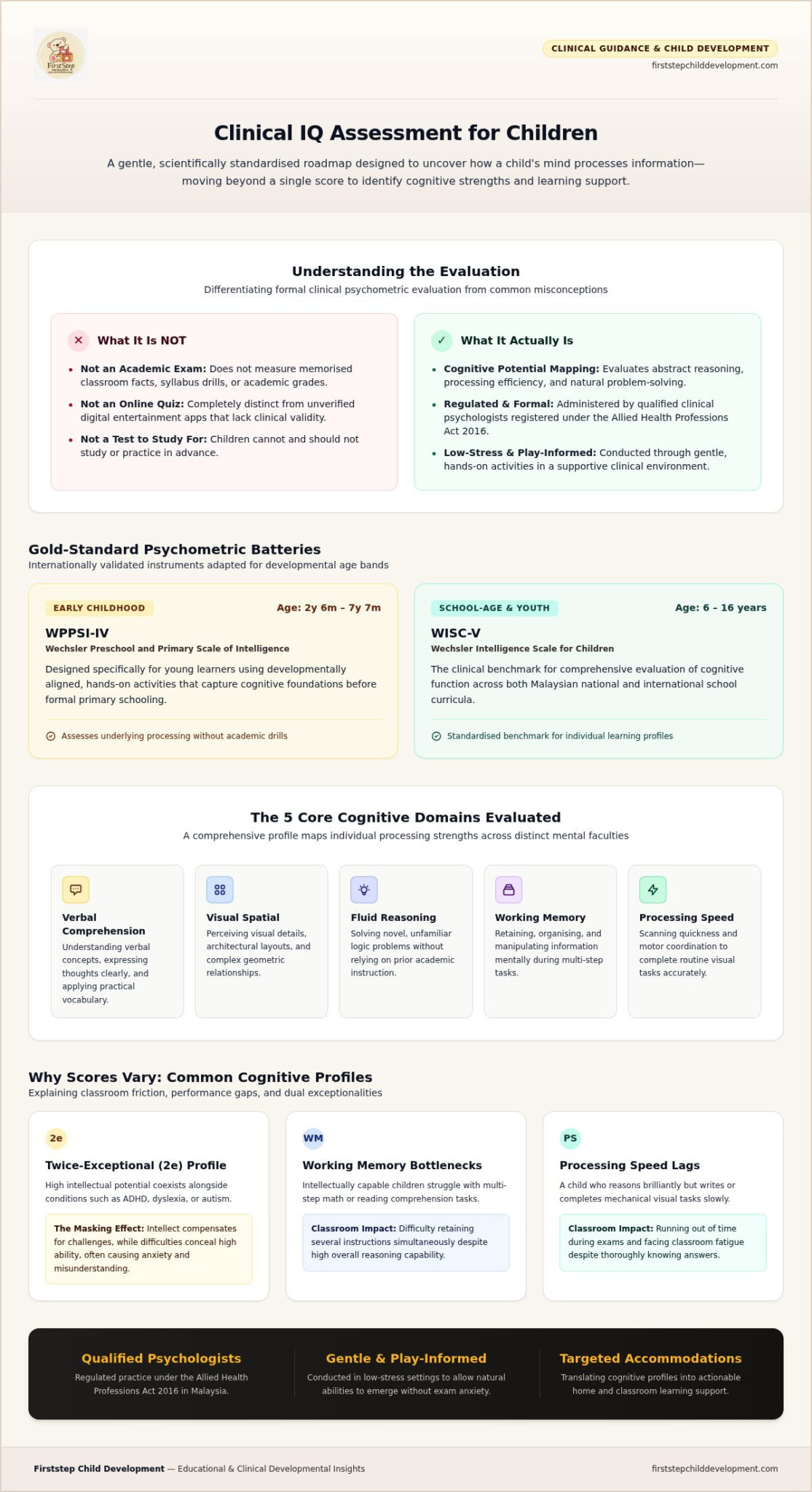
A clinical IQ assessment for children is not a school entrance exam, nor is it comparable to unverified digital quizzes found on entertainment apps. Instead, it is a formal, scientifically standardised psychological evaluation designed to measure cognitive potential, abstract reasoning, and problem-solving efficiency rather than memorised classroom facts. In Malaysia, authentic psychometric testing is administered by qualified clinical psychologists registered under the Allied Health Professions Act 2016, providing a safe, play-informed space where a child’s natural abilities can emerge without academic stress.
Gold-Standard Assessment Batteries: WISC-V and WPPSI-IV
Psychologists use internationally validated psychometric instruments that reflect developmental norms across both national and international schooling environments. For young learners aged 2 years 6 months to 7 years 7 months, specialists administer the Wechsler Preschool and Primary Scale of Intelligence (WPPSI-IV). For older youth aged 6 to 16, the Wechsler Intelligence Scale for Children (WISC) serves as the clinical benchmark. Because these batteries assess underlying processing rather than taught academic drills, children cannot and should not study for them in advance.
The Core Cognitive Domains Evaluated
Rather than reducing a learner to an isolated score, a comprehensive IQ assessment for children maps five foundational cognitive domains:
- Verbal Comprehension: The ability to understand verbal concepts, express thoughts clearly, and apply practical vocabulary.
- Visual Spatial: Evaluating how well a child perceives visual details, architectural layouts, and geometric relationships.
- Fluid Reasoning: The capacity to solve novel, unfamiliar logic problems without relying on prior academic instruction.
- Working Memory: Mental workspace required to retain, organise, and manipulate information during multi-step tasks.
- Processing Speed: The scanning quickness and motor coordination required to complete routine visual tasks accurately under gentle time limits.
When Should Parents Consider an IQ Assessment?
Parents often seek answers when an obvious gap emerges between their child’s intellectual curiosity and their day-to-day school results. You might see your child grasp advanced conversational topics at dinner, yet struggle to finish basic worksheets in class. Initiating a timely IQ assessment for children clarifies whether these hurdles stem from processing differences, attention bottlenecks, or learning barriers. Guided by the American Psychological Association’s guidance on psychological testing, psychologists evaluate behavioural and cognitive patterns together, ensuring your child receives purposeful support before chronic school frustration settles in.
Identifying Giftedness and Twice-Exceptional Profiles
A child with high intellectual potential may show intense curiosity, sophisticated humour, or rapid reasoning, but can quickly become disengaged when classroom work feels unstimulating. In some instances, intellectual giftedness coexists alongside ADHD, dyslexia, or autism. Known clinically as a twice-exceptional (2e) profile, these co-occurring traits often mask each other. The child’s intellect compensates for their challenge, while their challenge conceals their high ability, leaving them anxious and misunderstood without targeted intervention.
Investigating Learning Obstacles and Cognitive Discrepancies
Pronounced differences between individual cognitive skills frequently explain classroom fatigue:
- Working Memory Bottlenecks: Bright children may struggle with multi-step math problems or reading comprehension because they cannot retain several pieces of instruction simultaneously.
- Processing Speed Lags: A child who reasons brilliantly might write very slowly, running out of time during exams despite knowing the answers thoroughly.
Recognising these specific roadblocks allows psychologists to determine whether your child would benefit from a targeted learning difficulties assessment. If you notice persistent academic friction at home or in class, exploring professional developmental options through Firststep Child Development can provide much-needed clarity for your family.
The Step-by-Step Cognitive Assessment Journey
Understanding what happens during an evaluation helps ease parental worry. As detailed in Yale Medicine’s clinical overview of child psychological assessments, clinical testing follows a supportive, structured sequence designed to understand how your child approaches learning:
- Developmental Intake: A parent consultation exploring developmental milestones, medical background, and school feedback.
- Direct Evaluation: A one-on-one session using interactive, hands-on tasks and engaging materials.
- Behavioural Observation: Continuous clinical monitoring of focus, problem-solving methods, and frustration tolerance.
- Feedback Consultation: A dedicated parent session translating diagnostic findings into practical school and home accommodations.
Preparing Your Child Without Inducing Stress
Frame the appointment gently as a morning of brain games, puzzles, and interactive activities. Never drill practice questions or use test preparation sheets beforehand. Coaching artificially distorts standardised norms and elevates unnecessary test anxiety. Instead, ensure your child gets a restful night of sleep, a wholesome meal, and plenty of reassuring encouragement before arriving.
Clinical Observation Beyond Raw Numbers
Standardised scores only tell part of the developmental story. Throughout an IQ assessment for children, a psychologist observes how a learner manages rising complexity. Does your child use calm verbal self-talk to organise their thoughts, or do they depend on visual trial and error? Do they rush through items impulsively, or withdraw when a puzzle feels difficult? These qualitative nuances reveal executive functioning patterns that raw test marks miss entirely. To explore the next steps for your family, learn more about how assessments work at Firststep Child Development.
Interpreting Results: Turning Cognitive Profiles into Support
Psychometric evaluation reports present findings along a standard bell curve, where a score of 100 represents the population average. Percentile ranks illustrate how your child performs relative to same-age peers, highlighting both innate gifts and areas needing gentler scaffolding. Looking solely at a composite score can be misleading. An uneven cognitive profile, where verbal reasoning significantly outpaces processing speed, offers far richer clinical insight than an arbitrary single figure. It turns raw statistics into an actionable understanding of how your child experiences their learning environment.
Understanding Index Scores Versus Full Scale IQ
When an IQ assessment for children reveals major discrepancies between separate domain indexes, the overall Full Scale IQ often loses statistical reliability. For instance, a child with brilliant abstract thinking might show an average overall score simply because working memory or fine-motor speed lags behind. Psychologists interpret these domain variations to identify underlying processing bottlenecks. This detailed analysis ensures schools don’t misinterpret a specific cognitive vulnerability as a lack of effort or capability.
Collaborating with Schools and Child Specialists
Sharing your comprehensive psychological report with educators transforms diagnostic numbers into actionable classroom support. In Malaysia, formal cognitive profiles help teachers implement practical exam accommodations, adjust seating arrangements, or structure individualised education plans. These findings also clarify whether your child would flourish with multidisciplinary care, such as pediatric occupational therapy for motor coordination or speech therapy for communication. The clinical team at Firststep Child Development works closely alongside parents and schools to bridge clinical insight with daily academic success.
Taking the Next Step in Your Child’s Learning Journey
Every child learns and processes the world in their own unique way. Seeking a formal evaluation isn’t about placing limits on their future; it’s about replacing uncertainty with clinical clarity. By discovering your child’s specific cognitive strengths and processing bottlenecks early, you can advocate effectively for tailored school accommodations and lift the weight of classroom frustration.
Our multidisciplinary child development team in Petaling Jaya and Kuala Lumpur is here to guide your family with warmth and expertise. Standardised evaluations are administered by registered clinical psychologists who translate psychometric data into comprehensive, parent-friendly feedback reports built for both local and international school settings. Discover how a gentle IQ assessment for children at Firststep Child Development can provide the roadmap your child needs to flourish with confidence.
Frequently Asked Questions
Can a child study or prepare for an IQ assessment?
No, a child cannot and shouldn’t study for an IQ assessment. These psychometric tools evaluate underlying problem-solving ability, memory, and cognitive potential rather than memorised school curriculum. Attempting to drill practice questions invalidates the test results and creates unnecessary pressure. The most helpful preparation involves ensuring your child gets plenty of restful sleep, enjoys a nutritious breakfast, and arrives feeling relaxed, viewing the session simply as an engaging puzzle day.
At what age can a child reliably take an IQ assessment?
Standardised testing can reliably begin from age two years and six months using early childhood batteries like the WPPSI-IV. However, clinical psychologists often recommend an IQ assessment for children around ages six to eight, when academic and attentional demands increase. Evaluations conducted at school age provide strong stability over time, offering dependable guidance for primary school placement and academic accommodations across schools in Kuala Lumpur and Selangor.
What is the difference between an IQ assessment and an educational achievement test?
An IQ assessment measures a child’s innate cognitive capacity, logical reasoning, and information-processing efficiency. In contrast, an educational achievement test evaluates acquired academic knowledge, assessing specific proficiency in subjects such as reading, spelling, and mathematics. Psychologists often compare both results to identify significant discrepancies. When a child’s high cognitive ability is accompanied by low academic performance, it often signals an underlying learning difference that requires targeted intervention.
Will an IQ score stay the same as my child grows older?
General intellectual potential remains relatively stable throughout life when compared against same-age peers, but individual scores can fluctuate during childhood. A child’s brain develops rapidly, meaning changes in emotional well-being, attentional maturity, and health can influence performance. Receiving targeted developmental support or therapy can also strengthen processing efficiency, helping a child demonstrate their true capabilities more consistently as they grow older.
How do schools in Malaysia use clinical cognitive assessment reports?
Schools across Malaysia use clinical reports to design Individualised Education Plans and establish practical learning accommodations. For children facing attentional or processing hurdles, these formal evaluations provide the official evidence needed to secure exam arrangements, such as extra time, quiet exam rooms, or reader assistance. International schools and the Malaysian Examinations Syndicate rely directly on these psychometric profiles to support fair, stress-free academic participation.

Article by
Firststep Child Development Team
Firststep Child Development Team provides evidence-informed educational resources to help parents better understand child development, behaviour and learning. Our multidisciplinary services include clinical psychology, occupational therapy, speech and language therapy, developmental assessments and other child development support in Kuala Lumpur and Selangor.
Disclaimer
This article is for general educational and informational purposes only and is not a substitute for professional medical, psychological or therapeutic advice, diagnosis or treatment. Every child develops differently. If you have concerns about your child's development, behaviour, learning or wellbeing, please consult an appropriately qualified healthcare or allied health professional.