



A child’s communication support doesn’t begin and end in a therapy room. To start speech language therapy for kids in Malaysia, raise your concerns with a speech-language therapist, arrange an assessment and use agreed strategies in everyday routines. Speech-language therapists in Malaysia must be registered under the Allied Health Profession Act 774.
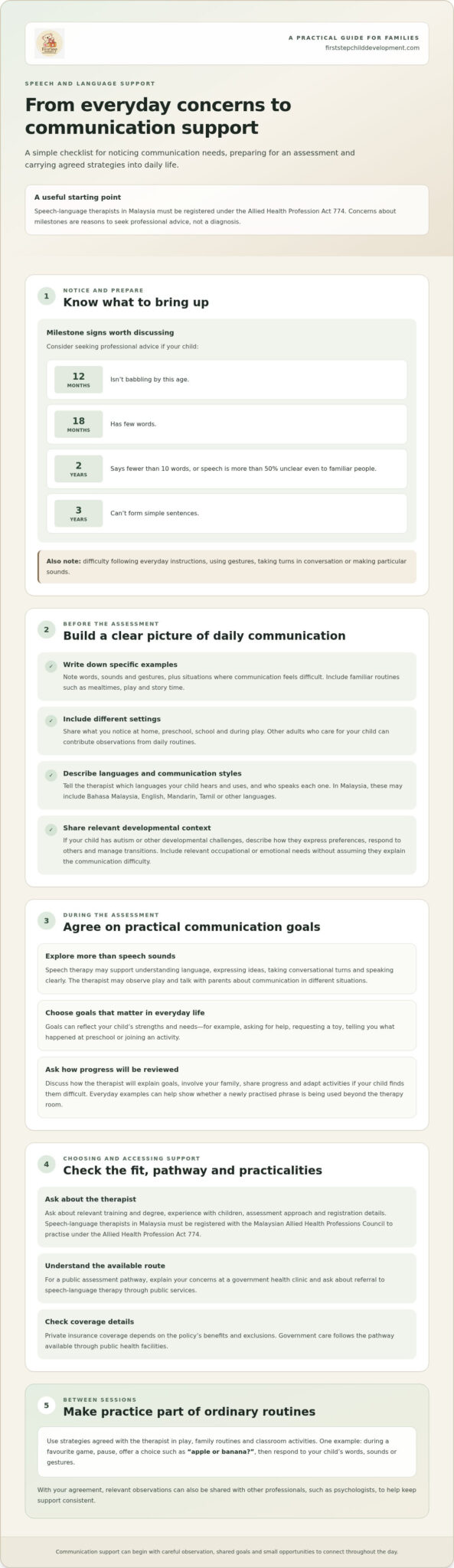
It’s understandable to wonder whether a child will simply start talking in their own time. Seek professional advice if your child isn’t babbling by 12 months, has few words by 18 months or can’t form simple sentences by 3 years of age. These signs are reasons to discuss your concerns, not a diagnosis.
This guide explains what speech therapy involves and how to take practical steps, from preparing for an assessment to supporting communication at home, preschool and school. You’ll also learn how to consider the languages your child hears and uses, so support connects with everyday life.
Key Takeaways
- Start by noting the communication skills your child uses in everyday situations, then share your observations during a professional assessment.
- Speech therapy can support communication in children with autism and other developmental challenges, with goals shaped around each child’s needs.
- Tell the therapist which languages your child hears and uses so strategies can fit family life and the child’s learning environments.
- Build communication practice into play, routines and classroom activities, and ask for guidance when you need help planning next steps.
Does the window of opportunity to develop speech and language close after a certain age?
- A particular birthday doesn’t determine whether communication support can help. Seek professional advice if a child isn’t babbling by 12 months, has few words by 18 months, or can’t form simple sentences by 3 years of age. At age 2, saying fewer than 10 words or having speech that’s more than 50% unclear, even to familiar people, may also merit discussion.
Note specific examples, such as difficulty following everyday instructions, using gestures, taking turns in conversation or making particular sounds. These observations help an assessment explore whether your child needs support with understanding, expressing ideas, speech sounds or social communication.
- Describe what you notice in familiar settings, including home, preschool and play. If your child has autism or other developmental challenges, share how they communicate preferences, respond to others and manage transitions. Therapy goals can then focus on practical communication, such as asking for help or joining an activity. Occupational or emotional needs may also affect participation, so include relevant observations without assuming they explain the communication difficulty.
- In Malaysia, speech-language therapists must be registered with the Malaysian Allied Health Professions Council to practise under the Allied Health Profession Act 774. Ask about the therapist’s relevant degree and registration details; as of July 2024, the Council was still working on registration and had no public portal for checking a therapist’s registration.
- For a public assessment pathway, explain your concerns at a government health clinic and ask about referral to speech-language therapy through public services. Private insurance coverage depends on policy benefits and exclusions; government care follows the pathway available through public health facilities.
To prepare, write down examples of words, gestures and situations where communication is difficult. A speech therapy assessment can help clarify a child’s needs and suitable next steps, including play-based speech practice. Adults who care for the child can share observations from daily routines.
What is Speech Therapy?
- Identify the communication skills you want to support. Speech therapy involves more than practising sounds: it can address understanding language, expressing ideas, taking conversational turns and speaking clearly. For example, your child might practise asking for a toy or telling you what happened at preschool.
- Bring concrete examples to the assessment. Note what your child says, understands or communicates through gestures during familiar routines. Describe what happens at mealtimes, during play or at story time, and raise any questions about participation with the therapist.
- Use the assessment to agree on practical goals. A therapist may observe play, talk with parents and explore how a child communicates in different situations. The findings help shape sessions around your child’s strengths and needs. For families seeking speech and language therapy for children in Malaysia, an assessment can clarify which skills to focus on first.
- Ask how you can support practice between sessions. A therapist might show you how to pause during a favourite game, offer a choice such as “apple or banana?”, then respond to your child’s words, sounds or gestures. Everyday routines offer small opportunities to practise communication goals.
- Compare therapists by their relevant training, experience with children, assessment approach and willingness to explain goals clearly. Ask how they involve families, share progress and adapt activities when a child finds them difficult. Choose a service that communicates respectfully and makes the plan easy to understand.
- Expect the first sessions to build rapport and gather useful information, often through play and conversation. The therapist can explain observations, discuss suitable goals and invite your input. Review progress through everyday examples, such as whether your child uses a newly practised phrase outside the therapy room.
- Coordinate support when your child has wider developmental needs. With your agreement, therapists can share relevant observations with other professionals, such as psychologists, to keep support consistent. For a child receiving speech and language therapy in Malaysia, clear communication between family and professionals helps keep goals relevant to everyday needs.
Therapy language and multilingual development
In Malaysia, a child may hear Bahasa Malaysia, English, Mandarin, Tamil or other languages at home, in childcare and at school. Share this language picture with the therapist before agreeing on goals.
-
Monitor Speech Development Milestones
Keep brief notes on communication in everyday situations, such as asking for food, following a familiar instruction, or joining play. Record the language used and the setting, then share examples with the therapist. Look for changes over time, not comparison with siblings or classmates. Early intervention is ideally begun between 16 months and 3 years of age.
- Discuss developmental concerns early rather than waiting for your child to use a particular language perfectly. A therapist can consider how your child understands and communicates across routines, relationships and learning environments. For children with developmental delays, tailored goals can support meaningful participation, such as requesting help at childcare or taking a turn during a family game. Share relevant advice with educators involved in your child’s day.
-
Consider Multilingual Language Development
List the languages your child hears, who speaks each one and where conversations happen. Explain which languages your child understands and uses, even if they mix words from different languages. Avoid dropping a family language just to simplify therapy. Everyday conversations with trusted relatives support relationships, while this information helps the therapist make intervention relevant to your child’s communication needs.
- Agree on a therapy language and home approach with the therapist, based on your child’s communication profile and family routines. For example, you might use the language you speak most naturally during meals, while educators reinforce a shared goal at preschool. Review whether your child can communicate needs in meaningful situations, rather than judging progress by vocabulary in just one language.
Speech and language activities at preschool, school, and home
Use familiar routines to give your child meaningful chances to communicate. Coordinate simple strategies across home, preschool and school, then share your observations with the clinical team.
- Choose one everyday activity and create opportunities for communication. During snack time, pause before handing over a preferred item, then wait for your child to request it using a word, sound, gesture or picture. Respond to their attempt and model a short phrase, such as “more banana”. Keep the exchange enjoyable rather than turning it into a test.
- Build language into play and shared reading at home. Name what your child is doing with toy animals, add a word or two to their phrase, and take turns making the animals move. While reading a picture book, comment on one detail and give your child time to point, vocalise or answer.
- Ask preschool or school staff to use the same communication cue during a familiar activity. For example, if your child is practising asking for help, agree on a simple prompt for classroom tasks and playground play. Share what works, such as offering a choice or showing a picture, to keep support consistent throughout your child’s day.
- Keep brief notes about the activity, your child’s response and any difficulties. Record whether your child initiated communication, followed a direction or needed extra support. Share these examples with the paediatric therapist, especially if hearing concerns affect responses to voices or instructions. This information helps the team adapt activities to your child’s needs.
- At home, follow your child’s interests, speak clearly and give them time to respond. Short, warm exchanges during dressing, meals or play can make practice part of family life. If an activity causes frustration, simplify it by offering one choice or using a familiar object, then try again during a calmer routine.
Firststep Psychology & Child Development Centre: Clinical Psychologist Consultation
Firststep Psychology & Child Development Centre offers Clinical Psychologist Consultation for parents who want to understand wider concerns affecting their child’s development and wellbeing. A consultation can explore how communication difficulties relate to learning, behaviour or emotional needs, and clarify appropriate next steps. It complements, rather than replaces, a speech-language assessment.
If autism, ADHD or learning difficulties are also concerns, an Autism Assessment, ADHD Assessment or Learning Difficulties Assessment can help build a clearer picture of your child’s needs. Bring examples from home or school to explain what you have noticed and what support would be useful.
If you’d like to discuss your child’s developmental needs, you’re welcome to visit the Clinical Psychologist Consultation page or explore Firststep’s website.
Take the next step with confidence
Choosing speech language therapy for kids in Malaysia can start a clearer, more supported communication journey. Keep noticing what helps your child participate, connect and express needs, then use those observations to guide conversations with professionals. A practical next step is to identify the questions that matter most to your family, such as how communication challenges affect learning or daily routines.
When concerns involve wider development, Firststep Psychology & Child Development Centre offers Clinical Psychologist Consultation, ADHD Assessment and Autism Assessment. These services help families explore related developmental questions alongside communication support.
If you’re ready to discuss your child’s needs, contact Firststep Psychology & Child Development Centre. Each thoughtful step can help you build a more supportive path forward for your child.
Frequently Asked Questions
Can My Child Only Learn One Language?
No. A child can learn and use more than one language; families do not need to restrict everyday communication to one. Notice how your child communicates with different people, such as using one language with grandparents and another at preschool. Share these examples with the therapist, including mixed-language phrases, so your child’s communication is understood in context.
How Long Will Therapy Last?
Therapy duration is guided by your child’s communication goals and reviewed as skills develop. A plan may focus on one practical target, such as asking for help, before moving to another. Discuss how progress will be reviewed and what shows that a skill is becoming useful beyond sessions, such as using it during play or classroom activities.
What Language is Therapy Conducted In?
Discuss the language used during sessions with the therapist in light of your child’s communication needs and family context. Before the first session, list the languages your child understands and uses, and who speaks them. This helps the therapist choose meaningful activities and explain how you can support communication between appointments.
What does speech and language therapy for children in Malaysia treat?
Speech and language therapy supports children with communication needs, including difficulty understanding or expressing ideas, unclear speech sounds or challenges taking part in conversations. For example, a child may know what they want but struggle to tell a teacher. An assessment identifies which communication skills need attention and helps set goals for everyday situations.
How can parents tell if a child in Malaysia needs speech therapy?
Consider an assessment if communication difficulties affect your child’s daily routines, play or ability to make their needs understood. For example, notice whether your child often becomes upset when trying to communicate or avoids joining conversations. Write down what happens, where it occurs and what helps; these details give a therapist useful context.
Where can I find paediatric speech-language therapists in Malaysia?
Families in Kuala Lumpur and Selangor can access Speech Therapy at Firststep Psychology & Child Development Centre. Explore its speech therapy service for information about support for children. When considering a therapist, look for relevant training and ask how they will explain assessment findings and therapy goals in language your family can understand.

Article by
Firststep Child Development Team
Firststep Child Development Team provides evidence-informed educational resources to help parents better understand child development, behaviour and learning. Our multidisciplinary services include clinical psychology, occupational therapy, speech and language therapy, developmental assessments and other child development support in Kuala Lumpur and Selangor.
Disclaimer
This article is for general educational and informational purposes only and is not a substitute for professional medical, psychological or therapeutic advice, diagnosis or treatment. Every child develops differently. If you have concerns about your child's development, behaviour, learning or wellbeing, please consult an appropriately qualified healthcare or allied health professional.