



Watching your child at a playground in Selangor, you might notice they hesitate to climb the frame while their peers move with ease. It’s a quiet, heavy worry that many parents carry, wondering if their little one is simply taking their time or if there’s a deeper hurdle in their development. You’re certainly not alone in these observations. It’s natural to feel anxious when milestones like jumping or balancing seem out of reach. This is where gross motor delay occupational therapy can make a significant difference in your child’s confidence.
Most parents agree that seeing their child struggle to keep up with friends is heartbreaking. This guide explains how paediatric occupational therapy identifies and supports gross motor delays to help your child move with independence. We’ll explore the specific signs to watch for, the functional benefits of play-based intervention, and how to find trusted clinical support in KL and Selangor. By the end, you’ll have a clear roadmap to help your child navigate their physical journey with joy.
Key Takeaways
- Identify the physical signs of gross motor delay, such as frequent falls or difficulty with stairs, to better understand your child’s developmental needs.
- Understand how gross motor delay occupational therapy focuses on functional independence in daily tasks like dressing, playing, and navigating the classroom.
- Discover what to expect during a play-based paediatric assessment and how professional support makes therapy feel like an engaging, positive experience.
- Learn how a multidisciplinary team approach in Malaysia can help your child meet the physical demands of primary school with confidence.
Gross Motor Delay and Occupational Therapy: Signs to Watch For
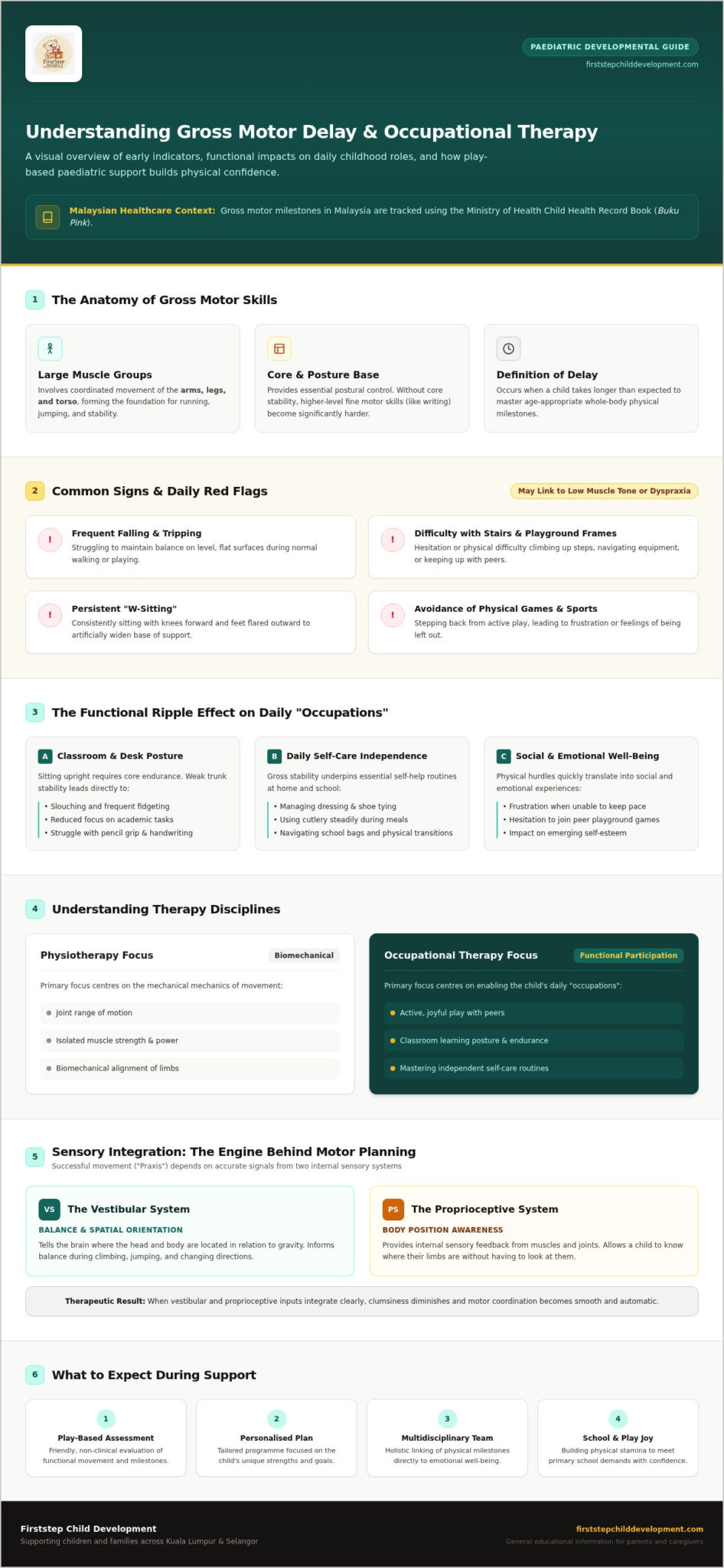
Gross motor delay occurs when a child takes longer than expected to master movements involving the body’s large muscle groups. This includes the arms, legs, and torso. These gross motor skills form the basis of every physical activity, from sitting upright at a desk to running in a park. In Malaysia, healthcare providers monitor these stages using the Ministry of Health’s Child Health Record Book, commonly known as the “Buku Pink.” When a child struggles to keep up, they don’t just face physical hurdles. They often feel left out during play, which can lead to frustration. Understanding the role of gross motor delay occupational therapy helps parents navigate these early years with confidence.
Common Signs to Watch For
Identifying a delay early allows for more effective support. You might notice specific red flags in your child’s daily movement:
- Frequent falling or tripping on flat surfaces.
- Difficulty navigating stairs or climbing playground equipment.
- Persistent “W-sitting,” where a child sits with their knees forward and feet flared out.
- General avoidance of physical games or sports.
These challenges are sometimes linked to conditions like low muscle tone or dyspraxia. Recognising these signs early helps clarify whether a child needs extra encouragement or professional intervention.
Why Early Identification Matters
Gross motor skills act as the foundation for a child’s entire physical development. Without a stable core and strong posture, fine motor tasks like writing or using cutlery become much more difficult. If you’ve noticed your child’s movement differs from their peers, trust your intuition. Choosing gross motor delay occupational therapy isn’t about finding “faults.” Instead, it’s about providing a compassionate path toward independence. Early support ensures your child has the strength to participate fully in school and play, building their self-esteem alongside their physical abilities.
How Occupational Therapy Supports Gross Motor Development
Many parents wonder how occupational therapy differs from physical therapy. While a physiotherapist often focuses on the biomechanical aspects of movement, such as joint range or muscle strength, gross motor delay occupational therapy prioritises functional participation. For a child, their “occupations” include playing with friends, learning in a classroom, and mastering self-care. We look at how physical challenges impact these daily roles. By consulting a developmental milestones record, our therapists can identify exactly where a child might need support to engage more fully with the world around them.
The Functional Approach to Movement
Occupational therapists focus on how muscles work together to complete a task. Consider the simple act of sitting at a desk. It requires significant core strength and postural control. If a child lacks this gross motor foundation, they’ll likely slouch or fidget, making it nearly impossible to focus on fine motor tasks like writing or drawing. We help children build the stability needed to navigate their school and playground environments with ease. If you’re concerned about your child’s physical progress, a paediatric occupational therapy assessment can provide a clear roadmap for support.
Sensory Integration and Motor Skills
Successful movement depends on motor planning, or “praxis.” This relies on two internal senses: the vestibular system (balance and spatial orientation) and the proprioceptive system (the body’s sense of its own position). When the brain doesn’t receive clear signals from these systems, a child may appear clumsy or uncoordinated. At Firststep, our multidisciplinary team links these physical milestones to emotional well-being. We understand that when a child moves with confidence, their self-esteem grows. This holistic approach ensures that therapy supports not just the body, but the child’s overall happiness and social development.
What to Expect During Gross Motor Delay Occupational Therapy
Stepping into a therapy centre shouldn’t feel clinical or intimidating for you or your child. At Firststep, we’ve designed our environment to feel like a supportive, welcoming space. We understand the anxiety parents feel when navigating developmental support. That’s why every child in KL and Selangor receives a personalised plan that focuses on their specific strengths and potential. Our goal is to make gross motor delay occupational therapy a positive, transformative experience for the whole family.
The Assessment Process at Firststep
Our journey begins with a comprehensive evaluation. We gather your child’s developmental history and observe how they naturally move and interact within our centre. This helps us identify specific physical developmental delays that might be affecting their confidence. To understand the clinical steps we take, you can learn more about how does an assessments work at our facility. We combine standardised testing with gentle, play-based observations to get a complete picture of your child’s abilities.
Typical Therapy Activities
We use play-based interventions because children thrive when they’re engaged. Our sessions often include activities that feel like games but have clear therapeutic goals. For example, obstacle courses challenge motor planning and balance as children navigate different heights. Climbing equipment builds bilateral coordination, teaching both sides of the body to work together effectively. Therapeutic ball work is also common, as it strengthens the core muscles needed for stable posture and focus.
Progress relies on a strong partnership between our therapists and your family. We provide actionable advice for home routines to ensure consistent growth outside our sessions. This collaborative approach helps your child carry their new skills into their daily life. If you’d like to see how our team can support your child’s physical journey, learn more about our paediatric occupational therapy services today.
Supporting Your Child’s Physical Journey in Malaysia
In Malaysia, the transition to primary school brings unique physical demands. Children must navigate busy canteens, carry school bags, and maintain posture during school assemblies. These tasks require strong gross motor foundations. If a child struggles with these movements, they might feel exhausted or anxious about their school day. Seeking gross motor delay occupational therapy is a proactive step that ensures your child enters the classroom with the physical confidence they need to succeed.
Navigating Local Support in KL and Selangor
Choosing a centre that understands the local Malaysian environment is beneficial. Our therapists at Firststep are familiar with the physical expectations of both public and private schools in the Klang Valley. By offering pediatric occupational therapy alongside clinical psychologists and paediatricians in one location, we provide a holistic support system. This multidisciplinary approach ensures that your child’s physical, emotional, and cognitive needs are addressed together, saving you the stress of navigating multiple clinics.
Empowering Your Child at Home
You can support your child’s progress through simple, engaging activities at home. Local parks in KL and Selangor offer great opportunities for climbing and balancing. You can also try these activities in your own living space:
- “Animal walks,” such as hopping like a frog or crawling like a bear, to build core strength and coordination.
- Jumping onto soft cushions to improve balance and body awareness in a safe way.
- “Heavy work” tasks, like helping to carry light groceries, which provide helpful sensory feedback to the muscles.
Remember that every small step counts. While progress takes time, professional guidance ensures you’re on the right path. Seeking support isn’t about highlighting a struggle; it’s about unlocking your child’s full potential for a bright, independent future. Our team is here to walk alongside you, providing the clarity and expertise your family needs to move forward with confidence.
Empowering Your Child’s Physical Potential
Supporting your child’s movement is about more than just physical strength; it’s about giving them the confidence to engage with the world. We’ve discussed how identifying early signs of delay and understanding the functional focus of gross motor delay occupational therapy can transform a child’s daily experience. Our multidisciplinary team of experts at Firststep provides a compassionate, child-centred environment designed to lower anxiety and provide clear paths forward. Conveniently located in KL and Selangor, our centre serves as a safe haven for families seeking reliable developmental support.
If you’re concerned about your child’s physical development, learn more about our paediatric occupational therapy or contact Firststep Child Development today for a professional consultation. Every child develops at their own pace, but professional guidance ensures they have the right foundation to reach their full potential. You don’t have to navigate these concerns alone; we’re here to be your trusted partner in your child’s developmental journey.
Frequently Asked Questions
Is gross motor delay the same as a physical disability?
A gross motor delay isn’t necessarily the same as a physical disability. A delay indicates that a child is taking longer to reach specific physical milestones compared to their peers. While some disabilities can cause motor delays, many children simply need targeted support to catch up. Our therapists in KL and Selangor focus on identifying the root cause and providing a clear path toward independence through personalised intervention.
How many occupational therapy sessions will my child need?
The number of sessions required for gross motor delay occupational therapy varies for every child. We don’t believe in one-size-fits-all solutions. After a comprehensive assessment at our centre, we’ll recommend a plan based on your child’s specific goals and progress. Some children benefit from short-term support to master a specific skill, while others thrive with more consistent, long-term guidance to build their confidence and physical strength.
Can gross motor delay affect my child’s performance in school?
Gross motor skills are foundational for school success in Malaysia. If a child struggles with core stability, they often find it difficult to sit upright at a desk, which leads to poor concentration and fatigue. Difficulties with running or climbing can also make them feel excluded during recess. Addressing these delays early ensures they can participate fully in both classroom learning and playground activities with their friends in Selangor.
What is the difference between an OT and a PT for gross motor skills?
While both professionals support movement, their focus differs. A physical therapist (PT) typically addresses the biomechanical aspects of movement, such as muscle strength and joint range of motion. A paediatric occupational therapist (OT) focuses on how these movements allow a child to perform their daily “occupations,” like playing, dressing, and learning. OTs look at the whole child, including how sensory processing and motor planning impact their functional independence.
Do I need a referral to see an occupational therapist in Malaysia?
You don’t need a formal medical referral to visit a private child development centre in Malaysia. Parents in KL and Selangor can contact Firststep directly to book a consultation or assessment. However, if you’re seeking support through the public healthcare system, you’ll typically need a referral letter from a Klinik Kesihatan or a general practitioner to access paediatric services at a government hospital, which often involves longer waiting times.

Article by
Firststep Child Development Team
Firststep Child Development Team provides evidence-informed educational resources to help parents better understand child development, behaviour and learning. Our multidisciplinary services include clinical psychology, occupational therapy, speech and language therapy, developmental assessments and other child development support in Kuala Lumpur and Selangor.
Disclaimer
This article is for general educational and informational purposes only and is not a substitute for professional medical, psychological or therapeutic advice, diagnosis or treatment. Every child develops differently. If you have concerns about your child's development, behaviour, learning or wellbeing, please consult an appropriately qualified healthcare or allied health professional.