



You’re at the park in Kuala Lumpur, watching other children climb the jungle gym with ease, while your own little one hesitates or trips frequently. It’s a quiet worry many parents carry, wondering if these stumbles are just a phase. If you’ve been searching for answers about gross motor delay occupational therapy, you’re likely looking for ways to ensure your child doesn’t get left behind. This therapy provides the functional coordination needed for daily tasks, bridging the gap between physical potential and school readiness.
It’s natural to feel anxious when your child’s physical development doesn’t follow the expected path. You want them to feel confident, yet the difference between various therapies can feel overwhelming. This guide replaces that uncertainty with clarity, helping you understand how specialised support transforms your child’s physical independence and participation in daily life.
We’ll explore red flags of gross motor delays, clarify how occupational therapy differs from other interventions, and provide a clear roadmap for families in Malaysia. By the end, you’ll have the actionable steps needed to choose the right path for your child’s unique journey.
Key Takeaways
- Understand that gross motor delays involve more than just reaching milestones, focusing instead on how your child uses their body for daily independence.
- Learn to recognise physical red flags, such as poor balance or persistent clumsiness, and when these signs warrant a professional assessment.
- Discover how gross motor delay occupational therapy differs from physical therapy by prioritising motor planning and sensory integration for functional tasks.
- Gain confidence in navigating early intervention options in Malaysia to support your child’s school readiness and physical development.
Understanding Gross Motor Delay and the Role of Occupational Therapy
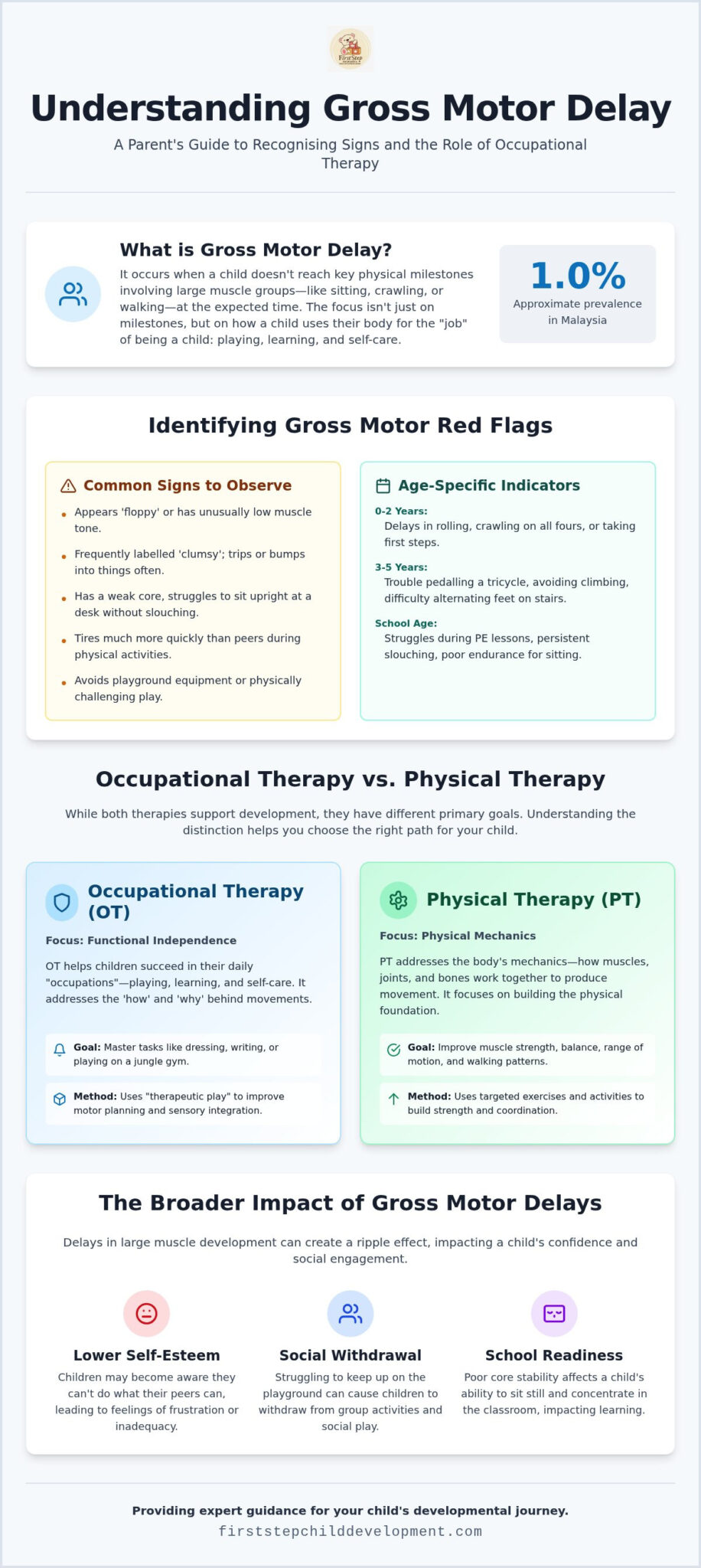
Gross motor delay occurs when a child doesn’t reach physical milestones at the expected time. This might look like a baby who isn’t sitting up by nine months or a toddler who hasn’t started crawling or walking. While every child develops at their own pace, consistent lags in large muscle movements like jumping or running can signal a need for support. In Malaysia, a 2026 study found the prevalence of gross motor delay to be approximately 1.0%, highlighting that while it’s not universal, it’s a significant concern for many families.
Unlike programmes that only focus on physical strength, gross motor delay occupational therapy looks at how these movements allow a child to participate in life. It’s about the “job” of being a child. Gross motor skills are the essential foundation for a child’s independence in both play and self-care. When these skills are delayed, children often face secondary challenges. They might experience low self-esteem or begin withdrawing from social groups because they can’t keep up with peers on the playground. In some cases, these delays are linked to conditions like Developmental Coordination Disorder (DCD), which affects motor planning and execution.
How OT Differs from Basic Physical Activity
Many parents wonder if a trip to the gym or extra time at the park is enough. While activity is great, pediatric occupational therapy uses “therapeutic play” to target specific neural pathways. It isn’t just exercise; it’s a structured approach to sensory-motor integration. An OT helps a child understand where their body is in space, which is vital for planning complex movements. This focus on sensory processing ensures that the child isn’t just moving, but moving with purpose and coordination.
Identifying Gross Motor Red Flags: A Checklist for Parents
Recognising the signs of a delay isn’t always about seeing a child miss a major milestone. Often, it’s about the quality of their movement. You might notice your child has a ‘floppy’ posture or seems to prefer leaning against walls rather than standing tall. Some children are frequently labelled as ‘clumsy’ because they trip or bump into things. While every child has stumbles, persistent clumsiness often indicates a deeper coordination delay that impacts their confidence and safety.
Stability at the core is essential for more than just running. It’s the secret to sitting still in a Malaysian classroom. If a child’s large muscles are weak, they’ll struggle to maintain their posture at a desk, leading to restlessness, fidgeting, and poor concentration. Trust your intuition if you notice your child tires much faster than their peers during a family outing or at the playground. These subtle signs often suggest that gross motor delay occupational therapy could provide the necessary support to build their endurance.
Age-Specific Signs to Watch For
Developmental needs change as your child grows. In the urban environment of Kuala Lumpur and Selangor, where high-rise living and structured preschools are common, these signs often manifest in specific daily routines:
- 0-2 years: Look for delays in fundamental movements like rolling over, crawling on all fours, or taking those first independent steps.
- 3-5 years: Notice if your child avoids playground equipment or has trouble pedalling a tricycle at local KL parks. Difficulty alternating feet when climbing stairs is another key indicator.
- School age: Watch for struggles during PE lessons or a persistent inability to sit upright without slouching over a workbook.
If these red flags feel familiar, a professional pediatric occupational therapy assessment can help determine if your child needs a helping hand to build their physical confidence and school readiness. Early identification allows us to address these challenges before they impact your child’s social and academic life.
Occupational Therapy vs. Physical Therapy: Which Does Your Child Need?
Parents often feel confused when deciding between Physical Therapy (PT) and Occupational Therapy (OT). While they share some common ground, their core focus differs. PT typically addresses the physical mechanics of movement, such as muscle strength, joint range of motion, and walking patterns. In contrast, gross motor delay occupational therapy prioritises ‘praxis,’ or motor planning. This is the brain’s ability to conceive, organise, and carry out a sequence of unfamiliar physical actions.
Occupational therapists look at the whole child, considering how sensory-motor integration allows them to interact with their environment. If a child has the raw strength to climb but doesn’t know how to coordinate their limbs to do so safely, an OT bridges that gap. Many families in Selangor find that learning how a developmental assessment works is the most effective first step to determine which therapy, or combination of services, will best support their child’s unique needs.
When Your Child Needs an OT’s Specialized Focus
Choose an occupational therapist when movement challenges are intertwined with sensory sensitivities or persistent clumsiness. OT is the primary choice if your goals are functional, such as improving your child’s ability to participate in school activities, manage dressing themselves, or engage in complex play with peers. This approach ensures that physical gains translate directly into better performance in the classroom and at home.
There is also a powerful synergy between OT and speech therapy. Motor planning issues often affect both large body movements and the fine coordination required for speech production. Addressing these together often leads to more robust global development. If you are ready to explore how these services can help your child thrive, we invite you to learn more about our pediatric occupational therapy sessions, which are designed to support every aspect of your child’s functional growth.
The Path Forward: Early Intervention and Therapeutic Strategies
Early childhood provides a unique window where the brain is most receptive to change. This neuroplasticity means that starting gross motor delay occupational therapy during these formative years can significantly shift a child’s developmental path. At Firststep Psychology & Child Development Centre, we don’t believe in rigid or repetitive drills that might overwhelm a young learner. Instead, we use play-based therapy to ensure that building strength and coordination feels like a game. By turning therapeutic goals into engaging activities, we keep children motivated to explore their physical potential without fear of failure.
Every child brings a unique set of abilities to their sessions. This is why our therapy plans are personalised to address specific gaps in motor planning or sensory processing. Reaching this level of clarity begins with a professional child developmental assessment. This evaluation provides the essential roadmap for all future progress, ensuring every intervention is purposeful and grounded in your child’s actual needs.
What to Expect During a Session at Firststep Psychology & Child Development Centre
Our sessions take place in a gentle, professional environment designed to be a safe haven for families in Kuala Lumpur and Selangor. We utilise specialised equipment such as therapeutic swings, sensory tunnels, and balance beams to challenge a child’s spatial awareness in a controlled way. These tools help children experience success in movement, which builds the confidence they need to try more difficult tasks at school or on the playground.
Progress isn’t limited to our clinic walls. We place high importance on parental feedback and provide home programmes to reinforce new skills in a familiar setting. This collaborative approach ensures that the gains made during a session carry over into daily life. If you’re ready to take the next step, our team is here to support you through our pediatric occupational therapy services.
Empowering Your Child’s Physical Journey
Recognising that physical development is about more than just reaching milestones allows you to focus on your child’s functional independence. By identifying red flags early and choosing gross motor delay occupational therapy, you provide the tools needed to navigate school and play with confidence. This specialised support transforms physical stumbles into purposeful coordination through the lens of sensory integration and motor planning, ensuring your child doesn’t feel left behind by their peers.
At Firststep Psychology & Child Development Centre, our multidisciplinary team in KL and Selangor is dedicated to a play-based, child-centered approach. We create personalised intervention plans that respect your child’s pace while nurturing their potential. You don’t have to navigate these developmental concerns alone; professional clarity is just a step away. We invite you to learn more about our Pediatric Occupational Therapy services or book a consultation at Firststep Psychology & Child Development Centre. Your child has incredible potential, and with the right support, they can reach every goal with a smile.
Frequently Asked Questions
How do I know if my child’s clumsy movements are just a phase or a gross motor delay?
Distinguish between occasional trips and persistent coordination issues. If stumbles occur daily or your child avoids physical play altogether, it may indicate a delay. A professional assessment helps determine if these movements are part of a developmental lag or simply a stage. Early detection ensures your child builds the necessary foundation for school readiness and social confidence.
Can occupational therapy help with gross motor delay if my child also has ADHD or Autism?
Yes, gross motor delay occupational therapy is highly effective for neurodivergent children. Many children with ADHD or Autism face challenges with sensory regulation and motor planning. OTs adapt strategies to suit their unique learning styles, focusing on the sensory-motor integration needed for daily tasks. This multidisciplinary approach ensures that physical progress supports their overall behavioural and social development.
How long does it typically take to see progress in gross motor skills with OT?
While every child is different, parents usually notice functional improvements within three to six months of regular therapy. Consistency is the key to seeing lasting results. The speed of progress depends on the child’s specific needs and how often therapeutic activities are reinforced at home. Small victories, like improved balance or better posture, often appear first as the child gains confidence.
Is a referral from a pediatrician required to start occupational therapy in Malaysia?
You don’t need a formal referral to begin sessions at a private developmental centre in Malaysia. Parents can reach out directly to book an initial consultation or assessment. While some families choose to consult their pediatrician first, many find that starting with a specialist therapist provides the immediate, practical answers they need to support their child’s physical growth and daily independence.
What is the difference between gross motor skills and fine motor skills in therapy?
Gross motor skills involve large muscle groups used for walking and jumping, while fine motor skills focus on small muscles for tasks like writing. In therapy, these are often addressed together because core stability provides the essential base for hand-eye coordination. An OT ensures your child develops both sets of skills to handle the complex demands of school life.
Article by
Firststep Child Development Team
Firststep Child Development Team provides evidence-informed educational resources to help parents better understand child development, behaviour and learning. Our multidisciplinary services include clinical psychology, occupational therapy, speech and language therapy, developmental assessments and other child development support in Kuala Lumpur and Selangor.
Disclaimer
This article is for general educational and informational purposes only and is not a substitute for professional medical, psychological or therapeutic advice, diagnosis or treatment. Every child develops differently. If you have concerns about your child's development, behaviour, learning or wellbeing, please consult an appropriately qualified healthcare or allied health professional.