



Small hand movements shape far more than a child’s ability to draw. Fine motor skills are the coordinated movements of the hands and fingers used to grasp, pick up and handle objects, and a fine motor delay in children may make everyday tasks harder. At 4 months, babies may open their hands, bring their fingers to their mouth and swing at dangling toys, according to the Ministry of Health Malaysia.
If your child finds tasks such as holding a spoon, turning book pages or using crayons difficult, it’s understandable to wonder whether they’re developing as expected. Children build these skills at their own pace, so one missed milestone doesn’t tell the whole story. Patterns across everyday activities can offer more helpful clues.
This article explains how fine motor skills develop, what may contribute to delays and how therapy and practical activities can support participation at home and in daily routines. You’ll also learn when it may be helpful to seek an evaluation, so you can take a calm, informed next step.
Key Takeaways
- Fine motor skills help children use their hands and fingers for play and everyday tasks. Notice how your child manages activities across different settings.
- Challenges with grasping, utensils, drawing or buttons can offer useful clues. Look for ongoing patterns rather than judging development by one task alone.
- There can be different reasons for motor difficulties, so an assessment considers a child’s overall development and individual needs.
- Playful practice and practical adaptations can support daily participation. Seek professional advice if you’re concerned or notice a loss of previously acquired skills.
What are fine motor skills?
Fine motor skills are the small, controlled movements children use to handle objects with their hands and fingers. They support play and self-care, from picking up a snack to using a spoon or making marks with a crayon. These movements work alongside larger motor skills, such as sitting, reaching and moving an arm towards a toy.
Skills develop through practice and everyday exploration. At 4 months, babies may open their hands from a fist, bring their fingers to their mouth and swing at dangling toys, according to the Ministry of Health Malaysia. By 12 months, children may put objects into containers and use a thumb and finger to pick up small items.
Signs vary with age: from 0-6 months, difficulty grasping objects or hands staying clenched when an object is offered may be a concern; from 6-12 months, watch for difficulty transferring objects between hands. At 1-2 years, difficulty using a spoon or stacking blocks may stand out, while at 2-3 years, holding a crayon or other drawing tool may be challenging.
Milestones are guideposts, not a diagnosis. Fine motor development can be influenced by a child’s sensory abilities, nervous system, muscles and joints. Conditions such as cerebral palsy, Down syndrome or ADHD may be associated with differences in motor skills, but a particular difficulty alone does not identify its cause.
Dyspraxia is a term sometimes used for developmental coordination disorder, which can involve difficulty planning and coordinating movements. A child might understand how to build a tower but struggle to position the blocks steadily. An assessment considers how these challenges affect everyday tasks, rather than relying on one activity.
At home, offer safe, hands-on practice: let your child post large objects into a container, turn thick book pages, draw with crayons or play with blocks. Keep activities enjoyable and adjust the objects to suit their grip. For tailored support with daily tasks, paediatric occupational therapy can help build practical skills through meaningful activities.
Occupational therapy and adaptations for daily tasks
Occupational therapy can help children take part in daily routines by practising movements and adapting tasks. Support focuses on activities that matter in a child’s day.
Occupational Therapy for Fine Motor Delays
In occupational therapy, a therapist identifies which part of a task is difficult and chooses meaningful practice. A child might practise holding paper steady while drawing with the other hand. This supports coordination for schoolwork, play and self-care. Physical therapy generally addresses larger movements, posture or mobility, while occupational therapy connects movement with daily activities. When needs overlap, professionals can coordinate goals around participation.
Assessment and Daily Task Adaptations
An occupational therapy assessment explores how a child approaches tasks, where they get stuck and what helps. The therapist may observe activities such as opening a lunchbox, using classroom tools or getting dressed. They can then suggest changes to the setup, materials or instructions. Breaking a task into smaller parts, for example, can make it easier to practise one movement at a time and gradually complete the whole routine.
When difficulties go unaddressed, everyday routines and classroom activities can become frustrating or tiring for children. Support can help identify barriers and useful adjustments before these challenges affect more activities.
For a private occupational therapy assessment, the fee depends on the case and is provided after a quote request. Factors include the assessment’s scope, the child’s needs and whether a written report is required.
In Malaysia, parents can seek guidance by arranging an appointment with a child development professional and describing the tasks causing concern. Bring examples from home or school, such as a lunch container your child struggles to open. If occupational therapy is appropriate, paediatric occupational therapy can help identify practical goals and adaptations for daily routines.
When to seek an evaluation for delayed or regressing skills
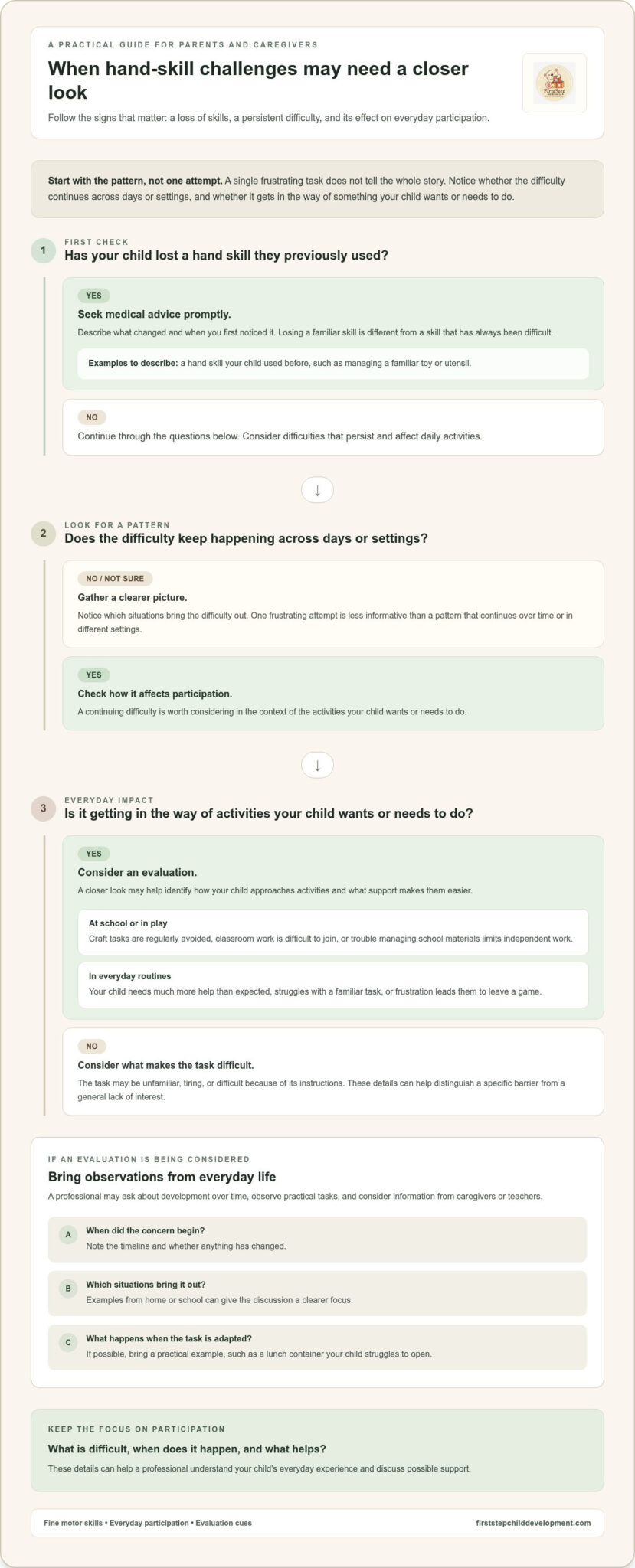
Consider seeking an evaluation when a hand-skill difficulty persists and interferes with activities your child wants or needs to do. A child who regularly avoids craft tasks, struggles to join classroom work or needs much more help than expected with daily routines may benefit from a closer look. One frustrating attempt is less informative than a pattern that continues across days or settings.
Consider how the difficulty affects participation, not just whether your child completes a task. For example, note whether trouble managing school materials limits independent work, or whether frustration leads your child to leave a game. Also consider whether the task is unfamiliar, tiring or difficult because of its instructions. These details can help distinguish a specific barrier from a general lack of interest.
An evaluation can explore how your child approaches activities and what support makes them easier. A professional may ask about development over time, observe practical tasks and consider information from caregivers or teachers. You can prepare by noting when concerns began, which situations bring them out and what happens when a task is adapted. These details give the discussion a clearer focus than relying on a general impression.
Seek medical advice promptly if your child loses a hand skill they previously used, such as being unable to manage a familiar toy or utensil. Describe what changed and when you first noticed it. A sudden loss differs from a skill that has always been difficult, so sharing the timeline helps a healthcare professional understand the concern.
In Malaysia, parents can start by discussing persistent concerns with their child’s healthcare provider and asking whether a developmental or occupational therapy evaluation is suitable. Bring observations from home and school, including examples of what your child can do independently and where they need help. This context can guide the next step without treating one difficulty as a diagnosis.
Possible causes of fine motor delay
Fine motor development depends on coordination between the brain, nerves, sensory abilities and muscles. A disruption in any of these systems may affect how a child moves a finger, grips a pencil or controls a drawing. The same difficulty can have different explanations, so one task alone cannot identify its cause. Fine motor delay in children is a sign to understand in context, not a diagnosis.
Many conditions can affect fine motor skills, with effects ranging from mild to severe. Some involve the central nervous system, which processes and directs movement; others affect peripheral nerves, which carry signals between the brain and body. Sensory differences or musculoskeletal concerns can also make precise hand movements harder. For example, a child may struggle to adjust finger pressure when holding a small object.
Some diagnoses associated with motor difficulties include cerebral palsy, spina bifida, Down syndrome, paediatric stroke and traumatic brain injury. Muscular dystrophy and juvenile arthritis may also affect movement. ADHD can be associated with differences in fine motor function, while achondroplasia is a genetic condition that may affect motor development. These examples show why similar challenges, such as difficulty fastening buttons, can have different causes.
Prematurity is another factor to consider. Fine motor and coordination difficulties occur at higher rates among children born before 37 weeks, particularly those born before 32 weeks. This history helps provide context, but it does not determine an individual child’s abilities. A child’s current hand control, sensory responses and daily participation all contribute to understanding their needs.
Development is also shaped by everyday opportunities to handle objects and practise movements. Limited practice may affect experience, but it does not explain every persistent difficulty. A useful next step is to note which tasks are challenging, whether both hands are involved and how the pattern affects dressing, eating or drawing. These details help professionals consider possible contributing factors without assuming a cause from one sign.
Firststep Psychology & Child Development Centre: Clinical Psychologist Consultation
Firststep Psychology & Child Development Centre offers Clinical Psychologist Consultation for parents seeking to understand concerns about their child’s development and daily functioning. If fine motor challenges appear alongside difficulties with attention, communication, learning or emotions, a consultation can help clarify the broader concerns and discuss appropriate next steps.
Where relevant, support may include an ADHD Assessment, Autism Assessment or Learning Difficulties Assessment. These assessments address specific developmental questions; they do not replace an occupational therapy evaluation of hand skills. Sharing examples from home or school, such as difficulty managing classroom tools, can help make the discussion practical and focused on your child’s needs.
If you’d like to discuss your concerns, explore the Clinical Psychologist Consultation or visit Firststep Child Development.
Choose a thoughtful next step for your child
Small, consistent observations can help turn concern into a clearer plan. Note which activities feel difficult, what helps your child take part, and whether the same challenge appears at home, during play or at school. These details can make a conversation about fine motor delay in children more specific and useful.
Support can focus on practical goals that matter to your family, while recognising your child’s strengths and preferences. An evaluation can help clarify which areas need attention and whether occupational therapy or broader developmental support may be appropriate. You don’t need to wait for difficulties to affect every part of daily life before seeking guidance.
If you’d like to discuss your concerns or explore an assessment, contact Firststep Psychology & Child Development Centre. A considered next step can help you support your child with greater clarity and confidence.
Frequently Asked Questions
What causes fine motor delay in children?
Fine motor difficulties can have several contributing factors, rather than one single cause. Differences in how the brain plans movement, how nerves carry signals, sensory processing, or muscle and joint function may affect tasks such as controlling a finger while drawing. Prematurity and some developmental or physical conditions can also be relevant. An assessment considers the child’s broader development and daily experiences, not just one difficult activity.
How is fine motor delay diagnosed and assessed?
Assessment usually combines developmental history with observation of how a child handles practical tasks. A clinician may look at how the child uses both hands, follows visual cues and manages activities suited to their age. The Movement Assessment Battery for Children-2 includes fine motor tasks such as placing pegs in a board and threading beads. Assessment findings are considered alongside the child’s everyday participation, not used in isolation.
When should parents seek medical advice for fine motor delays?
Seek advice if difficulties persist, affect several routines or make it hard for your child to participate at home or school. A sudden loss of a skill needs prompt discussion with a healthcare professional. Before an appointment, note examples and when they occur, such as struggling to open a lunch container but managing larger toys. This record can help explain the concern clearly and show how it affects daily life.
What therapies help children with fine motor delays, including occupational therapy?
Occupational therapy can help children practise hand movements through activities linked to their goals, such as using classroom tools or managing fasteners. A therapist may adapt the task, materials or positioning to make practice more accessible. Support depends on the child’s needs and the activities they find difficult. A healthcare professional can help determine whether an occupational therapy evaluation is appropriate.
What fine motor activities can parents do at home?
Choose enjoyable activities that invite different hand movements. Your child could squeeze and shape play dough, peel and place large stickers, use child-safe tongs to move soft objects, or turn pieces in a simple puzzle. Offer one activity at a time and let your child try independently before helping. Keep practice playful, and notice which materials or grips make participation easier.
Can fine motor delay be linked to developmental conditions such as autism or ADHD?
Yes, fine motor differences can occur alongside developmental conditions, including autism and ADHD, but they do not confirm either condition. A child’s hand skills are only one part of their developmental profile. If concerns also involve communication, attention, play or learning, discuss the full pattern with a qualified professional. Looking across these areas helps clarify what support may suit the child’s needs.

Article by
Firststep Child Development Team
Firststep Child Development Team provides evidence-informed educational resources to help parents better understand child development, behaviour and learning. Our multidisciplinary services include clinical psychology, occupational therapy, speech and language therapy, developmental assessments and other child development support in Kuala Lumpur and Selangor.
Disclaimer
This article is for general educational and informational purposes only and is not a substitute for professional medical, psychological or therapeutic advice, diagnosis or treatment. Every child develops differently. If you have concerns about your child's development, behaviour, learning or wellbeing, please consult an appropriately qualified healthcare or allied health professional.