



What if the most helpful first step isn’t finding a label, but finding someone who can explain what your child may need? If you’re looking for a child psychologist for ADHD and autism Malaysia, it’s understandable to feel unsure about whom to contact, what an assessment involves, or how to make sure your child is understood.
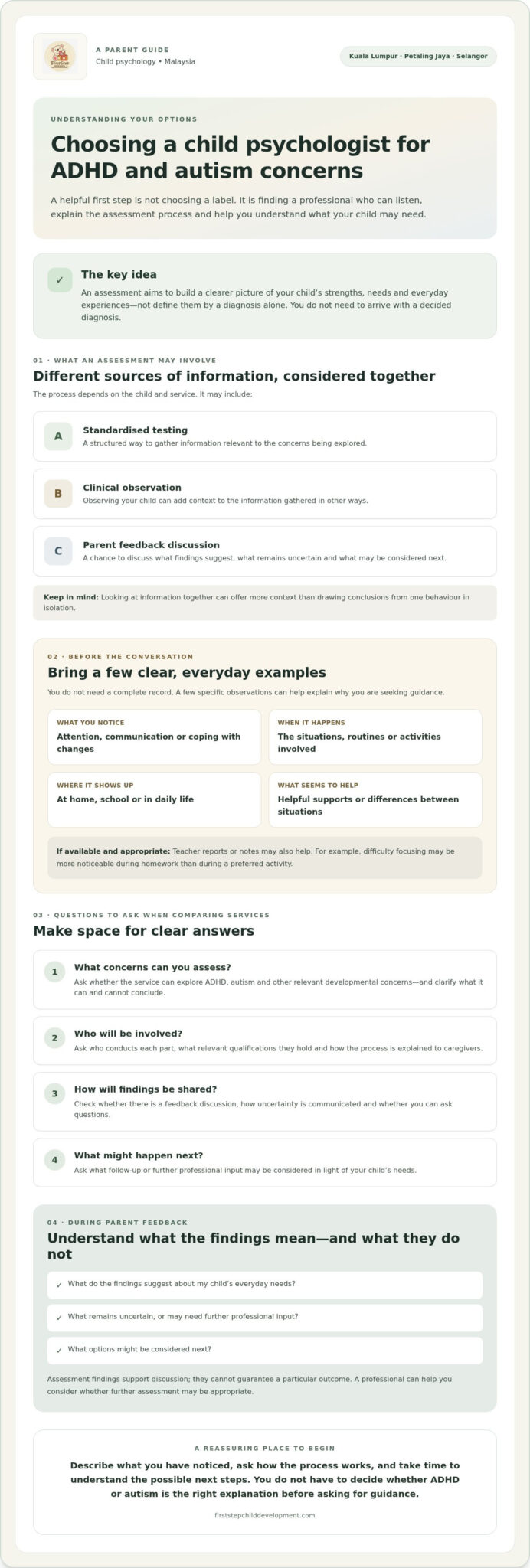
A thoughtful assessment should build a clearer picture of your child’s strengths and challenges, not define them by a diagnosis alone. It can also give you space to discuss your concerns and consider possible next steps with a professional.
This guide explains what to ask when comparing child psychology services, what to expect from assessment and parent feedback, and how to prepare for an initial conversation. Whether you’re seeking support in Kuala Lumpur, Petaling Jaya or elsewhere in Selangor, these practical steps can help you decide what to ask before booking.
Key Takeaways
- When comparing a child psychologist for ADHD and autism Malaysia, check that the service can assess your child’s specific concerns and explain its approach clearly.
- Ask whether an assessment may include standardised testing, clinical observation and a parent feedback discussion.
- Prepare a few specific examples of what you’ve noticed and how it affects your child at home, school or in daily life.
- Use the initial conversation to understand possible next steps. You don’t need to arrive with a decided diagnosis.
Finding a child psychologist for ADHD and autism concerns in Malaysia
Concerns about your child’s attention, communication or development can leave you unsure where to begin. Searching for “child psychologist for ADHD and autism Malaysia” is a starting point. Next, look for child-focused clinical psychology support and check whether the service assesses the concerns you’ve noticed.
A child psychologist can help families understand a child’s development, behaviour and emotional needs through consultation and, where appropriate, assessment. A professional’s scope depends on their qualifications and experience, so ask what they’re qualified to assess. An online article can’t determine whether a child has ADHD, autism or another developmental difference.
What should parents look for in a child psychologist?
Ask about the clinician’s experience working with children, relevant qualifications and the concerns they assess. Find out who will conduct the assessment, how the process is explained, and whether you’ll have time to discuss findings and questions. Clear communication can help you understand what an assessment may clarify and where there may still be uncertainty.
When ADHD and autism are both concerns
You don’t need to decide which diagnosis fits before asking for guidance. Share what you’ve observed, such as difficulty sustaining attention, communicating needs or coping with changes. Explain where and when these concerns arise, and how they affect daily life. A professional can help you consider whether further assessment may be appropriate. For local details, read about ADHD assessment in Malaysia.
How child psychologists explore ADHD and autism concerns
An assessment gathers information about a child’s strengths, needs and everyday experiences. It may include standardised testing, clinical observation and a feedback discussion with parents. Looking at these sources together can give more context than drawing conclusions from one behaviour in isolation.
For example, difficulty staying focused might be more noticeable during homework than during a preferred activity. Tell the clinician when it happens, what seems to help and how it affects your child’s day. The World Health Organization’s ADHD fact sheet offers further background on the condition, but it can’t determine what is causing a particular child’s difficulties.
What information may contribute to an assessment?
Consider bringing examples from home and school, along with observations about communication, routines and social situations. Teacher reports or notes may also help, if available and appropriate. You don’t need to organise a complete record. A few clear examples, including when a concern occurs and how it affects your child, can help explain why you’re seeking guidance.
How can parents understand the feedback?
Use the feedback discussion to ask what the findings suggest, what remains uncertain and whether further professional input may be appropriate. You can also ask how the findings relate to your child’s everyday needs and what options might be considered next. Assessment findings support discussion; they can’t guarantee a particular outcome.
If you’re comparing a child psychologist for ADHD and autism Malaysia, ask how the service shares findings with caregivers and whether you’ll have time to discuss the report. For service-specific information, see Firststep’s assessment process overview.
Questions to ask before choosing ADHD and autism support in Kuala Lumpur or Selangor
When comparing child psychology services in Kuala Lumpur, Petaling Jaya or elsewhere in Selangor, focus on whether the clinician explains the process and considers your child’s individual needs. These questions can help you make an informed choice before booking.
- What concerns can you assess? Ask whether the service can explore ADHD, autism and other relevant developmental concerns, and clarify what it can and cannot conclude.
- Who will be involved? Ask who conducts each part of the assessment, what relevant qualifications they hold and how the process is explained to caregivers.
- How will we receive and discuss the findings? Check whether you’ll have a feedback discussion, how uncertainties are communicated and how you can raise questions.
- What might happen next? Ask what follow-up or further professional input may be considered in light of your child’s needs.
Describe observations, not a fixed conclusion
You don’t need to arrive knowing whether ADHD or autism is the right explanation. Describe what you’ve noticed and how it affects daily life. For example, explain when your child finds it difficult to follow instructions, communicate needs or manage changes. Where relevant, mention whether the same concern appears in different settings, such as at home and at school. You can also ask how the service keeps caregivers informed and takes your child’s individual circumstances into account.
A child psychology consultation is one way to discuss your concerns and ask what support may be appropriate.
Prepare for a first conversation
Before speaking with a service in Kuala Lumpur, Petaling Jaya or elsewhere in Selangor, note a few examples, questions and any relevant school or developmental information. You don’t need to prepare a complete record or use clinical terms. Use the conversation to clarify what the proposed process involves, how findings will be shared and what next steps might be considered. If you’re comparing costs, ask whether the service charges per session or offers a fixed-price assessment package, and what each includes.
To learn more about the centre, visit Firststep Child Development.
Taking the next step with a child psychologist for ADHD and autism
You don’t need to have decided on a diagnosis before starting a conversation. If you’re looking for a child psychologist for ADHD and autism Malaysia, begin by explaining what you’ve noticed and asking whether a consultation or assessment may be suitable. The next step depends on your child’s concerns and the professional’s view of what support may help.
When an assessment may be worth discussing
Consider speaking with a professional if ongoing concerns are affecting your child’s learning, communication, relationships or everyday routines. A behaviour on its own doesn’t confirm ADHD or autism. Its context, frequency and impact matter. Sharing what you observe can help a clinician explore whether further assessment is appropriate.
How findings may guide support
After feedback, ask what the findings mean for your child, what recommendations are being made and whether further professional input may be useful. Possible support should be considered in relation to your child’s individual needs, not assumed from a label alone. If autism-specific assessment is relevant, you can review the autism assessment service.
Firststep Psychology & Child Development Centre offers clinical psychologist consultations and ADHD and autism assessments for families in Kuala Lumpur, Petaling Jaya and Selangor. To explore one possible next step, read about ADHD assessment in Malaysia, or visit the Firststep homepage to learn more about the centre.
Take a considered next step for your child
If you’re looking for a child psychologist in Malaysia to discuss ADHD or autism concerns, start with a professional who will listen to your observations, explain the assessment process and help you understand your child’s individual needs. An assessment can offer a clearer picture of strengths and challenges without rushing to a label or promising a particular outcome.
Before deciding, ask what concerns the service can assess, how findings will be shared and what support may be appropriate afterwards. Firststep Psychology & Child Development Centre offers ADHD and autism assessments and clinical psychologist consultations. Its assessment packages include standardised testing, clinical observation and detailed feedback reports for parents. The centre also uses a play-based approach and provides multidisciplinary support.
If you’d like to explore a possible next step, read about ADHD assessment in Malaysia or learn more about Firststep. Contact the centre to discuss your concerns and ask whether a consultation or assessment may suit your child.
Frequently Asked Questions
How do I find a child psychologist for ADHD and autism in Malaysia?
Look for child-focused clinical psychology support and check whether the service assesses the concerns you’ve noticed. Ask about the clinician’s qualifications and experience with children, what the assessment may involve, and how findings are shared with parents. For families in Kuala Lumpur, Petaling Jaya or Selangor, comparing these details can help you choose a suitable first conversation without deciding on a diagnosis beforehand.
Can a child psychologist assess both ADHD and autism?
Some services offer assessment for both ADHD and autism, but confirm the scope with the provider. Ask who conducts the assessment, which concerns they can consider and how they’ll explain their findings. Firststep Psychology & Child Development Centre offers ADHD and autism assessments. If you have observations related to both attention and communication, raise them together rather than trying to decide which diagnosis fits.
What should I bring to my child’s first psychology consultation?
Bring a few clear examples of what concerns you and how these affect your child’s daily life. Notes about home routines, communication, learning or social situations may help, as could relevant school observations or developmental information you already have. You don’t need to prepare a complete history or use clinical terms. Your questions and everyday observations are a useful starting point for discussion.
Does an ADHD or autism assessment guarantee a diagnosis?
No. An assessment doesn’t guarantee a diagnosis. Its purpose is to consider information about your child’s strengths, needs and experiences, and explain what the findings may suggest. A professional may discuss uncertainties or recommend further input if needed. The outcome can help guide a conversation about appropriate next steps, whether or not the assessment supports the concern that prompted you to seek advice.
What happens after a child’s assessment in Kuala Lumpur or Selangor?
After the assessment, the professional should explain the findings and discuss recommendations with you. Possible next steps depend on your child’s profile and the concerns raised. They may include considering relevant support or seeking further professional input. Firststep serves families in Kuala Lumpur, Petaling Jaya and Selangor, and its assessment packages include parent feedback. Ask any provider how recommendations will be shared and discussed.

Article by
Firststep Child Development Team
Firststep Child Development Team provides evidence-informed educational resources to help parents better understand child development, behaviour and learning. Our multidisciplinary services include clinical psychology, occupational therapy, speech and language therapy, developmental assessments and other child development support in Kuala Lumpur and Selangor.
Disclaimer
This article is for general educational and informational purposes only and is not a substitute for professional medical, psychological or therapeutic advice, diagnosis or treatment. Every child develops differently. If you have concerns about your child's development, behaviour, learning or wellbeing, please consult an appropriately qualified healthcare or allied health professional.