



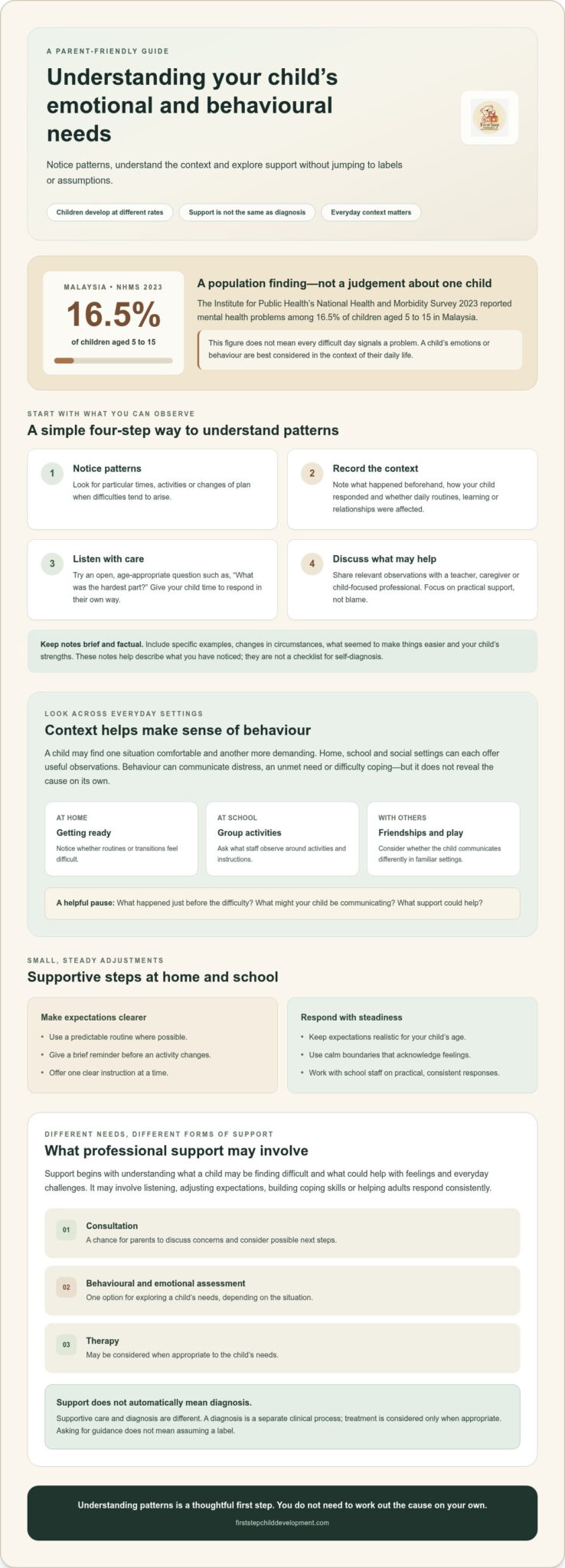
In Malaysia, 16.5% of children aged 5 to 15 had mental health problems, according to the Institute for Public Health’s National Health and Morbidity Survey 2023. That figure doesn’t mean every difficult day signals a problem, but if your child’s emotions or behaviour are affecting family life, it’s understandable to wonder what support might help. Exploring emotional behavioral support for children doesn’t mean labelling your child or assuming a diagnosis.
Children develop at different rates, and behaviour can be shaped by what’s happening at home, school or with friends. Look for patterns, consider how long concerns have lasted, and note whether they interfere with everyday activities such as getting ready for school, learning, friendships or family routines.
This article explains what support may involve, practical steps to try at home, and when to seek professional guidance. It also covers how parents, schools and child-focused professionals can work together, including options for families in Kuala Lumpur, Petaling Jaya and Selangor.
Key Takeaways
- Seeking emotional behavioral support for children can help you understand your child’s needs; it doesn’t automatically mean they’ll receive a diagnosis.
- Keep brief notes on when concerns arise, what happened beforehand, and how they affect daily routines to help clarify patterns.
- At home and school, try predictable routines, clear expectations, and calm boundaries that acknowledge your child’s feelings.
- A consultation, behavioural and emotional assessment, or therapy can offer different forms of support, depending on your child’s needs.
What does emotional and behavioural support for children involve?
Emotional and behavioural support starts with understanding what a child may be finding difficult and what could help with feelings and everyday challenges. It might involve listening, adjusting expectations, building coping skills, or helping parents and school staff respond consistently. Seeking support doesn’t automatically mean a child has a diagnosis.
Supportive care helps a child and the adults around them understand and respond to everyday needs; diagnosis is a separate clinical process, and treatment is considered only when appropriate. The CDC’s overview of children’s mental health offers general information about children’s emotional and behavioural well-being, but no general resource can determine what a particular child needs. Parents can ask for guidance without making assumptions or applying a label.
In practice, emotional behavioral support for children may be relevant when a child becomes upset as activities change, finds it hard to express frustration, or needs help explaining feelings. These examples are reasons to look more closely, not conclusions about a child.
How emotional and behavioural needs may appear in daily life
Notice what you can observe at home, school and in social situations. Does your child find getting ready for school difficult, become frustrated during group activities, or communicate more easily in a familiar setting? Note how often it happens, how long the pattern has been present, and whether it affects routines, friendships or learning. Specific examples are more useful than a general description such as “difficult behaviour”.
Why behaviour needs to be understood in context
Behaviour can communicate distress, an unmet need or difficulty coping, but it doesn’t reveal the cause on its own. A child who resists a transition may be tired, unsure what comes next, or responding to something else in their day. Before blaming or punishing, pause and consider what happened beforehand, what the child might be communicating, and what support could help. A clinical psychologist consultation can give parents a chance to discuss concerns and consider possible next steps.
How can parents understand what their child may need?
You don’t need to work out the cause on your own. A few calm, factual observations can help you understand what’s happening and explain your concerns if you seek emotional behavioral support for children.
Try this simple sequence:
- Notice patterns: Is there a particular time, activity or change of plan when difficulties tend to arise?
- Record the context: Note what happened beforehand, how your child responded, and whether it affected routines, learning or relationships.
- Listen to your child: Ask an open, age-appropriate question, such as, “What was the hardest part?” Give them time to answer in their own way, without pressure.
- Discuss concerns: Share relevant observations with a teacher, caregiver or child-focused professional, focusing on what might help.
What to note before asking for support
Brief notes are enough. Include specific examples, changes in circumstances, what seemed to make a situation easier, and your child’s strengths. For example, record the activity, what happened just before the difficulty, how your child responded, and what helped them settle or rejoin the activity. Avoid turning observations into a checklist for self-diagnosis; they’re simply a record of what you’ve noticed. For practical ideas on responding to behaviour, the Parent’s Guide to Problem Behavior may also be useful.
When school and home observations can add context
A child may manage one situation comfortably but find another more demanding. Teachers or caregivers may notice patterns around group activities, instructions or transitions that aren’t as apparent at home. Observations across settings help show when a concern arises, what surrounds it and how it affects a child’s daily life.
When speaking with school staff, share concrete examples and ask what they’ve observed, rather than assigning blame. Keep the conversation focused on practical support, and share only information relevant to your child’s care while respecting their privacy. If you’d like help making sense of your observations, you can explore a clinical psychologist consultation.
What supportive steps can families try at home and school?
Small, steady adjustments can make everyday expectations easier to understand. A predictable morning routine, a brief reminder before an activity changes, or one clear instruction at a time may help a child know what to expect. Keep expectations realistic for their age and explain boundaries in simple, respectful language.
Choose one manageable change first, then notice how your child responds. For example, try a visual checklist for getting ready and observe whether it makes the routine clearer. Introducing several new strategies at once can make it harder to tell what is helping.
Responding calmly when a child is distressed
Acknowledge the feeling while holding the boundary: “I can see you’re angry. I won’t let you hit. Let’s take a moment, then we can talk.” This shows that the emotion is heard without accepting unsafe or hurtful behaviour. If you’re both upset, focus on safety and give the conversation time. Revisit what happened once you and your child are calmer, and consider together what might help next time.
Working with school and other caregivers
Share practical observations with teachers or caregivers and ask what approaches already seem helpful. Agreeing on a simple, consistent response can reduce mixed messages between settings. Keep discussions factual and private, and avoid talking about the child as though they aren’t present when it’s appropriate to include them. For further guidance on when to seek professional help for your child, the American Academy of Child and Adolescent Psychiatry offers information for families.
These are general educational suggestions, not a substitute for individual professional advice. If you’d like to discuss what may suit your child, a clinical psychologist consultation is one possible next step in emotional behavioral support for children.
How to explore professional emotional and behavioural support in Kuala Lumpur and Selangor
Consider discussing concerns with a child-focused clinical psychologist if they persist, affect everyday routines or relationships, or leave you unsure how best to respond. You don’t need to arrive with a diagnosis in mind. A conversation can help clarify what you’ve noticed and what options may be appropriate for your child.
Choosing between a consultation, assessment, or therapy
The right starting point depends on your questions and your child’s needs. A consultation gives parents space to discuss concerns and consider next steps. A behavioural and emotional assessment may help build a fuller understanding of a child’s strengths and difficulties. Play therapy may be considered when ongoing support is appropriate. These options aren’t a set sequence, and not every child needs each one. Find out more about a clinical psychologist consultation.
What parents can expect from a child-centred first conversation
You can share examples from home, school or other settings, explain what you hope to understand, and ask how the professional will approach the conversation. Useful questions include:
- What does the consultation or assessment involve?
- How will findings and recommendations be explained to parents?
- How might suggested support fit into our child’s everyday routines?
A conversation or assessment can help explore possible next steps, but it doesn’t guarantee a diagnosis or a particular outcome. If you’re considering an assessment, read about how a child assessment works. Check current service availability, appointment arrangements and clinician credentials directly before making plans.
Firststep Psychology & Child Development Centre serves families in Kuala Lumpur and Selangor. Services include clinical psychologist consultations, behavioural and emotional assessments, parent guidance and play therapy. To explore emotional behavioral support for children, visit Firststep Child Development and consider which questions you’d like to discuss.
Take a thoughtful next step for your child
Understanding a child’s needs starts with noticing patterns, listening without pressure and considering what may be happening across home, school and social settings. Predictable routines and calm, consistent boundaries can be helpful first steps. Persistent concerns or difficulties affecting everyday life may be worth discussing with a child-focused professional.
Seeking emotional behavioral support for children doesn’t mean assuming a diagnosis. A consultation can help parents talk through concerns, while an assessment or therapy may be considered if it fits the child’s needs. The right next step is individual to each family.
Firststep Psychology & Child Development Centre serves families in Kuala Lumpur, Petaling Jaya and Selangor, with child-focused clinical psychologist consultations, behavioural and emotional assessments, and parent consultation and guidance. You can read about the clinical psychologist consultation or explore child-focused support with Firststep.
You don’t have to have every answer before asking a question. To discuss your concerns, contact Firststep about child-focused support.
Frequently Asked Questions
What is emotional and behavioural support for children?
It is help to understand a child’s needs and support them with feelings, behaviour and everyday challenges. Emotional behavioral support for children may include parent guidance, a consultation with a child-focused professional, an assessment or therapy, depending on the child and family’s concerns. Support aims to identify helpful next steps; it doesn’t automatically mean a child has a diagnosis or needs every type of service.
When should I seek emotional or behavioural support for my child?
Consider seeking guidance if concerns persist, affect everyday routines or relationships, or you’re unsure how to support your child. Notice whether difficulties happen in more than one setting, change over time, or interfere with school, friendships, sleep or family life. You don’t need to wait until you’re certain something is wrong. Sharing specific examples with a child-focused professional can help you consider appropriate next steps.
Can emotional or behavioural difficulties be supported without a diagnosis?
Yes. Parents can seek guidance to understand a child’s needs without assuming that a diagnosis is necessary. A consultation may help you discuss your observations and consider practical support. An assessment is a separate process that may be considered if more information is needed. Any recommendations should relate to the child’s circumstances, and a professional can explain what each option involves before you decide how to proceed.
What can I do at home to support my child’s emotions?
Offer predictable routines, simple age-appropriate expectations and calm, consistent boundaries. Acknowledge feelings while making clear that unsafe or hurtful actions aren’t acceptable. For example, you might say, “I can see you’re upset. I won’t let you hit.” Choose one manageable change at a time, then notice how your child responds. These general ideas may not suit every situation, so seek individual advice if concerns continue.
Where can parents in Kuala Lumpur or Selangor explore child emotional support?
Families in Kuala Lumpur, Petaling Jaya and Selangor can explore child-focused support through Firststep Psychology & Child Development Centre. Listed services include clinical psychologist consultations, behavioural and emotional assessments, and parent consultation and guidance. Ask about current availability, appointment arrangements, the process and how feedback may inform everyday support. A conversation can help you understand possible next steps without assuming that your child needs a diagnosis.
If you’d like to discuss your concerns, learn more about a clinical psychologist consultation or explore child-focused support with Firststep. A conversation can be a gentle place to begin.

Article by
Firststep Child Development Team
Firststep Child Development Team provides evidence-informed educational resources to help parents better understand child development, behaviour and learning. Our multidisciplinary services include clinical psychology, occupational therapy, speech and language therapy, developmental assessments and other child development support in Kuala Lumpur and Selangor.
Disclaimer
This article is for general educational and informational purposes only and is not a substitute for professional medical, psychological or therapeutic advice, diagnosis or treatment. Every child develops differently. If you have concerns about your child's development, behaviour, learning or wellbeing, please consult an appropriately qualified healthcare or allied health professional.