



What if your toddler’s speech delay or fleeting eye contact isn’t an alarming deficit, but an invitation to understand how they experience the world? When you begin noticing behavioural differences, it’s natural to wonder where typical variation ends and developmental support begins. Recognising the early signs of autism in children Malaysia parents observe shouldn’t feel like an intimidating medical checklist. Instead, it serves as a gentle cue to help you seek timely, nurturing guidance for your little one.
It’s exhausting to balance unsolicited advice from extended family against your own quiet parental instincts, especially when you simply want clarity and reassurance. In this guide, you’ll gain objective criteria to distinguish everyday developmental variations from subtle autism spectrum traits. We’ll also outline the practical roadmap to multidisciplinary assessments and early intervention across Malaysia, empowering you to advocate for your child’s growth with complete confidence.
Key Takeaways
- Learn how to observe the early signs of autism in children Malaysia parents often detect between 12 and 36 months, focusing on subtle social communication cues.
- Separate reassurance from reality by addressing common cultural myths, including assumptions about late-talking boys and multilingual home environments.
- Discover how gentle, play-based multidisciplinary assessments provide diagnostic clarity without causing distress for your young child.
- Gain a clear roadmap to accessible early intervention pathways, including speech and paediatric occupational therapy, designed to nurture your child’s developmental growth.
Recognising Early Signs of Autism in Children Across Developmental Milestones
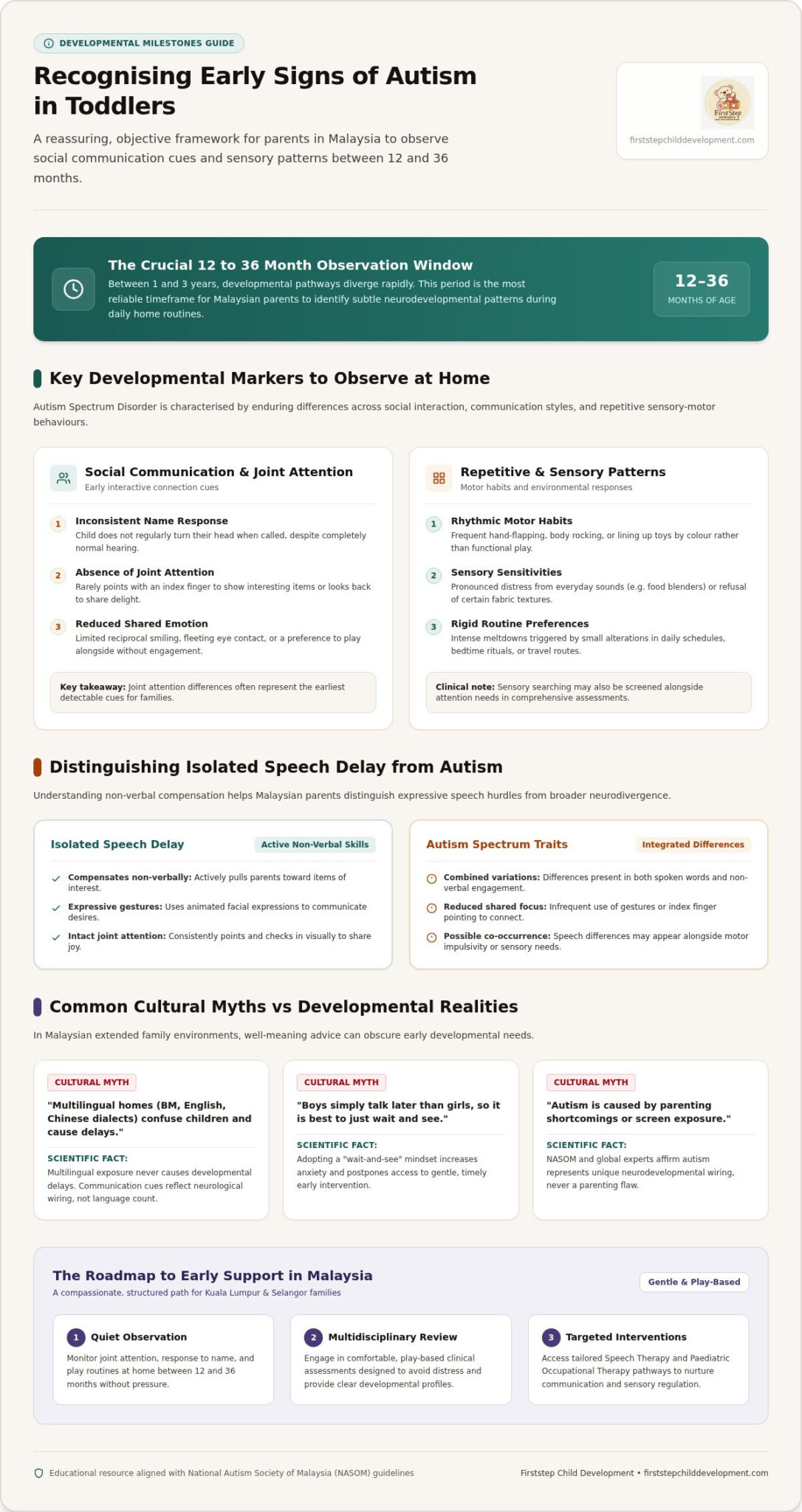
According to international paediatric consensus, Autism Spectrum Disorder represents a neurodevelopmental profile characterised by enduring differences in social interaction, communication styles, and repetitive sensory-motor patterns. Between 12 and 36 months of age, developmental pathways diverge rapidly. This period serves as the most reliable window for identifying the subtle early signs of autism in children Malaysia families often notice during quiet home routines.
Social Communication and Joint Attention Indicators
Social communication markers typically offer the earliest clues for parents to observe:
- Inconsistent name response: Your child doesn’t regularly turn their head when called, even though their hearing is completely normal.
- Absence of joint attention: They rarely point using an index finger to show you an interesting object or look back to share their delight.
- Reduced shared emotion: You notice limited reciprocal smiling, fleeting eye contact, or a preference to play alongside others without engaging directly.
Repetitive Behaviours and Unique Sensory Responses
Repetitive actions and heightened sensory perceptions frequently accompany social communication variations:
- Rhythmic motor habits: Frequent hand-flapping, body rocking, or lining up toys by colour rather than using them for functional play.
- Sensory sensitivities: Extreme distress from everyday sounds like food blenders, or refusal to wear certain fabric textures.
- Rigid preferences: Pronounced meltdowns over small alterations in daily family schedules, bedtime rituals, or travel routes.
Because developmental traits can present simultaneously, professionals conducting an ADHD assessment Malaysia clinics offer will also check whether sensory searching reflects attentional needs or the early signs of autism in children Malaysia specialists identify during early screenings.
Common Myths Versus Realities: Clarifying Autism Signs for Malaysian Parents
Malaysian households are often filled with rich, extended family networks, but well-meaning relatives frequently offer comforting myths instead of clarity. Many parents hear that boys simply talk later, or that navigating Bahasa Malaysia, English, and Chinese dialects at home confuses speech. Scientific evidence clarifies that multilingual exposure never causes developmental delays; rather, early communication patterns provide vital clues about neurodivergence.
Distinguishing Isolated Speech Delays from Autism
Differentiating expressive language challenges from social differences helps clarify whether a child needs targeted language guidance or a comprehensive evaluation:
- Compensatory non-verbal skills: Children with an isolated speech delay actively pull you toward items, point, and use animated facial expressions to communicate their desires.
- Integrated communication differences: The early signs of autism in children Malaysia clinicians observe generally involve differences in both verbal language and non-verbal shared engagement.
- Overlapping developmental profiles: Speech differences combined with intense motor impulsivity may suggest considering an ADHD assessment Malaysia centres offer alongside communication reviews.
Addressing Cultural Stigma and Wait-and-See Advice
Adopting a “wait-and-see” mindset often increases maternal anxiety and postpones crucial early support. Respected organisations like the National Autism Society of Malaysia (NASOM) emphasise that neurodiversity simply reflects unique neurological wiring rather than any parenting shortcoming. A timely review brings immense peace of mind, and parents seeking gentle guidance can schedule an assessment with Firststep Child Development to understand their child’s unique developmental profile.
How Multidisciplinary Assessments Identify Autism in Malaysia
When developmental differences emerge, many parents worry that formal clinical evaluations will feel cold or distressing for a young child. Modern clinical evaluations across Kuala Lumpur and Selangor take an entirely different approach. Rather than sitting through rigid clinical exams, clinicians identify the early signs of autism in children Malaysia families observe through gentle, play-based sessions paired with comprehensive parent discussions regarding sleep patterns, feeding habits, and early milestones.
Standardised Clinical Tools and Observational Play
Clinical psychologists use standardised diagnostic tools to assess communication styles, social reciprocity, and imaginative play in a natural manner. Children explore carefully selected toys, bubbles, and interactive games while clinicians observe how they respond to subtle social bids, share eye contact, and regulate their sensory responses. These play-centred interactions keep children relaxed, ensuring clinicians capture an accurate reflection of their genuine daily capabilities and unique strengths.
Multidisciplinary Collaboration for Complete Developmental Clarity
Gaining complete developmental clarity relies on collaborative insights from a multidisciplinary team rather than a single isolated viewpoint:
- Clinical psychologists: Evaluate behavioural tendencies, social-emotional development, and underlying cognitive profiles.
- Speech-language therapists: Assess receptive language comprehension, non-verbal gestures, and functional communication intent.
- Paediatric occupational therapists: Examine sensory processing differences, fine motor coordination, and motor planning skills.
The evaluation concludes with a clear, supportive feedback session and an actionable developmental report tailored for your home and preschool environments. If you want objective answers and practical next steps, schedule an autism assessment at Firststep Child Development to support your child’s journey.
Empowering Next Steps: Early Intervention and Therapy Pathways
Receiving developmental clarity provides parents with a supportive roadmap rather than a permanent label or limitation. Observing the early signs of autism in children Malaysia clinicians evaluate is simply the first step toward unlocking meaningful growth and self-advocacy. Timely, compassionate support harnesses the remarkable neuroplasticity of early childhood, strengthening practical life skills while completely respecting your child’s innate identity and neurodivergent worldview. Exploring a structured early intervention program equips families with collaborative clinical guidance tailored to their child’s specific developmental pace.
Core Therapy Modalities Supporting Young Children
Multidisciplinary therapy nurtures foundational capabilities through gentle, play-based strategies:
- Pediatric occupational therapy: Enhances sensory processing, fine motor coordination, and everyday self-care routines like dressing and feeding.
- Speech therapy: Develops functional communication using spoken language, visual cards, or expressive gestures to reduce daily frustration.
- Play-based interventions: Foster emotional regulation, collaborative turn-taking, and peer engagement in supportive social environments.
Partnering with Schools and Building Home Routines
Practical progress flourishes when therapy extends seamlessly into daily home life and educational settings. Multidisciplinary specialists collaborate closely with parents across Kuala Lumpur and Selangor to establish practical visual schedules, calming sensory zones, and predictable routines at home. Concurrently, educators receive individualised recommendations to support inclusive preschool integration, ensuring your child experiences confident peer interactions without sensory overwhelm. Responding proactively to the early signs of autism in children Malaysia early educators notice creates an empathetic environment where every young learner can thrive.
Nurturing Your Child’s Unique Developmental Journey
Recognising developmental differences early isn’t about assigning labels; it’s about opening pathways to understanding and tailored support. Gaining clarity on the early signs of autism in children Malaysia parents encounter helps replace lingering uncertainty with practical, proactive guidance. Every step you take now honours your child’s distinct strengths and neurodivergent worldview.
You don’t have to navigate these observations alone. Conveniently located across Kuala Lumpur and Selangor, the dedicated team at Firststep Psychology & Child Development Centre collaborates alongside paediatric specialists from Firststep Child Specialist Clinic. Through child-centred, gentle play-based autism assessment services designed to minimise anxiety, our clinicians ensure your little one feels secure, understood, and empowered as your family moves forward with confidence.
Frequently Asked Questions
At what age can early signs of autism be reliably detected in children?
Early developmental differences often surface between 12 and 18 months, with experienced clinicians reliably identifying indicators by 24 months. Identifying the early signs of autism in children Malaysia clinical guidelines recognise allows families to initiate prompt support during critical developmental windows, rather than waiting for primary school entry.
Does raising a child in a bilingual or multilingual Malaysian home cause speech delays?
No, raising a child in a multilingual household does not cause speech delays or neurodevelopmental conditions. Children growing up hearing Bahasa Malaysia, English, and Chinese dialects naturally develop the capacity to navigate multiple language systems without experiencing underlying communication impairments.
What is the main difference between an isolated speech delay and autism spectrum traits?
Children with isolated speech delays actively communicate their wants using hand gestures, facial expressions, and pointing. In contrast, the early signs of autism in children Malaysia specialists assess involve social communication differences, including reduced eye contact, inconsistent name response, and fewer shared emotional interactions.
What should parents expect during a clinical child developmental assessment?
Parents can anticipate a welcoming, play-based session where clinicians observe your child’s natural interactions with engaging toys rather than formal academic testing. Evaluators discuss daily family routines, sensory preferences, and developmental history to build an accurate, holistic understanding of your child’s unique capabilities.
Do children need an official diagnosis before beginning supportive therapies in Malaysia?
No formal diagnosis is necessary to begin foundational therapies such as speech therapy or paediatric occupational therapy. If you notice functional communication barriers or sensory processing sensitivities, you can initiate targeted therapy immediately to support your child’s daily independence while continuing formal diagnostic evaluations.

Article by
Firststep Child Development Team
Firststep Child Development Team provides evidence-informed educational resources to help parents better understand child development, behaviour and learning. Our multidisciplinary services include clinical psychology, occupational therapy, speech and language therapy, developmental assessments and other child development support in Kuala Lumpur and Selangor.
Disclaimer
This article is for general educational and informational purposes only and is not a substitute for professional medical, psychological or therapeutic advice, diagnosis or treatment. Every child develops differently. If you have concerns about your child's development, behaviour, learning or wellbeing, please consult an appropriately qualified healthcare or allied health professional.