



Could a child who explains ideas clearly but struggles to put them on paper be facing more than untidy handwriting? Dysgraphia in children can affect handwriting, spelling or the organisation of written ideas, but messy or slow writing on its own doesn’t confirm a learning difficulty. Children develop at different rates, so it’s understandable to wonder what’s typical and when to seek guidance.
Look for patterns: writing that takes unusual effort, difficulty keeping up with classroom tasks, or a noticeable gap between what your child can say and write. These challenges may overlap with spelling, language, coordination or attention difficulties, and they aren’t a sign of laziness. Low-pressure adjustments can help reduce strain while you learn more.
This article explains signs worth discussing with your child’s school, practical ways to support writing, and what a learning difficulties assessment may explore. The aim is to understand your child’s individual learning profile, not draw conclusions from handwriting alone.
Key Takeaways
- Dysgraphia in children may involve persistent difficulties with written expression, not only untidy handwriting.
- Consider how handwriting, spelling and organising ideas may each affect a child’s written work.
- Try breaking writing tasks into smaller steps and allowing time to plan, without adding pressure.
- If difficulties persist or affect learning and confidence, an assessment can help clarify your child’s individual needs.
Dysgraphia in children: what writing difficulties can look like
A child may know an answer and explain it clearly, yet find it difficult to show the same understanding in writing. This can be confusing for parents, especially if written tasks take much longer than expected or leave a child tired or frustrated. Handwriting is only one part of the picture.
Dysgraphia is a term often used for persistent difficulties with writing skills or written expression. In the DSM-5-TR, these difficulties may be considered under “Specific Learning Disorder with impairment in written expression”, rather than as a separate disorder called dysgraphia. A peer-reviewed clinical review discusses the range of writing challenges and factors considered in understanding and assessing dysgraphia. Untidy handwriting alone, however, doesn’t establish dysgraphia or another learning difficulty.
Which writing difficulties might parents notice?
Signs can vary by child, task, age and learning context. You might notice that your child:
- Writes slowly or finds written work tiring.
- Has difficulty forming letters, spacing words or keeping writing legible.
- Struggles to organise ideas into sentences or on the page.
- Writes less than they can explain aloud.
These patterns can help you describe what is difficult, but none alone confirms dysgraphia in children.
When does handwriting difficulty deserve a closer look?
Consider seeking guidance if writing challenges persist and regularly interfere with school tasks, completing written work or participating in class. Notice whether the difficulty appears during copying, dictation or writing original ideas, as these tasks place different demands on a child.
Talk calmly with your child and teacher. Ask what feels hardest and share examples from home and school without blame or pressure. These observations can help guide a conversation with a professional, but they aren’t a diagnosis.
Why dysgraphia can affect more than handwriting
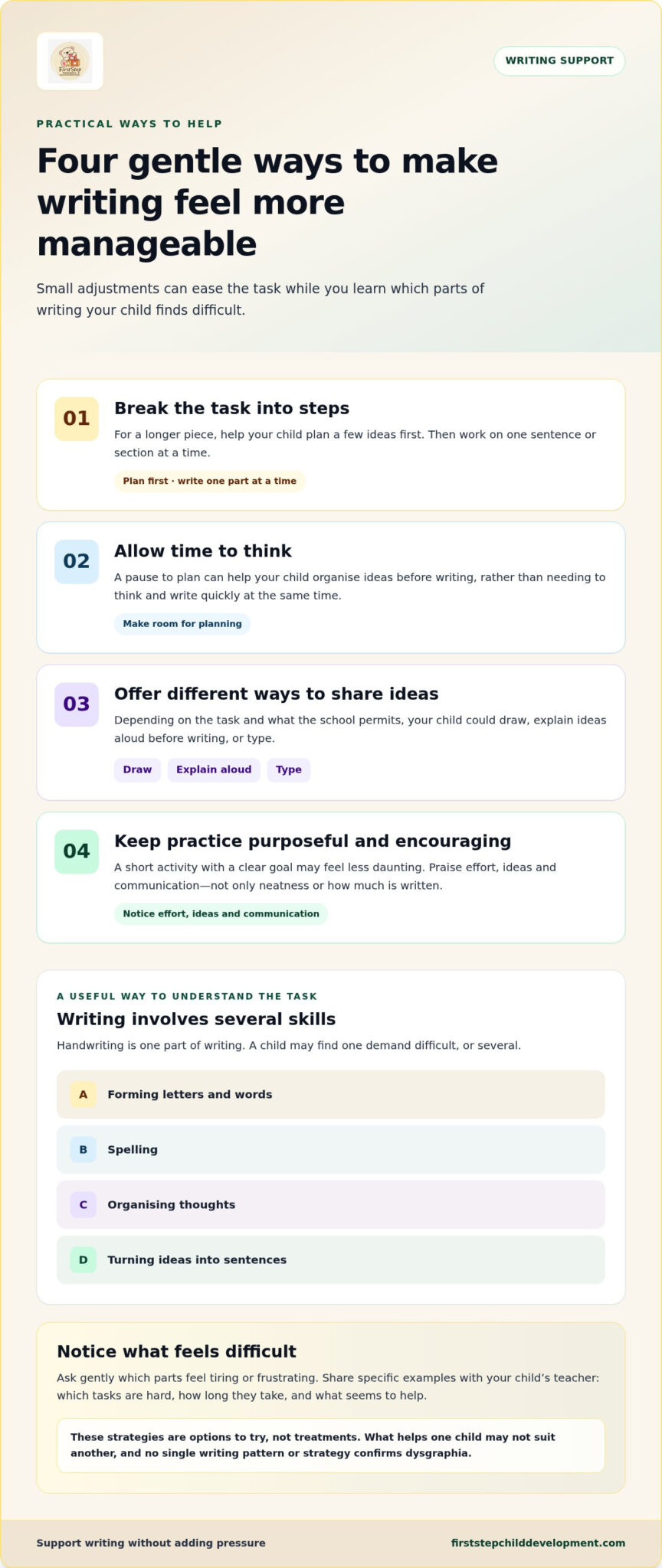
Writing is a multi-step task. A child needs to form letters and words, spell, organise thoughts and turn ideas into sentences, often while keeping pace with a classroom activity. These demands are connected, but they aren’t the same skill. A child may form letters neatly yet struggle to plan a paragraph, or have strong ideas but find handwriting slow and tiring.
Handwriting can show that writing is difficult, but it can’t by itself explain why. Similar challenges may have different explanations, including difficulties with spelling, language, coordination or attention. A particular pattern is not proof of dysgraphia in children; understanding the child’s broader learning and developmental needs matters. A clinical review discusses the range of factors considered in assessment for dysgraphia.
Handwriting, spelling and putting ideas on paper
Letter formation involves producing written shapes, while composition involves choosing words, building sentences and arranging ideas. These demands can affect one another: if forming letters takes considerable effort, a child may have less time or attention left to develop an answer. Another child may write legibly but find spelling or organising ideas difficult. Neither pattern alone identifies the cause.
How assessment can clarify a child’s learning profile
A learning difficulties assessment may consider a child’s developmental and learning history, clinical observation and relevant standardised testing. Together, these can help build a fuller picture than a handwriting sample alone, while exploring needs without assuming a diagnosis. At Firststep Psychology & Child Development Centre, assessment may include standardised testing, observation and detailed feedback for parents, helping families understand the findings and possible support needs.
If writing concerns are affecting your child’s learning, explore Firststep Psychology & Child Development Centre’s learning difficulties assessment. You can also learn more about Firststep Psychology & Child Development Centre.
Practical ways to support a child who finds writing difficult
Small adjustments can make writing feel more manageable while you learn what your child needs. These are options to try, not treatments, and a strategy that helps one child may not suit another.
Support writing practice without increasing pressure
- Break tasks into steps. For a longer piece, help your child plan a few ideas first, then work on one sentence or section at a time.
- Allow time to think. A pause to plan can help a child organise ideas before writing, rather than having to think and write quickly at once.
- Offer different ways to express ideas. Depending on the task and what the school permits, your child might draw, explain ideas aloud before writing, or type.
- Keep practice purposeful and encouraging. A short activity with a clear goal may feel less daunting. Praise effort, ideas and communication, not just neatness or the amount written.
Ask gently which parts feel tiring or frustrating. Their answer can help you notice whether the main challenge is forming letters, spelling, planning or something else. These observations can guide support for dysgraphia in children, but no single strategy or pattern confirms a diagnosis.
Work together with school and relevant professionals
Share specific examples with your child’s teacher: which tasks are difficult, how long they take, and what seems to make them easier. Ask what classroom approaches may fit your child’s needs and the school context. A clear picture from home and school can help adults respond consistently without adding pressure.
If handwriting or other functional skills are affecting everyday activities, paediatric occupational therapy may be relevant to explore. It can help consider the child’s individual needs, without promising a particular result. Learn more about paediatric occupational therapy, or visit Firststep Child Development to explore support for your family.
When to seek an assessment for dysgraphia in children
Consider seeking guidance if writing difficulties continue over time or regularly affect your child’s learning, classroom participation or confidence. For example, they may struggle to complete written tasks, avoid activities involving writing, or become distressed when asked to put ideas on paper. These signs don’t confirm dysgraphia, but they can show that your child may benefit from a closer look at their learning needs.
An assessment isn’t simply a search for a label. It can help build a fuller picture of how your child learns and where they may need support. At Firststep, a learning difficulties assessment may include standardised testing, clinical observation and detailed feedback for parents. Findings are discussed in context, rather than based on handwriting alone.
What can parents prepare before discussing concerns?
A little preparation can make conversations more focused. Gather examples of schoolwork and note when writing seems easier or harder, such as copying, spelling or writing a response independently. Include observations from home and school without describing your child as lazy or careless. You could also write down questions about what the assessment involves and how findings will be shared. Read about how assessments work to help you prepare.
A supportive next step for Kuala Lumpur and Selangor families
Asking for guidance doesn’t mean rushing to a conclusion. It’s a way to understand your child’s strengths, challenges and possible support needs. For families in Kuala Lumpur, Petaling Jaya and Selangor, learning more about a learning difficulties assessment may help clarify the next steps. You’re welcome to explore Firststep Child Development for further information.
Take the next step with understanding
Dysgraphia in children can affect more than handwriting, and a child’s written work alone can’t explain the reason for their difficulties. Notice whether challenges persist or affect learning, participation or confidence, and consider gentle adjustments that make writing tasks feel more manageable.
A professional assessment can help clarify a child’s individual learning profile without assuming a particular diagnosis. Firststep’s learning difficulties assessments may include standardised testing, clinical observation and detailed feedback for parents. Clinical psychologist consultations and paediatric occupational therapy are also available as relevant support options, depending on a child’s needs.
If you’re considering whether further guidance may help, explore Firststep’s learning difficulties assessment, or learn more about Firststep Child Development. With a clearer understanding, you can work with your child and their school to find thoughtful next steps.
Frequently Asked Questions
Can messy handwriting mean a child has dysgraphia?
Messy handwriting by itself doesn’t establish dysgraphia. Notice whether the difficulty continues over time and affects everyday school tasks, including writing quickly, forming letters or organising work, rather than focusing on appearance alone. A child’s age, experience and learning context matter too. If you’re concerned, share specific examples with the teacher or a qualified professional; observations can guide a discussion, but they can’t diagnose dysgraphia in children.
At what age can dysgraphia be identified in children?
There isn’t one age or handwriting milestone that parents can use to identify dysgraphia. Writing develops over time, and expectations depend on a child’s age, learning experience and context. Consider seeking professional guidance if difficulties persist or affect classroom participation and learning. An assessment can consider your child’s history and current needs, rather than relying on a single writing sample or comparing their work with classmates.
Can a child have dysgraphia and still be good at spelling or speaking?
Yes. A child may speak confidently and explain ideas well but find it difficult to record those thoughts in writing. They might also spell accurately while handwriting feels slow or tiring, or write neatly but struggle to organise a paragraph. Strengths and challenges can differ across tasks. These patterns don’t confirm dysgraphia, but describing them to a teacher or assessor can help build a broader understanding of the child’s learning profile.
How can parents support a child who struggles with writing?
Keep practice calm and purposeful, divide longer tasks into manageable steps, and ask your child which parts feel hardest. Share specific examples with the teacher and discuss classroom approaches suited to your child and school context. Avoid comparing their handwriting with siblings or classmates. If writing difficulties persist or affect learning or confidence, families in Kuala Lumpur, Petaling Jaya and Selangor can explore Firststep’s learning difficulties assessment, which may include testing, observation and parent feedback.

Article by
Firststep Child Development Team
Firststep Child Development Team provides evidence-informed educational resources to help parents better understand child development, behaviour and learning. Our multidisciplinary services include clinical psychology, occupational therapy, speech and language therapy, developmental assessments and other child development support in Kuala Lumpur and Selangor.
Disclaimer
This article is for general educational and informational purposes only and is not a substitute for professional medical, psychological or therapeutic advice, diagnosis or treatment. Every child develops differently. If you have concerns about your child's development, behaviour, learning or wellbeing, please consult an appropriately qualified healthcare or allied health professional.