



Does My Child Have Dyscalculia? Signs of Maths Difficulties Parents Should Know
Many parents wonder:
“Why does my child struggle with maths even though we practise regularly?”

Your child may have difficulty remembering number facts, understanding quantities, or solving simple maths problems.
While many children find some areas of maths challenging, persistent difficulties may require additional support.
One possible reason may be Dyscalculia.
Understanding the early signs can help parents respond with clarity, support, and the right intervention at the right time.
What Is Dyscalculia?
Dyscalculia is a learning difficulty that affects a child’s ability to understand numbers and mathematical concepts.
A child with dyscalculia may find it harder to:
✿ Understand quantities and numbers
✿ Remember basic maths facts
✿ Perform calculations
✿ Understand mathematical symbols
✿ Apply maths skills in everyday situations
Dyscalculia is not a sign of low intelligence or laziness.
A child may understand other subjects well and have many strengths while still experiencing significant difficulties with maths.
Dyscalculia can look different from child to child. Some common signs parents and teachers may notice include:
1. Difficulty Understanding Numbers and Quantities
Your child may have difficulty understanding what numbers actually represent.
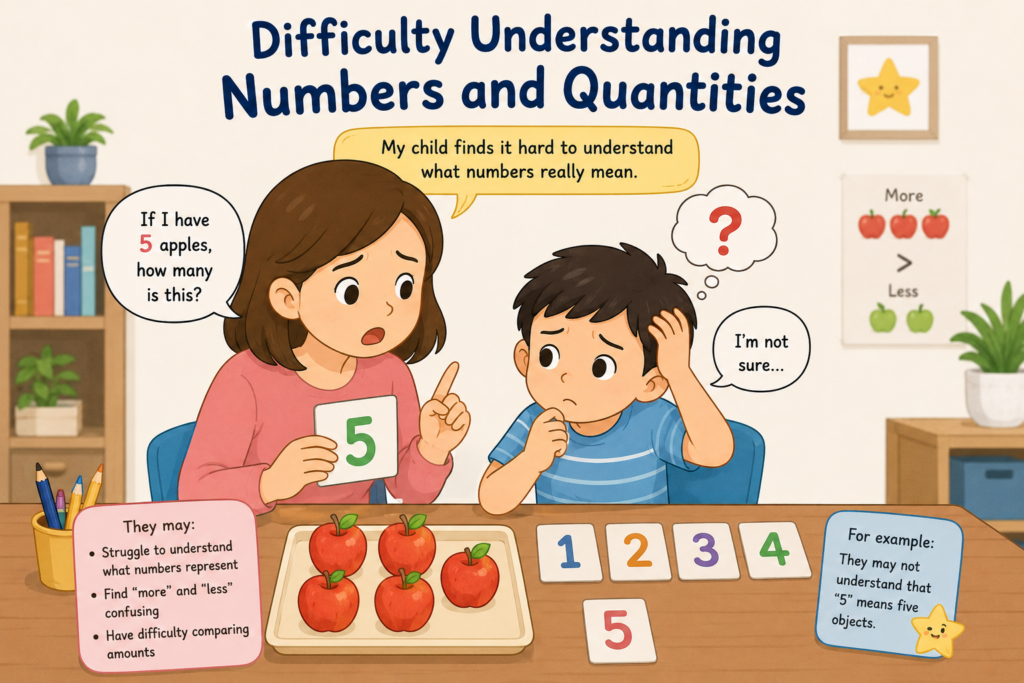
For example, they may struggle to understand that 5 means five objects, even after practising counting.
They may also find concepts such as more, less, bigger, and smaller confusing.
2. Struggles With Counting
Some children may have difficulty remembering numbers in the correct order.
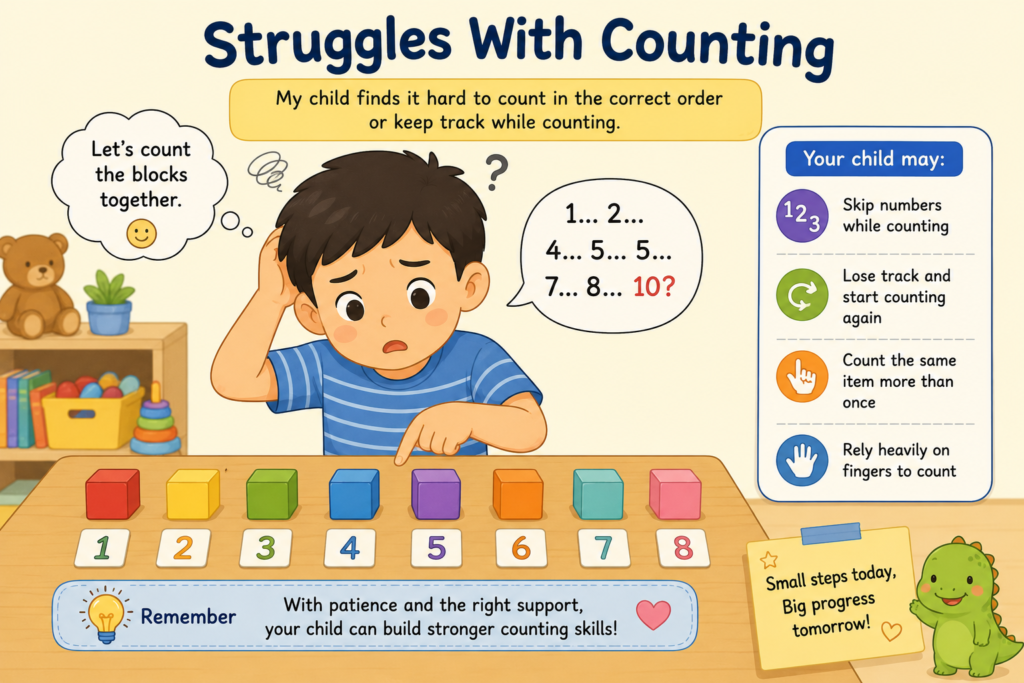
They may:
- Skip numbers while counting
- Lose track while counting objects
- Need to start counting again
- Continue relying heavily on their fingers
For example, when asked to count 8 blocks, they may count the same block twice or lose track of where they stopped.
3. Has Difficulty Remembering Basic Maths Facts
Your child may repeatedly struggle to remember simple number facts.
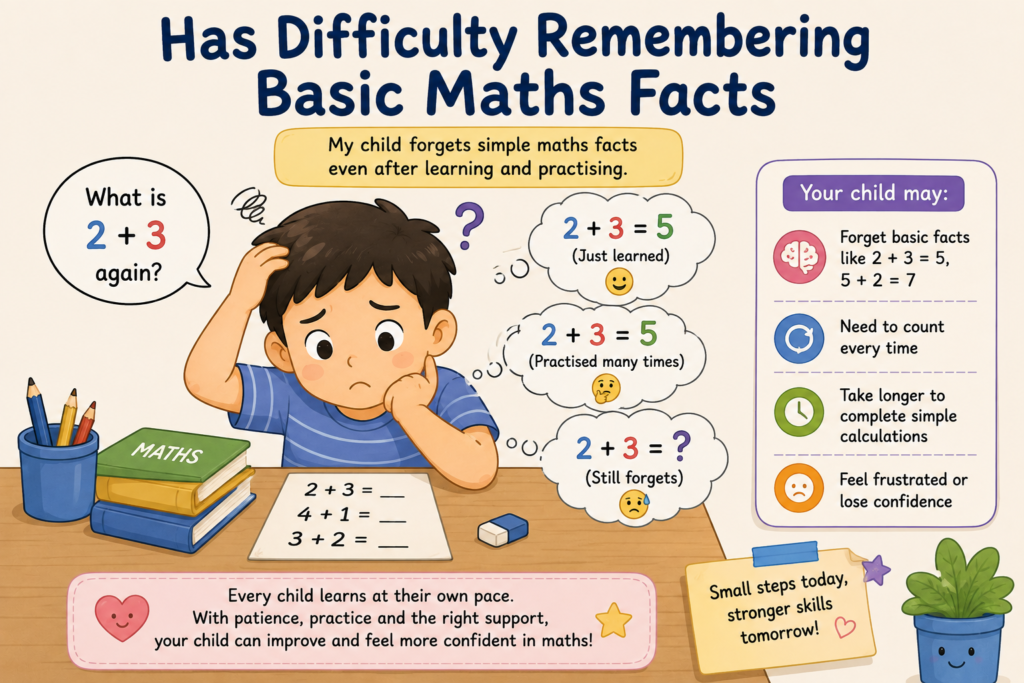
For example:
2 + 3 = 5
Even after learning and practising the same calculation, they may need to work it out again each time.
This can make maths tasks feel slow and tiring.
4. Finds Maths Problems Difficult to Solve
Your child may understand parts of a maths problem but struggle to work out which steps to take.
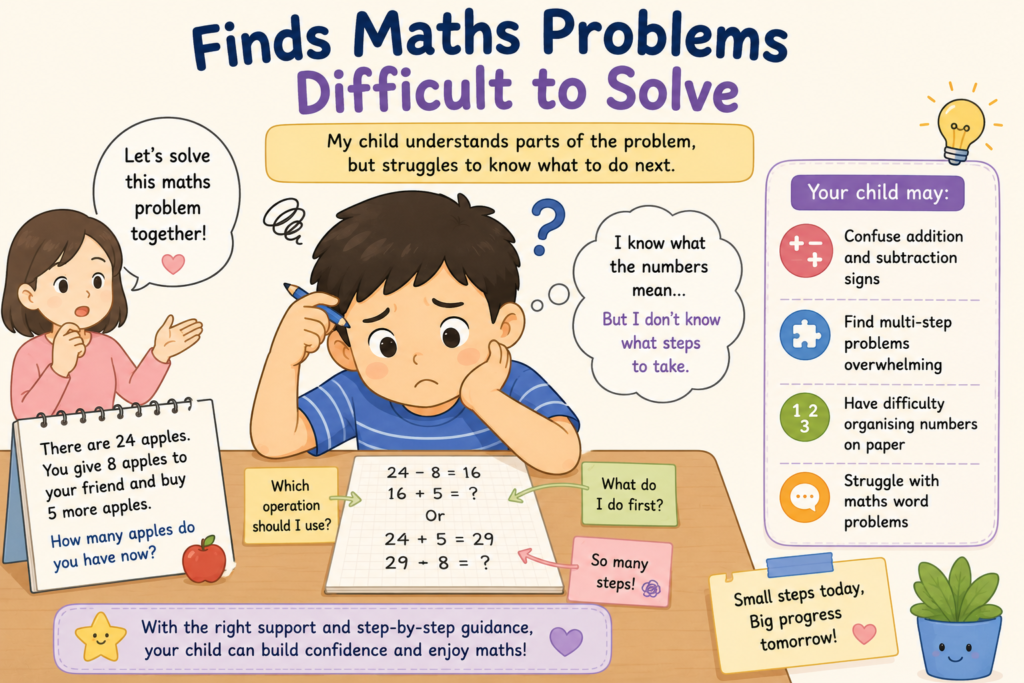
For example, they may:
- Confuse addition and subtraction symbols
- Find multi-step problems overwhelming
- Have difficulty organising numbers on paper
- Struggle with maths word problems
This may happen even when they have practised similar questions before.
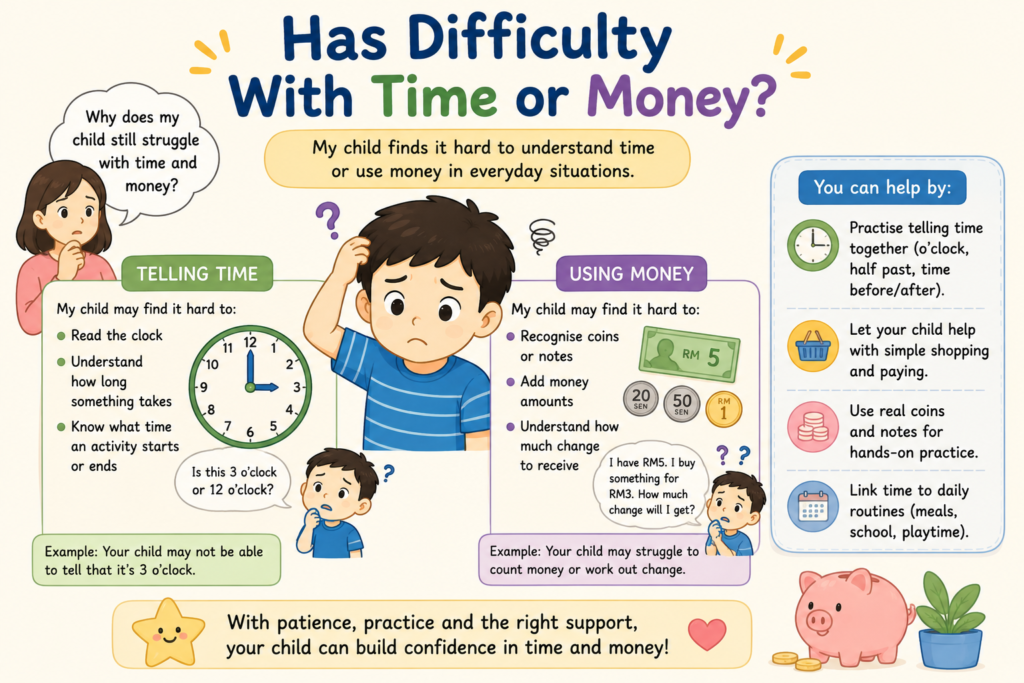
5. Has Difficulty With Time or Money
Maths skills are also used in everyday life.
Your child may have difficulty:
- Telling the time
- Understanding how long something will take
- Counting money
- Working out simple change
For example, they may struggle to understand how much RM5 + RM3 is when buying something.
6. Avoids Maths Activities
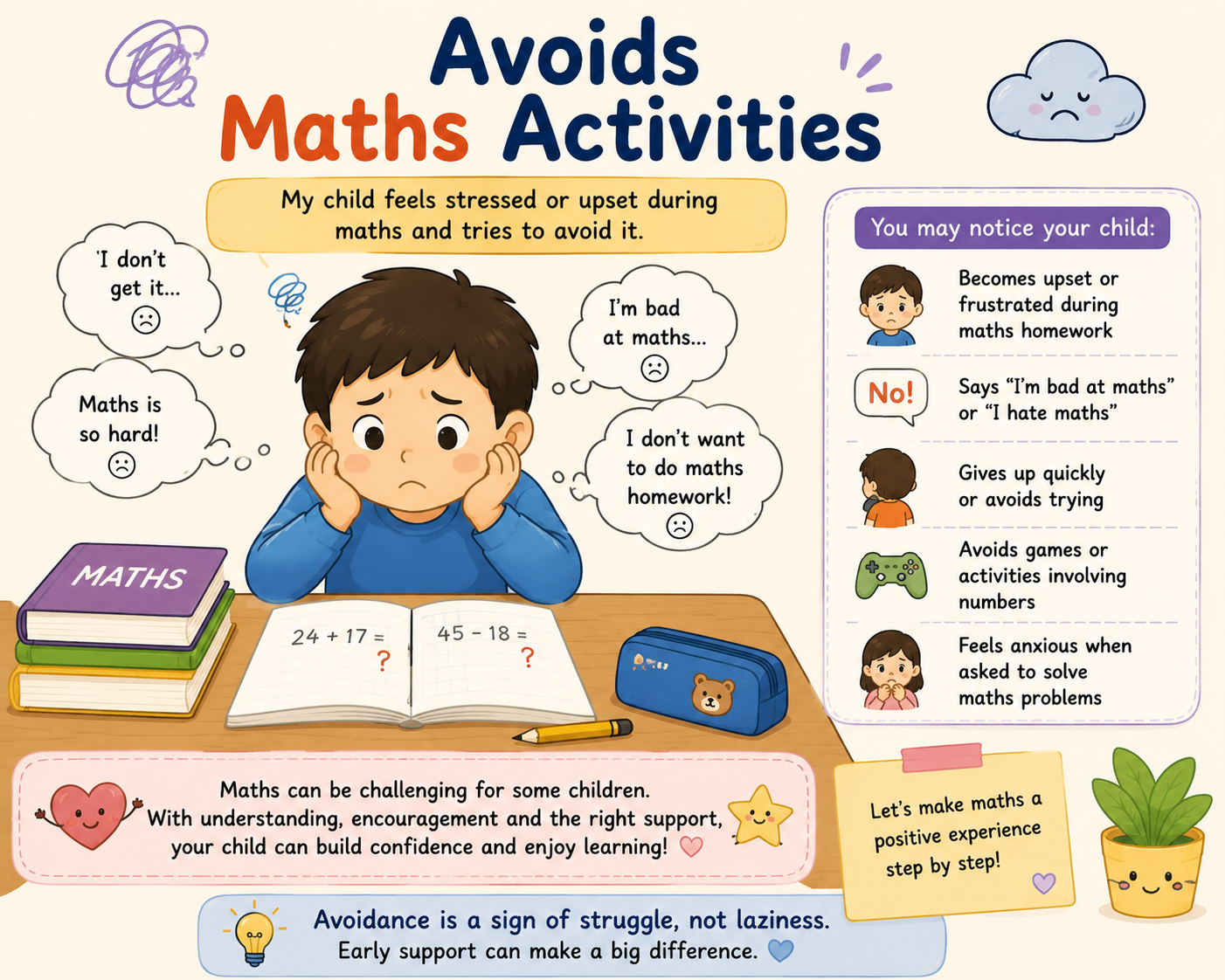
When maths feels consistently difficult, some children may begin avoiding it.
Your child may:
- Become upset during maths homework
- Say, “I’m bad at maths”
- Give up quickly
- Avoid games involving numbers
- Become anxious when asked to solve maths problems
This does not necessarily mean your child is lazy. Maths may genuinely require much more effort for them.
6 Ways Parents Can Help
1. Use Everyday Objects to Teach Maths
✿ Make numbers more concrete by using objects your child can see and touch.
✿ For example, use:
1. Coins
2. Blocks
3. Buttons
4. Fruits
5. Toys
✿ You can ask:
“We have 3 apples. If we add 2 more, how many do we have altogether?”
✿ Hands-on learning may help children understand mathematical concepts more clearly.
2. Break Problems Into Smaller Steps
✿ A long maths problem can feel overwhelming.
✿ Try breaking it down.
✿ Instead of asking your child to solve everything at once, help them focus on:
Step 1 → Understand the question
Step 2 → Decide what to do
Step 3 → Solve one part at a time
✿ This can make the task feel more manageable.
3. Make Maths Part of Everyday Life
✿ Maths does not only have to happen during homework.
✿ Try practising through everyday activities.
For example:
1. Count items while shopping
2. Read prices together
3. Measure ingredients while cooking
4. Count steps while walking
5. Play simple number games
✿ This can help your child see how numbers are used in daily life.
4. Give Your Child Extra Time
✿ Try not to rush your child when they are working through a maths problem.
✿ Give them time to:
1. Look at the numbers
2. Think about the question
3. Use strategies that help them
✿ Some children may need more time to process mathematical information.
5. Praise Effort and Progress
✿ Focus on your child’s effort, not only whether they get the answer correct.
✿ For example:
“I can see you kept trying even though that question was difficult.”
“You worked hard to solve that problem step by step.”
✿ Specific encouragement can help protect confidence and reduce the fear of making mistakes.
6. Seek Support When Needed
✿ If maths difficulties continue and affect your child’s learning or confidence, further guidance may be helpful.
✿ A professional assessment can help identify:
1. Which areas of maths are difficult
2. Your child’s learning strengths
3. Whether other learning factors may be involved
4. What support may be appropriate
✿ Understanding why your child is struggling is often the first step towards finding the right support.
When Should Parents Seek Professional Advice?
Consider seeking further advice if your child:
✿ Continues to struggle with maths despite regular support
✿ Has persistent difficulty understanding basic number concepts
✿ Finds counting and basic calculations unusually difficult
✿ Struggles with everyday skills involving time or money
✿ Avoids maths because of significant frustration
✿ Is losing confidence in school
Having one or two of these signs does not necessarily mean a child has dyscalculia. Persistent difficulties should be considered as part of the child’s overall learning profile.
Key Takeaway
❀ Every child learns maths at their own pace, but persistent difficulties should not simply be dismissed as laziness or a lack of effort.
❀ A child may be bright, creative, and capable in many areas, yet still find numbers and mathematical concepts particularly challenging.
❀ If your child continues to struggle, understanding why can help you find the right support.
❀ Early support is not about labelling a child, it is about understanding their learning needs and helping them build skills and confidence.
🌟 Stay Connected with Us! We love sharing tips, insights, and inspiring stories about children’s growth and mental wellbeing.
💙 Follow us on Instagram and Facebook for more updates and parenting advice.
Join our community and let’s grow together. One positive step at a time!

References
American Psychiatric Association. (2022). Diagnostic and statistical manual of mental disorders (DSM-5-TR).
Psychiatry.org; American Psychiatric Association. https://www.psychiatry.org/psychiatrists/practice/dsm
Working Hours
Tuesday to Saturday – 8.30am to 6pm
Monday & Sunday – Closed
Please also subscribe us at
Contact Us
Discover Our Team!
📞+60102502833
firststepdevelopmentcentre@gmail.com
B1-7, Plaza Damas 3, Jalan Sri Hartamas 1, 50480 Kuala Lumpur.
Copyright 2025. Firststep Child Development Sdn Bhd. All rights reserved.