



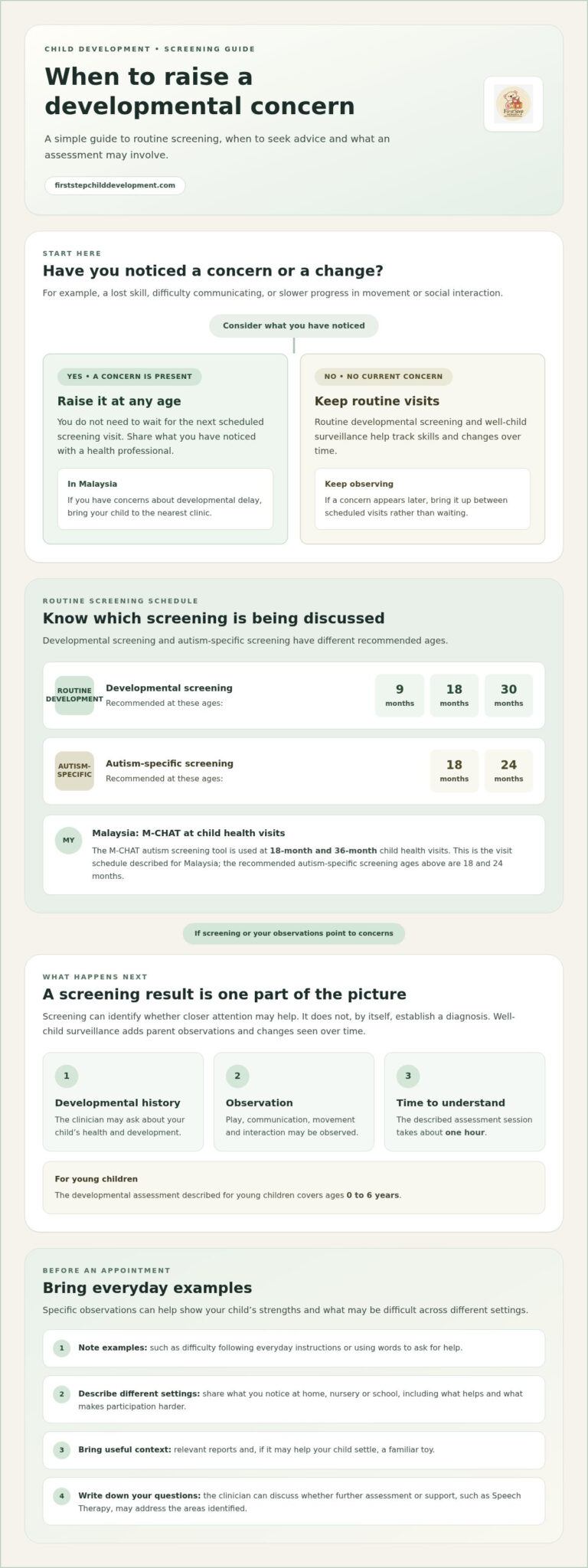
Routine developmental screening is recommended at 9, 18 and 30 months, with autism-specific screening at 18 and 24 months. In Malaysia, child health clinics use the M-CHAT for autism screening at 18-month and 36-month visits. A developmental clinic can help assess concerns at other ages too, especially when a child isn’t meeting expected milestones.
It’s understandable to wonder whether differences in speech, movement, learning or social interaction reflect a child’s individual pace or suggest they could benefit from support. Well-child surveillance builds a picture over time, while a focused assessment explores concerns in more detail.
This guide explains when screening usually takes place, what surveillance involves and which developmental, learning and behavioural concerns may be assessed. You’ll also learn what to expect from an assessment and how to take the next step in Malaysia.
Key Takeaways
- Use routine developmental screening as a starting point, and raise concerns between scheduled visits if you notice changes in your child’s progress.
- Keep track of your child’s milestones and everyday examples; they can help make well-child surveillance and assessment more informative.
- Developmental, learning and behavioural concerns can overlap, so an assessment can help clarify what support may be useful.
- Prepare your main questions and observations before booking, so you can explain what prompted you to seek guidance.
At what ages should my child be screened?
A developmental clinic assesses how a child is growing, learning and communicating. Screening questions, developmental history and observation can help identify areas that need closer attention. Services may include a child developmental assessment and guidance on suitable support.
A paediatric clinic provides broader healthcare for infants, children and adolescents, including care for physical health concerns. A child development centre focuses on developmental, learning or behavioural needs, and may offer assessment or therapy. Services vary, so consider what you want to discuss when choosing an appointment.
Routine developmental screening is recommended at 9, 18 and 30 months. Autism-specific screening is recommended at 18 and 24 months. In Malaysia, the M-CHAT autism screening tool is used at 18-month and 36-month child health visits. Screening identifies whether further assessment may help; it does not, by itself, establish a diagnosis.
Seek advice if your child seems to lose a skill, has difficulty communicating, or is not progressing in movement or social interaction. You can raise concerns at any age rather than waiting for a scheduled screening visit. In Malaysia, children with developmental delays should be brought to the nearest clinic. A developmental assessment described for young children covers ages 0 to 6 years.
An assessment draws on more than a single screening result. The clinician may ask about your child’s health and developmental history, then observe play, communication, movement and interaction. For example, they may notice how your child responds to their name or uses gestures. The session takes about one hour, giving time to understand your child’s strengths and concerns.
To prepare, note specific examples, such as difficulty following everyday instructions or using words to ask for help. Bring relevant reports and describe what you have noticed at home or nursery. A familiar toy may help your child settle. The clinician can discuss whether further assessment or support, such as Speech Therapy, may address the areas identified.
Developmental screening ages and well-child surveillance
Well-child surveillance brings together milestone checklists, parent observations and changes seen over time. It helps track development across physical, language, thinking and social-emotional skills.
Understanding Strengths and Difficulties
Screening can show where a child is progressing and where closer attention may be helpful. A child might communicate confidently but find movement tasks or social interaction more difficult. Share examples from home, childcare or school so the clinician can understand how skills vary between settings. A checklist is one part of the picture, not a complete account of a child’s abilities.
The CDC and the American Academy of Pediatrics revised milestone checklists in 2022, placing each milestone at the age by which about 75% of children have reached it. This helps parents notice when to raise a concern, while recognising that children develop at different paces.
Child Developmental Screening
Screening is a structured way to identify whether a child may benefit from further assessment. It can include questions for caregivers and observation of communication, movement, play and interaction. The CDC milestone checklists cover recommended well-child visits from 2 months through 5 years. In Malaysia, a child developmental screening tool was developed with support from Universiti Malaya and Sunway University to establish norms specific to Malaysian children.
Surveillance adds context between screening points. Keep brief notes about new skills, ongoing difficulties and when they occur. For example, record whether your child follows instructions at home but struggles in a noisy classroom. These details help show whether a skill is still emerging or is affecting everyday participation.
Developmental screening is different from a physical health check. Childhood diabetes is a medical concern, not a developmental milestone. Raise health questions during your child’s medical care so they can be considered separately from learning or behaviour.
For a clearer picture of your child’s progress, explore child development support and consider what observations you’d like to discuss.
Developmental, learning and behavioural difficulties
Children may need support for differences in learning, behaviour, communication or physical development. In Malaysia, these concerns can overlap, so consider how they affect everyday activities at home, school and during play.
ADHD, Autism, and Learning Difficulties
ADHD, autism and learning difficulties relate to different areas of concern, but a child may experience more than one. Note practical examples, such as difficulty completing classroom tasks, distress when routines change or challenges joining group play. These observations help clarify what to explore, but do not establish a diagnosis on their own.
Malaysia’s Ministry of Health identifies autism, cerebral palsy, Down syndrome, global developmental delay, specific learning disabilities such as dyslexia, and hearing or visual impairment among commonly identified special needs. Children may have physical, sensory, intellectual, learning, behavioural or emotional differences and need support to achieve optimal development.
Understanding Learning Difficulties
Learning difficulties may show up in particular activities, such as reading instructions, writing answers or understanding number concepts. Compare tasks your child finds difficult with ones they manage more comfortably. Share examples from school and home, including what helps and what makes participation harder. This gives the assessment a clearer picture of strengths as well as support needs.
For example, a child who understands a story when it is read aloud but struggles to read it independently may benefit from further exploration of learning needs. A learning difficulties assessment can help examine these concerns. A paediatric professional may consider developmental history, current learning challenges and the child’s daily environment.
Malaysia’s Ministry of Health provides developmental screening for children with special needs and early intervention programmes for at-risk infants and children. Its approach includes early detection, early intervention and continuing support through primary and specialist health facilities. Before an appointment, make a short list of concerns and note which difficulties most affect learning, relationships or daily routines.
Booking and appointment details
Booking routes and waiting times depend on whether you use a public or private service. Before arranging an appointment, prepare a clear summary of your concerns.
Booking an Appointment
Start by identifying the concern you want discussed, such as speech, learning or behaviour. When booking, share your child’s age, the main concern and any relevant screening history. Keep school reports or notes from teachers ready, as these can help explain how difficulties affect daily routines. The assessment team confirms appointment slots through WhatsApp within one working day.
Public and private appointments do not follow one shared timetable. In public services, the route through clinics and specialist referrals affects scheduling; private appointments depend on available slots and the assessment needed. These factors shape waiting times, so there is no single estimate for all of Malaysia.
Referral Requirements
There isn’t one referral route for every developmental appointment in Malaysia. For developmental delays, take your child to the nearest clinic. The Ministry of Health refers children to relevant specialists, including family physicians, paediatricians, occupational therapists, physiotherapists and speech therapists.
For a private appointment, referral arrangements depend on the service and provider. Prepare any existing referral letter, screening results or school observations, if you have them. A concise note describing your main concern can also help the appointment focus on your child’s needs.
Before booking, note when you first noticed the concern and where it occurs. For example, does your child struggle to follow instructions at school, at home or in both settings? Include what helps, such as visual reminders or a quieter environment. These details give the assessment team practical context beyond a brief description.
Ask what the appointment will involve, who should attend and which documents to bring. A caregiver who regularly spends time with the child can share useful examples. Be clear about the purpose, whether you’re seeking guidance on development or a closer assessment of learning and behaviour.
If you’re ready to discuss your child’s needs, explore child development support and take the next step towards an appointment.
Firststep Psychology & Child Development Centre: Clinical Psychologist Consultation
Firststep Psychology & Child Development Centre offers Clinical Psychologist Consultation for families who want to discuss developmental, emotional or behavioural concerns. Parents can share observations from home or school and explore whether further assessment may help clarify their child’s needs.
For specific concerns, the centre offers ADHD Assessment, Autism Assessment and Learning Difficulties Assessment. These assessments help families explore patterns affecting attention, communication or learning and understand possible next steps. A consultation also gives parents space to discuss questions and relevant background, such as school feedback or changes in daily routines.
To explore a Clinical Psychologist Consultation, contact Firststep Psychology & Child Development Centre or visit Firststep Child Development.
Take the Next Step Towards Clearer Support
A developmental clinic can help turn questions about your child’s progress into a clearer understanding of their needs. The aim is not to label every difference, but to understand what your child finds easy, what feels challenging and what support may help in daily life. A thoughtful discussion can also help you decide which concerns to prioritise with your family and school.
Firststep Psychology & Child Development Centre provides consultations and assessments for families seeking professional guidance about child development. If you’d like to discuss your concerns with a psychologist, explore the Clinical Psychologist Consultation and consider what you hope to understand better. You’re welcome to contact Firststep Psychology & Child Development Centre to take that step at a pace that feels right for your family.
Frequently Asked Questions
How do I book?
Book through WhatsApp or by phone on 010-2502833, or email firststepdevelopmentcentre@gmail.com. Include your child’s age and the concern you want to discuss. You can also mention whether you have school feedback or previous assessment documents. The centre is at B1‑7, Plaza Damas 3, Jalan Sri Hartamas 1, 50480 Kuala Lumpur, and is open Monday to Sunday – 8.30am to 6pm, except public holidays.
How long is the session?
A developmental assessment session takes about one hour. Before attending, decide which questions matter most to your family so you can raise them during the appointment. You might ask how the findings will be explained or what information could help your child’s teacher understand their needs. Preparing this way keeps the discussion focused and gives you clear points to consider afterwards.
What ages is this assessment for?
The child developmental assessment described here is designed for children aged 0 to 6 years. If your child is older, describe the main concern when arranging an appointment, such as difficulty keeping up with reading or managing classroom tasks. This gives the team useful context about the support you’re seeking and helps direct your enquiry towards an appropriate assessment or consultation.
When do I get the medical report?
Diagnostic assessment packages include standardised testing, clinical observation and detailed feedback reports for parents. The report explains the assessment findings and can support discussions about your child’s needs. Ask how the feedback will be shared and what information you can pass on to your child’s school. This can help you plan a practical conversation with teachers after the assessment.
Who should I see in Kuala Lumpur if I am worried about my child’s development?
Parents in Kuala Lumpur, Petaling Jaya and Selangor can contact Firststep Psychology & Child Development Centre for a Clinical Psychologist Consultation. For concerns about attention, social communication or learning, the centre also offers ADHD Assessment, Autism Assessment and Learning Difficulties Assessment. Before booking, consider which everyday situation concerns you most, such as completing schoolwork or communicating needs, and share an example with the team.
Who should visit a developmental clinic in Malaysia?
Parents and caregivers may seek developmental guidance when questions arise about a child’s communication, learning, behaviour or participation in daily life. For example, a caregiver might notice that a child avoids activities with other children or becomes distressed during familiar routines. A developmental clinic can help families discuss these observations and consider whether further assessment or support would be useful.

Article by
Firststep Child Development Team
Firststep Child Development Team provides evidence-informed educational resources to help parents better understand child development, behaviour and learning. Our multidisciplinary services include clinical psychology, occupational therapy, speech and language therapy, developmental assessments and other child development support in Kuala Lumpur and Selangor.
Disclaimer
This article is for general educational and informational purposes only and is not a substitute for professional medical, psychological or therapeutic advice, diagnosis or treatment. Every child develops differently. If you have concerns about your child's development, behaviour, learning or wellbeing, please consult an appropriately qualified healthcare or allied health professional.