



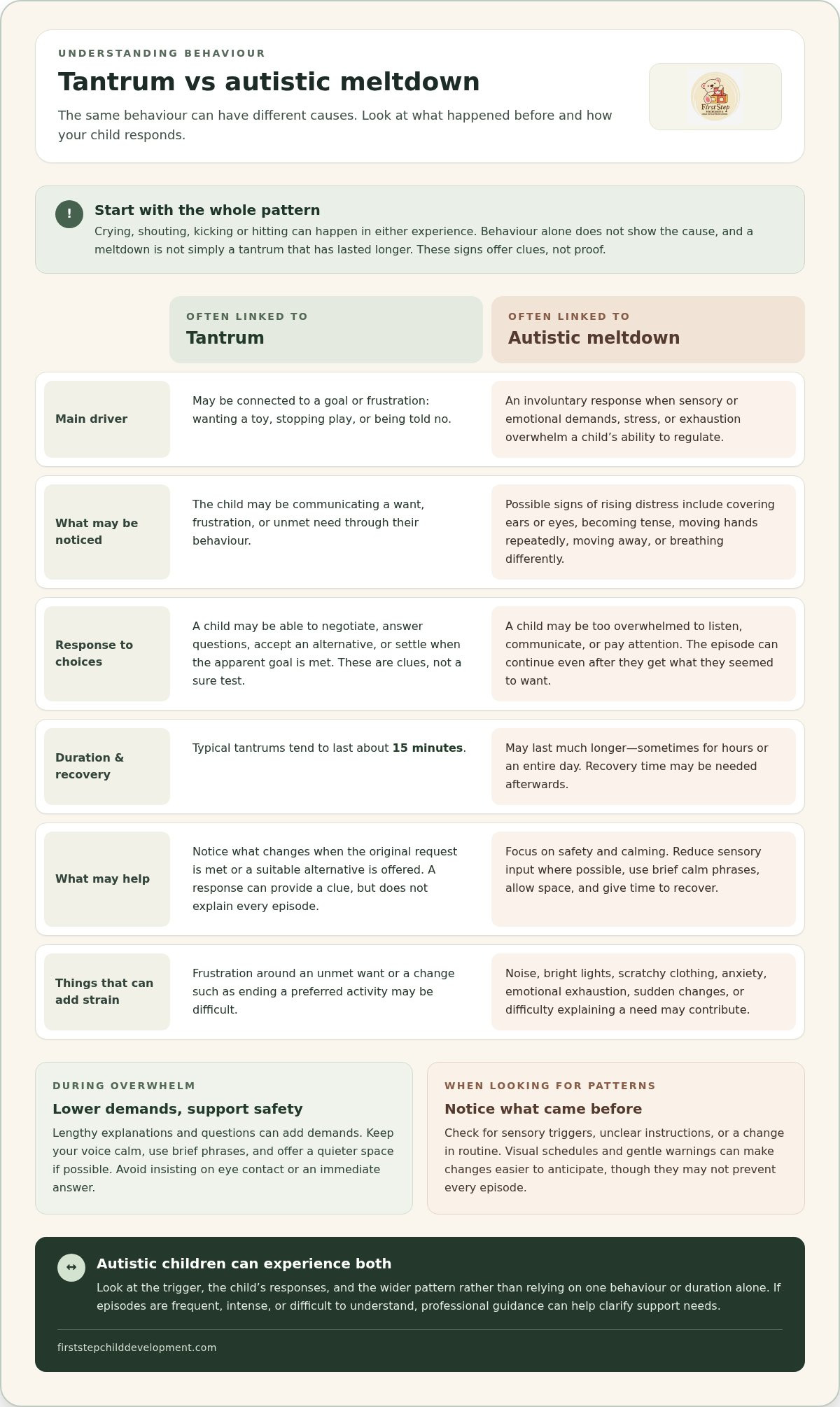
The same outburst can have very different causes. In a child tantrum vs autism meltdown, a tantrum may be linked to a goal or frustration, while a meltdown is an involuntary response to sensory overload, stress or emotional exhaustion. Autistic children can experience both.
It can be hard to tell what is happening when a child is crying, shouting or hitting. Behaviour alone does not reveal the cause, and a meltdown is not simply a tantrum that has lasted longer.
This guide explains how goals, sensory triggers and communication difficulties can shape each experience, and what may help in the moment. You will also learn why an autistic child can have ordinary tantrums, how to recognise signs of overwhelm, and when repeated or intense episodes may call for professional guidance.
Key Takeaways
- Look beyond the behaviour: what happened beforehand and whether a child can respond to choices may help you understand what they need.
- Notice possible signs of sensory overload and reduce noise, bright light or other stressors where possible.
- Use visual schedules and gentle warnings to make changes in routine more predictable, and practise calming strategies when your child is settled.
- If episodes are frequent, intense or difficult to understand, a professional consultation or assessment can help clarify your child’s support needs.
Tantrum vs Autistic Meltdown: What Is The Difference?
Both can involve crying, shouting, kicking or hitting, so behaviour alone may not explain what is happening. A typical tantrum is often linked to frustration or a goal, while a meltdown is an involuntary response to overwhelm.
Recognizing Autistic Meltdowns
An autistic meltdown happens when sensory or emotional demands overwhelm a child’s ability to regulate. It may look like yelling, lashing out, pacing, or becoming quiet and withdrawn. Recognising the pattern matters because a child may not be able to respond to reasoning during the episode.
Notice what happens before your child’s behaviour changes. Covering their ears or eyes, becoming tense, or moving their hands repeatedly may signal rising distress. A meltdown can continue even after a child gets what they seemed to want, and may last for hours or an entire day. Recovery time may be needed afterwards.
Common Sensory and Emotional Triggers
Sensory triggers are sounds, smells, lights or other sensations that feel overwhelming. For example, a loud hand dryer in a busy shopping centre may be harder to manage than the same sound in a quiet room. Bright lights, noise and scratchy clothing can add to the strain.
Emotional exhaustion and anxiety can also contribute. Watch for your child covering their ears, moving away, or breathing differently when a setting becomes difficult. If you notice a pattern, reduce the trigger where possible: lower the noise, dim the lights or offer a quieter space. These steps support regulation without treating distress as deliberate behaviour.
Routine and Communication Triggers
An unexpected transition or sudden change in routine can increase stress for children with autism. For instance, ending a preferred activity without warning may be difficult to process, especially in a busy setting. A visual schedule or warning before a change can make the next step easier to anticipate.
Communication difficulties may leave a child unable to explain discomfort, confusion or a need for a break. Watch for escalation after unclear instructions or changes in plans. Use simple language, gestures or visual cues to show what happens next. This can reduce uncertainty, though it may not prevent every episode.
Duration alone does not identify the cause: typical tantrums tend to last about 15 minutes, while autistic meltdowns may last much longer. Consider the trigger, whether the child can respond to alternatives, and whether the behaviour changes when their apparent goal is met. Children with autism can have tantrums as well as meltdowns, so look at the whole pattern rather than relying on one sign.
How do communication delays contribute to frustration?
A child who cannot express a need may show distress through behaviour instead. Looking at how the episode begins and how your child responds can help you distinguish frustration from overwhelm.
Intent, Control, and Communication Differences
During a tantrum, a child may retain some control and use behaviour to communicate a want, frustration or unmet need. For example, a child might stop screaming after receiving a requested toy. That response can offer a clue, but it does not explain every episode.
During a meltdown, a child may be too overwhelmed to communicate, listen or pay attention. Anxiety, sensory pressure or difficulty expressing discomfort can build until the child loses the ability to regulate. The same action, such as crying, can therefore have different causes. Consider the situation and your child’s response rather than judging intent from behaviour alone.
Communicating During a Meltdown
During a meltdown, lengthy explanations and questions can add demands when a child cannot easily process language. Keep your voice calm, use brief phrases and allow space. Instead of saying “Calm down”, try a simple statement such as “You’re safe” or point to a familiar visual showing a quiet place.
Reduce demands and focus on immediate safety. If bright lights or loud sounds are adding stress, move to a quieter area when possible. Avoid insisting on eye contact or an immediate answer. Your child may need time to recover before communicating or returning to an activity.
Support can be tailored to how a child communicates. Try offering a choice between two pictures, accepting a gesture, or using a visual schedule to show what happens next. Emotion charts can help children practise naming feelings when calm, rather than during an episode. If communication difficulties and meltdowns repeatedly affect daily life, an Autism Assessment can help explore the child’s developmental profile and support needs.
Goal-oriented tantrums versus sensory-overload meltdowns
A tantrum may be goal-oriented: a child wants a toy, resists stopping play or dislikes being told no. If the child can negotiate, answer questions or accept an alternative, that response may suggest frustration linked to the situation. It does not prove the child is pretending or choosing to be difficult. Observe what changes when the original request is met or a suitable option is offered.
A meltdown is different. Sensory overload, stress or emotional exhaustion can overwhelm a child’s ability to regulate, rather than serve a goal. Rewards, distraction or discipline may not stop it, and correction can add pressure. Parents and caregivers can focus on safety and calming instead of expecting the child to explain themselves or change their behaviour immediately.
Reduce sensory input one change at a time. In a noisy room, lower background sound or move with your child to a quieter space. Dim bright lights where possible, limit physical contact if it increases distress, and offer space. If clothing feels uncomfortable, remove the scratchy item when practical. Notice whether each change reduces signs of overload, such as tension or covering the ears.
Offer familiar sensory tools without insisting your child use them. Noise-cancelling headphones, a fidget or a preferred stuffed toy may help some children; another child may prefer quiet and no touch. A softly lit area can provide a calmer setting. Keep options predictable, and avoid introducing several new tools during an episode, when your child may struggle to process choices.
Practise calming activities when your child is settled, so the steps feel familiar during stress. Deep breathing, soft music or squeezing a stress ball are examples to explore together. You can note which settings and supports help, then use that pattern to plan calmer transitions. These observations can also help distinguish goal-related frustration from sensory overload over time.
Does tantrum happen in children with autism?
Yes, autistic children can have temper tantrums, just like other children. Autism does not mean every outburst is a meltdown; a child may protest a limit or feel frustrated about an unmet want.
Respond to a tantrum calmly: acknowledge the feeling, keep the boundary, and offer two appropriate choices. For example, if your child cries because a snack is unavailable, you might say, “You wanted the crackers. Would you like fruit or yoghurt?” Avoid changing the boundary simply to stop the behaviour.
Notice how your child communicates in different situations. They might bring you an object, point, use a familiar phrase, or guide your hand towards something they need. Recognising these signals can help you respond before frustration builds. If speech is difficult, accept gestures or pictures as meaningful communication rather than waiting for spoken words.
Also consider what the behaviour means for your child. Rocking, pacing or finger movements may help them regulate, but stimming can also happen when they feel happy or excited. Look for changes from their usual pattern, such as tension, withdrawal or distress, rather than treating one movement as proof of a meltdown.
Practise naming feelings when your child is calm. A simple comment such as “You look disappointed” can connect an emotion with words without demanding an answer. You can also model a coping action, such as asking for help or taking a quiet pause. These skills take practice and should suit your child’s communication style.
If episodes are becoming more frequent or difficult to manage, write down what happened beforehand and how your child recovered. Include sleep, hunger, communication demands and the setting. These notes can reveal patterns that are hard to recall later and help you describe your concerns during a professional discussion.
Firststep Psychology & Child Development Centre: Clinical Psychologist Consultation
Firststep Psychology & Child Development Centre offers Clinical Psychologist Consultation to help parents explore patterns behind a child’s distress and discuss suitable next steps. Consider professional guidance when outbursts are frequent, difficult to understand, or affecting family routines, learning or relationships.
A consultation can help you organise observations, such as what happened before an episode, how your child communicated, and what helped them recover. If developmental concerns also arise, an Autism Assessment can explore your child’s developmental profile. The focus is understanding needs, not labelling a child based on one behaviour.
You’re welcome to contact Firststep Psychology & Child Development Centre or visit Firststep’s website to learn more.
Take the Next Step with Confidence
Understanding the difference between a child tantrum and an autism meltdown can help you respond with care, but you do not need to work everything out alone. Keep brief notes about what happened beforehand, how your child communicated, and what seemed to help. These observations can give a professional a clearer starting point for discussing your child’s needs.
Firststep Psychology & Child Development Centre offers Clinical Psychologist Consultation, ADHD Assessment and Autism Assessment. A consultation can help you discuss your concerns and consider whether an assessment may be useful.
If you’d like to talk through your child’s development and possible next steps, contact Firststep Psychology & Child Development Centre. Each thoughtful observation can help you build a clearer picture of the support your child needs.
Frequently Asked Questions
What can I do when my child is having a meltdown?
First, make the immediate area safer by moving breakable or sharp objects out of reach. Stay nearby without crowding your child, and use a few calm words rather than repeated questions. If your child is hurting themselves, gently protect them while limiting extra stimulation. Wait until they are settled before discussing what happened; during intense distress, a conversation may add demands rather than help.
What Is a Tantrum?
A tantrum is an intense display of frustration or distress that can occur during childhood, especially when a young child struggles to manage strong feelings. It might involve crying, shouting or refusing a request after a change of plans. For example, a child may protest when playtime ends. The behaviour communicates difficulty in that moment, but does not by itself explain a child’s developmental profile.
Are Temper Tantrums Early Signs of Autism?
Temper tantrums alone don’t establish that a child is autistic. Consider whether you also notice ongoing differences in communication, social interaction, or responses to everyday sensory experiences, rather than drawing conclusions from one outburst. Autism assessments may be possible from 12 to 18 months, although some children show signs later. A professional assessment considers a child’s development and behaviour across situations.
How does communication impact tantrum and meltdown occurrence?
When a child cannot make a need understood, frustration can build or show through behaviour. Communication may include speech, gestures, facial expressions, pictures or an augmentative and alternative communication (AAC) device. For instance, a child might point to a “break” symbol instead of explaining that a crowded room feels uncomfortable. Notice which communication methods your child uses reliably, including during everyday routines.
How to Tell in the Moment: Is It a Tantrum or a Meltdown?
Look at the events leading up to the episode, not only its outward signs. Ask yourself whether a specific request or limit came just before it, or whether your child was coping with accumulated demands. Notice whether they can take in a simple choice or communicate a preference. These observations can guide your response, but one episode alone may not reveal its cause.
What is the difference between a typical child tantrum and an autism meltdown?
A typical tantrum often reflects frustration during a child’s development, while a meltdown is an involuntary response to demands that overwhelm regulation. Their outward behaviours can look similar, so context and patterns matter. Tantrums commonly occur in toddlers and preschoolers and rarely continue after age five for most children. A longer pattern of distress or communication differences warrants attention to the child’s broader development.

Article by
Firststep Child Development Team
Firststep Child Development Team provides evidence-informed educational resources to help parents better understand child development, behaviour and learning. Our multidisciplinary services include clinical psychology, occupational therapy, speech and language therapy, developmental assessments and other child development support in Kuala Lumpur and Selangor.
Disclaimer
This article is for general educational and informational purposes only and is not a substitute for professional medical, psychological or therapeutic advice, diagnosis or treatment. Every child develops differently. If you have concerns about your child's development, behaviour, learning or wellbeing, please consult an appropriately qualified healthcare or allied health professional.