



What if a screening result is a starting point, not a label? If you’re wondering whether your child’s communication, movement or social skills are developing as expected, it’s understandable to want clear answers. This guide to child development screening Malaysia explains what an initial check can and can’t tell you.
Screening is different from ongoing developmental monitoring and from a formal assessment that may lead to a diagnosis. In Malaysia, child health visits at government clinics provide an opportunity to discuss development, and a child’s health record book can help you keep track of growth and appointments. A screening result is one piece of information, not a complete picture of your child.
Here, you’ll learn what screening may involve, what observations and questions to share with a professional, and how to take a calm next step if you have concerns. We’ll also explain how child developmental assessment and parent consultation can offer families in Kuala Lumpur and Selangor a clearer understanding of a child’s strengths and support needs.
Key Takeaways
- Use child development screening Malaysia as an initial guide to areas that may need a closer look, not as a diagnosis.
- Keep brief notes of specific examples from everyday routines to help explain your concerns clearly.
- A screening result can help guide whether further discussion or assessment may be useful, but it cannot confirm ADHD, autism or another developmental condition.
- After screening, discuss a next step that reflects your child’s individual strengths and support needs.
What does child development screening in Malaysia look for?
Child development screening is an initial check for signs that an area may need closer attention. It can consider communication, movement, learning and social interaction, but it doesn’t establish why a child may be finding something difficult. Screening points to whether further discussion may be helpful; a clinical assessment gathers more information and is not the same as a screening result.
The US Centers for Disease Control and Prevention explains the role of developmental screening as part of identifying whether a child may benefit from a closer look. Screening can help guide follow-up, but it isn’t a diagnosis. That distinction can help parents view a result as useful information, not a label.
Screening, developmental monitoring and assessment: what is the difference?
Developmental monitoring means noticing how your child learns and changes over time, and sharing concerns with a professional. Screening is a more structured check at a particular point. A fuller assessment gathers broader information to understand a child’s strengths and support needs. The appropriate next step depends on the child and professional judgement. Read how a child assessment works for more about the assessment process.
Why parents’ everyday observations matter
Your examples can add important context. Note what you notice at home, childcare or school, without trying to diagnose the reason. For instance, describe when your child finds it hard to follow a two-part instruction, or what helps them join a group activity. A child may communicate comfortably at home but be quieter in a busy classroom, so observations across settings can help build a fuller picture.
If a professional recommends a fuller assessment, it may explore a specific concern, such as attention, alongside your child’s broader development. Families can learn about the ADHD assessment in Malaysia as one example of a focused assessment pathway. Screening itself cannot confirm ADHD or another developmental condition.
What can child development screening identify, and what can’t it confirm?
A screening result can indicate that a child’s development may benefit from closer discussion or further assessment. It can’t explain the reason for a difficulty or confirm ADHD, autism or another developmental condition. The result needs to be understood alongside the child’s experiences, development and circumstances.
A screening concern is a prompt to understand a child more fully, not a label that defines them.
A screening concern is not the same as a diagnosis
This comparison shows how the purpose and possible next step differ:
Screening
Purpose: identify areas that may need closer attention.
Typical output: an indication that follow-up could be useful.
What may happen next: discussion, monitoring or fuller assessment.
Clinical assessment
Purpose: build a fuller understanding of a child’s development and needs.
Typical output: professional conclusions based on relevant information and observations.
What may happen next: recommendations tailored to the child.
A comprehensive assessment may draw on more than one source of information, including parents’ observations and professional observations. The right approach depends on the questions raised and the child’s individual needs.
Can development vary without indicating a disorder?
Children develop at different rates, and a single behaviour doesn’t prove a condition. For example, a child who speaks less in a busy setting may respond differently in a familiar one. Still, if a concern persists or affects everyday life, it’s sensible to discuss it with a professional rather than assume it will resolve. The Malaysian Paediatric Association’s Developmental Milestone Tracker can help parents organise observations across areas such as speech, social interaction and movement.
For families considering child development screening Malaysia, a professional autism assessment may be one possible next step when further evaluation is recommended. The right pathway depends on the child’s individual presentation.
How can parents prepare for child development screening in Kuala Lumpur and Selangor?
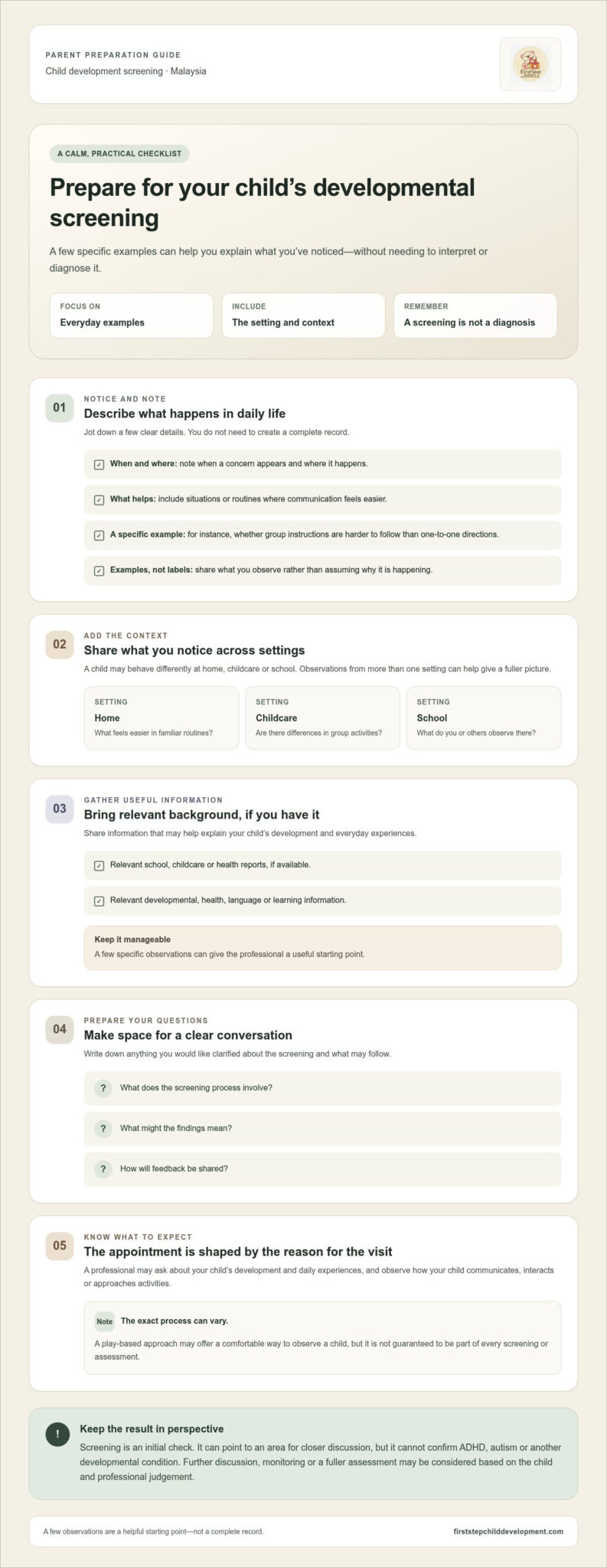
A little preparation can help you explain what you’ve noticed without needing to interpret it. For child development screening Malaysia, focus on everyday examples and the context around them. Share what you see across home, childcare or school, as well as any relevant developmental, health, language or learning information.
What observations and documents may be useful?
Before the appointment, jot down a few clear details. Note when a concern appears, where it happens and what seems to help. For example, does your child find group instructions harder to follow than one-to-one directions? Are there particular routines where communication feels easier?
- Write down examples rather than labels or assumptions.
- Bring relevant school, childcare or health reports if you have them.
- List questions about the screening process, what the findings may mean and how feedback will be shared.
You don’t need to create a complete record. A few specific observations can give a professional a useful starting point and help make the conversation feel more manageable.
What should parents expect from a child-centred appointment?
A professional may ask about your child’s development and daily experiences, and observe how they communicate, interact or approach activities. The exact process depends on the reason for the visit. A play-based approach can offer a comfortable way to observe a child, but it isn’t a guaranteed part of every screening or assessment.
In Kuala Lumpur and Selangor, families can seek a child-centred discussion that considers the child’s strengths alongside areas of concern. You can learn more about Firststep Psychology & Child Development Centre if you’d like support understanding your child’s development.
What happens after child development screening in Malaysia?
A screening result is information to discuss, not a decision about your child’s future. Depending on the findings and your concerns, the next step may be continued observation, a conversation with a professional or a fuller assessment. If no further assessment is suggested immediately, keep noting how your child manages everyday activities and raise any new or continuing concerns.
If further assessment is suggested
An assessment can explore the questions raised by screening in more depth without assuming a diagnosis. It may help clarify your child’s strengths and areas where support could be useful. Recommendations should reflect the child’s individual needs, rather than follow a one-size-fits-all plan. Once those needs are better understood, the family and professionals can consider suitable support and practical next steps.
If no immediate assessment is recommended
That doesn’t mean you need to dismiss a concern or stop paying attention. Development continues, and what a child needs may become clearer over time or in a different setting. Keep sharing relevant observations with a professional, particularly if a concern persists or begins to affect daily routines, communication, learning or relationships.
For families in Kuala Lumpur and Selangor, Firststep offers child developmental assessment and parent guidance to help make sense of concerns and consider next steps. The aim is to understand the child as a whole, including their strengths, experiences and support needs. A clinical psychologist assessment may be one option to explore when a fuller professional understanding is appropriate.
If you’re considering what support may help your family, learn more about clinical psychologist assessment or visit the Firststep Child Development Centre homepage.
Take a calm, informed next step
Child development screening Malaysia can help highlight areas to discuss, but it isn’t a diagnosis or a complete picture of your child. A result may lead to continued observation, a professional conversation or fuller assessment. Sharing clear examples from everyday life can help make those next steps more relevant to your child.
If further support would be helpful, an assessment can explore your concerns while considering your child’s strengths and individual needs. Firststep’s multidisciplinary team includes paediatricians and child development professionals, with play-based assessment and clear feedback for parents.
Families in Kuala Lumpur and Selangor can learn more about a clinical psychologist assessment and explore child development support at Firststep. You don’t need to have every answer before seeking guidance. One thoughtful conversation can help you decide what feels right for your family.
Frequently Asked Questions
Is child development screening the same as a diagnosis?
No. Screening is an initial check that can indicate whether a child’s development may need closer discussion or assessment. It cannot, on its own, diagnose ADHD, autism or another developmental condition. A professional considers the screening result alongside relevant developmental information and observations before discussing what it may mean and whether further assessment could be helpful.
What happens if my child does not pass a developmental screening?
A result that raises a concern doesn’t confirm a condition. It suggests that a follow-up conversation or fuller assessment may be useful. Ask the professional to explain which area prompted concern and what next step they recommend. Depending on your child’s needs, this could involve monitoring progress, discussing observations or exploring an assessment to understand strengths and support needs more fully.
Can a child need support even if screening does not raise a concern?
Yes. A screening check reflects a particular point in time and may not capture every difficulty a child experiences across different settings or routines. If concerns continue, affect everyday activities or arise later, share specific examples with a professional. A result that doesn’t raise concern at one check shouldn’t prevent you from seeking guidance if your child’s needs change.
How should I prepare for my child’s developmental screening in Malaysia?
Before the appointment, note what you’ve observed, when it happens and what seems to help. Bring relevant school, childcare or health reports if available, and write down questions about the process and feedback. Share useful context about your child’s development, health, languages and learning. For child development screening Malaysia, concrete examples are more helpful than trying to name or diagnose a condition.
Where can parents in Kuala Lumpur or Selangor seek child development assessment?
Families in Kuala Lumpur, Petaling Jaya and Selangor can explore child developmental assessment and parent guidance at Firststep Psychology & Child Development Centre. Its multidisciplinary team includes paediatricians and child development professionals, and the centre uses play-based assessment with clear feedback for parents. Learn more about Firststep’s child development support and the options available for understanding your child’s needs.

Article by
Firststep Child Development Team
Firststep Child Development Team provides evidence-informed educational resources to help parents better understand child development, behaviour and learning. Our multidisciplinary services include clinical psychology, occupational therapy, speech and language therapy, developmental assessments and other child development support in Kuala Lumpur and Selangor.
Disclaimer
This article is for general educational and informational purposes only and is not a substitute for professional medical, psychological or therapeutic advice, diagnosis or treatment. Every child develops differently. If you have concerns about your child's development, behaviour, learning or wellbeing, please consult an appropriately qualified healthcare or allied health professional.